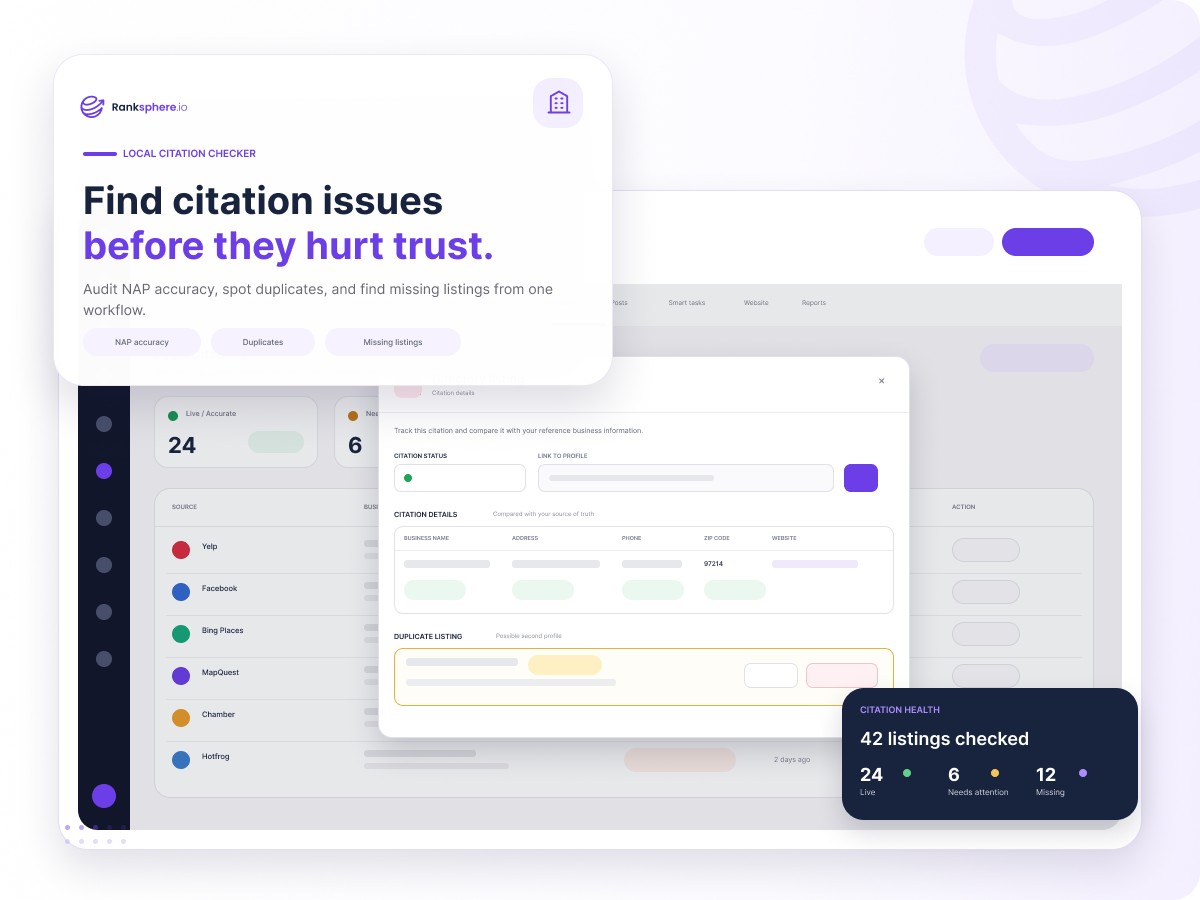
A local citation checker helps you find where your business is listed online, identify incorrect business information, and find directories where your business may be missing.
For local SEO, this usually means checking your business name, address, phone number, website, and other important details across directories, maps, industry websites, and local platforms.
But a citation checker should do more than give you a score.
Its real purpose is to help you understand whether the information being published about your business across the web is accurate enough to reinforce a clear and trustworthy business identity.
When important sources consistently reference the same legitimate business, those citations can help search engines and customers understand who the business is, where it operates, and how to contact it.
With Ranksphere Citation Management, businesses and agencies can monitor citation data, identify NAP inconsistencies, find missing listings, investigate duplicates, and keep citation work connected to the rest of their local SEO activity.
What Is a Local Citation Checker?
A local citation checker searches for online business listings and compares the information it finds with the business details you know to be correct.
The information commonly checked includes:
| Business information | What to look for |
|---|---|
| Business name | Old names, misspellings, or incorrect variations |
| Address | Previous locations or incorrect address details |
| Phone number | Old, disconnected, or incorrect numbers |
| Website | Broken URLs, old domains, or incorrect landing pages |
| Category | Incorrect business classifications |
| Listing status | Existing, missing, incomplete, or unverified listings |
| Duplicates | Multiple listings that may represent the same business |
Your business name, address, and phone number are commonly referred to as NAP.
Maintaining accurate NAP information is part of a broader local SEO strategy that also includes your Google Business Profile, reviews, website, links, rankings, and local relevance.
A citation does not necessarily need to contain a backlink. Your business can be cited on a directory, professional association website, chamber of commerce page, local publication, industry website, or other third-party source even when the mention does not link back to your website.
That is why an SEO citation checker is different from a backlink checker.
A backlink checker focuses primarily on links pointing to your website. A citation checker focuses on where your business appears online and whether those sources describe the business accurately.
Why Do Local Citations Matter?
Local citations help create a wider information footprint for your business.
Google explains that Business Profile and local-search information can come from several sources, including publicly available web content, licensed third-party data, information supplied by users and business owners, and Google's own interactions with local places. You can read Google's explanation of how it sources business information.
That matters because your Google Business Profile does not exist in isolation.
Information about your business may also appear on directories, your website, local organizations, professional associations, review platforms, mapping services, and industry websites.
When reputable sources consistently describe the same real-world business, they help confirm important facts such as the business name, location, phone number, website, and category.
Think of citations as supporting evidence for the identity and legitimacy of the business.
They are not simply ranking points.
The process is better understood like this:
Accurate business information → stronger confirmation → greater confidence in the business entity → stronger opportunity for local visibilityThat does not mean Google assigns a published “trust score” to citations. It means that accurate, consistent information gives search engines fewer conflicting signals about the business they are trying to understand.
Google also states that businesses with complete and accurate information are more likely to appear in relevant local search results. Its local ranking guidance explains that local visibility is primarily based on relevance, distance, and prominence.
So citation work should not be viewed as an isolated ranking trick. It is part of establishing a credible and well-supported local business presence.
How Citations Can Support Local Visibility
Citations can support visibility in several connected ways.
- They help reinforce business identity. If your website says the business is located at one address while major directories repeatedly publish another, search engines and customers are left with conflicting information.
- Citations help reinforce location. Listings on relevant local sources can associate the business with a specific city, neighborhood, or region.
- They can reinforce business relevance. Industry directories, associations, and category-specific platforms can provide additional context about what the business actually does.
- Citations can strengthen prominence and discoverability when the business is mentioned across legitimate third-party sources.
None of this means that adding one more directory listing automatically moves your Maps position.
Citation value comes from the combined information environment surrounding the business, not simply the total number of directory entries.
That is why 40 accurate and relevant citations can be more useful than 300 low-quality listings containing inconsistent information.
How to Run a Local Citation Audit
A local citation audit compares the business information published across citation sources with the information you know is correct.
1. Establish Your Source of Truth
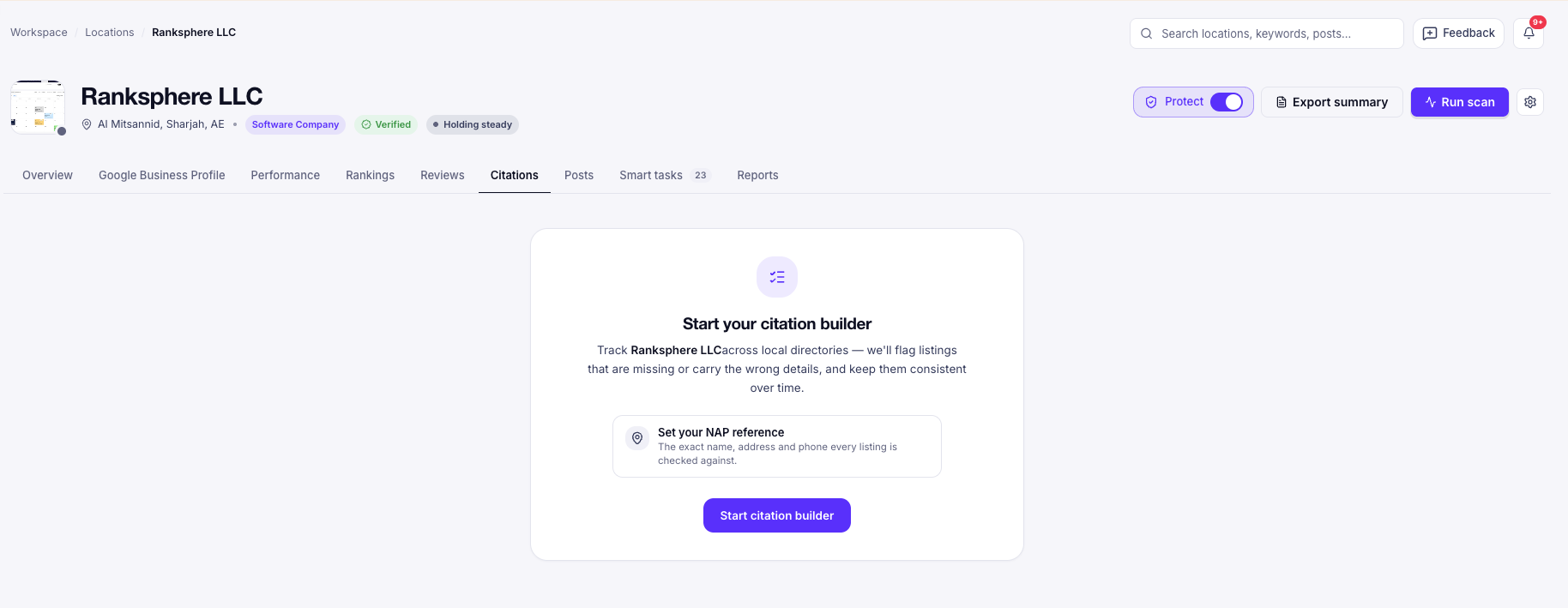
Start with the correct information for the business:
- Business name
- Address or service area
- Phone number
- Website
- Primary category
- Opening hours
For multi-location businesses, keep separate reference information for each location.
Google's Business Profile guidelines recommend representing a business accurately and consistently with how it is recognized in the real world.
Ranksphere uses your reference business information to compare citation data and identify listings that may need attention.
2. Review Existing Listings
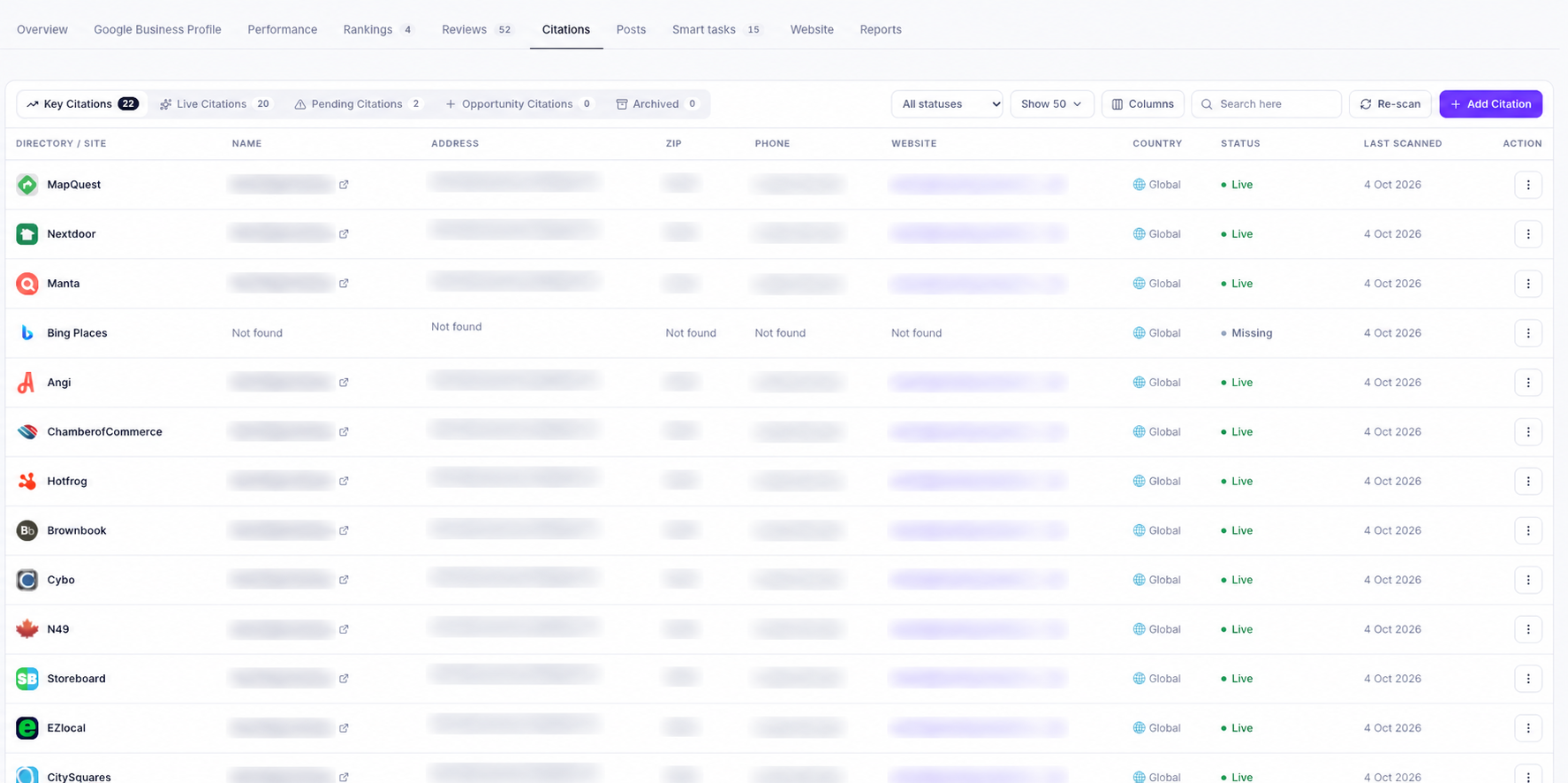
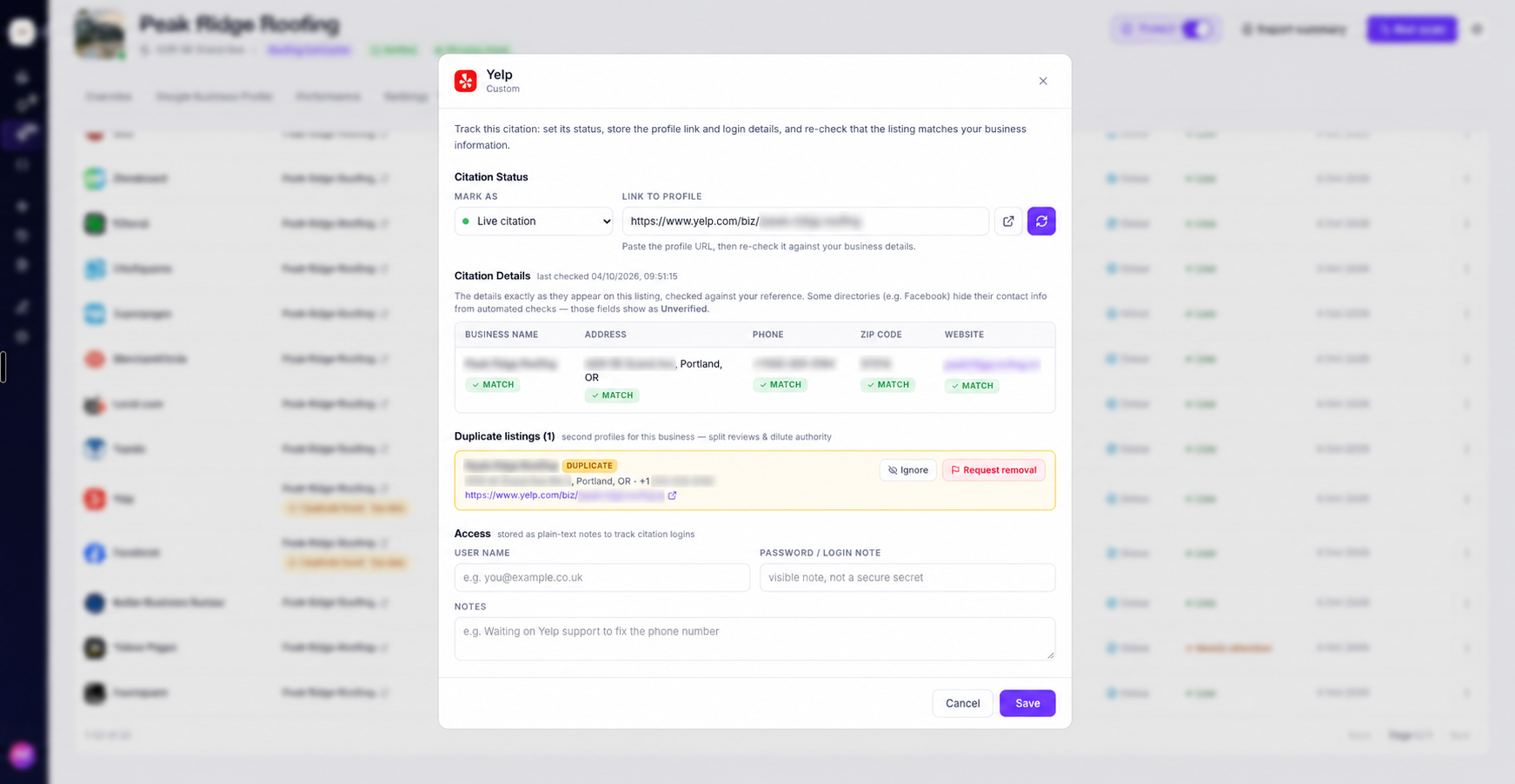
Use Ranksphere Citation Management to review the listings already associated with the business.
Look for issues such as:
- Incorrect business names
- Old addresses
- Wrong phone numbers
- Outdated websites
- Incorrect categories
- Possible duplicate listings
The goal is to identify factual problems that could misrepresent the business or confuse customers.
3. Prioritize the Problems That Matter
Not every difference needs the same attention.
Fix incorrect contact information, previous addresses, outdated websites, and genuine duplicates before worrying about small formatting differences.
For example, an old phone number matters much more than one directory using “Street” while another uses “St.”
How to Find Missing Business Citations
Once you have reviewed your existing listings, the next step is to see where the business may still be missing.
- Add your correct business information.Enter your business name, address, phone number, website, country, category, and other important location details.
- Review where your business is already listed. Ranksphere checks supported citation sources and helps you see which listings already represent your business.
- Check missing citation opportunities. Review directories where your business has not been found. Ranksphere suggests citation opportunities based on your business and location, helping you focus on sources that are more relevant.
- Pay attention to outdated business information. If your business has moved, rebranded, changed phone numbers, or switched domains, older listings may still contain previous information and may need attention.
- Prioritize relevant sources. Focus on established business directories, local sources, industry-specific directories, professional associations, and other platforms that make sense for your business.
The goal is not to appear on every directory available. It is to build an accurate business presence across sources that are relevant to your location and industry.Which Citation Problems Matter Most?
Not every discrepancy deserves the same priority.
| Priority | Citation problem | Why it matters |
|---|---|---|
| Highest | Wrong business name, address, phone, or website | Can misrepresent the business and confuse customers |
| High | Genuine duplicate on an important platform | Can create conflicting versions of the business |
| High | Major trusted source with outdated information | Weakens consistency around the business identity |
| Medium | Missing relevant local or industry citation | Reduces coverage on useful third-party sources |
| Medium | Incorrect secondary information | Worth correcting on important listings |
| Low | Harmless formatting difference | Usually does not change the business identity |
| Low | Irrelevant directory | Usually provides little practical value |
For example, an old phone number is much more important than one source writing “Street” while another writes “St.”
The objective is not character-for-character uniformity.
The objective is to make sure third-party sources consistently describe the same legitimate business.
Ranksphere Smart Tasks can help turn issues found across citations and other areas of local SEO into actionable tasks rather than leaving the audit as a static report.
Are More Citations Better?
Not automatically.
Citation building is sometimes approached as a numbers game: submit the business to as many directories as possible and assume the largest citation count wins.
That is not a useful way to think about local visibility.
A citation is more valuable when the source is legitimate, relevant, accurate, and likely to help confirm the business.
That may include major mapping platforms, established business directories, local chambers, professional organizations, industry directories, and other trusted sources.
A large collection of weak or inaccurate citations can create more cleanup work without creating a stronger business footprint.
Focus first on accuracy and relevance, then expand coverage where it makes sense.
Are Free Local Citation Checkers Enough?
A free local citation checker can be useful for an initial review.
It may reveal obvious problems such as an old address, incorrect telephone number, missing listing, duplicate profile, or outdated website.
The important question is not whether a checker is free or paid.
Ask whether it shows the actual listings, explains what information differs, separates missing citations from unverified citations, checks relevant sources, and gives you enough evidence to decide what needs correcting.
A useful citation checker should help you understand your business footprint—not simply generate a bigger score.
Local Citation Checker vs. Citation Management Services
A local citation checker and local citations management services address different stages of the same workflow.
A citation checker helps identify where the business appears and where problems may exist.
A citation audit evaluates those findings and determines which issues matter.
Citation management software helps organize and monitor the work over time.
A managed citation service may go further by submitting listings or requesting corrections on behalf of the business.
Finding incorrect information and correcting the source of that information are separate tasks.
Ranksphere focuses on helping businesses and agencies identify, compare, monitor, and organize citation data. When an external directory contains incorrect information, the actual correction may still need to be submitted through that directory.
Citations, Trust, and Local Visibility
The most useful way to understand citations is not:
More citations = higher rankings
A better model is:
Accurate citations = stronger verification of business informationWhen your business information is supported by multiple reliable sources, it becomes easier to establish a consistent picture of the business across the web.
This can strengthen confidence in details such as the business identity, location, contact information, and industry.
That stronger foundation supports local visibility because search engines are working with clearer, more reliable business information.
Google itself explains that business information comes from multiple web and third-party sources and that complete and accurate information improves the likelihood that a business can appear for relevant searches.
That is why citation management should be seen as business verification and information consistency, not simply directory submission.
Connect Citation Management With Local Rank Tracking
Citation cleanup should not end when the listings have been corrected.
You still need to monitor how your local visibility changes over time.
Ranksphere Local Rank Tracker lets you measure how a business appears across different areas of its market instead of relying on one ranking position.
That creates a more useful workflow:
verify business information → Audit citations → fix meaningful inconsistencies → strengthen citation coverage → recheck listings → monitor local visibilityThe important part is that citations are not being treated as an isolated checklist.
They become part of a wider local SEO system involving business information, rankings, Google Business Profile activity, reviews, website performance, and ongoing optimization.
For businesses managing their own local presence, the Ranksphere local business platform connects these areas within one workflow.
When Should You Run Another Citation Audit?
A citation audit becomes especially useful whenever important business information changes.
That includes moving to another address, changing the primary phone number, rebranding, changing domains, opening or closing locations, or acquiring another business.
It is also worth auditing citations if customers begin reporting incorrect information or if you discover conflicting business details appearing online.
Multi-location companies generally have a greater need for ongoing monitoring because they have more locations and more third-party listings that can become outdated.
Frequently Asked Questions
What is a local citation checker?
A local citation checker searches for online business listings and compares them with known business information. It can help identify missing, inaccurate, inconsistent, duplicate, or unverified citations.
Why are local citations important?
Citations help establish and confirm the identity of a business across the web. Accurate listings can reinforce information such as the business name, location, phone number, website, and category, giving search engines and customers a clearer picture of the legitimate business.
Do citations help local SEO rankings?
Citations can support local search visibility by strengthening the accuracy, consistency, and confirmation of business information across third-party sources.
They should not be treated as a simple ranking-points system where each new listing automatically increases a business's position.
Their value comes from helping create a reliable information footprint around the business, which works alongside Google's broader relevance, distance, and prominence systems.
Do all NAP differences need to be fixed?
No.
Prioritize differences that change the meaning of the information or could cause uncertainty about the business, such as an incorrect phone number, old address, wrong business name, or obsolete website.
Small formatting variations are generally less important than factual accuracy.
How do I find missing business citations?
Add your business to Ranksphere Citation Management and enter your correct business information, including your name, address, phone number, website, and other location details.
Ranksphere compares your business information across relevant citation sources and suggests the most accurate citation opportunities for your business. This makes it easier to see where your business is already listed, which listings may need attention, and which relevant citations are still missing.
Instead of searching directories one by one, you can use Ranksphere to identify citation opportunities that are more relevant to your business and location.
Are more citations always better?
No.
Relevant, accurate, and legitimate citations are more useful than simply collecting the highest possible number of directory listings.
Focus on strengthening the quality and consistency of the business footprint.
Turn Your Local Citation Audit Into a Stronger Business Footprint
A local citation checker should not leave you with nothing more than a percentage.
Its real value is helping you understand how clearly and consistently your business is represented across the web.
Accurate citations reinforce your identity.
Relevant citations strengthen your connection to a location or industry.
Consistent information helps search engines and customers verify that the listings they encounter refer to the same legitimate business.
That stronger information foundation can support local visibility.
With Ranksphere.io, businesses and agencies can monitor citations, identify inconsistencies, investigate missing listings, organize fixes, and then measure local visibility with rank tracking and other local SEO tools.
The goal is not simply to build more citations.
It is to create a credible, accurate, and well-supported online footprint for the business.
Turn this post into action.
Everything above becomes automated inside Ranksphere. 14-day free trial, no credit card, first insight in 90 seconds.