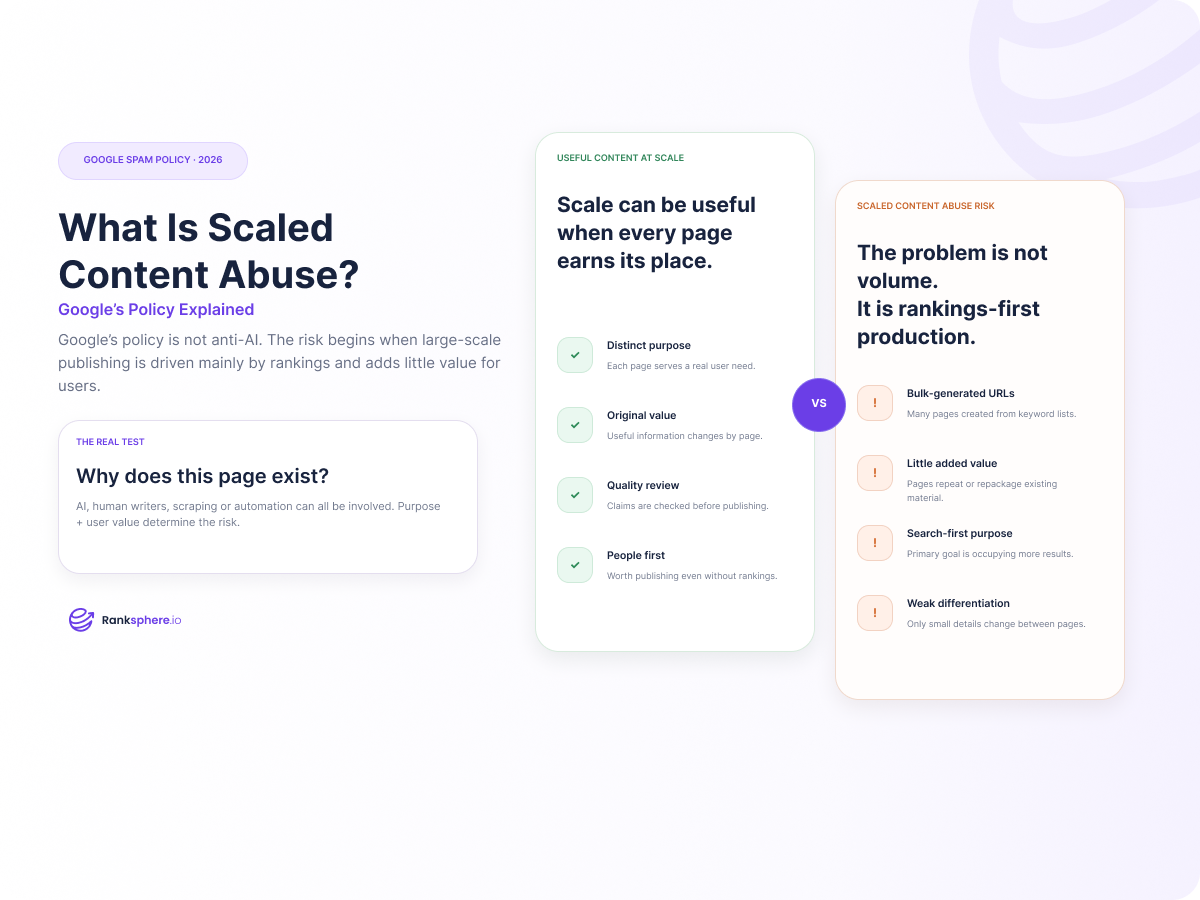
Scaled content abuse is a Search spam policy covering many pages generated primarily to manipulate search rankings rather than help users.
The current spam-policy documentation adds two useful details. The pattern typically involves large amounts of unoriginal content that provides little or no value, and the production method does not determine whether the policy applies.
AI can be involved. So can scraping, templates, automated transformations, human writers, or a mixture of methods.
The useful question is not “Was this made with AI?” It is “Why were all these pages created, and what does each one give the reader?”
If your concern is whether AI use itself can trigger a penalty, see Does Google Penalize AI Content?.
What Does the Scaled Content Abuse Policy Look For?
Three parts of the policy matter most:
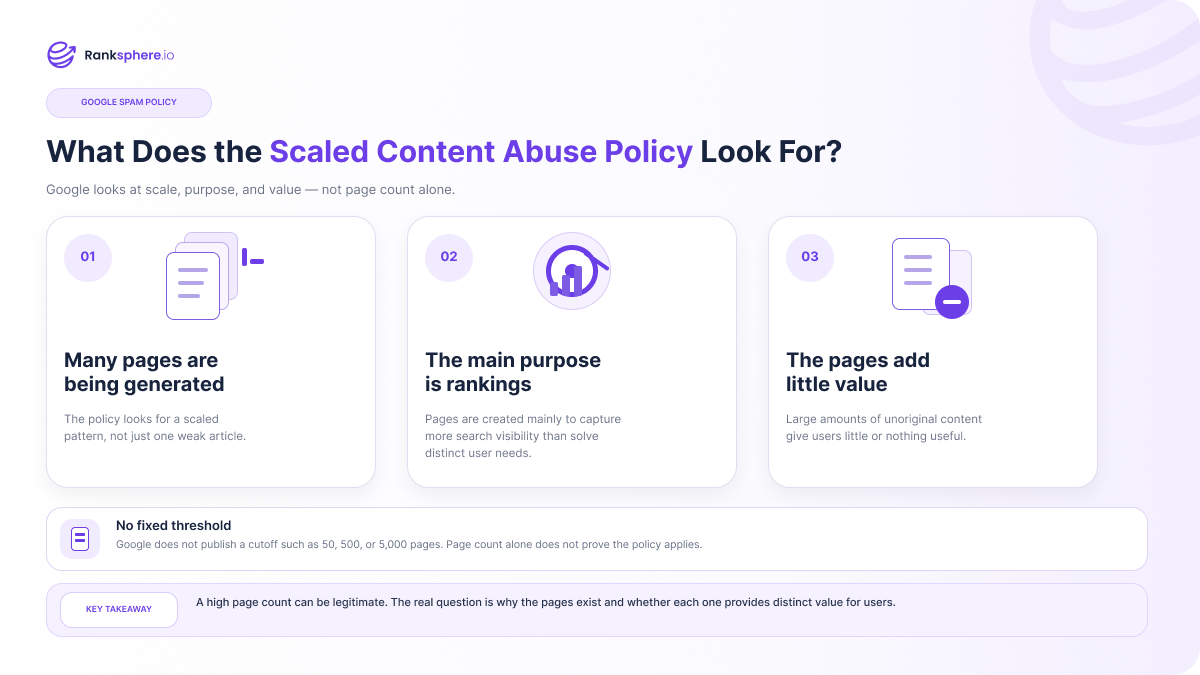
- Many pages are being generated. The policy is about a scaled pattern rather than one weak article.
- The primary purpose is manipulating rankings. The pages are being produced mainly to capture more search visibility rather than solve distinct user needs.
- The pages add little value. The policy describes large amounts of unoriginal content that gives users little or nothing useful.
There is no published threshold such as 50, 500, or 5,000 pages.
A marketplace, directory, ecommerce site, publisher, or multi-location business may legitimately need a large number of URLs. Page count alone does not tell you whether the policy applies.
What Examples Are Included in the Policy?
The current scaled-content section lists examples such as:
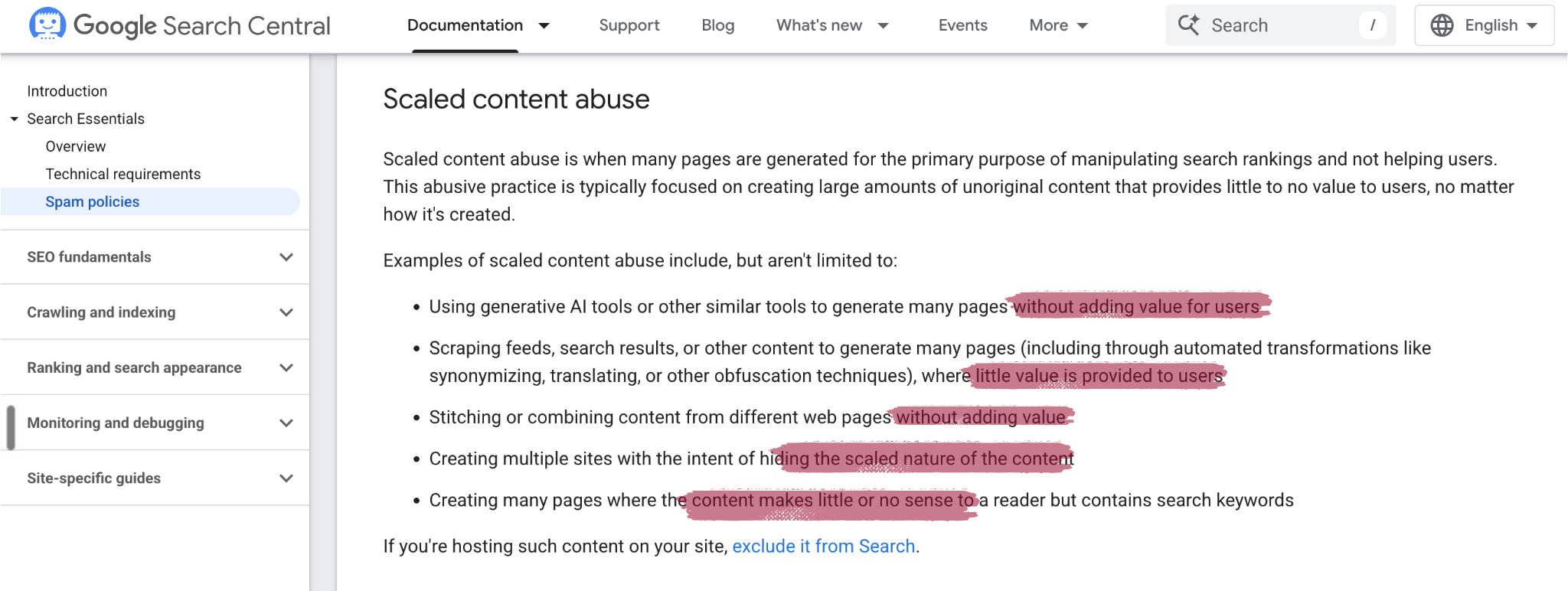
- using generative AI or similar tools to generate many pages without adding value;
- scraping feeds, search results, or other material and turning it into many low-value pages, including through automated transformations;
- combining material from different webpages without contributing anything useful;
- creating multiple sites to hide the scale of the publishing operation;
- producing many keyword-focused pages that make little or no sense to readers.
These examples share the same pattern: more pages are being created without a corresponding increase in usefulness.
They are examples, not an exhaustive checklist. A publishing strategy can still deserve review even when it does not match one example word for word.
Is AI-Generated Content Automatically Scaled Content Abuse?
No. Search Central’s current generative AI guidance describes AI as useful for research and for adding structure to original content. The warning appears when generative tools are used to produce many pages without adding value.
AI involvement therefore does not settle the policy question.
A well-reviewed page built around reliable sources, unique data, original experience, or a distinct user need is a different publishing pattern from mass-producing near-identical articles because hundreds of keyword variations are available.
The October 2026 documentation update also gives editorial teams a clearer quality-control standard: AI-generated material should be manually reviewed for accuracy and trustworthiness before publication.
Ranksphere’s thin content guide covers the related problem of pages that provide little useful value. Thin content and scaled content abuse can overlap, but they are not interchangeable terms.
Is Programmatic SEO Automatically Scaled Content Abuse?
No. “Programmatic SEO” is not itself a spam-policy category.
A programmatic system can create useful pages when each URL serves a real need and is supported by accurate, sufficiently distinct information.
A directory might have thousands of pages because each entity has different first-party data, attributes, availability, specifications, or other information visitors genuinely need.
The template is not the deciding factor.
Review the output instead:
- What useful information changes from page to page?
- Would someone searching for this specific entity or topic be satisfied?
- Is only a keyword, city, or product name changing?
- Is the underlying data reliable and current?
- Does every page need to be indexable?
- Would the page still have a purpose if search traffic were not available?
Unique data is a good reason for pages to differ. It is not a blanket exemption from Search policies.
What About Location Pages?
Location pages need extra care because more than one spam policy can become relevant.
A legitimate location page may contain genuinely local information: address or service area, hours, staff, services available there, directions, parking information, original photographs, local projects, or other details specific to that location.
A large set of pages where only the city name changes is different.
If those pages are produced at scale mainly to capture searches while offering little local value, the scaled-content policy may be relevant.
The separate doorway abuse policy may also apply when substantially similar pages target specific cities or queries and funnel visitors toward the same final destination.
For local SEO, it is better to identify the actual pattern than to call every weak city page “scaled content abuse.”
How Is Normal Content Scaling Different?
Publishing frequently is not the violation.
A scalable content system can use templates, databases, automation, or AI while preserving a distinct purpose at the page level.
Search Central’s people-first content guidance provides a useful review framework: does the page contain original information or analysis, add substantial value, and exist primarily for people rather than search-engine traffic?
Ranksphere’s search intent guide is particularly useful before creating separate pages for minor keyword variations.
A large site should be able to explain why each indexable page exists without pointing only to a keyword spreadsheet.
Can Scaled Content Abuse Affect Search Visibility?
Yes. This is a spam-policy issue, not simply an editorial-quality label.
The main spam-policy documentation explains that violations can be detected through automated systems and, when needed, human review. A violating site may rank lower or fail to appear in Search.
Human review can also lead to a manual action.
The Manual Actions report includes a Major spam problems category for aggressive spam techniques, including scaled content abuse among other violations. A manual action may affect part of a site or the whole site.
That does not mean every weak AI-assisted page receives a manual action.
If Search Console shows one, use the message in the Manual Actions report as the starting point rather than inferring the cause from a traffic drop.
Ranksphere’s Google Search Console guide explains where manual actions, indexing information, and search-performance data fit into a broader diagnosis.
What Should You Do With Hundreds or Thousands of Weak Pages?
Do not begin by rewriting every URL.
First decide which pages deserve to exist.
Keep
Keep pages with a distinct purpose, reliable information, and enough usefulness to justify their own URLs.
Improve
Improve pages where the topic deserves a URL but the current version is generic, inaccurate, outdated, or too dependent on a template.
Consolidate
Merge pages that serve substantially the same intent when one stronger resource would be more useful. Use an appropriate redirect when a retired URL has a genuinely relevant replacement.
Remove or Exclude From Search
Pages with no useful purpose, little or no value, or a role in an abusive scaled publishing pattern should not remain indexable in their current form.
The scaled-content policy explicitly instructs sites hosting such content to exclude it from Search.
Ranksphere’s indexing guide can help distinguish noindexing, redirects, canonicalization, and removal. Do not redirect every deleted URL to the homepage.
What If Search Console Shows a Manual Action?
Fix the publishing pattern before requesting review.
The Manual Actions documentation recommends bringing the site back into compliance and then submitting a reconsideration request. For serious spam actions, the review should explain what was wrong and what was changed.
A practical process is:
- Identify the affected section and the workflow that produced the pages.
- Remove, exclude, consolidate, or substantially rebuild violating content.
- Stop the process that continues creating the same problem.
- Check related spam patterns such as scraping, doorway pages, cloaking, or site reputation abuse where relevant.
- Document the changes.
- Request review only when the violation has actually been addressed.
Adding a few human edits to every page is not a meaningful fix if the underlying system still produces large amounts of low-value content mainly for rankings.
How Can You Scale Content More Safely?
Before publishing a large page set, define what makes every URL useful.
A practical pre-publication review is:
- Identify the user need.
- Confirm that another page does not already satisfy the same intent.
- Define the unique information, data, experience, or functionality the page will contain.
- Verify factual claims against reliable sources or first-party data.
- Review generated content before publication.
- Check for templated sections that add no page-specific information.
- Decide whether every page genuinely needs to be indexable.
- Review samples from different template and data conditions before releasing the full set.
- Monitor indexing, impressions, and Search Console messages after launch.
For a large site, sampling should include weak and unusual cases, not only the best-looking pages.
Ranksphere’s Website Audit Tool can also help with this review. Once Google Search Console is connected, it shows search performance by page and keyword, including clicks, impressions, click-through rate, and average position, alongside indexing and technical audit findings. That makes it easier to see which pages are actually appearing in Search, which pages are getting little visibility, and where a larger content set may need closer review.
What Is the Practical Test?
There is no one-number compliance test.
Start with a simple editorial question:
Would these pages still have a useful reason to exist if search traffic disappeared?That is not an official policy formula. It is a way to test the publishing purpose before looking at the stronger evidence.
Then review the actual pattern:
- Are many pages being generated?
- Are they largely unoriginal?
- Do they provide little or no added value?
- Is ranking manipulation the main reason they exist?
- Does the workflow resemble the current spam-policy examples?
The answer should come from the pages and the publishing system, not from whether an AI tool appears somewhere in the process.
Frequently Asked Questions
How many pages count as scaled content abuse?
There is no published numeric threshold. The policy refers to “many pages” and focuses on the purpose, originality, and value of the scaled publishing pattern. A large website is not automatically in violation because it has thousands of URLs.
Is programmatic SEO automatically scaled content abuse?
No. Programmatic publishing can produce useful pages when each URL serves a real need and contains sufficiently distinct information or functionality. The risk is a system designed mainly to generate large numbers of unoriginal, low-value pages for rankings.
Can location pages violate the policy?
Yes, depending on the pattern. Large sets of near-identical location pages created mainly to capture search traffic with little local value can raise a scaled-content concern. Similar pages that funnel visitors toward the same destination may also need review under doorway abuse.
Can scaled content abuse cause a manual action?
Yes. Spam-policy violations can be handled through automated systems or human review. Search Console’s Manual Actions documentation lists scaled content abuse among the aggressive techniques that can appear under Major spam problems.
Should weak scaled pages be deleted, noindexed, consolidated, or improved?
It depends on why the URL exists. Keep or improve pages with a legitimate, distinct purpose. Consolidate overlapping pages when one stronger URL is more useful. Remove or exclude pages that have no useful purpose or remain part of a violating scaled-content pattern.
See where you rank on Google Maps
Track your rankings, Google Business Profile, reviews, and citations in one place. 14-day free trial, no credit card.