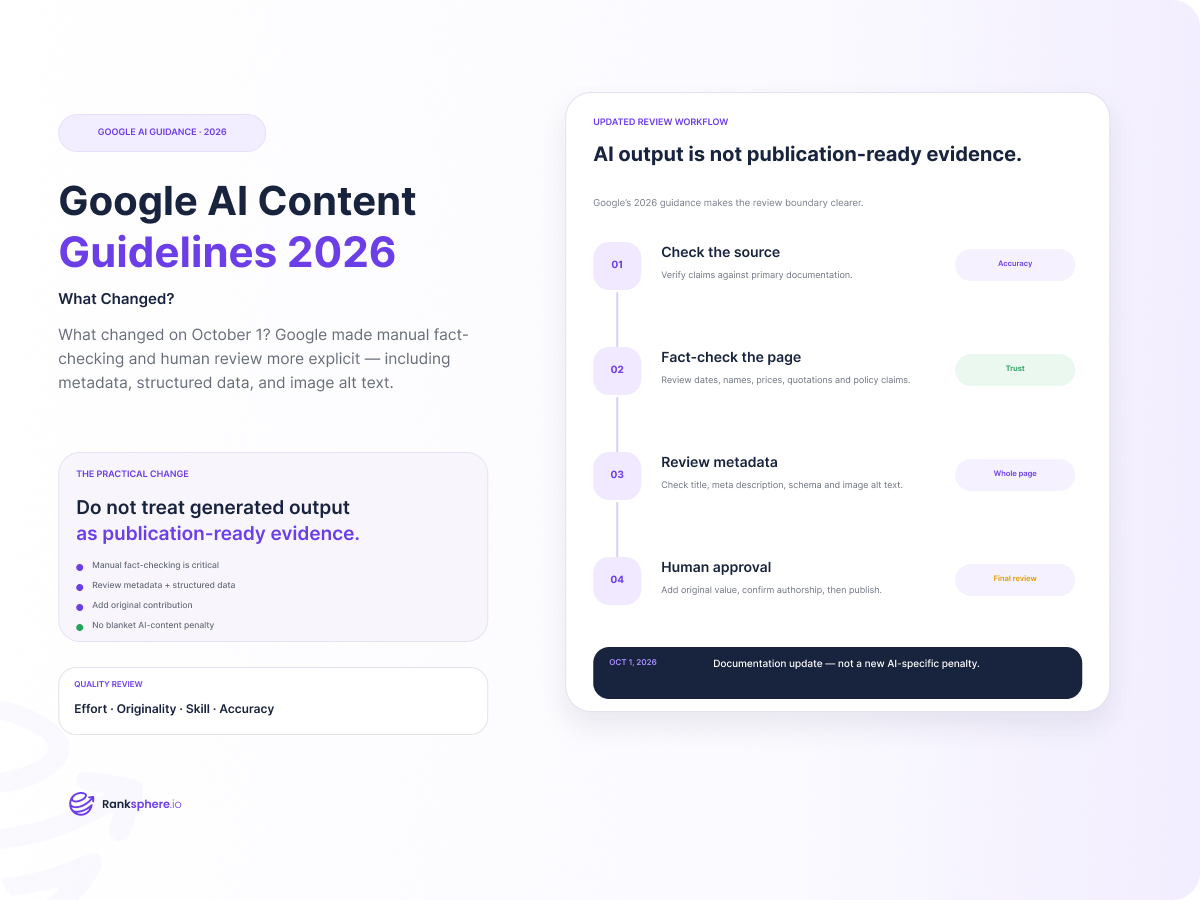
Google updated its official guidance on using generative AI content on October 1, 2026.
The clearest change is the wording around verification. The current guidance explains that generative AI can produce inaccurate information and describes manual fact-checking and review for accuracy and trustworthiness as critical before publication.
That review also extends beyond the article itself. Search Central specifically includes generated title elements, meta descriptions, structured data, and image alt text.
The update is important for publishers using AI, but it should not be confused with a new AI-specific ranking system or penalty. Search Central’s documentation changelog records it as an update to the generative AI content guide.
What Changed on October 1, 2026?
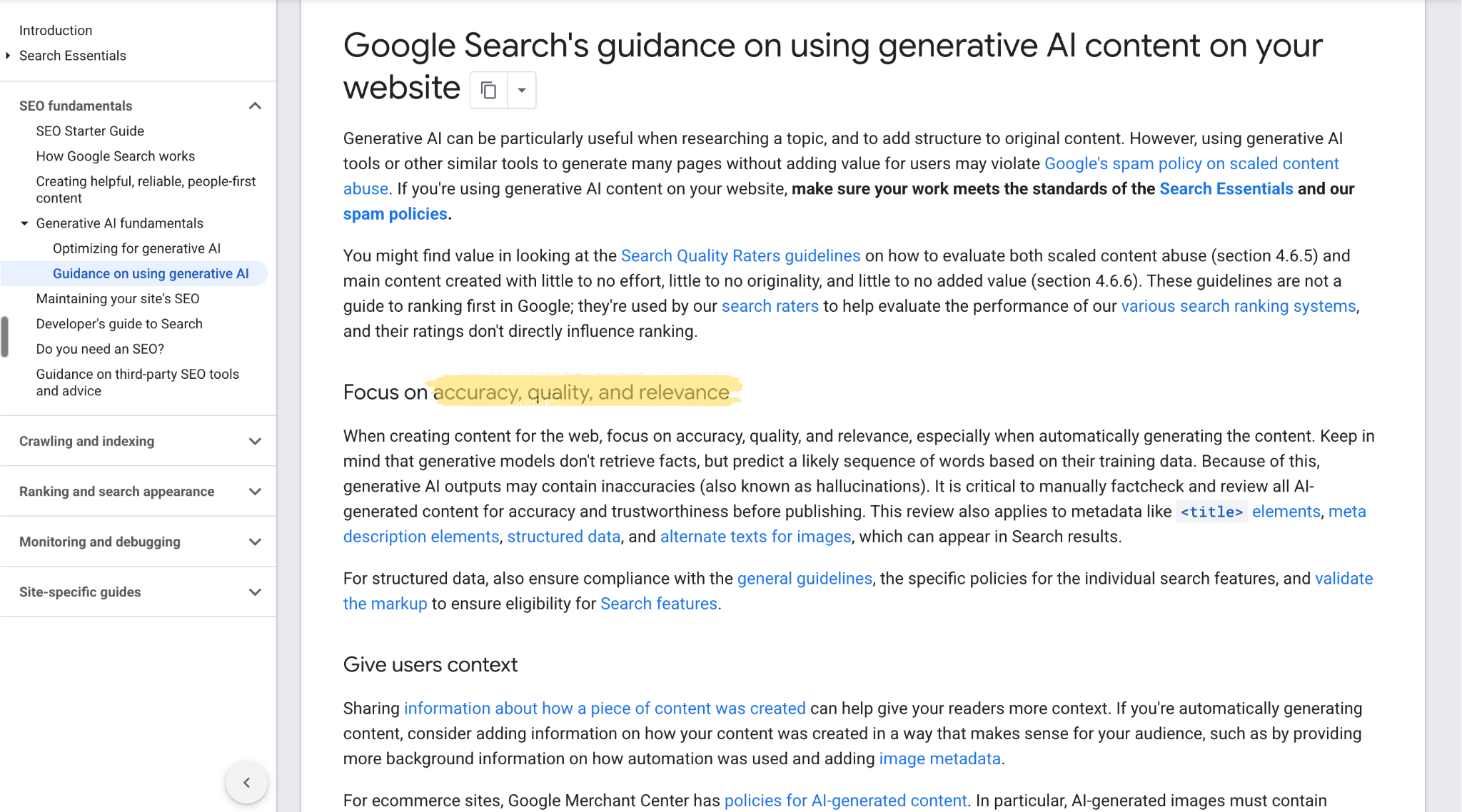
The October 1 changelog entry states that the generative AI content guide was updated with information from the Search Quality Rater Guidelines.
The current page also adds a more direct explanation of why AI-generated material needs review. Generative models predict likely sequences of words rather than retrieve facts from a verified database, so the output can contain inaccuracies or hallucinations.
That makes editorial review a factual-checking task, not a cosmetic rewrite.
A polished draft can still contain:
- an incorrect date;
- a statistic the source does not support;
- an invented quotation;
- an outdated product feature;
- a misread policy;
- a confident summary that goes further than the evidence.
The practical question before publication is simple: Can the important claims on this page be verified?
The Review Applies to Metadata Too
Search Central’s current generative AI guidance specifically includes:
- <title> elements;
- meta descriptions;
- structured data;
- image alt text.
This matters because those elements are often generated automatically even when the main article receives human editing.
A title can overstate the conclusion. A meta description can promise something the page does not provide. Structured data can contain a date, author, price, rating, or other value that does not match the visible page. Alt text can inaccurately describe an image.
The separate title-link guidance recommends clear, concise titles that accurately describe the page. The snippet guidance recommends page-specific descriptions that accurately summarize the content. Structured data should also match what users can see and follow the applicable structured data guidelines.
For AI-assisted publishing, quality control should cover the whole page rather than only the body copy.
Did the October 2026 Update Introduce a New AI Content Penalty?
The October 1 documentation update did not announce a new AI-specific penalty.
For the broader distinction between AI-assisted publishing and an actual Google penalty, see our guide to whether Google penalizes AI content.
The current generative AI guide continues to treat AI as a tool that can be useful for research and for adding structure to original content. The policy risk appears when automation is used to create many pages without adding value.
Google’s scaled content abuse policy defines the problem as generating many pages primarily to manipulate search rankings rather than help users. Using generative AI to create many pages without adding value is one example, but the policy also covers other methods.
That distinction matters.
AI-generated content and scaled content abuse are not the same thing.
A page can involve AI and still be useful, accurate, and well reviewed. A human-written page can still be thin, repetitive, or created mainly to capture search traffic.
Is This the Same as the Spam Update That Ended October 8?
No. The September 2026 spam update began on September 24 and finished rolling out on October 8, according to the Google Search Status Dashboard.
The October 1 generative AI change was a documentation update.
The dates are close together, but they refer to different events. The Search Status Dashboard does not state that the September spam update specifically targeted AI-generated content, and the October 1 documentation entry does not present itself as the announcement of that ranking update.
Keeping those events separate avoids implying a connection that has not been documented.
What Do the Search Quality Rater Guidelines Have to Do With It?
The updated generative AI guide points readers to sections of the Search Quality Rater Guidelines covering scaled content abuse and main content created with little effort, originality, or added value.
Quality raters do not manually decide where individual pages rank.
Search Central explains that raters help evaluate the performance of ranking systems, while individual ratings do not directly determine rankings.
That makes the guidelines useful as a quality reference, not as a checklist of direct ranking factors.
For publishers, the useful question is whether automation has replaced the work needed to make the page accurate, distinct, and worth reading.
Google’s broader people-first content guidance also asks publishers to evaluate originality, factual accuracy, sourcing, expertise, and whether content was created primarily to help people rather than attract search traffic.
Does Google Require AI Content Disclosure?
There is no universal requirement in Search Central’s editorial guidance that every AI-assisted article carry the same disclosure.
The current generative AI page recommends giving readers useful context about how automated content was created when that information makes sense for the audience.
The broader people-first guidance takes a similar approach: details about the creation process can be useful when readers would reasonably wonder how the content was produced.
That is different from a mandatory SEO label.
Some Google products have more specific requirements. Merchant Center, for example, has separate rules for AI-generated product data and AI-generated images.
For a normal editorial article, disclosure is better treated as a transparency decision based on the role automation played and what readers would reasonably expect to know.
What Should Publishers Change in Their AI Workflow?
The updated guidance supports a practical review process:
- Start with reliable sources, preferably the original source for factual and policy claims.
- Use AI for research assistance, organization, or drafting where it genuinely helps.
- Verify important claims before publication.
- Check dates, names, numbers, quotations, product details, and policy statements.
- Review the title and meta description against the actual page.
- Check structured data against visible content.
- Review image alt text for accuracy.
- Remove unsupported claims, repetition, and generic filler.
- Confirm that the page serves a distinct search intent rather than duplicating an existing URL.
- Have a person make the final publishing decision.
Ranksphere’s guide to search intent can help when deciding whether related keyword variations belong on one page or need separate URLs
After publication, use first-party search data rather than assuming the content-production method caused any change. Ranksphere’s Google Search Console guide explains how query, page, click, impression, and position data can help diagnose what actually changed.
Do These Guidelines Create Special Rules for AI Overviews or AI Mode?
No separate content standard is required just because a page may appear in an AI-powered Search feature.
Search Central’s AI features guidance states that the same foundational SEO practices apply to AI Overviews and AI Mode and that there are no additional technical requirements or special optimizations required specifically for those features.
Pages still need to meet normal Search requirements, be indexed, and be eligible to appear with a snippet.
That means publishers do not need an “AI-only” writing style, special schema, or a separate page for every conversational query variation.
What Actually Changed for Publishers?
The October 1 update makes the review expectation much more explicit.
AI-generated material should not be treated as publication-ready simply because it reads well. Important claims need verification, and the same care should extend to titles, descriptions, structured data, and image alt text.
The update also reinforces an existing boundary: automation becomes a policy problem when it is used to create many low-value pages primarily for ranking manipulation.
What it does not introduce is a blanket AI penalty, a new AI ranking factor, or a published percentage of human-written text that every page must contain.
AI can still be part of the workflow. The publisher remains responsible for the accuracy, purpose, sourcing, and final quality of the page.
Frequently Asked Questions
Was October 8 the date Google updated its AI content guidelines?
No. Search Central’s documentation changelog records the generative AI content update on October 1, 2026. October 8 is the completion date of the separate September 2026 spam update shown on the Search Status Dashboard.
Does every AI-assisted article need an AI disclosure?
No universal Search requirement applies to every editorial article. Search Central recommends giving readers useful context about automation when that information makes sense for the audience. Other Google products can have their own specific disclosure or labeling rules.
Can AI-assisted content still rank after human review?
AI assistance is not prohibited by the current guidance. Human review can improve factual accuracy and catch weak output, but review itself is not a ranking guarantee. The finished page still has to compete based on its usefulness, relevance, quality, and compliance with Search policies.
Is publishing a lot of AI content automatically scaled content abuse?
No. The spam policy does not define scaled content abuse by AI use or by a fixed number of pages. The issue is generating many pages primarily to manipulate rankings rather than help users, particularly when those pages add little or no value.
Do I need special optimization for AI Overviews or AI Mode?
No. Search Central’s AI features documentation states that the same foundational SEO practices apply and that there are no additional technical requirements or special optimizations required specifically for AI Overviews or AI Mode.
See where you rank on Google Maps
Track your rankings, Google Business Profile, reviews, and citations in one place. 14-day free trial, no credit card.