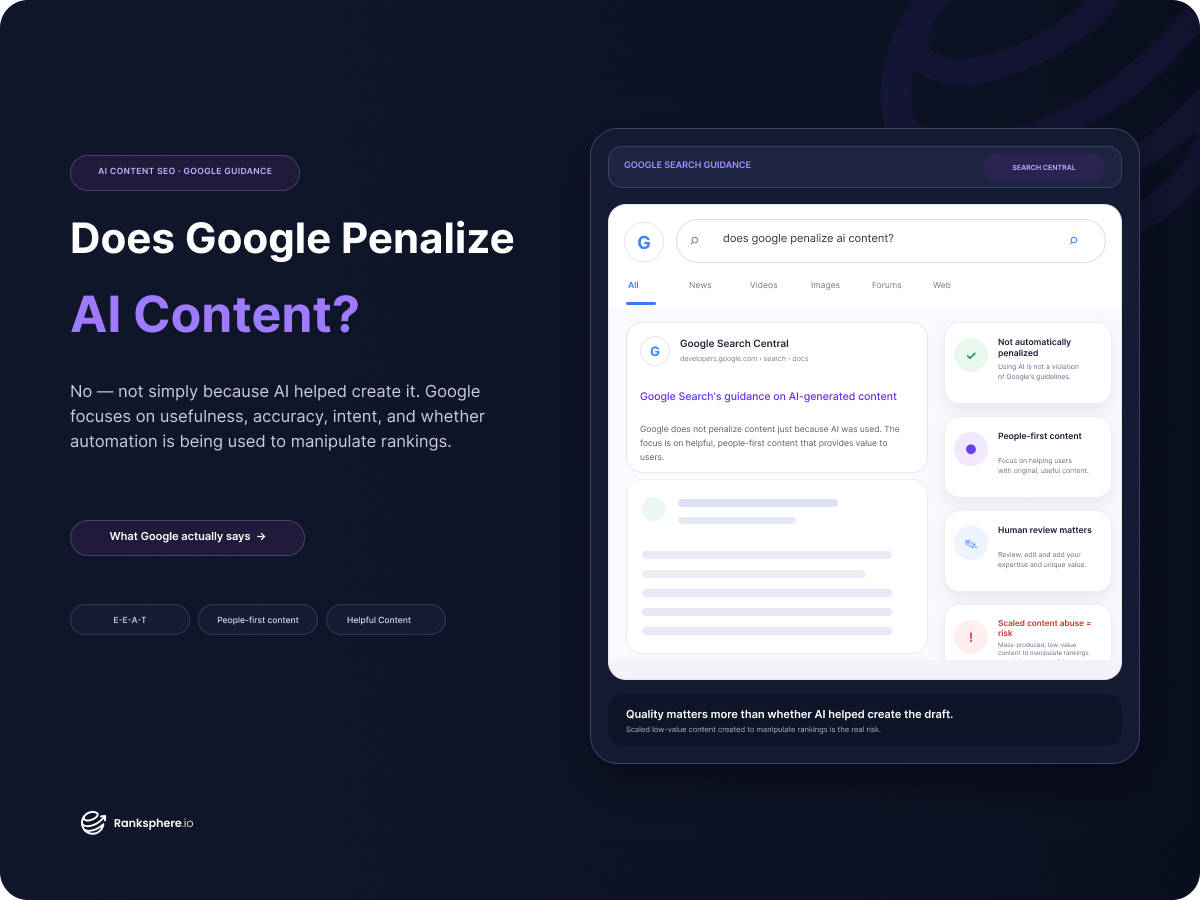
No. Google does not say that content should be penalized simply because AI helped create it.
Google’s published guidance focuses on the finished content and how automation is being used. In its guidance about AI-generated content, Google says appropriate use of AI or automation is not against its guidelines. Using automation primarily to manipulate search rankings is a different matter and can violate its spam policies.
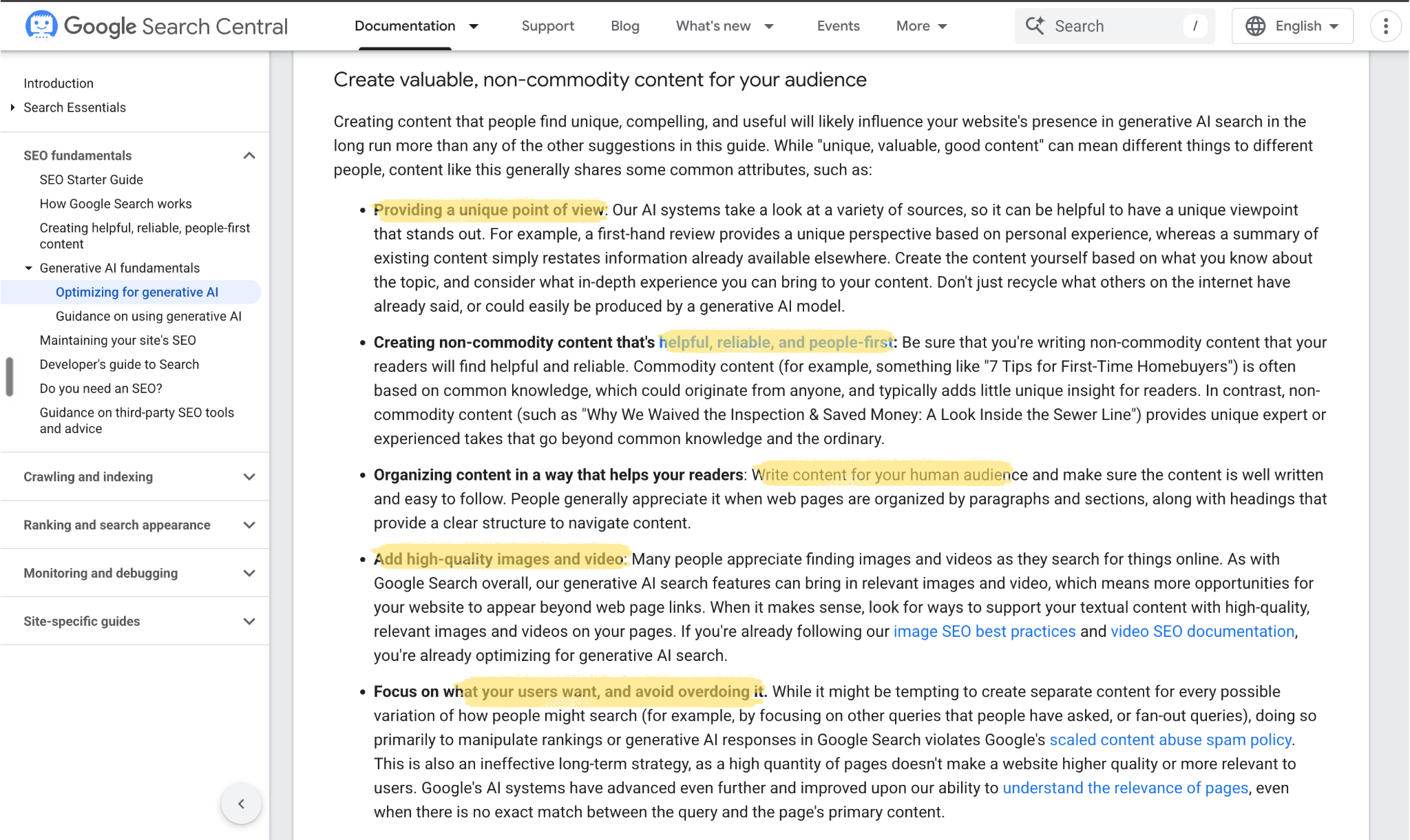
That makes the source of the words less useful as a risk test than the purpose and quality of the page.
An AI-assisted article can rank. A human-written article can perform poorly. A page can also lose traffic or remain unindexed for reasons that have nothing to do with whether AI was involved.
Does Google Penalize AI-Generated Content?
Google does not publish a rule that applies a penalty simply because content was generated or assisted by AI.
Its 2023 AI-content guidance says Google’s systems aim to reward original, high-quality content regardless of how it was produced. The same guidance says AI provides no special ranking advantage: useful, helpful, original content may perform well, while content that does not meet those standards may not.
The important limit is automation used for ranking manipulation.
If AI helps a subject-matter expert organize research, build an outline, or prepare a draft for review, that is different from automatically producing hundreds of pages because a list of keywords is available.
For SEO planning, search intent is a better starting point than treating every keyword variation as a reason to publish another URL. Closely related searches may belong on one page when they represent the same underlying need.
What Has Google Added to Its AI Guidance in 2026?
Google’s current guidance on using generative AI content was updated on October 1, 2026.
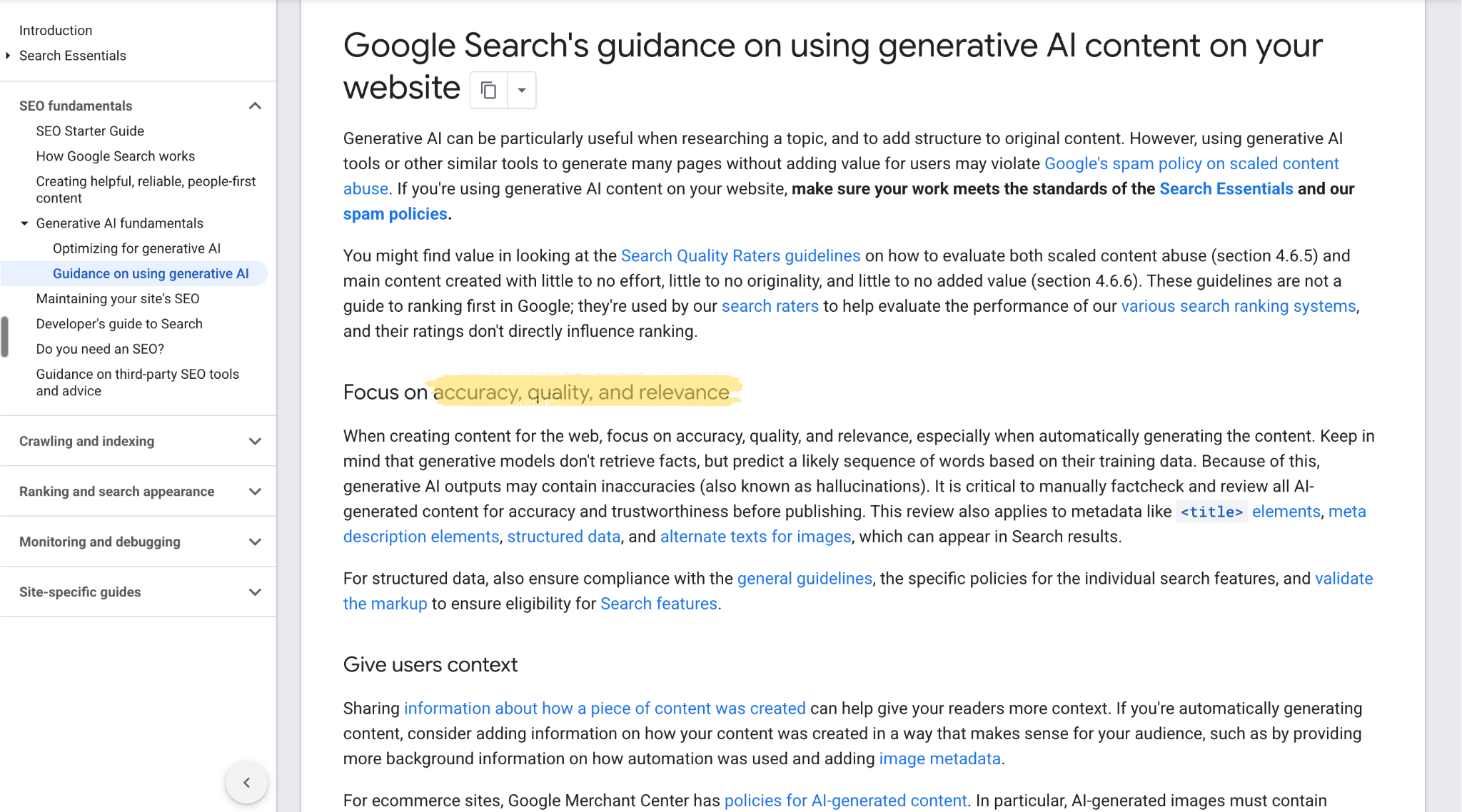
The current guidance is more explicit about accuracy. Google explains that generative models can produce incorrect information and says AI-generated content should be manually fact-checked and reviewed for accuracy and trustworthiness before publication.
That review is not limited to the visible article. Google also calls out generated title elements, meta descriptions, structured data, and image alt text.
For publishers, this turns “human review” into a practical quality-control step rather than a cosmetic rewrite. Check whether claims are true, current, supported by the source being cited, and represented accurately in the page’s metadata.
This update does not announce a new AI-specific ranking penalty. It clarifies what Google expects publishers to check when they use generative AI.
When Can AI Content Become a Google Search Problem?
The clearest policy risk is using automation to create large amounts of low-value content mainly to influence rankings.
Google’s spam policies call this scaled content abuse. The policy applies regardless of whether the pages were produced by AI, human writers, scraping tools, or a mixture of methods.
Google gives using generative AI to create many pages without adding value for users as one example.
This is why volume alone is not a useful test. A site may legitimately publish many pages when each one serves a distinct purpose. The concern is large-scale production where pages are unoriginal, weakly differentiated, or created mainly to capture search traffic.
For example, these queries are close:
- does Google penalize AI content
- can AI content rank on Google
- is AI-generated content against Google guidelines
- will AI content get my site penalized
Creating a separate article for each phrase would add unnecessary overlap. One page can answer the shared intent, while genuinely different questions can become supporting articles.
Can AI Content Rank on Google?
Yes. Google’s own AI-content FAQ says using AI does not give content special gains in Search. It is still evaluated as content.
Google’s people-first content guidance asks publishers to consider whether a page provides original information, research, reporting, or analysis; whether it adds value compared with other search results; and whether it contains easily verifiable factual errors.
The same guidance now describes content quality in terms that include effort, originality, and accuracy. It also explains that E-E-A-T is not one specific ranking factor.
A useful review therefore looks beyond whether a draft “sounds human.” It asks whether the page answers the query, adds something useful, uses reliable sources, and has been checked by someone who understands the subject.
What Should You Check Before Publishing AI-Assisted Content?
A short review can catch many of the problems that make AI-assisted pages weak:
- Verify factual claims against primary sources where possible.
- Check dates, names, statistics, quotations, product features, and policy statements.
- Remove claims that the cited source does not actually support.
- Make sure the page satisfies the intended search query instead of merely repeating the keyword.
- Add real experience, examples, screenshots, data, or analysis when they genuinely improve the answer.
- Review titles, meta descriptions, structured data, and image alt text.
- Check whether an existing page on your site already serves the same intent.
The goal is not to disguise AI involvement. The goal is to make the published page accurate and useful.
What If Rankings Drop After You Publish or Rewrite Content With AI?
Do not treat the timing alone as proof that AI caused the decline.
Start with the pages and queries that changed. Google Search Console shows impressions, clicks, average position, indexing information, and the queries associated with your own pages.
Check whether the decline affected one URL or a wider group. Look for changes in search intent, content removed during the rewrite, competing pages on your own site, indexing status, internal links, and technical issues before assigning a cause.
Ranksphere’s Website Performance view can bring Search Console data, indexing, page speed, and technical audit findings together when you need to investigate a drop across more than the article copy itself.
A separate guide on Does AI Content Hurt SEO? can cover that diagnosis in more depth.
So, Does Google Penalize AI Content?
Google does not say that AI-generated or AI-assisted content is penalized simply because AI was used.
Its published guidance draws the line elsewhere: content should be useful, accurate, original enough to add value, and created primarily for people rather than to manipulate rankings. Google also warns that producing many low-value pages with generative AI can violate its scaled content abuse policy.
The 2026 guidance adds another practical requirement to the publishing workflow: manually check AI-generated content and metadata for accuracy and trustworthiness before it goes live.
If AI helps you research, structure, or draft a page, that can be part of a normal content process. The publisher still owns the final decision about what is accurate, useful, and ready to publish.
See where you rank on Google Maps
Track your rankings, Google Business Profile, reviews, and citations in one place. 14-day free trial, no credit card.