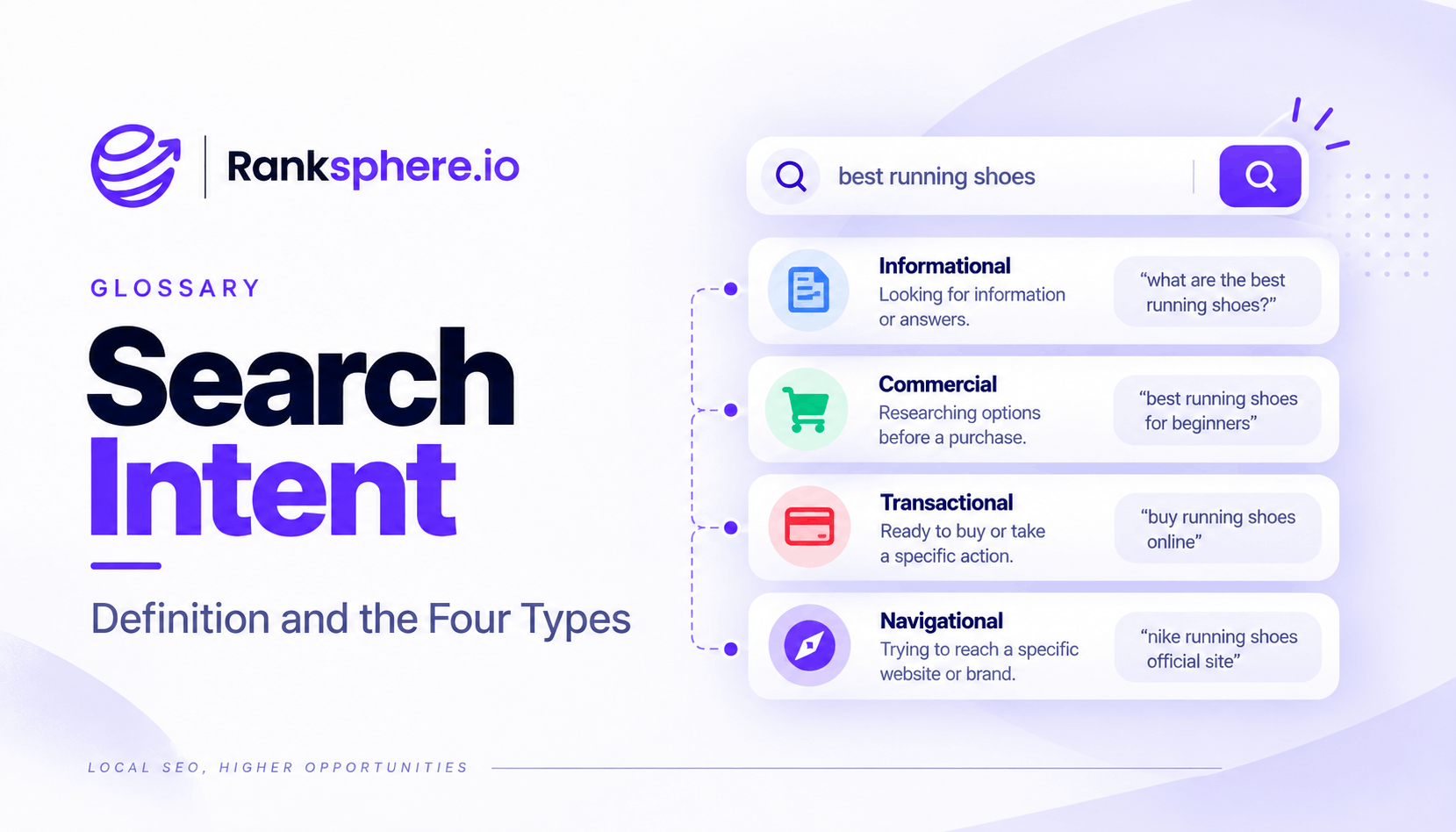
Search intent is the reason behind a search query, what the person is actually hoping to find, learn or do.
In SEO, understanding search intent helps you choose the right type of page for a keyword. Someone searching for an explanation needs different content from someone who is ready to book a service or compare providers.
This is why keyword matching alone is not enough. A page can use the right phrase throughout and still struggle to rank if it does not satisfy what people are looking for.
If Google is showing guides for a query and your page is a sales page, the issue may not be the wording. It may simply be the wrong type of content.
Four search intent types to understand
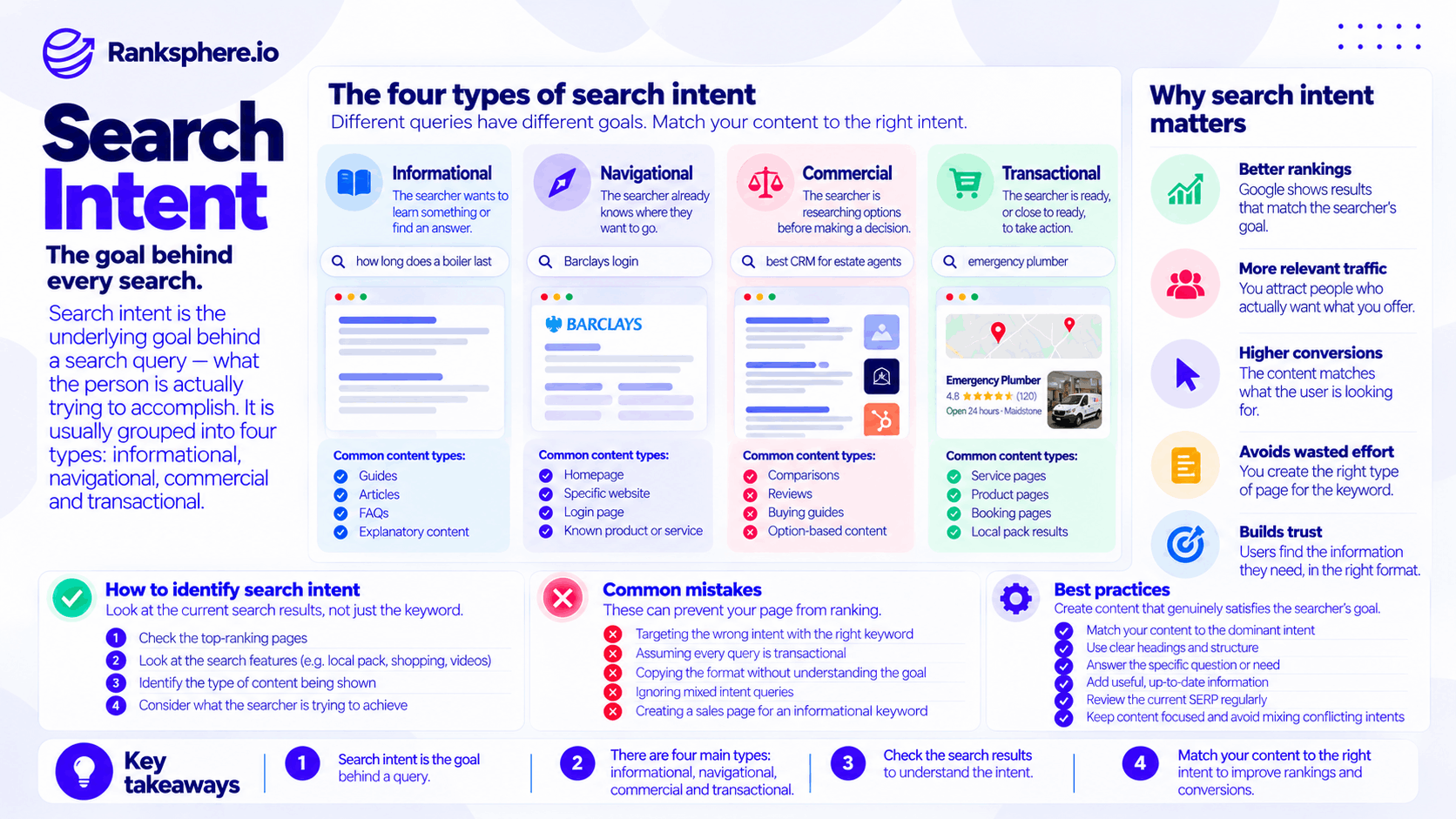
Search intent is usually grouped into four broad categories. Some queries sit between two types, but the framework is still useful when deciding what kind of page to create.
Informational intent
The searcher wants to learn something or find an answer.
Examples include:
- “how long does a boiler last”
- “what is probate”
- “how often should I service my car”
These searches are commonly served by guides, articles, FAQs and explanatory content.
Navigational intent
The searcher already knows where they want to go.
They may search for:
- A company name
- A specific website
- A login page
- A known product or service
For example, someone searching “Barclays login” is not looking for a comparison of banking websites. They are trying to reach Barclays.
Commercial intent
The searcher is researching options before making a decision.
Examples might include:
- “best accountant for small business”
- “composite vs uPVC doors”
- “best CRM for estate agents”
These searches often return comparisons, reviews, buying guides and pages that help people evaluate different options.
Transactional intent
The searcher is ready, or close to ready, to take action.
Examples include:
- “emergency plumber”
- “book dental appointment”
- “boiler repair near me”
Service pages, product pages, booking pages and the local pack commonly appear for this type of search.
How to identify search intent
Do not rely on the keyword alone.
One of the simplest ways to understand intent is to search the term and look carefully at the results Google is already showing.
Ask:
- What types of pages are ranking? If most results are guides, the query is probably informational. If service or product pages dominate, the intent is likely more commercial or transactional.
- Which SERP features appear? A local pack often points to local commercial or transactional intent. Shopping results suggest product-focused intent. People Also Ask may indicate that users want more information around the topic.
- What kind of content do the top results provide? Look at whether people are being given explanations, comparisons, prices, booking options or direct services.
- Does Google show a mixture? Some queries have mixed intent, so the results may include guides alongside commercial pages.
You do not need to copy the pages that already rank. The goal is to understand what need Google believes the search is trying to satisfy.
If the results page looks completely different from the content you were planning to create, that is a useful signal to reconsider the page.
Search intent in local SEO
Search intent is particularly important in local SEO because many queries have an immediate local or commercial purpose.
Someone searching “electrician” from a mobile phone may not include a city or the words “near me,” but Google can still understand that they are probably looking for a nearby service.
When the local pack appears prominently, your Google Business Profile becomes an important part of the search experience alongside your website.
Different local searches still need different content.
For example:
- Transactional local searches may be best supported by a strong Google Business Profile and a clear service page.
- Informational searches usually need useful guides or answers.
- Commercial searches may benefit from comparison content, service explanations, FAQs and case studies.
Ranksphere's rank tracker separates local pack position from organic position, helping you see whether a keyword is performing through the local results, organic search, or both.
Search intent and page type
Once you understand the intent, the next step is matching it with the right page.
A query such as:
“how much does roof replacement cost?”
is usually looking for information.
A page that immediately asks someone to request a quote may not answer enough of the question.
On the other hand:
“roof replacement company near me”
suggests that the person is much closer to choosing a contractor. A detailed educational article may not be the most useful result for that search.
Search intent helps you decide whether the keyword belongs on:
- A service page
- A product page
- A category page
- A comparison
- A guide
- An FAQ
- A location page
- A booking or enquiry page
This can also help prevent multiple pages from competing for essentially the same search.
Common search intent mistakes
- Choosing a page type before checking the SERP. The search results may show that Google interprets the keyword differently from you.
- Using a sales page for an informational query. If the searcher wants an answer, pushing straight to a conversion may not satisfy the query.
- Writing a long guide for someone ready to act. Transactional searches usually need a clear route to the service, product or booking.
- Assuming intent from a single word. Terms such as “best,” “cost” and “near me” can behave differently depending on the topic.
- Ignoring local results. A local pack can change what success looks like for a keyword.
- Trying to make one page serve unrelated intents. A page that tries to educate, compare and sell everything at once can become unfocused.
- Relying only on a keyword tool. Search volume and difficulty do not tell you what the searcher actually wants.
Search intent best practices
- Check the live search results for important keywords. The SERP gives you direct evidence of how Google currently interprets the query.
- Match the page to the purpose of the search. Give people the type of content they are expecting.
- Look at the whole results page. Local packs, shopping results, videos and other features can reveal intent.
- Separate clearly different intents. An informational guide and a commercial service page may both be useful for the same broad topic.
- Use intent when clustering keywords. Terms that mean similar things but have different intent may need different pages.
- Revisit intent over time. Search results change, and Google can interpret queries differently as user behaviour evolves.
- Let the SERP challenge your assumptions. Keyword tools provide data, but the results page shows what is actually ranking.
Example
“Ashgate Roofing wants to target the keyword “roof replacement cost.”
The original plan is to use the term on a service page because anyone researching price could eventually become a customer.
But the search results tell a different story.
Most of the ranking pages are detailed guides explaining average costs, materials, roof sizes and the factors that affect the final price. Google appears to interpret the query mainly as informational.
Instead of forcing the keyword onto the service page, Ashgate creates a useful cost guide that answers those questions properly.
The existing roof replacement service page continues to focus on people looking for a contractor, quote or local roofing company.
Both pages are now doing different jobs.
The guide helps people who are still researching. The service page helps people who are ready to speak to a roofer.
That is the value of understanding search intent: you create the page the searcher needs instead of trying to make every keyword fit the page you already have.”
See also
- Keyword research, where search intent is assessed before targeting a term
- Local pack, a strong signal that a query has local intent
- Long-tail keyword, specific searches that often reveal clearer intent
- Featured snippet, a search feature commonly associated with informational queries
- Near me search, a strong indicator of local commercial or transactional intent
- Keyword cannibalisation, what can happen when multiple pages target the same topic without a clear purpose