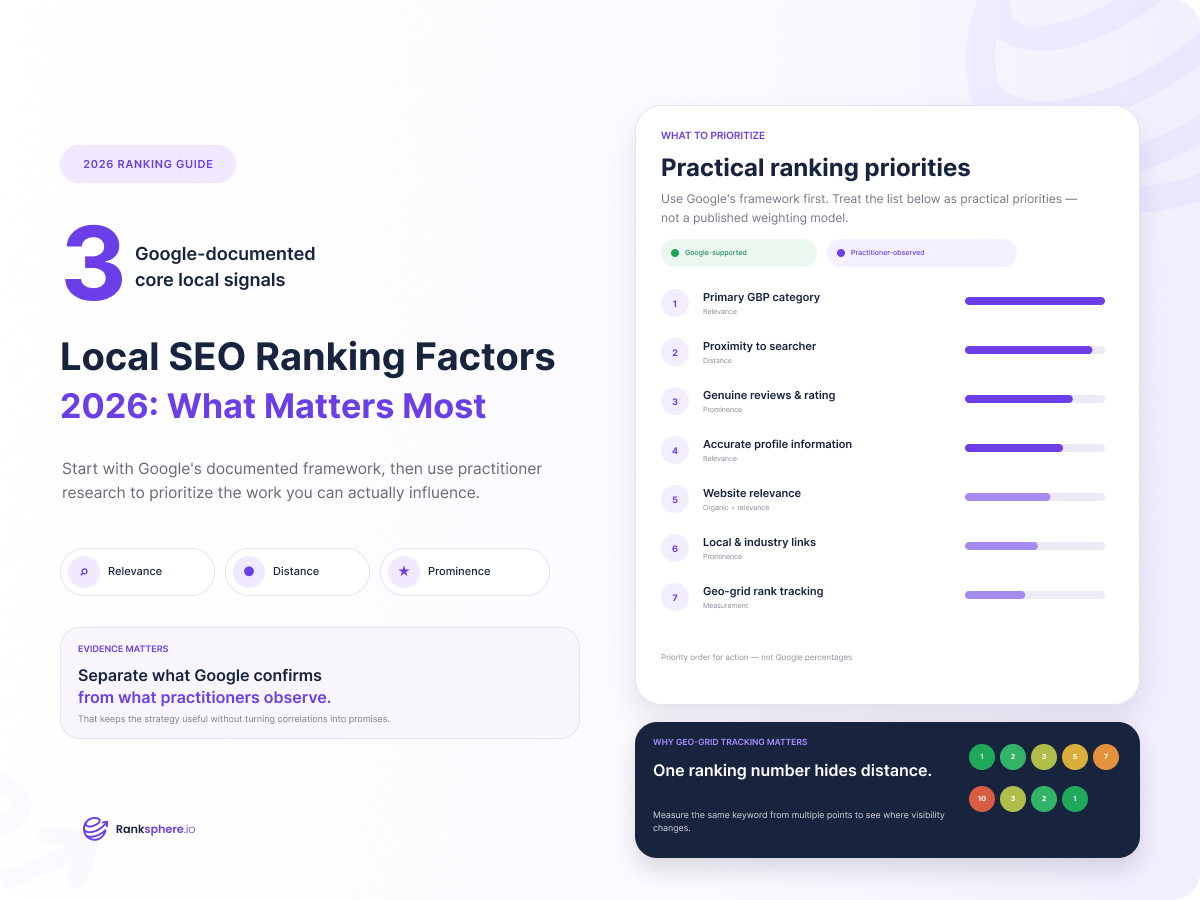
Google has not published a secret list of hundreds of local ranking factors for 2026. Its public explanation is still much simpler: local results are mainly based on relevance, distance, and prominence (Google's current help page also uses the word "popularity" in its summary).
Those three concepts are the starting point. The long lists of categories, reviews, links, website content, hours, citations, and other signals are best understood as things that may contribute to one of those three areas, or as practitioner-observed factors rather than confirmed algorithm rules.
That distinction matters in 2026. The latest industry research gives local SEOs a useful picture of what appears to correlate with stronger Local Pack and Maps performance, but it is not the same as Google revealing its algorithm.
If you want the short version, prioritize:
- The correct Google Business Profile categories
- Relevance between the query, profile, services, and website
- Realistic expectations around proximity
- Genuine Google reviews and a strong rating
- Accurate hours, address, and profile information
- A locally relevant website with useful service and location pages
- Authoritative local and industry links and mentions
- Measurement with location-based local rank tracking
The rest of this guide explains why those areas matter and how strong the evidence is for each.
Google's three local ranking factors: relevance, distance, and prominence
Google's own local ranking guidance says local results are mainly based on relevance, distance, and prominence/popularity.
Relevance
Relevance is how well a Business Profile matches what someone is searching for.
A plumber should be relevant to plumbing searches. A cosmetic dentist may be relevant to "teeth whitening near me" but not necessarily to every general medical query. Google recommends providing complete and detailed information so it can better understand the business and match it with relevant searches.
Relevance can be supported by:
- The primary and additional Business Profile categories
- Services and products that accurately describe the business
- Website service pages
- Location-specific website content where it is genuinely useful
- Consistent business information across the web
Not every field is an individual ranking factor. Think of the profile and website as a set of signals that help Google understand what the business is, what it offers, and where it operates.
Distance
Distance is the part of local SEO that businesses have the least control over.
Google considers how far a potential result is from the person searching. If the user does not share a precise location, Google uses what it knows about that user's location.
This is why a business can rank well near its address and much lower several miles away. It is also why one manual search from your office is a poor way to judge citywide visibility.
Distance cannot be "optimized" with a larger service-area setting, more city names in the description, or a pile of "near me" keywords. The practical response is to understand the radius in which the business is realistically competitive and improve the controllable signals inside that area.
Prominence
Prominence is how well-known a business is.
Google says prominence is informed by information it finds across the web, including links and reviews. It also explicitly states that more reviews and positive ratings can help a business's local ranking.
For local SEO work, prominence often overlaps with:
- Google reviews
- Links from relevant websites
- Local press and community mentions
- Industry directories and associations
- Brand searches and real-world recognition
- A website with enough authority to support the business entity
The important point is that prominence is broader than "build citations." Google is trying to understand whether the business is a known and trusted result for the query.
What changed in the 2026 local ranking research?
The Whitespark 2026 Local Search Ranking Factors report surveyed local search practitioners and asked them to score factors based on their observed impact.
The report is useful because it reflects current practitioner experience. Whitespark is also explicit that contributors do not have private access to Google's algorithm.
For Local Pack and Maps results, the top eight factors in the 2026 survey are:
| 2026 survey rank | Factor | How to interpret it |
| 1 | Primary GBP category | Strong relevance signal; Google itself says categories affect local ranking |
| 2 | Proximity to the searcher | Directly consistent with Google's documented distance factor |
| 3 | Keywords in the GBP business title | Strong observed signal, but only legitimate real-world business names should be used |
| 4 | Physical address in the city of search | Closely tied to location and proximity |
| 5 | Business open at the time of search | Newer high-priority practitioner observation; hours must remain truthful |
| 6 | High numerical Google ratings | Consistent with Google's statement that positive ratings can help local ranking |
| 7 | Address showing on GBP | Relevant to eligible storefronts, not a reason for service-area businesses to violate address rules |
| 8 | Additional GBP categories | Useful when they accurately represent the business |
Two cautions are important.
First, these are survey rankings, not percentages published by Google.
Second, a factor appearing high in a survey does not mean you should manipulate it. The business-name example is the clearest case: keyword-rich names may correlate with rankings, but Google's Business Profile guidelines require the profile name to match the real-world business name. Adding a city or service just for SEO can create policy risk.
1. Primary Google Business Profile category
The primary category deserves attention because both Google and 2026 practitioner research point in the same direction.
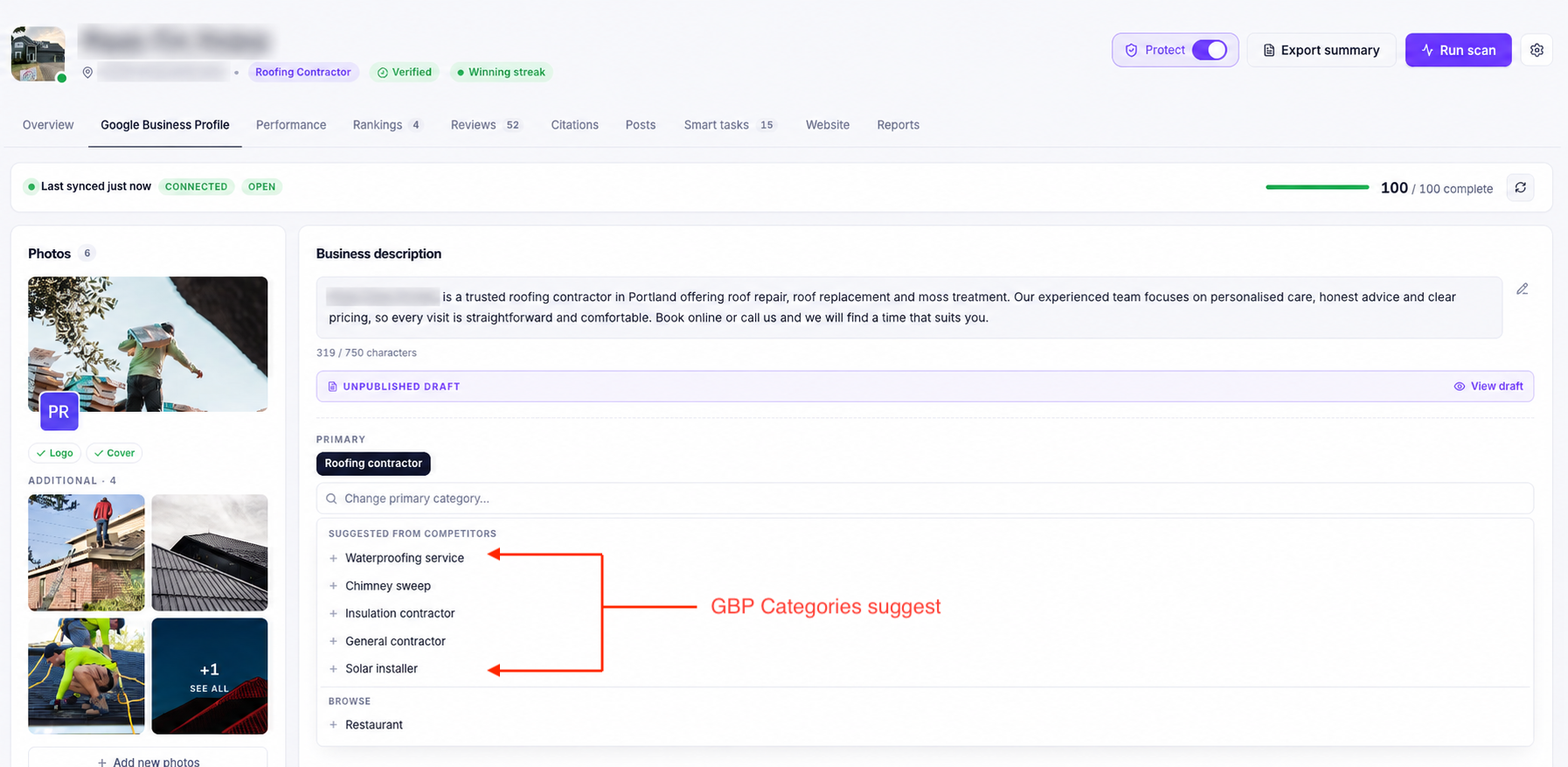
Google's category guidance states that the categories a business selects affect local ranking. It recommends choosing the most specific primary category that accurately describes the main business.
Whitespark's 2026 survey ranks Primary GBP Category first for Local Pack/Maps impact.
What to do:
- Choose the category that best describes what the business is.
- Prefer a specific category over a vague one when an accurate option exists.
- Check what categories your competitors are using by connecting your Google Business Profile to Ranksphere. Run a local ranking scan, open the completed results, and compare the primary categories used by businesses appearing across the grid. Use those competitor categories as research clues, not as a list to copy.
- Use additional categories only when they genuinely describe other parts of the business.
Google's own guideline is to use as few categories as possible while accurately representing the core business. More categories are not automatically better.
2. Proximity to the searcher
Proximity ranked second in Whitespark's 2026 survey and is directly part of Google's documented distance factor.
A business can do everything else well and still lose a "near me" search to a similarly relevant competitor that is much closer to the searcher.
This is one reason local ranking reports need geographic context. "We rank #3 for dentist" is incomplete unless you know where the search was performed.
A more useful question is:
Where across the target area do we rank in the top 3, top 10, or outside the visible range?
That is the job of local rank tracking. A geo-grid scan samples the same keyword from multiple points so you can see the shape of local visibility instead of relying on one search location.
You cannot remove proximity from the algorithm. You can measure it and avoid blaming every ranking change on profile edits.
3. Business name relevance — without keyword stuffing
Keywords in the Business Profile title rank third in the 2026 Whitespark survey.
This needs one of the strongest caveats in local SEO.
Google requires the Business Profile name to reflect the business's real-world name as it is used on signage, stationery, the website, and other branding. Unnecessary information in the name is not permitted and can create suspension risk.
So if the legitimate brand name naturally contains a service term, that may coincide with a ranking advantage. That is different from changing:
Smith & Co.

to:

Smith & Co. Best Emergency Plumber Chicago
because the second version looks better for search.
Treat the survey result as an observation about how Google's system behaves, not as permission to rewrite a business name for SEO.
4. Business location and city relevance
Physical address in the city of search ranks fourth in the 2026 survey. Address visibility for eligible storefront businesses also appears near the top.
This fits the broader reality of distance: where the business genuinely exists matters.
For a storefront, keep the address accurate and the map pin correct. For a service-area business that does not serve customers at its address, follow Google's address guidance and hide the address when required.
Do not create fake offices, virtual locations, or inaccurate addresses simply to expand ranking coverage.
If a company genuinely opens another staffed, eligible location, that can change the geographic area from which the business competes. A service-area setting by itself does not make the physical business closer to a searcher.
5. Business hours and "open now" visibility
"Business is Open at Time of Search" entered the 2026 Whitespark survey near the top of the Local Pack/Maps list at number five.
Google also tells businesses to keep their hours accurate, and local search often has immediate intent. Someone searching for an emergency locksmith, restaurant, pharmacy, or coffee shop may need a business that is open now.
The right action is not to stretch hours for SEO. It is to publish the hours the business can actually honor and keep regular and special hours current.
Accurate hours improve the customer experience even when a specific ranking effect is difficult to isolate.
6. Google reviews and local rankings
Google reviews are one of the areas where the official evidence is unusually clear.
Google says more reviews and positive ratings can help local ranking. Its current local ranking documentation also references review quantity as part of prominence.
Whitespark's 2026 survey ranks high numerical Google ratings sixth for Local Pack/Maps, and its broader review group gained perceived importance compared with earlier editions.
That does not mean every review-related tactic is a confirmed ranking factor.
What Google confirms
Google confirms that:
- Review count contributes to local ranking.
- Positive ratings can help local ranking.
- Reviews help potential customers evaluate a business.
What is mainly industry observation
Practitioners often monitor:
- Review recency
- Review velocity
- Keywords in review text
- Review photos
- Review sentiment
These may be useful signals to study, but Google does not publicly assign them the same confirmed status as review count and rating.
Are review replies a ranking factor?
Google recommends replying to reviews because it shows customers that their feedback matters. That is good reputation management.
Google does not say that simply replying to a review is a standalone ranking factor. Whitespark's 2026 report also places "keywords in owner responses to reviews" among low-impact local SEO myths.
Reply because customers can see the response, not because you want to insert keywords into it.
For teams managing reviews across locations, a review management workflow can help surface unanswered reviews and keep response work organized. The ranking case should still be based on genuine reviews and customer experience, not automated keyword insertion.
7. Additional categories, services, and profile relevance
Additional Business Profile categories rank eighth in Whitespark's 2026 Local Pack/Maps survey.
Google says categories help connect businesses with customers searching for relevant products or services. The safest approach is to choose categories that describe the business accurately, not to use categories as a list of target keywords.
Services can also help Google and customers understand what the business offers. Whitespark's 2026 survey includes predefined services and service-title relevance among observed factors, but these are not all individually confirmed by Google as ranking factors.
Use them because they make the profile more accurate and useful. If rankings improve, treat that result as something to measure rather than a guaranteed outcome.
8. Website relevance and local organic signals
A Business Profile does not exist in isolation.
Google says prominence is informed by information from across the web. Whitespark's 2026 local organic ranking list gives high positions to:
- Dedicated pages for each service
- Geographic relevance of content
- Quality and authority of inbound links
- Relevant title tags on the GBP landing page
- Industry-relevant links
- Internal linking across the website
For a local business website, that means the basics still matter:
- Give important services their own useful pages when the search intent justifies it.
- Build real location pages for locations or service areas that deserve unique content.
- Link related services, locations, and supporting articles together.
- Make the page linked from the Business Profile closely match what the business actually does.
- Avoid creating dozens of near-duplicate city pages with only the place name changed.
The Ranksphere local SEO glossary explains why local visibility needs to be measured across both the map and the website rather than treated as a Business Profile-only project.
9. Local and industry links
Google explicitly mentions links when it explains prominence.
For local businesses, useful links can come from:
- Local news coverage
- Industry associations
- Chambers of commerce
- Local sponsorships and organizations
- Suppliers or partners where a link makes editorial sense
- Relevant directories
- Community resources
The goal is not a high volume of generic backlinks. The better question is whether the link helps establish that the business is known in its location or industry.
10. Citations and business information consistency
Citations are mentions or listings of a business's name, address, phone number, and other details across directories and websites.
They still matter operationally because inconsistent information can confuse customers and create entity-data problems. But citations should not be treated as the top local SEO lever in 2026.
Whitespark reports that citation signals continued to decline slightly in practitioner-perceived Local Pack weighting. That does not make them useless. It means a business with correct core listings should usually spend the next hour on a higher-priority problem rather than adding its 150th generic directory.
Focus first on:
- Apple Maps and Bing where relevant
- Major national directories used in the market
- Important industry directories
- Strong local directories
- Accurate NAP information on the business's own website
11. Photos, videos, and Google Posts
Google recommends photos and videos because they help customers understand what a business offers. Its photo guidance emphasizes clear, well-lit, realistic images.
That is a customer and profile-quality benefit.
Do not turn "add photos" into "more photos automatically increase rankings." Google does not document photo quantity or upload frequency as a standalone ranking factor.
The same caution applies to Google Posts. Posts can communicate offers, updates, and events. They can support conversion and profile activity, but "post every week to rank higher" is stronger than the evidence allows.
Use photos, videos, and posts to make the listing more useful and persuasive. Measure ranking changes separately.
12. Behavioral signals: useful to watch, hard to claim
Whitespark says behavioral signals gained practitioner-perceived importance in 2026. Its survey group includes things such as click-through rate, clicks to call, and engagement.
Google does not provide a public list confirming these as individual Local Pack ranking factors.
That makes this an area where local SEOs should avoid manufactured engagement schemes. Optimize the profile so real customers can understand the offer and take the next step. Then monitor what happens.
Google Business Profile performance data can show actions such as calls, direction requests, and website clicks. Ranksphere's GBP Performance view brings those Google-sourced metrics together for comparison over time.
Which local SEO factors should you prioritize first?
Not every ranking factor deserves equal effort. A practical order is:
| Priority | Work on | Why |
| 1 | Eligibility, accurate business name, address/service area, verification | Bad foundational data can prevent the rest of the work from helping |
| 2 | Primary and relevant additional categories | Strong relevance signal with direct Google support |
| 3 | Accurate hours, services, contact details, landing page | Helps Google and customers understand the business |
| 4 | Genuine Google review acquisition and rating quality | Google explicitly connects reviews and positive ratings with local ranking |
| 5 | Service and location page quality | Supports relevance and local organic visibility |
| 6 | Local/industry links and mentions | Supports prominence and website authority |
| 7 | Core citation accuracy | Clean entity information before chasing more directories |
| 8 | Photos, videos, posts, review replies | Useful for customers and conversion; avoid overstating direct ranking impact |
| 9 | Geo-grid rank tracking and performance measurement | Shows where visibility changes and prevents decisions based on one search |
The order will change if one problem is unusually severe. A wrong primary category can be more urgent than link building. A business with hundreds of strong reviews but no relevant service pages may need website work. A new business in a dense market may simply face a hard proximity and prominence gap.
Local rank tracking is part of ranking-factor analysis
Local SEO ranking factors are difficult to evaluate with a single rank number because distance changes the result.
A useful local rank tracking setup should:
- Track the same keyword from multiple map points
- Use a consistent grid and scan schedule
- Separate branded and non-branded queries
- Compare visibility before and after meaningful changes
- Avoid attributing every fluctuation to the most recent edit
- Track calls, directions, website clicks, and leads alongside rankings
For example, a category change might improve visibility on the north side of a grid but do almost nothing farther south because proximity becomes the limiting factor. An average ranking can hide that pattern.
Ranksphere's Local Rank Tracker uses location-based grid tracking so businesses and agencies can compare visibility across an area rather than relying on one point.
Local SEO ranking myths to avoid in 2026
"Geotagging GBP photos will improve rankings"
Whitespark's 2026 survey places the presence of geo-tagged photos among its lowest-impact factors. Google recommends realistic, useful photos but does not say geotagging them improves ranking.
Spend the time on better business-specific photos instead.
"Google Ads will improve Local Pack rankings"
Google says there is no way to request or pay for a better local ranking. Paid advertising and organic/local ranking are separate systems.
"Put keywords in every review reply"
Google recommends useful review replies. It does not identify keywords in owner replies as a ranking factor, and Whitespark's 2026 survey ranks this tactic near the bottom.
Write for the customer reading the response.
"Add more service areas to rank farther away"
Service-area settings tell customers where a business operates. They do not make the business physically closer to the searcher.
Use accurate service areas, then measure realistic visibility with a geo-grid.
"More GBP posts mean higher rankings"
Posts can be useful for offers, updates, and conversion. Google does not publicly confirm post frequency as a standalone ranking factor.
"Add keywords to the business name"
Only if those words are genuinely part of the real-world business name. Google prohibits unnecessary information in the Business Profile name.
A 30-day local SEO ranking-factor workflow
If you are auditing a location now, use this sequence.
Week 1: Establish the baseline
Run geo-grid scans for high-value local queries so you can see how visibility changes across the target area. You can use Ranksphere's Local Rank Tracker to scan the same keyword from multiple map points and establish a geographic baseline before making SEO changes.
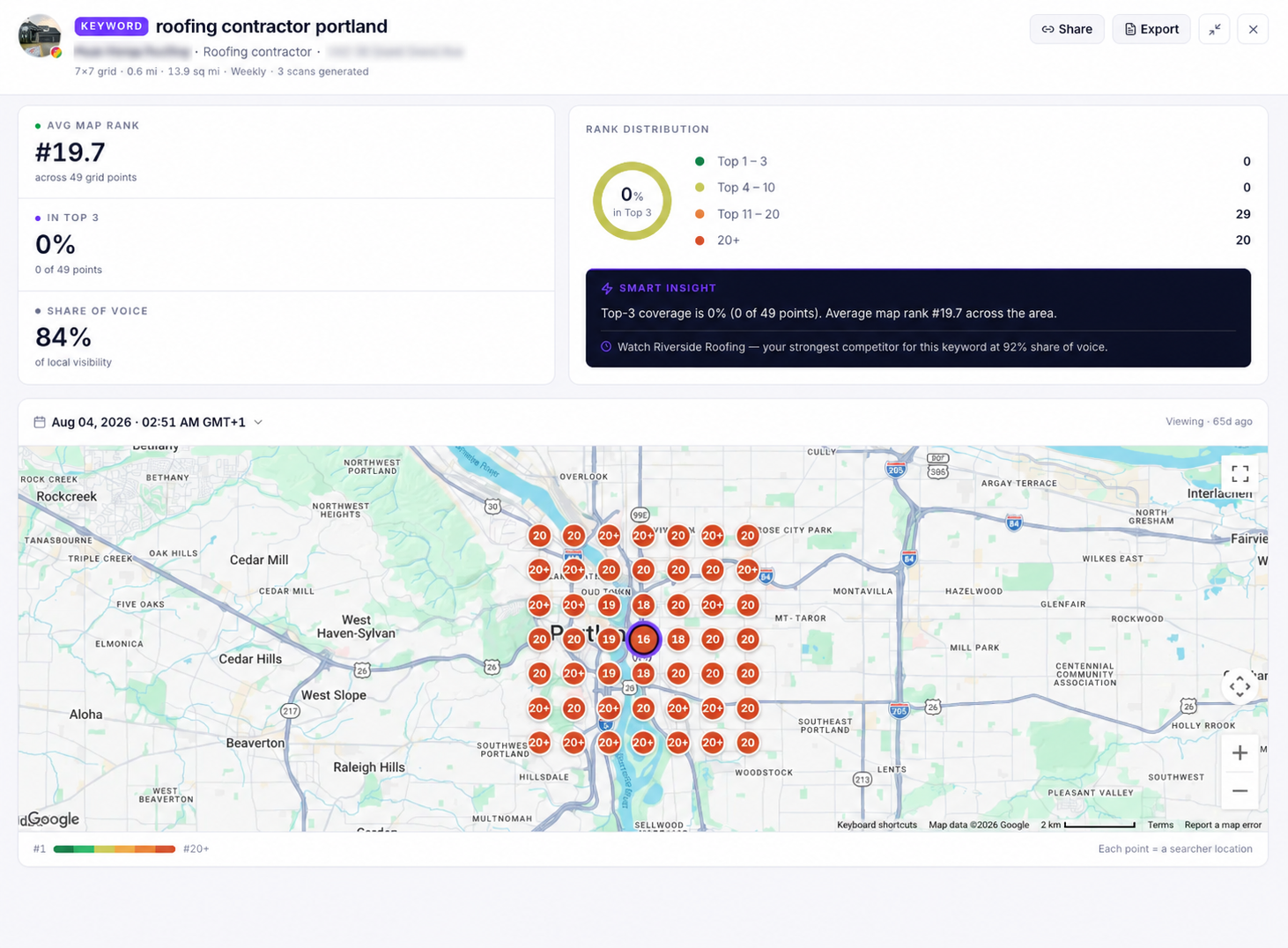
Record:
- Top 3 coverage
- Top 10 coverage
- Weak areas on the grid
- Average rating and review count
- Primary and additional categories
- Current hours
- Landing page
- Major citation inconsistencies
- Calls, directions, and website clicks where available
Do not change everything before you know the baseline.
Week 2: Fix relevance and profile accuracy
Start with the primary category. Compare it with the categories used by businesses that actually rank for your target queries. In Ranksphere's Local Rank Tracker, open a completed scan and review the competitors appearing across the grid. Ranksphere can show competitor categories alongside ranking position, ratings, review counts, and share of voice, which makes it easier to spot category differences worth investigating.
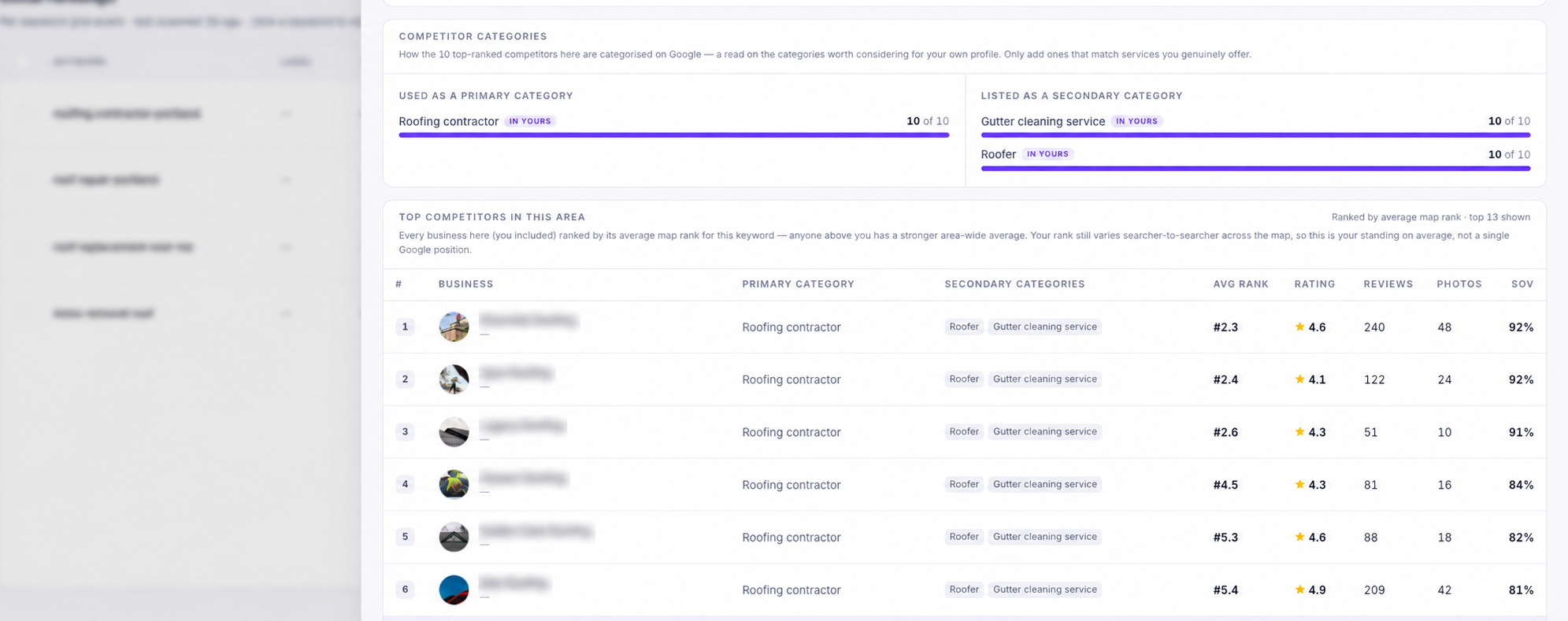
Do not copy a competitor's category just because they rank above you. Use the comparison as a research clue, then choose the most specific category that accurately represents the business.
Review:
- Primary category and how it compares with ranking competitors
- Additional categories
- Business name compliance
- Address or service-area setup
- Hours and special hours
- Services
- Website URL
- Landing page relevance
Make only accurate changes.
Week 3: Strengthen reviews and the website
Build a compliant process for requesting genuine reviews. Do not pay for positive reviews or gate customers based on sentiment.
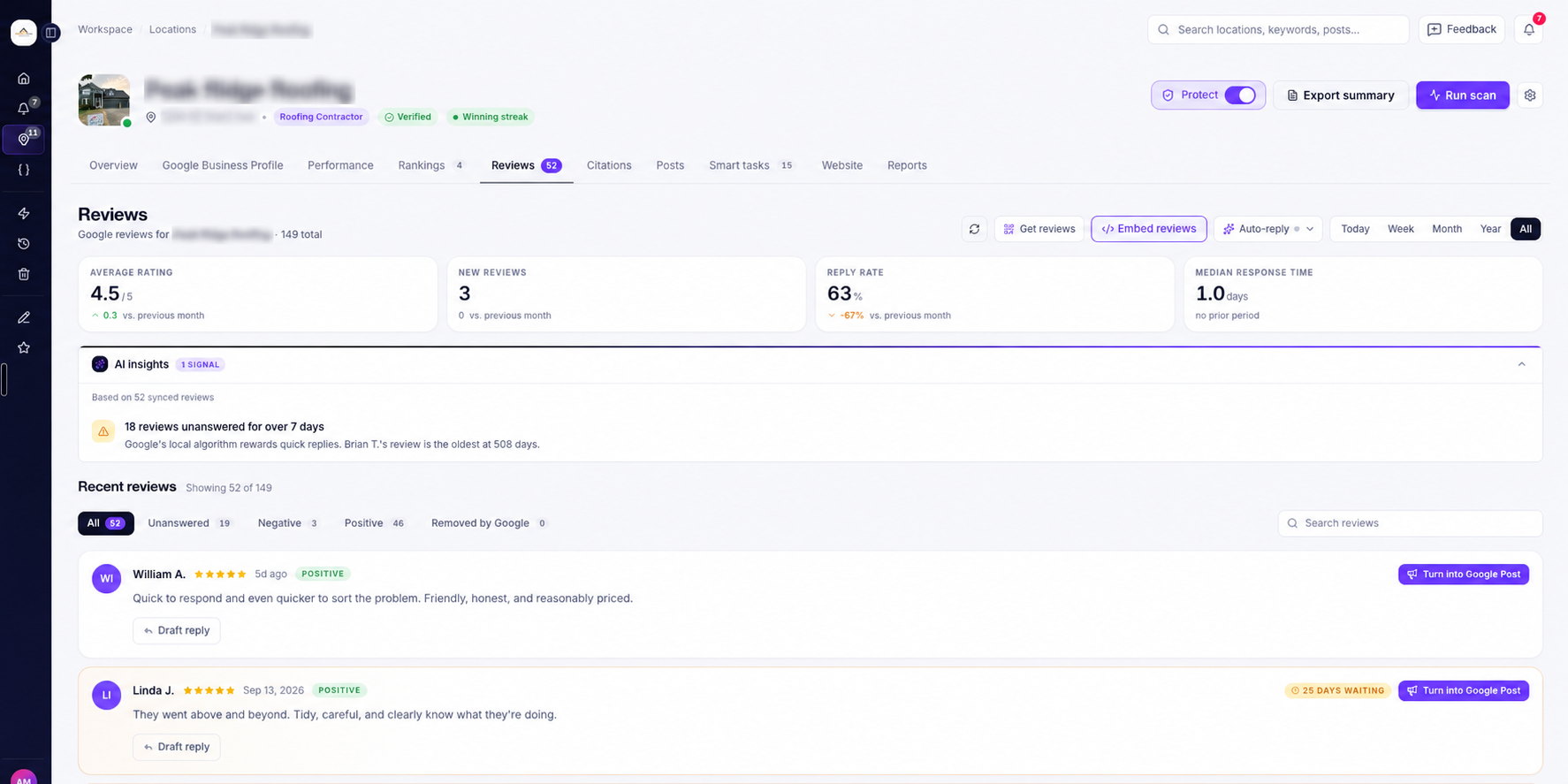
Be prompt and consistent when replying to reviews, whether the feedback is positive or negative. Acknowledge the customer, respond to what they actually said, and keep unresolved concerns from sitting unanswered. This is primarily a customer-service and reputation practice; Google recommends replying to reviews, but does not identify review replies themselves as a standalone ranking factor.
If review volume makes consistency difficult, use Ranksphere's Review Management to keep unanswered reviews visible and monitor response activity. You can also turn on AI Review Auto-Reply for a connected location. It can automatically write and post replies to new Google reviews in your brand voice, with rules for whether it replies to all reviews, positive reviews, or negative reviews, plus your preferred tone and reply delay. Use those controls to make sure both praise and complaints are acknowledged without losing oversight.
On the website, improve the service and location pages that support the queries you are tracking. Add relevant internal links and make sure the Business Profile landing page reflects the real services and location.
Week 4: Build prominence and measure again
Look for a small number of relevant local or industry link opportunities, then audit your citations for errors and gaps.
Use Ranksphere's Citation Management to review your live listings, NAP accuracy, listings that need attention, and citation opportunities. Check for:
- Incorrect or inconsistent business names, addresses, phone numbers, websites, hours, or categories
- Duplicate listings that may need to be merged or removed
- Missing listings on relevant local, general, or industry-specific directories
- Existing citations that should be re-checked after you make corrections
Ranksphere can identify mismatches, missing listings, duplicate listings, and directory opportunities. The actual correction, merge, removal, or new listing still needs to be completed through the directory itself, then re-checked in Ranksphere.
Then repeat the same geo-grid scans.
Do not ask only, "Did the average rank go up?" Look at where visibility improved, where it did not, and whether customer actions changed at the same time.
What matters most in 2026?
The biggest mistake is treating every local SEO tactic as an equal ranking factor.
Google gives a clear framework: relevance, distance, and prominence. The 2026 practitioner data helps translate that framework into areas worth investigating, especially categories, proximity, legitimate business-name relevance, location, hours, ratings, additional categories, website relevance, and links.
The practical priorities are straightforward:
- Make the Business Profile accurate.
- Choose the right categories.
- Build real relevance between the profile, services, website, and query.
- Earn genuine reviews and protect customer experience.
- Build local and industry prominence.
- Accept that proximity creates geographic limits.
- Track rankings across the map instead of trusting one search.
That gives you a local SEO program you can measure and improve without turning uncertain correlations into promises.
See where you rank on Google Maps
Track your rankings, Google Business Profile, reviews, and citations in one place. 14-day free trial, no credit card.