Most of what people call SEO assumes one set of results for everyone. Local SEO does not. Two people searching the same words from opposite ends of the same city see different businesses, in a different order, because Google is answering a different question: not “what is the best page about this” but “which business near this person can do this job.” Almost everything that makes local SEO distinct follows from that one difference.
Why local SEO matters
For a business that serves customers in person — a clinic, a plumber, a restaurant, a law firm with an office — local search is usually the largest single source of new customers. The searches carry high intent. Someone typing “emergency electrician” is not researching a topic, they are about to call somebody.
It is also the part of search where a small business can genuinely beat a large one. National authority counts for little when Google is deciding who is nearby, relevant and well regarded. A single-location dentist with a complete profile, steady reviews and consistent listings can outrank a chain in its own neighbourhood.
- High-intent searches that convert at far higher rates than general queries
- A level field where proximity and reputation matter more than domain authority
- Visibility in Google Maps as well as Search
- Results that vary by neighbourhood, so there is room to win an area at a time
How local SEO differs from traditional SEO
The disciplines overlap, but the levers are not the same. Traditional SEO is almost entirely about your website. Local SEO is about your website plus a second asset you do not own: your Google Business Profile.
- The profile is the main asset. For local pack and Maps results, your Google Business Profile carries more weight than your homepage.
- Results are personalised by location. There is no single rank. Your position changes block by block, which is why geo-grid rank tracking exists.
- Reviews are a ranking input, not just social proof. Volume, recency and rating all feed prominence.
- Consistency across third-party listings matters. Citations and NAP data reinforce that the business is real and where it says it is.
- Proximity puts a ceiling on reach. No amount of optimisation makes a business rank in a suburb twenty miles away for a proximity-driven query.
What local SEO actually involves
In practice the work splits into four areas, and most businesses are weak in one of them rather than all four.
- Profile management — categories, services, hours, photos, attributes, Q&A, posts, and keeping all of it accurate
- Reputation — generating reviews steadily, responding to them, tracking rating and reply rate
- Listings and citations — accurate, consistent name, address and phone across the directories that matter
- Website — location and service pages, internal linking, LocalBusiness schema, and a site that loads properly on a phone
Google's guidance on improving local ranking sets out the three factors it weighs, which are covered in detail in local ranking factors.
How to measure local ranking
This is where local SEO trips people up. A traditional rank tracker reports one number for a keyword, which is meaningless when the answer changes by neighbourhood. A business can sit at position one outside its own front door and be invisible four miles north, and a single-point tracker will show only the flattering half.
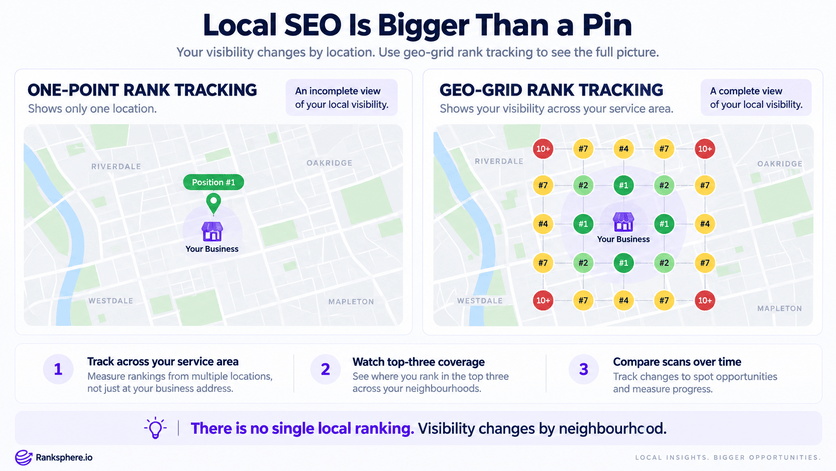
- Track position across a grid of points covering your service area, not one location
- Watch top-three coverage across that grid, not average position alone
- Monitor Google Business Profile performance data for calls, direction requests and website clicks
- Separate local pack rankings from organic rankings — they move independently
- Compare scans over time rather than reading a single snapshot
Ranksphere's local rank tracker runs grid scans across your service area so you can see where you are strong, where you are invisible, and how that changes week to week.
Common mistakes
- Treating it as a one-off setup. A profile filled in once and never touched loses ground to competitors who post, reply and update.
- Chasing the wrong metric. Average position hides the shape of the problem; coverage tells you where to work.
- Keyword-stuffing the business name. The single most common cause of a suspension.
- Ignoring reviews. An unanswered review wall signals an inactive business to customers and to Google.
- Building location pages with the city name swapped. Thin duplicate pages help nobody.
- Optimising the website while the profile sits half empty. The profile is usually the faster win.
Best practices
- Complete every field on the profile, then keep it current
- Pick the narrowest primary category that accurately describes the business
- Build reviews steadily rather than in bursts, and reply to them
- Fix name, address and phone inconsistencies across directories before building new listings
- Write genuinely distinct pages for each location and each service
- Measure across a grid, and judge progress over months rather than days
Example
“Cedar Creek Veterinary opens a second clinic six miles from the first. Rankings for the original location are strong, so the team assumes the new site will follow.
It does not. Grid scans show the new clinic ranking in the top three within about a mile of its door and nowhere beyond that, while the original location still holds most of the shared middle ground. The profile for the new clinic has one category, no services listed, four photos and two reviews.
Over three months they complete the categories and services, publish weekly posts, ask every client for a review at checkout, and write a real page for the new location rather than copying the first. Top-three coverage across the grid moves from roughly one square in five to more than half, and the two clinics stop competing for the same middle ground.
Nothing in that list was clever. It was the fundamentals, applied to an asset that had been left half finished.”
See also
- Local pack — the map unit local SEO is mostly aiming at
- Google Business Profile — the central asset in any local SEO programme
- Local ranking factors — the three things Google says it weighs
- Geo-grid rank tracking — how local position is actually measured
- Citation — third-party listings that reinforce your business data
- Multi-location SEO — local SEO applied across more than one address