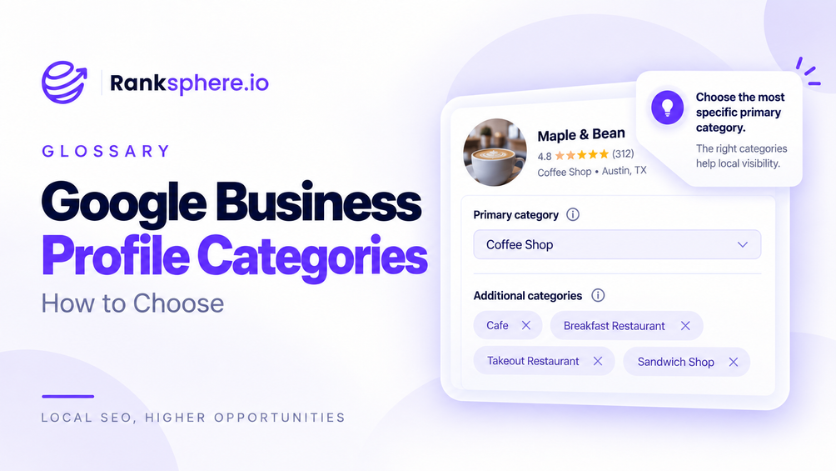
Google Business Profile categories tell Google what type of business you operate. Every profile has one primary category, with the option to add secondary categories for other services the business genuinely provides.
Choosing the right categories matters because they help Google understand when your business is relevant to a local search.
A roofing company, for example, should usually choose a category that describes roofing rather than a broad option such as “Contractor.” The more accurately the category reflects the business, the easier it is for Google to understand what the profile represents.
Why Google Business Profile Categories Matter for Local Visibility
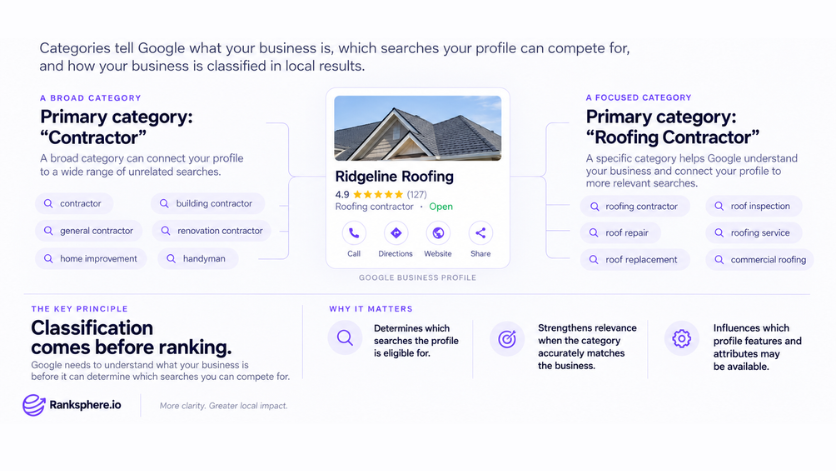
Categories are one of the main ways Google classifies a business.
Your primary category tells Google what the business is primarily known for, while secondary categories provide more context about the other services available.
That can affect:
- Which local searches your business may be relevant for
- Which features and attributes appear on your profile
- How Google understands your main service
- Which related services Google associates with the business
Categories are important, but they are only one part of local SEO. Proximity, reviews, website relevance, business information and other local signals still play a role in how a profile performs.
Primary vs secondary categories
Your primary category should describe the main purpose of the business.
If you run a roofing company, “Roofing Contractor” is usually more useful than a broad category such as “Contractor.” If you run a specialist legal practice, a more specific category may better reflect the work you actually do.
Secondary categories are there for genuine additional services.
For example, a roofing contractor that also provides gutter cleaning may add “Gutter Cleaning Service” as a secondary category.
The goal is not to add as many categories as possible. Use the ones that accurately describe the business and leave out anything that only loosely applies.
How to choose the right categories
Start with what the business actually does.
Then look for the most specific category available that still describes the business accurately.
A good process is to:
- Search the category field for different ways your main service could be described
- Review the full list of relevant options rather than selecting the first suggestion
- Look at the primary categories used by strong local competitors for additional context
- Choose a specific category when it genuinely fits the business
- Add secondary categories only for services you actually provide
- Review your categories when the business changes or adds new services
You cannot create your own category. Google provides a fixed list and updates it over time, so it is worth checking occasionally to see whether a more suitable option has been added.
Ranksphere's GBP audits flag category gaps against competitors, and smart tasks surface them as prioritised fixes rather than leaving them buried in a report.
Common mistakes
- Choosing a category that is too broad. A more specific option may describe the business more accurately and give Google clearer context.
- Adding every category that seems remotely relevant. Categories should reflect services the business genuinely provides.
- Choosing categories based only on keywords. A category should describe the business, not simply match a phrase you want to rank for.
- Copying competitors without checking their setup. Their categories may not suit your services, and they may not have chosen correctly themselves.
- Using categories for services you do not offer. The profile should accurately represent the real business.
- Never reviewing the categories again. Google updates its category list, and your services may also change over time.
- Changing the primary category without a clear reason. Category changes should reflect a genuine change or a better understanding of the business, not constant SEO experimentation.
Best practices
- Choose the most accurate primary category. It should describe the main service or purpose of the business.
- Keep secondary categories relevant. Add them when they represent real services rather than simply expanding the list.
- Check the competition for context. Competitor profiles can help you identify categories you may have overlooked, but they should not be copied blindly.
- Make sure the rest of the profile supports the category. Services, business information and website content should all tell the same story.
- Review categories from time to time. New options may become available as Google updates its category list.
- Update categories when the business changes. If your main service changes, your primary category may need to change with it.
Example
“Willow & Vine is a bakery that also sells coffee and light lunches.
When the profile was first created, “Restaurant” was selected as the primary category. It was not completely unrelated, but it did not describe the business particularly well. Most customers knew Willow & Vine as a bakery, and bakery products were the main reason people visited.
The owner later changed the primary category to “Bakery” and added “Coffee Shop” and “Cafe” as secondary categories.
The profile now gives Google a clearer picture of the business: bakery first, with coffee and cafe services as additional offerings.
That is the main purpose of category optimisation. It is not about finding a secret category that suddenly changes rankings. It is about making sure the profile describes the business as clearly and accurately as possible.”
See also
- Google Business Profile, where your primary and secondary categories are managed
- Local ranking factors, the signals that influence local search visibility
- Local pack, where eligible local businesses may appear in search results
- Google Business Profile suspension, what can happen when profile information does not follow Google’s guidelines
- Local SEO, the wider process of improving local search visibility
- Keyword research, understanding how customers search for your services