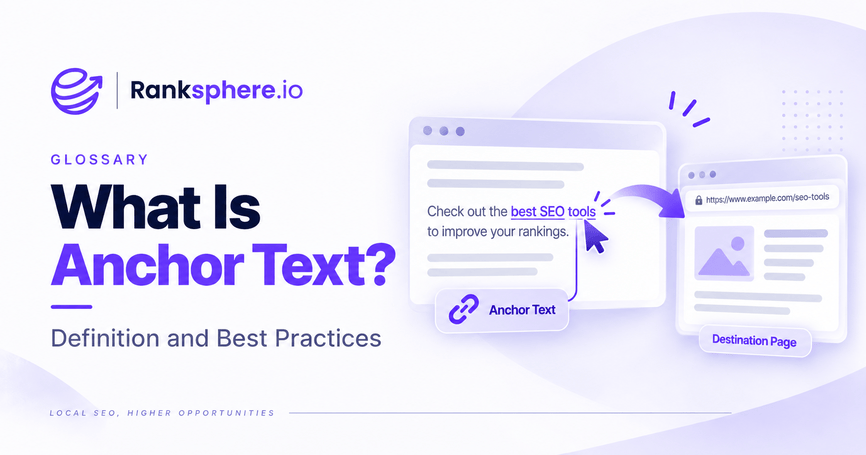
Anchor text is the visible, clickable text of a hyperlink. It tells a reader where the link goes, and it tells search engines what the destination page is about. Google treats it as a relevance signal for the page being linked to, which makes the specific words you choose a genuine ranking input.
Anchor text is one of the oldest signals in search and one of the few that has never stopped mattering. It is also the one most people get backwards. They obsess over the anchors on links pointing at their site, which they barely control, and ignore the anchors on their own internal links, which they control completely.
Why anchor text matters for SEO
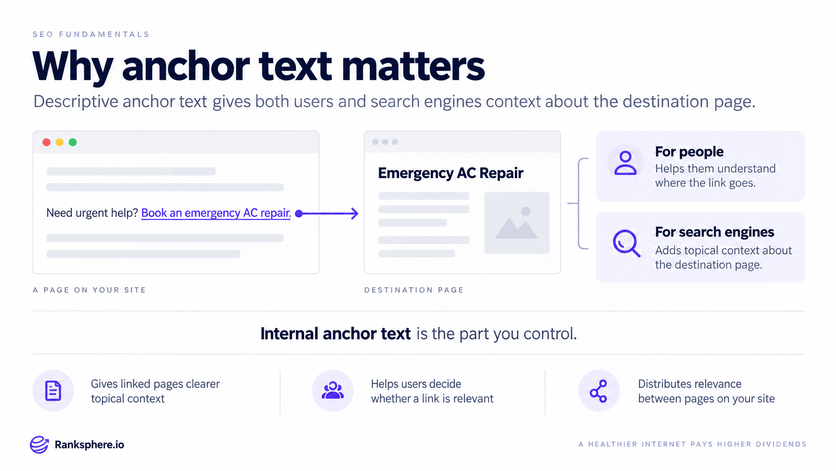
When many pages link to the same destination using similar phrasing, that repetition helps Google associate the destination with that topic. It works across sites and within one.
Internally, it is how you tell Google which of your pages is the authoritative answer for a given subject. Every time a blog post links to your emergency call-out page as “book an emergency AC repair,” you are reinforcing what that page is for and which query it should answer.
For a local business, anchor text supports the rest of the picture rather than carrying it. It will not outrank a competitor with more reviews and a better-optimised profile. But descriptive internal anchors pointing at your money pages are close to free, entirely within your control, and most local sites are doing nothing with them.
- Gives search engines topical context about the linked page
- Helps people decide whether a link is worth clicking
- Distributes relevance between pages on your own site
- Supports keyword targeting when it reads naturally
Types of anchor text
A healthy link profile uses a mix. Over-reliance on any one type, especially exact-match keywords on external links, is the pattern that looks engineered.
- Exact-match, the target keyword verbatim: dental implants
- Partial-match, a natural variation containing it: affordable dental implants in Portland
- Branded, your business name: Maple Dental
- Naked URL, the raw address: mapledental.com
- Generic, click here, read more, learn more
- Image links, the image's alt text functions as the anchor
Two mechanics are worth knowing. If an <a> element has no text at all, Google may fall back to the title attribute. And an image used as a link takes its anchor text from the alt attribute, which means your alt text is doing double duty on every linked logo, button and thumbnail on the site.
How to set it up and measure it
Split the problem in two, because the two halves need completely different approaches.
Internal anchors are yours. Write links using words that describe the destination, keep the phrasing consistent across the site, and make sure your important pages are actually receiving descriptive anchors rather than a wall of “learn more.” Google's link best practices documentation is direct about this: paying attention to internal anchor text helps both people and Google make sense of a site.
External anchors mostly are not. They are decided by whoever links to you. You influence them indirectly, by having a clear brand name, clear page titles, and content worth citing. What you should not do is ask contributors to drop keyword-rich anchors into guest posts pointing back at you. Google's link schemes guidance names that specific behaviour, and it is the fastest way to build a profile that looks manufactured.
- Audit internal links so key pages receive descriptive anchors
- Check the balance of branded versus keyword-rich anchors across your backlink profile
- Watch for spikes in exact-match anchors arriving from low-quality sites
- Confirm image links carry meaningful alt text
- Pull linking pages and anchors from the Links report in Google Search Console
To see what your own site is saying about itself, Ranksphere's website audit can surface internal anchor text across your pages, including links that use no descriptive text at all.
Common mistakes
Nearly all of them come from trying too hard.
- Over-using exact-match anchors on external links, the clearest over-optimisation signal there is
- Generic anchors on links that matter, “click here” wastes the slot entirely
- Stuffing a keyword string into one link, reads as spam, helps nobody
- Using identical anchor text for links to different pages, actively confusing to Google
- Chasing backlinks while ignoring internal linking, the half you control, neglected
- Linking the same phrase repeatedly in one paragraph, dilutes each link and irritates the reader
Best practices
The test: if you deleted the link and left the text, would the sentence still read naturally? And if you saw the anchor text alone, with no surrounding context, would you know where it goes?
- Keep a natural mix of branded, partial-match and descriptive anchors
- Match the anchor to what is actually on the target page
- Prioritise descriptive internal links to your money pages, this is the controllable half
- Keep anchors to a few words
- Vary the phrasing so no single phrase dominates
- Write for the reader first, the search benefit follows from that, not the other way round
Example
“Summit Air, an HVAC company, wants its AC repair page to rank across its service area.
The tempting approach is twenty external links all using the anchor “AC repair.” What they get instead, over six months, is a spread: the local paper mentions them by business name, a supplier directory uses the naked URL, a trade blog links with “emergency air conditioning repair,” and a chamber of commerce listing uses “Summit Air, Boise.”
Meanwhile, on their own site, they rewrite every internal link pointing at that page, from the services index, from three blog posts, from the footer, replacing “learn more” and “click here” with anchors like “schedule an AC repair” and “24-hour air conditioning service.”
The external profile looks earned because it was earned. The internal linking is the part that did the deliberate work, and it is the part that cost nothing.”
See also
- Backlink, an inbound link from another site
- Internal link, a link between pages on the same site
- Link equity, the ranking value a link passes to its destination
- Nofollow, a link attribute that hints to Google not to pass ranking signals
- Link scheme, manipulative link building, including keyword-rich anchors in placed content
- Alt text, what serves as anchor text on an image link