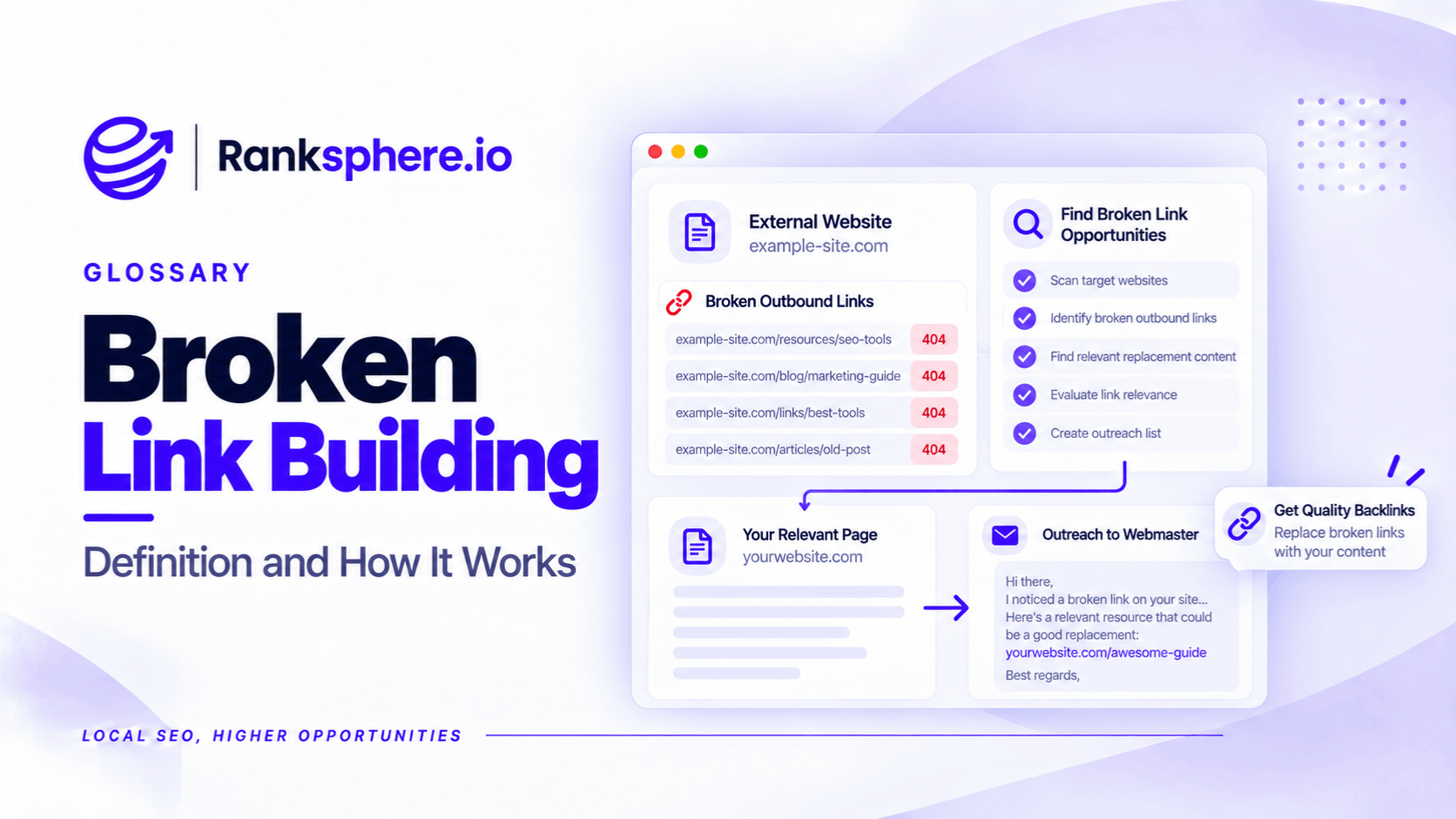
Broken link building is an SEO technique that involves finding links on other websites that no longer work and suggesting a relevant page as a replacement.
For example, a local charity's website might link to a veterinary advice page that has been deleted. If your veterinary practice has a useful guide covering the same topic, you could contact the charity and suggest it as an alternative.
The website owner gets a working resource for their visitors, and your business may earn a backlink.
The approach is straightforward, but it doesn't guarantee a link.
Broken link building works best when you're genuinely helping someone fix a problem, rather than using a broken link as an excuse to request a backlink.
For local businesses, this often means focusing on relevant community websites and organisations instead of sending hundreds of generic outreach emails.
How Does Broken Link Building Work?
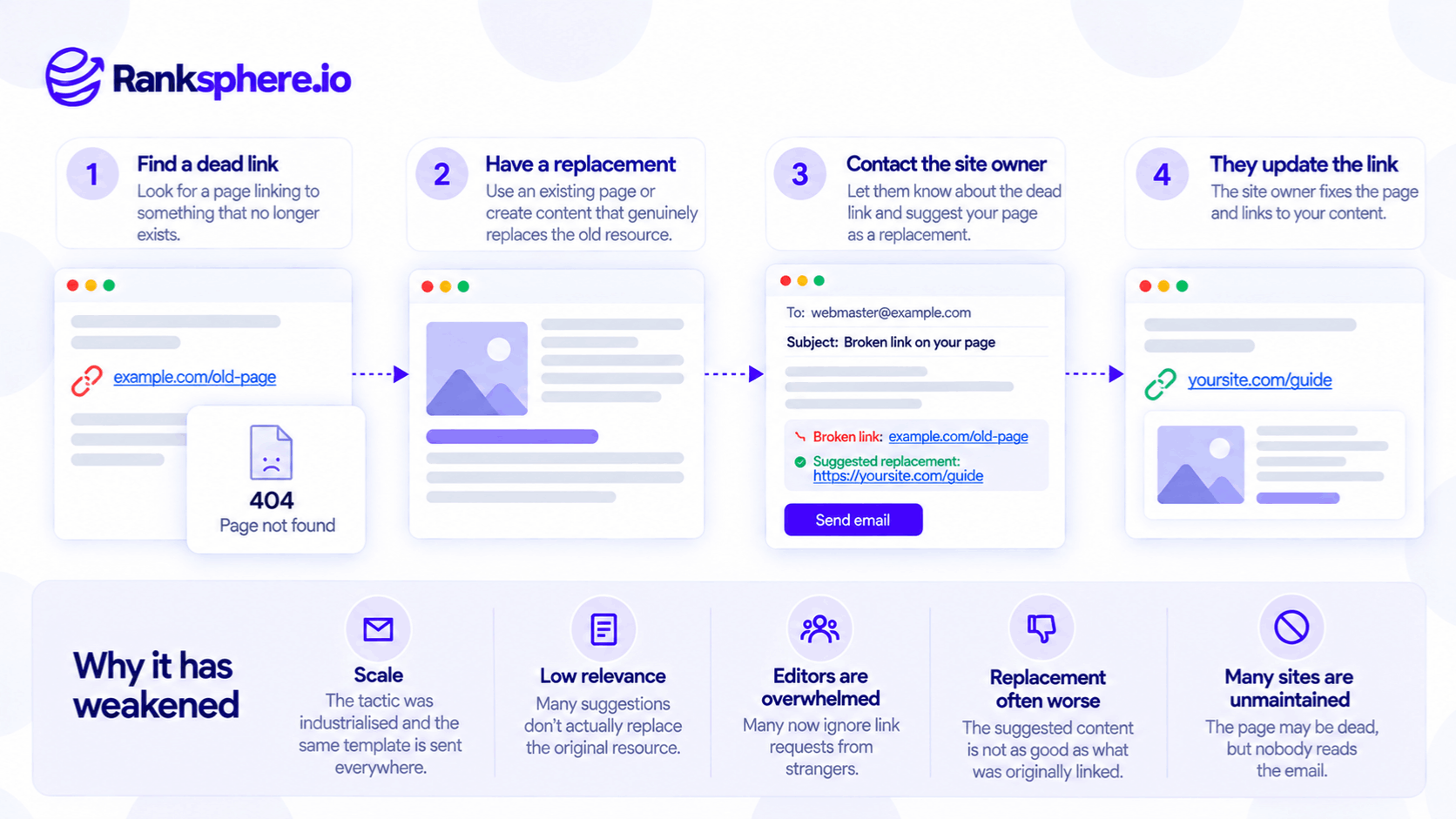
The process involves four main steps.
- Find a page on another website containing a broken outbound link.
- Identify what the missing page originally provided.
- Find or create a genuinely relevant replacement.
- Contact the website owner and suggest the correction.
For example, imagine a local gardening organisation links to an outdated guide about hedge maintenance.
The original page no longer exists.
If a landscaping company has published a helpful guide covering the same information, it could suggest that guide as a replacement.
The organisation can choose whether to update the link.
If it does, the landscaping company earns a relevant backlink.
However, the replacement needs to serve the same purpose as the original resource.
A commercial service page isn't necessarily a suitable replacement for an educational guide.
Does Broken Link Building Still Work?
Broken link building remains a legitimate outreach technique, but results depend heavily on relevance and execution.
Over time, the approach has become widely used.
Website owners, bloggers, and editors may receive frequent emails pointing out broken links and suggesting replacements.
That creates several problems.
Generic Outreach Is Easy to Ignore
Many campaigns use nearly identical messages.
For example, an email might say:
"I noticed a broken link on your website. Here's my article you can use instead."
The recipient may have received similar messages several times that week.
Without a genuine connection or useful information, there is little reason to respond.
The Replacement Often Doesn't Fit
A common problem is suggesting content that doesn't actually replace the missing resource.
For example, a community website may have linked to a detailed guide about protecting wildlife in gardens.
Suggesting a landscaping company's homepage doesn't solve that problem.
The website owner still needs a resource that answers the original question.
Some Websites Aren't Actively Maintained
Older resource pages may contain broken links because nobody regularly reviews them.
The person responsible for the website may have left, or the organisation may no longer have someone maintaining its content.
Even a useful suggestion may receive no reply.
Scale Doesn't Guarantee Results
Sending hundreds of emails may produce some links, but the time and effort aren't always justified.
Mass outreach can also damage relationships when messages are irrelevant or repetitive.
For many local businesses, a smaller number of carefully selected opportunities is more practical.
Broken Link Building for Local SEO
Broken link building can be particularly useful when the target website serves the same local community as your business.
For example, a veterinary practice might investigate websites operated by:
- Local animal rescue organisations
- Community groups
- Parish councils
- Local business associations
- Charities
- Event organisers
- Relevant local publications
These organisations may maintain resource pages linking to businesses, advice articles, or community services.
Some links may have stopped working because a business closed, changed its domain, or removed an old webpage.
If your business has a relevant replacement, it may be worth contacting the organisation.
However, local relevance alone isn't enough.
The suggested page still needs to be useful to the site's visitors.
See local link building for other ways businesses can earn relevant backlinks in their area.
How to Find Broken Link Building Opportunities
There are several ways to identify broken links.
1. Check Local Resource Pages
Start with websites relevant to your business and community.
For example, a veterinary practice might check a local animal welfare organisation's resource page.
Look for links to useful resources that no longer exist.
Community directories and older resource pages can be good places to investigate.
2. Use a Broken Link Checker
Website crawlers and SEO tools can identify outbound links returning errors.
For example, a tool may detect links leading to pages that return a 404 error.
However, a failed request doesn't always mean the page has been permanently removed.
Some websites block automated tools or experience temporary server problems.
Check important opportunities manually before contacting the website owner.
3. Research Competitors' Broken Pages
A competitor may have deleted a useful article that still has backlinks.
For example, a roofing company may have removed an old guide about gutter maintenance.
Other websites might still link to it.
If your business has a suitable guide, those referring pages may offer outreach opportunities.
However, check why the original content attracted links before assuming your page is an appropriate replacement.
4. Check Archived Versions of the Missing Page
This is one of the most useful steps.
A broken URL doesn't always reveal what the page originally contained.
An archived version may show whether it was:
- An educational guide
- A local service directory
- A research report
- A business homepage
- A downloadable resource
For example, if the missing page was an animal care guide, you need to know which questions it answered.
An archived copy can help determine whether your replacement genuinely fits.
5. Review the Linking Page
Don't focus only on the broken URL.
Read the page containing the link.
Why did the website owner include that resource?
For example, if a local charity linked to a guide explaining how to care for rescued cats, it probably wanted visitors to receive reliable animal care information.
Your replacement should serve that purpose.
How to Create a Suitable Replacement
A successful replacement should provide value comparable to the missing resource.
For example, imagine a local community website links to a deleted guide about preparing gardens for winter.
A landscaping company could offer an updated guide covering:
- Seasonal garden maintenance
- Plant protection
- Drainage concerns
- Practical preparation tips
However, it shouldn't create a thin article solely to acquire the backlink.
The page should be useful independently of the outreach opportunity.
If the original resource contained unique research or detailed information that your business cannot reproduce accurately, it may be better to find another opportunity.
You don't need to replace every broken link you discover.
How to Contact Website Owners
Broken link building outreach should be short, relevant, and respectful.
For local businesses, an existing relationship can make the conversation easier.
For example, a veterinary practice may already support a local animal rescue charity.
If its website contains a broken resource link, the practice manager could contact the charity directly.
The message should explain where the broken link appears and why the replacement may be useful.
Avoid making the backlink request the entire focus.
Here's an example of a suitable email:
Subject: Broken link on your animal care resources page
Hi,
I noticed that the cat care guide linked from your resources page is no longer available.
Our practice has a guide covering similar advice, which may be useful as a replacement.
Here's the page: [Relevant guide URL]
Thought I'd mention it in case you're updating the resources page.
Thanks!
The email identifies a specific problem and offers a relevant solution.
It also leaves the decision with the website owner.
If they don't respond, avoid repeated follow-ups that create unnecessary pressure.
Broken Link Building vs Unlinked Brand Mentions
Before spending significant time looking for broken links, local businesses may want to check their existing brand mentions.
An unlinked brand mention occurs when another website mentions a business without linking to its website.
For example, a local newspaper may publish an article about a veterinary practice supporting a charity event but omit a website link.
The business could politely ask whether adding a link would be helpful to readers.
This may be more straightforward than broken link building because the publisher already chose to mention the business.
However, neither method guarantees success.
Prioritise opportunities based on relevance, existing relationships, and the value the link would provide to visitors.
Is Broken Link Building Against Google's Guidelines?
Broken link building isn't inherently a violation of Google's spam policies.
Suggesting a genuinely useful replacement allows the website owner to make an editorial decision.
However, link acquisition can become problematic when it involves practices intended to manipulate rankings.
For example, Google prohibits buying or selling links that pass ranking credit for ranking purposes, along with certain excessive link schemes.
Businesses should avoid paying for manipulative placements or pressuring website owners to use keyword-stuffed anchor text.
The objective should be earning a relevant editorial link, not manufacturing ranking signals.
Common Broken Link Building Mistakes
- Sending generic outreach emails. Messages that could apply to any website offer little value.
- Suggesting irrelevant pages. A service homepage rarely replaces a detailed educational resource.
- Failing to check the original content. You need to know what visitors expected from the link.
- Assuming every error is a permanent 404. Some failures are temporary or caused by crawler restrictions.
- Targeting websites without relevant audiences. Local and topical relevance should guide outreach.
- Creating low-quality replacement content. The suggested page must genuinely help visitors.
- Contacting inactive websites repeatedly. Not every opportunity has someone available to respond.
- Ignoring existing brand mentions. Those may provide simpler outreach opportunities.
- Treating every acquired link as valuable. Link quality and context matter more than quantity.
Broken Link Building Best Practices
- Focus on relevant local and industry websites.
- Check whether the broken link is genuinely unavailable.
- Review archived copies of missing pages.
- Understand why the website linked to the original resource.
- Suggest content that provides comparable or better information.
- Use existing community relationships where appropriate.
- Write personalised, concise outreach messages.
- Explain the broken link before suggesting your replacement.
- Avoid unnecessary follow-ups.
- Respect editorial decisions.
- Measure the value of links by relevance and usefulness, not just quantity.
The best opportunities are those where fixing the link improves the website for its visitors.
Example of Broken Link Building for a Veterinary Practice
Consider a hypothetical veterinary practice called Netherby Veterinary.
The practice wants to earn more relevant local backlinks but has a limited marketing budget.
Instead of contacting hundreds of unrelated websites, the practice manager reviews several local organisations the business already works with.
These include a community group, an animal rescue charity, and a local event organiser.
What the Practice Finds
The manager discovers several outdated links.
Some lead to businesses that have closed.
Others point to educational resources that are no longer available.
One animal care resource page links to an old guide about helping pets cope with fireworks.
Netherby Veterinary has a relevant, up-to-date guide covering the same subject.
What the Practice Does
The practice manager contacts the organisation responsible for the resource page.
She explains that the original link no longer works and offers the practice's guide as an alternative.
She also points out other broken links that the organisation may want to review.
The message is useful even if the organisation decides not to link to the veterinary practice.
What Happens Next?
The organisation reviews the suggested resource.
If it considers the guide relevant and reliable, it may replace the broken link.
Other organisations may choose to remove outdated links without adding a replacement.
Both outcomes improve their websites.
The veterinary practice may earn a relevant backlink, but that isn't guaranteed.
Example
“The practice focused on helping organisations already connected to its community.
Rather than sending large volumes of generic emails, it identified specific problems and offered appropriate solutions.
The value came from relevance and a genuine relationship, not the number of outreach messages sent.
Broken link building is most effective when the replacement genuinely deserves to be linked to.
For local businesses, a handful of relevant opportunities can be more worthwhile than a large outreach campaign aimed at websites with little connection to their services or community.”
See Also
- Local Link Building — Other methods of earning relevant local backlinks.
- Brand Mention — Finding unlinked references to your business.
- Link Building — The wider practice of acquiring relevant backlinks.
- 404 Error — Understanding missing webpages and broken URLs.
- Backlink — A link from another website pointing to yours.
- Digital PR — Earning coverage and links through newsworthy stories and relationships.