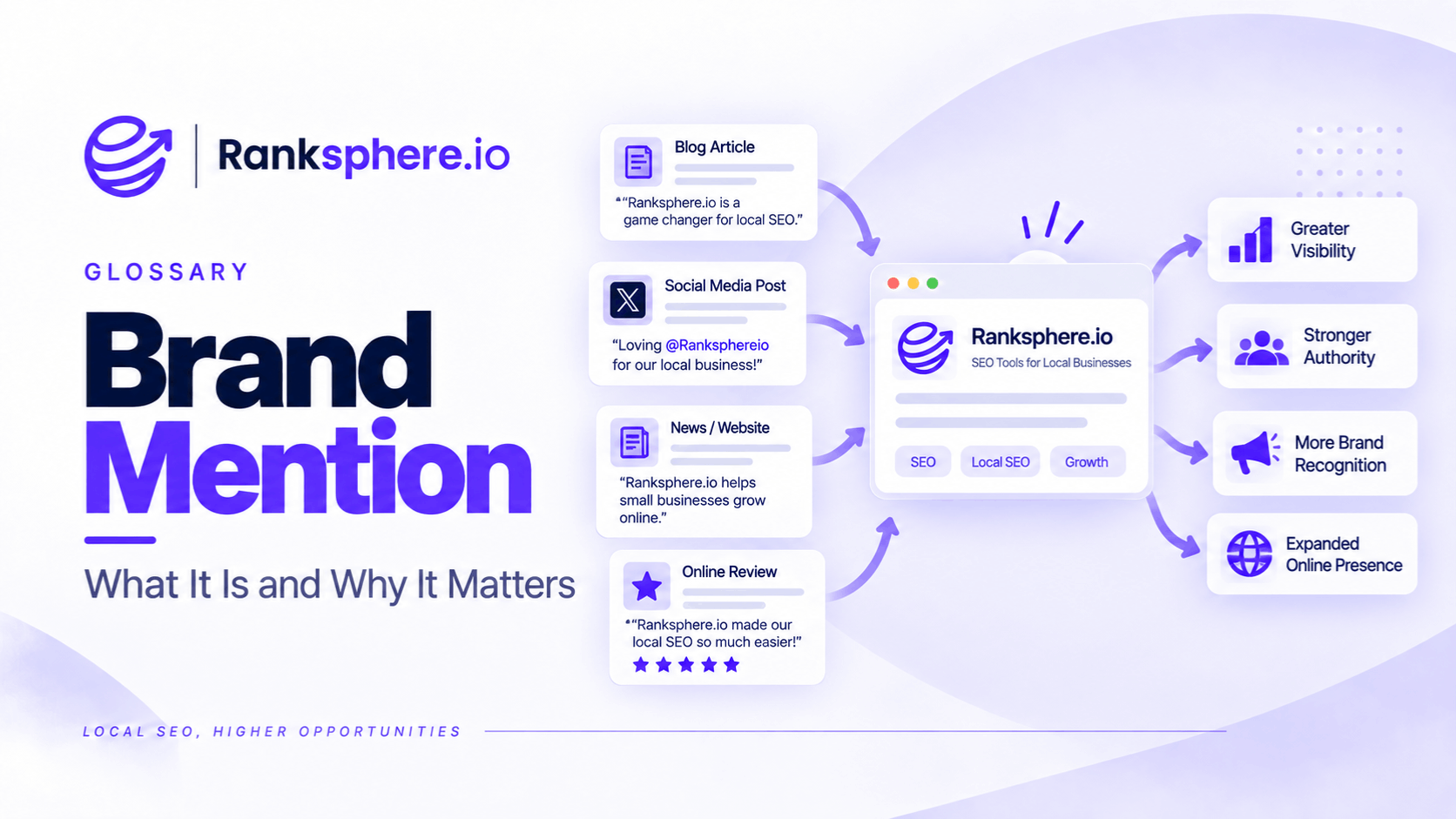
A brand mention is any reference to a business or brand by name on another website or online platform.
The reference may include a link.
Or it may simply mention the name.
For example:
Linked mention
Netherby Veterinary has published a guide to seasonal pet allergies.
with a link to the practice website.
Unlinked mention
Netherby Veterinary helped organise this year's local pet adoption event.
with no link.
Both can create brand exposure.
A linked mention can also provide additional SEO and referral benefits depending on how the link is implemented.
The important distinction is that a brand mention and a backlink are related, but they are not the same thing.
What is a brand mention?
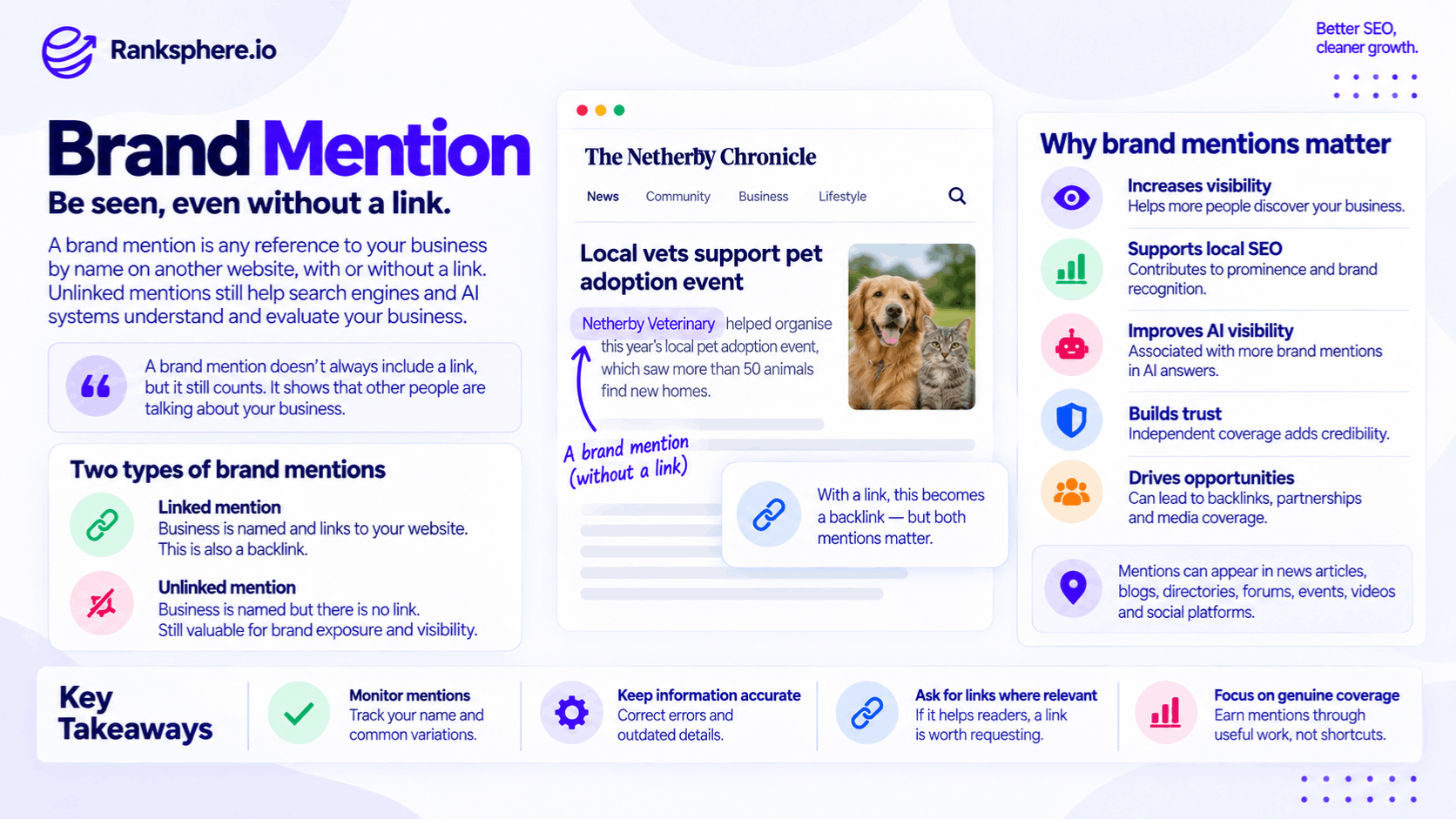
A brand mention occurs whenever another source refers to:
- A business
- Brand
- Product
- Organisation
- Named professional
in a way that identifies it.
Mentions can appear in:
- News articles
- Blogs
- Reviews
- Directories
- Forums
- Community websites
- Association pages
- Podcasts and transcripts
- Videos
- Social platforms
Some contain links.
Others do not.
From a marketing perspective, both matter because somebody other than the brand is talking about it.
Linked vs unlinked brand mentions
Linked brand mention
The business is named and the reference links to its website.
For example:
This is also a backlink.
Unlinked brand mention
The business is named but there is no hyperlink.
For example:
Netherby Veterinary supported Saturday's community adoption event.
The business receives exposure and contextual association, but there is no direct clickable route to the website.
A linked mention is not automatically a stronger SEO link
A linked mention may offer additional benefits, but not every link works in exactly the same way.
A link may be:
- Standard editorial
- nofollow
- sponsored
- ugc
Google explicitly uses links to discover pages and as a signal when determining relevance, but different link relationships can be qualified differently.
So avoid simplifying this to:
linked mention = passes link equity
in every case.
Link equity is an informal SEO concept rather than a measurable amount transferred by every link.
Why brand mentions matter
Brand mentions can be valuable for several different reasons.
They can support:
- Brand discovery
- Referral traffic
- Reputation
- Local visibility
- Brand recognition
- AI visibility research
- Link-building opportunities
The important point is to separate documented benefits from SEO assumptions.
Brand mentions and local SEO
Google says local results are primarily influenced by:
- Relevance
- Distance
- Prominence
and defines prominence broadly as how well known a business is.
Google currently says prominence can be informed by factors such as how many websites link to the business and its review profile.
That makes a strong wider web presence useful.
But do not turn that into:
“Every unlinked brand mention increases local rankings.”
Google does not publish such a rule.
See local ranking factors for the broader picture.
Brand mentions and prominence
A business repeatedly appearing in:
- Local news
- Community organisations
- Trade publications
- Professional associations
has a different public footprint from a business that exists only on its own website.
Those references can contribute to real-world awareness and provide search systems with additional information about the business.
Google confirms that local business information can be gathered from sources including:
- Publicly available web content
- Third-party licensed data
- Business owners
- User contributions
That does not mean each mention receives a known ranking weight.
The value lies in the broader, corroborated web presence.
Brand mentions and entity understanding
An entity is a distinct thing that search systems can identify, such as:
- A company
- Person
- Place
- Organisation
Consistent third-party references can make it easier to associate information with the correct business.
For example:
Netherby Veterinary — Netherby — veterinary practice
is clearer than sources alternately referring to:
- Netherby Vets
- Netherby Animal Centre
- A different town
when those differences are inaccurate.
But there is no public:
“entity authority score”
that increases by one point every time the brand is mentioned.
Treat entity clarity as an information-consistency issue rather than an invented metric.
Brand mentions and citations
A brand mention can sometimes function as an unstructured citation.
For example, a newspaper article saying:
Netherby Veterinary, based on Market Street in Netherby...
provides clear identifying information about the business without using a formal directory listing.
However, not every brand mention is necessarily a local citation.
A sentence that simply says:
“We spoke to Netherby Veterinary.”
may provide brand exposure but little location information.
So it is useful to distinguish between:
Structured citation
A listing containing fields such as:
- Business name
- Address
- Phone number
Unstructured citation
A contextual reference to the business within an article or other content.
Brand mention
Any identifiable reference to the brand, whether or not full citation information appears.
Brand mentions and AI visibility
This is where brand mentions have become particularly interesting.
AI-generated answers do not always include conventional blue links when they mention businesses or brands.
A brand can be:
- Mentioned in the answer
- Cited as a source
- Both
- Neither
These should be measured separately.
AI mention vs AI citation
In AI visibility reporting:
Mention
The AI response names the brand.
Citation
The AI response provides a source reference or link.
Those are not the same thing.
Ahrefs, for example, measures brand mentions and citations separately in its AI visibility tooling.
That distinction matters when analysing brand visibility.
Do web mentions help AI visibility?
Current third-party research suggests there is a relationship.
Ahrefs analysed 75,000 brands and reported strong correlations between branded web mentions and visibility across:
- ChatGPT
- Google AI Mode
- Google AI Overviews
Its 2025 study reported branded web mention correlations of roughly 0.66 to 0.71, depending on the AI surface.
That is noteworthy.
But it does not prove:
more mentions directly cause more AI appearances.
Well-known brands naturally tend to have:
- More coverage
- More searches
- More links
- More reviews
- More customers
All of those factors can move together.
The correct conclusion is:
brand mentions are associated with AI visibility in current third-party research, but there is no published universal AI ranking formula based on mentions.
Do not optimise for AI mentions mechanically
Avoid strategies such as:
“We need 50 brand mentions this month to rank in ChatGPT.”
No reliable threshold exists.
Instead, aim to earn genuine references in places where:
- Customers spend time
- Journalists research
- Industry professionals participate
- Search systems can discover useful information
That is valuable even if no AI system ever references the mention.
Why unlinked mentions still matter
An unlinked mention can still produce:
- Brand awareness
- Reputation
- Referral through branded search
- Local credibility
- Context about what the business does
It may also be useful evidence when monitoring how widely a business is discussed online.
What it does not provide is a direct clickable route from the referring page to the website.
That makes some unlinked mentions good link-reclamation opportunities.
Unlinked mention link building
An unlinked mention exists when somebody has already chosen to name your business but has not linked to it.
That can make outreach easier than conventional cold link building.
The publisher already knows:
- The brand
- Why it is relevant
- Why it belongs on the page
The request is simply whether adding a link would help the reader.
When should you ask for the link?
A link request makes most sense when a visitor might reasonably want to learn more.
For example:
Netherby Veterinary has published advice for owners travelling abroad with pets.
A link to the advice would help the reader.
Another example:
The event was sponsored by Netherby Veterinary.
A link may be useful, but if the placement is part of a paid sponsorship, the publisher should handle the link appropriately.
Google recommends using rel="sponsored" for paid or sponsored links, with nofollow also acceptable.
Do not turn sponsorship into a scheme designed primarily to obtain ranking links.
When not to push for a link
Not every mention needs one.
For example:
- Printed material reproduced online
- Historical archive
- Brief list of participants
- Publication with a no-link editorial policy
If the publisher declines, move on.
The existing mention can still have:
- Brand value
- Reputation value
- Discovery value
Do not damage a useful relationship because somebody refuses an SEO request.
How to find unlinked brand mentions
Start with simple searches.
Search the business name in quotation marks:
"Netherby Veterinary"
Then try combinations such as:
"Netherby Veterinary" Netherby
"Netherby Veterinary" event
"Netherby Veterinary" charity
Also search:
- Former trading names
- Common misspellings
- Previous brand names
These can reveal references that ordinary brand monitoring misses.
Search for important people too
In some industries, the person's name receives more coverage than the company.
For example:
- Doctor
- Dentist
- Solicitor
- Architect
- Founder
A local newspaper may mention:
Dr Jane Morris
without naming the clinic prominently.
That can still be useful brand-related coverage where the relationship is clear and accurate.
Do not artificially turn every employee reference into an SEO asset.
Focus on people genuinely associated with the business publicly.
Search local sources
For a local business, some of the most useful places to check include:
- Local newspapers
- Chambers of commerce
- Community groups
- Charities
- Professional associations
- Event websites
- Supplier sites
- Local clubs
These sources often contain references businesses have forgotten about.
Set up monitoring
Brand monitoring can help surface new references.
Track variations such as:
- Exact brand name
- Common abbreviation
- Former trading name
- Key public-facing names
Monitoring is particularly useful for:
- PR
- Reputation issues
- Link reclamation
- Incorrect business information
It does not need to become a daily task for every small business.
Search reviews and forums
Brand discussions can also happen in:
- Forums
- Community groups
- Review platforms
Those references may reveal:
- Customer sentiment
- Common problems
- Comparison with competitors
Do not approach every forum post asking for a backlink.
Often the greater value is understanding what customers actually say about the business.
How to request a link
Keep outreach simple.
A useful request could say:
Thanks for mentioning Netherby Veterinary in your adoption-event article. If useful for readers, would you mind linking the practice name to our website here: [URL]?
That is usually enough.
Avoid:
Dear Webmaster, we noticed your website contains an unlinked citation with high domain authority...
The publisher is a person.
Write like one.
Contact the right person
Where possible, contact:
- Article author
- Editor
- Organisation administrator
- Page owner
rather than sending the request to:
info@
with no context.
The person responsible for the page is more likely to understand the request.
Give a reader-focused reason
A link request is stronger when the reason is:
“It helps readers find the resource.”
rather than:
“We need backlinks for SEO.”
The publisher has no obligation to improve your rankings.
The link should make sense on the page.
Do not prescribe anchor text aggressively
If the publisher agrees to link, do not insist on:
best emergency vet Netherby
as the anchor.
A simple branded anchor such as:
Netherby Veterinary
is often perfectly natural.
Over-optimised link acquisition can create unnecessary risk.
Brand mention accuracy
When auditing mentions, check whether the information is correct.
Common problems include:
- Wrong location
- Former phone number
- Old trading name
- Incorrect service
- Misspelled brand
Correction may be more important than obtaining a link.
Mentions and NAP
NAP means:
Name, Address and Phone number.
Not every article needs to print all three.
But where a third-party source provides factual business details, those details should be correct.
Do not worry unnecessarily about formatting differences such as:
Street
versus:
St
The problem is factual contradiction.
Former brand names
Old mentions are not automatically wrong.
Suppose the business traded as:
Netherby Animal Clinic
until 2023 and later became:
Netherby Veterinary.
A 2021 newspaper article using the former name is historically accurate.
It does not necessarily need editing.
The issue arises when a current page continues presenting an outdated name as though it were still correct.
Context matters.
Misspellings
Minor misspellings may still be understandable, but correcting them helps:
- Customers
- Brand consistency
- Monitoring
Ask for the correction politely.
Do not claim a spelling mistake is directly harming rankings unless there is evidence of a meaningful identity problem.
How to earn brand mentions
The most sustainable mentions usually come from doing something worth mentioning.
Examples include:
- Community activity
- Expert commentary
- Local research
- Useful resources
- Partnerships
- Events
- Professional work
That is closer to real PR than traditional directory submission.
Local press
Journalists regularly need:
- Local experts
- Quotes
- Data
- Case examples
A veterinary practice might provide informed comment on:
seasonal tick cases
or:
a local dog-theft warning.
If the information is genuinely useful, the resulting article may naturally mention the practice.
Professional associations
Memberships, accreditations and professional bodies can create legitimate third-party references.
Use only genuine relationships.
Do not join low-quality organisations purely because their membership directory offers a backlink.
Supplier and partner coverage
Businesses sometimes appear in:
- Supplier case studies
- Partner stories
- Project showcases
These can be valuable when the relationship is real.
Again, the objective should be useful public information rather than manufactured link exchanges.
Google explicitly lists excessive link exchanges and links created primarily to manipulate rankings among its link-spam examples.
Sponsorships
Local sponsorship can produce:
- Brand exposure
- Community goodwill
- Event mentions
A link may also appear.
But if money or something of value was exchanged for the placement, do not treat the resulting link as an ordinary editorial backlink.
Paid links should be appropriately qualified.
The sponsorship should make sense even without an SEO benefit.
Original local data
Original information can give journalists and industry sites a reason to mention the business.
For example:
A roofing company might analyse:
the most common storm-damage call-outs it received over five years.
A veterinary practice might summarise anonymised trends in:
seasonal flea enquiries.
The data must be:
- Real
- Responsibly handled
- Relevant
Do not invent statistics simply to generate press coverage.
Brand mentions and digital PR
Brand mentions often overlap with digital PR.
Good PR can lead to:
- Coverage
- Brand recognition
- Links
- Search demand
But not every successful piece of PR needs to provide a followed backlink.
A reputable publication naming the business accurately may still be valuable.
Measure mentions separately from backlinks
Do not combine them into one number.
Track:
Brand mentions
How often relevant external sources name the business.
Linked mentions
How many of those mentions include a link.
Referring domains
How many unique websites link to the business.
Referral traffic
How many visitors actually arrive through those links.
AI mentions
How often tracked AI answers name the business.
Those are different measures.
AI mentions need their own monitoring
If LLM visibility matters to the business, monitor AI responses separately.
Do not assume:
100 web mentions = X AI mentions.
Current AI systems vary by:
- Prompt
- Model
- Location
- Time
- Data source
Visibility can change even when the underlying website remains unchanged.
Branded search volume
Branded search can provide additional context about awareness.
For example:
An increase in searches for:
Netherby Veterinary
may indicate greater interest in the brand.
But it is not a clean measure of brand mentions.
Branded search can increase because of:
- Advertising
- PR
- Offline marketing
- Word of mouth
- Seasonality
Use it alongside other evidence.
Do not call it a direct proxy.
Mention quality matters more than raw volume
Ten meaningful mentions from relevant local or industry sources may be more useful than hundreds of automated mentions on low-quality sites.
For example:
Potentially valuable
- Local newspaper
- Trade organisation
- Professional association
- Relevant community group
Less useful
- Scraped directory
- Automatically generated profile
- Unrelated foreign website
Do not turn brand mentions into another volume race.
Relevance matters
A veterinary practice being mentioned by:
a local animal rescue charity
makes obvious contextual sense.
The same practice appearing in:
a random cryptocurrency directory
does not.
Earn references from places connected to:
- The business
- Its customers
- Its location
- Its industry
Authority is not one number
Do not decide whether a mention is worthwhile solely from:
- Domain Authority
- Domain Rating
- Authority Score
These are third-party metrics.
A small neighbourhood publication may have modest SEO-tool scores but reach exactly the customers a local business cares about.
Evaluate real relevance too.
Brand mentions are also reputation signals for people
SEO analysis can make this topic unnecessarily technical.
A simple reason mentions matter is:
people see them.
Someone researching a business might encounter:
- A local-news article
- An association profile
- A community recommendation
before visiting the company's website.
That independent context can influence trust.
Negative brand mentions matter too
A brand mention is not automatically positive.
Monitoring can uncover:
- Complaints
- Incorrect reporting
- Old business details
- Reputation problems
Do not attempt to suppress legitimate criticism simply because it contains the brand name.
Sometimes the correct response is to:
- Correct a factual error
- Respond professionally
- Fix the underlying issue
Ranksphere and citation monitoring
Ranksphere's citation management tracks listings and mentions across 500+ directories, helping businesses monitor the structured side of their local presence systematically.
That complements broader brand-mention monitoring across:
- News
- Community sites
- Associations
- Other editorial sources
A directory tool and a web-wide mention-monitoring process do related but different jobs.
How often should brand mentions be audited?
There is no universal quarterly requirement.
A national brand generating frequent press may need continuous monitoring.
A small local company may be fine checking periodically.
Review frequency should depend on:
- Brand activity
- PR activity
- Reputation risk
- Business size
Event-based checks are also useful after:
- Rebranding
- Moving premises
- Changing business name
Do not treat mention building as a quota
Avoid objectives such as:
“Build 30 mentions every month.”
That can push teams towards:
- Poor directories
- Artificial placements
- Unnecessary sponsorships
A healthier objective might be:
increase relevant third-party coverage and correct inaccurate references.
That keeps the focus on actual brand presence.
Common brand mention mistakes
- Treating every unlinked mention as a confirmed Google ranking signal.
- Claiming brand mentions directly cause AI citations.
- Confusing AI mentions with AI citations.
- Assuming every linked mention passes the same amount of link equity.
- Ignoring useful unlinked mentions simply because they contain no backlink.
- Demanding links from every publisher that mentions the business.
- Insisting on keyword-rich anchor text.
- Turning sponsorships into undisclosed paid-link campaigns.
- Allowing current third-party pages to display incorrect business information.
- Treating every historical former-name reference as an error.
- Measuring brand awareness only through branded search volume.
- Chasing raw mention numbers instead of relevant coverage.
- Using third-party authority metrics as the only measure of a mention's value.
Brand mention best practices
- Monitor the business's main name and common variations.
- Check former trading names where relevant.
- Prioritise accurate references on reputable local and industry sources.
- Treat unlinked mentions as potential link opportunities, not failed backlinks.
- Ask for links only where they genuinely help readers.
- Keep outreach brief and relationship-focused.
- Correct inaccurate business details even when no link is added.
- Keep NAP facts accurate without obsessing over formatting.
- Earn mentions through genuine community, PR and professional activity.
- Qualify paid or sponsored links correctly.
- Measure mentions, links, referral traffic and AI visibility separately.
- Treat current AI correlation studies as useful evidence rather than proof of causation.
Example
“Netherby Veterinary audits its online brand presence.
The team finds nineteen external references.
Four contain links.
Fifteen mention the practice without linking.
Those fifteen include:
- Local news coverage
- Rescue charity pages
- Community event programmes
- Supplier pages
The team does not automatically treat all fifteen as:
“lost backlinks.”
Instead, it reviews each reference.
Several are already useful because they:
- Name the practice correctly
- Describe genuine community involvement
- Appear on locally relevant websites
Eight pages would genuinely be more useful to readers with a link.
The practice contacts the page owners with a short request explaining where the link should point and why it may help readers.
Some agree.
Some do not.
That is fine.
During the audit, two more important issues appear.
One current page still lists the practice in the wrong village.
Another uses an old trading name in a context where the current name should now appear.
The practice asks for both to be corrected.
Those corrections matter regardless of whether a backlink is added.
At the end of the exercise, Netherby has:
- More useful referral paths
- Better third-party business information
- A clearer picture of where its brand is discussed online
It does not claim that:
eight new links caused a specific ranking increase
or:
nineteen mentions guarantee inclusion in AI answers.
Instead, it treats the work for what it is:
building a clearer, more accurate and more visible presence across the web.
That is the right way to think about brand mentions.
A mention can create awareness and corroborate information even without a link. A linked mention may add referral and search benefits. Neither should be reduced to a simple points system, and the most valuable mentions usually come from genuine reasons for other people to talk about the business.”
See also
- Backlink — when a brand mention includes a link to the website
- Citation — structured and unstructured references to a local business
- Entity — how search systems distinguish identifiable businesses, people and places
- Local link building — earning relevant links and mentions from local sources
- LLM visibility — measuring how brands appear in AI-generated answers
- NAP — keeping core business information factually accurate across the web