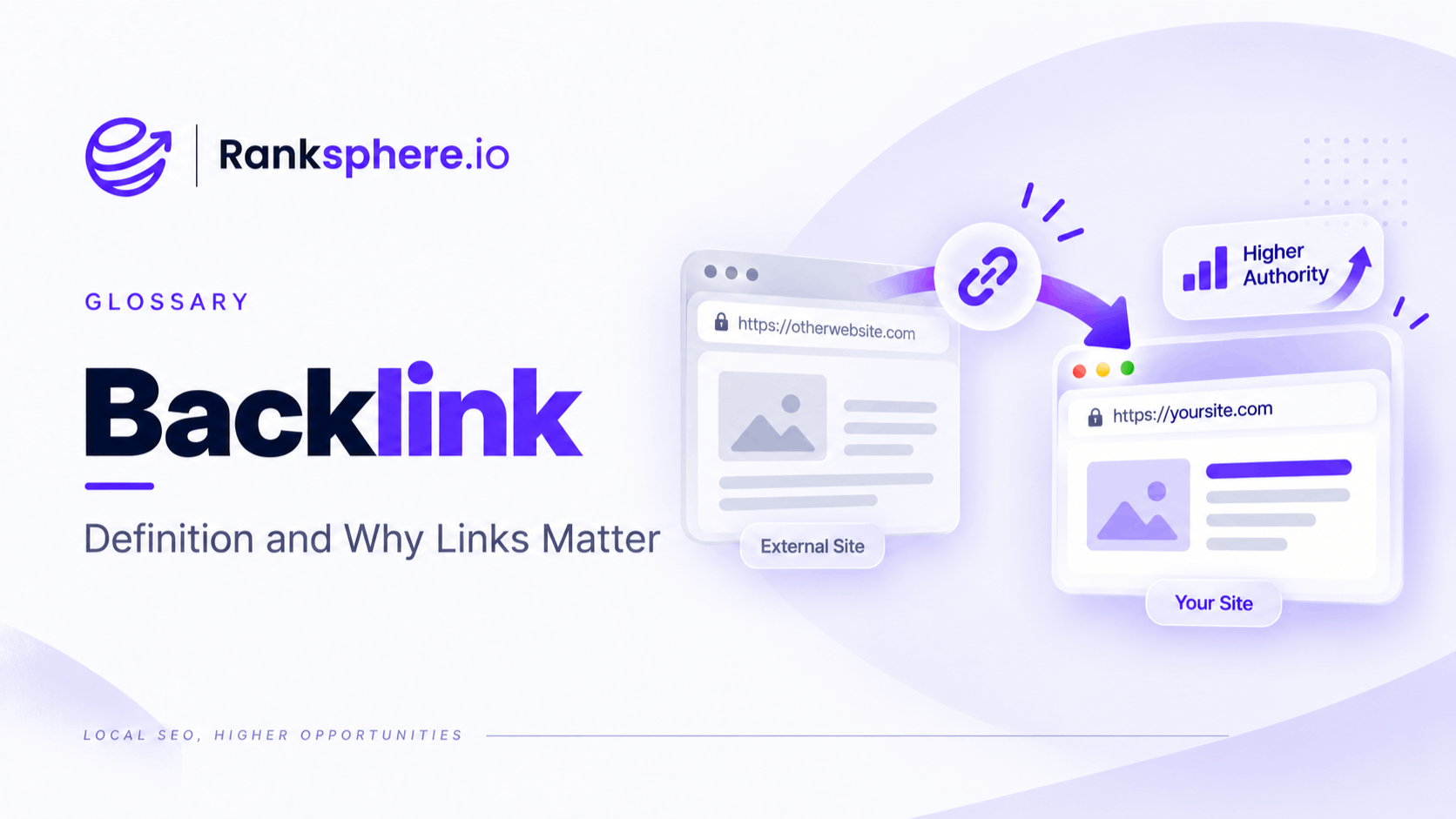
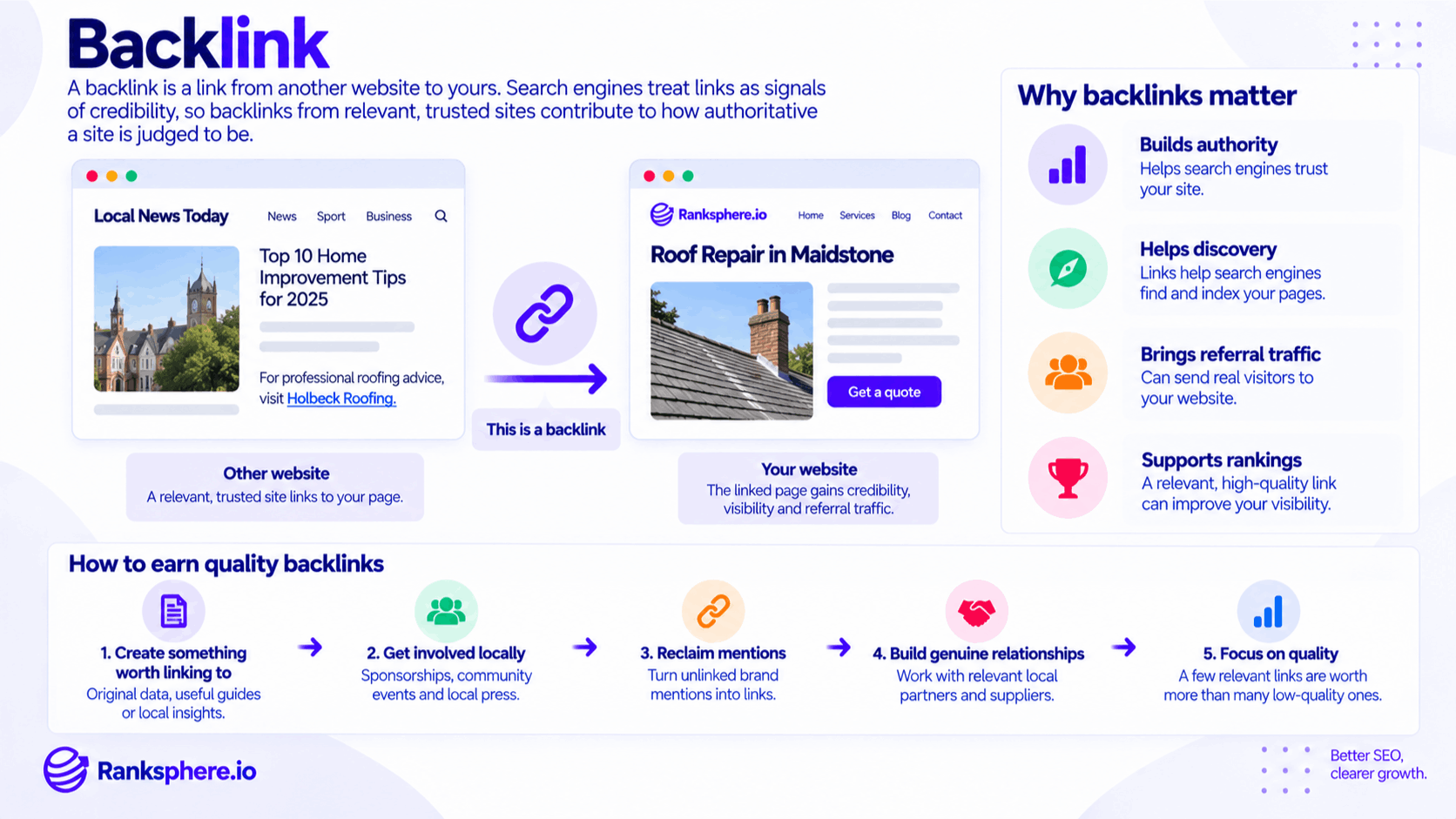
A backlink is a link from another website to a page on your website.
Backlinks can help search engines discover pages and understand how websites across the web relate to one another. Links from relevant, reputable sources can also contribute to the wider signals search engines use when assessing a site's prominence and credibility.
But backlinks are not all equal.
A useful link from a respected local publication, trade organisation or industry website can be more meaningful than dozens of links from unrelated directories created purely for SEO.
That is why backlink quality, relevance and context matter more than simply increasing the number in a backlink report.
Why backlinks matter for SEO
Links have been part of Google's ranking systems since the early days of modern search.
The basic idea is straightforward:
When another website links to a page because it is useful, informative or worth referencing, that connection can provide search engines with information about the destination.
Backlinks can help with several things.
Discovery
Search engine crawlers follow links between pages.
A backlink can therefore help search engines discover a URL they may not have encountered through your own website yet.
This is particularly useful for:
- New websites
- New pages
- Pages with limited internal visibility
Backlinks are not the only discovery method, but they form part of the wider web crawling system.
Link signals
Links can pass signals between webpages.
SEO practitioners often refer to this as link equity.
Not every link passes the same value, and it is not possible to calculate exactly how much a particular backlink contributes.
Factors such as relevance, placement, source quality and how the link was created can all matter.
Context
The surrounding content and anchor text can provide context about the destination page.
For example, a local newspaper linking to:
emergency roof repairs after storm damage
provides clearer context than a completely unrelated link placed in a generic directory.
Anchor text should arise naturally rather than being engineered around exact-match keywords.
Referral traffic
A backlink can also send real people to your website.
That matters independently of SEO.
A supplier case study, local newspaper article or industry guide may continue sending:
- Potential customers
- Partners
- Journalists
- Other website owners
A link that generates relevant visitors has value even if you cannot measure what it contributes to rankings.
Backlinks and local SEO
Backlinks can be useful for local businesses, but they are only one part of local search.
Google describes local results in terms of relevance, distance and prominence.
See local ranking factors for the wider picture.
Backlinks can contribute to prominence, but they do not replace:
- A relevant business profile
- Accurate business information
- Customer reviews
- Local relevance
- Physical proximity
- Useful website content
A roofing company does not need thousands of backlinks simply because a national publisher has thousands.
The competitive environment is different.
For many local businesses, a relatively small number of useful and relevant links can form a perfectly healthy backlink profile.
What makes a good backlink?
There is no single formula for backlink quality.
A useful way to judge a link is to ask whether it makes sense independently of SEO.
Relevance
A link from a website related to your business, industry or audience can provide useful context.
For example, a landscaping company might naturally receive links from:
- Garden suppliers
- Local property websites
- Community organisations
- Landscaping associations
- Local news publications
A link from an unrelated website created purely because it sells placements has much less contextual relevance.
Reputation
The quality of the source matters.
A genuine link from a trusted publication, recognised organisation or established industry website can be more meaningful than links from sites created primarily to publish SEO content.
Do not reduce this to a third-party authority score.
Reputation and relevance require judgement.
Editorial context
Links placed naturally within relevant content can be particularly useful because the surrounding page explains why the destination is worth visiting.
For example:
After the January storms, Holbeck Roofing reported a noticeable increase in emergency ridge-tile repairs.
with a relevant link to the roofing company has a clear editorial reason to exist.
A random keyword link in an unrelated footer does not provide the same context.
Local relevance
For a local business, local sources can be particularly useful.
Examples include:
- Local newspapers
- Chambers of commerce
- Sports clubs
- Schools
- Community organisations
- Suppliers
- Local charities
- Regional trade groups
A link does not need to come from a national publication to be valuable.
A smaller website that is highly relevant to your local audience may be a better fit.
Anchor text
Anchor text describes the clickable part of a link.
Natural anchors might include:
- Holbeck Roofing
- the company's roof repair guide
- emergency roofing advice
- this local roofing contractor
You do not need to ask every website to use an exact keyword such as:
best roofer Leeds
Repeatedly manufacturing keyword-rich anchor text can make a link profile look unnatural.
Let legitimate publishers choose wording that fits their content.
Referral potential
Ask:
Could someone genuinely click this link?
A backlink from a website your potential customers actually read has value beyond rankings.
That is often a better quality test than asking for a Domain Authority score.
Backlink quality vs quantity
Backlink count is one of the easiest SEO numbers to measure.
That does not make it the most useful.
A website may have thousands of links because:
- One domain links sitewide
- It appears in hundreds of automated directories
- Spam sites have scraped its content
- Old tools created low-quality placements
Another website may have far fewer links, but they come from relevant publications, suppliers and industry organisations.
The raw totals do not tell you which site has the stronger backlink profile.
Look at:
- Which websites link
- Why they link
- Where the links appear
- Whether the source is relevant
- Whether real people might use the link
Quality cannot be reduced to count alone.
Backlinks vs referring domains
Backlink tools often report both backlinks and referring domains.
They are different.
If one website links to you from 100 pages, that may appear as:
100 backlinks
but only:
1 referring domain
This is why backlink totals can be misleading.
A diverse set of legitimate relevant websites linking naturally to your business can tell a different story from hundreds of repeated links from one source.
Neither metric should be treated as a ranking score by itself.
Are backlinks a ranking factor?
Links remain part of Google's ranking systems, but there is no public formula showing exactly how much any individual backlink affects a result.
The effect also depends heavily on:
- Query
- Competition
- Search intent
- Content quality
- Site relevance
- Other ranking signals
This makes statements such as:
“You need 50 backlinks to rank.”
or:
“One DA 80 link will move you three positions.”
unreliable.
Backlinks are signals within a much larger ranking system.
Backlinks and the local pack
Links can contribute to the wider prominence of a business, but they should not be treated as a shortcut to local pack rankings.
Local visibility also depends heavily on:
- Relevance to the query
- Distance from the searcher
- Business prominence
- Profile information
- Reviews and reputation
A backlink cannot move a physical business closer to the searcher.
Likewise, building more links does not compensate for a business profile that inaccurately represents the company.
Use backlinks as part of a broader local SEO strategy.
Backlinks and organic local results
Backlinks can be particularly relevant to the standard organic results surrounding local search.
For example, a local business may want its:
- Service pages
- Location pages
- Guides
- Case studies
to rank organically beneath or around the local results.
Relevant links can support those pages alongside:
- Useful content
- Strong internal linking
- Clear search intent
- Good site architecture
- Technical SEO
This is why backlinks should not be treated purely as a Google Business Profile tactic.
They support the website itself.
Links vs citations
Backlinks and citations are related but not identical.
A backlink is a clickable link from another site.
A citation is a mention or listing of business information, often including:
- Business name
- Address
- Phone number
A citation may contain a backlink, but it does not have to.
Business directories often provide both.
Editorial backlinks from useful sources and accurate business citations serve different purposes within local SEO.
Ranksphere's citation management covers 500+ directories, helping manage the structured-listing side of local visibility, while genuine editorial backlinks generally need to come from real relationships, coverage or useful content.
What backlinks should you avoid?
The problem is not that every deliberately acquired link is bad.
Businesses naturally:
- Join associations
- Work with suppliers
- Sponsor events
- Issue press releases
- Contribute expert commentary
- Advertise
The risk comes when links are created primarily to manipulate search rankings rather than because there is a legitimate reason for them to exist.
Examples worth avoiding include:
Paid links intended to manipulate rankings
Paying for exposure is normal advertising.
Paying specifically for unqualified links designed to influence search rankings can violate Google's spam policies.
Sponsored links should be appropriately marked, commonly with:
rel="sponsored"
nofollow can also be used in appropriate cases.
The point is to distinguish advertising or compensated placement from an ordinary editorial link.
Large-scale link exchanges
Businesses link to partners naturally all the time.
The problem is systematic schemes based on:
“Link to me and I will link to you.”
at scale purely for SEO.
A genuine partner link is not the same thing as operating an exchange network.
Private blog networks
Private blog networks are groups of sites created or controlled primarily to manufacture backlinks.
They are designed to imitate independent editorial links.
That makes them fundamentally different from earning coverage on genuine publications.
Automated link building
Software that submits a website to:
- Thousands of directories
- Comments
- Forums
- Profile pages
may generate impressive-looking backlink numbers.
Most of those links provide little real value and can create unnecessary risk when the purpose is manipulative.
Comment and forum spam
Participating genuinely in a community can be valuable.
Posting keyword-rich links across unrelated comments purely to build backlinks is not.
Manipulated anchor text
Be cautious with campaigns that promise links using exactly the keyword you want to rank for.
A natural backlink profile generally contains varied anchors because different people describe the same business differently.
Are directory backlinks bad?
No.
A legitimate directory can be perfectly useful.
Examples might include:
- Professional associations
- Local chambers
- Trusted industry directories
- Established business platforms
The problem is not “directory link = bad.”
The problem is submitting to hundreds of low-quality directories solely to manufacture backlinks.
Ask whether customers or industry peers would reasonably expect the business to appear there.
If yes, the listing may have value regardless of SEO.
Should you buy backlinks?
Buying advertising and sponsorship is normal.
Buying links specifically because someone promises they will improve Google rankings is much riskier.
Common warning signs include:
- Guaranteed ranking improvements
- Bulk link packages
- Fixed numbers of “high DA” links every month
- Unrelated guest-post websites
- No concern about your industry or audience
- Exact-match anchor guarantees
- Sites that obviously exist to sell articles
If the pitch focuses entirely on metrics rather than readership, relevance or editorial quality, be cautious.
What happens to spammy backlinks?
Google's systems are designed to recognise many types of manipulative linking patterns.
Often, links that Google does not consider useful for ranking purposes may simply provide little or no ranking benefit.
But deliberate participation in link schemes can create greater risks, including manual actions in some circumstances.
This is why:
“Google will just ignore everything”
is too broad.
A safer approach is not to create manipulative links in the first place.
Should you disavow bad backlinks?
Usually, businesses should not panic because an SEO tool discovers low-quality sites linking to them.
Every established website can accumulate strange links it never requested.
These might come from:
- Scrapers
- Spam sites
- Automated directories
- Broken domains
A low-quality backlink appearing in a tool does not automatically mean the site has a Google penalty.
Disavowal is a specialised measure and should not be used reflexively every time an unfamiliar domain appears.
Investigate the circumstances and use Google's guidance before taking action.
How many backlinks does a local business need?
There is no universal number.
The answer depends on:
- Industry
- Location
- Competition
- Existing reputation
- Search queries
- Website quality
A solicitor competing across London may face a very different backlink environment from a landscaper serving one small town.
Instead of asking:
“How many backlinks do we need?”
ask:
“Which websites would naturally reference a respected business like ours?”
That question usually produces a healthier strategy.
Local backlink opportunities
Local businesses often have more link opportunities than they realise.
Examples include:
- Local press coverage
- Supplier case studies
- Professional associations
- Community organisations
- Local events
- Charities
- Sponsorships
- Business partnerships
- Educational institutions
- Industry resources
The strongest opportunities usually come from things the business is already doing.
Link building works better when it reflects real activity.
See local link building for strategies specifically suited to local businesses.
Creating content worth linking to
Not every page naturally attracts backlinks.
A generic service page saying:
“We provide high-quality roofing services.”
gives another website little reason to reference it.
More linkable resources might include:
- Original research
- Local data
- Detailed guides
- Useful calculators
- Original photography
- Industry statistics
- Practical resources
- Case studies
For example, a roofing company might publish anonymised data showing the most common types of storm damage it repaired during a severe winter.
That provides something a local journalist could actually reference.
Unlinked brand mentions
Sometimes another website already mentions the business without linking to it.
For example:
Holbeck Roofing provided repairs to the community centre after January's storm.
If the mention is relevant, it can be reasonable to contact the publisher and ask whether they would consider linking to the company's website.
Do not demand a link.
The publisher should decide whether adding one benefits its readers.
Backlinks and internal links
Backlink acquisition often receives more attention because external links feel harder to obtain.
But do not neglect internal links.
You control those completely.
Good internal linking can help:
- Distribute internal link signals
- Connect related pages
- Improve crawling
- Clarify page relationships
- Send users towards important services
A business spending heavily on outreach while leaving its main service pages poorly linked internally is ignoring one of the easiest improvements available.
Backlinks and Domain Authority
Domain Authority and similar metrics are created by third-party SEO platforms.
They are not Google ranking metrics.
They can sometimes be useful for comparing websites within the same tool.
But they should not become the goal.
A high metric does not automatically make a website:
- Relevant
- Trustworthy
- Editorial
- Useful to your audience
Evaluate the actual website behind the score.
How to assess a backlink opportunity
Before pursuing a link, ask:
- Is the website relevant to our business or audience?
- Is it a genuine website with real readers?
- Does the link make editorial sense?
- Would we still want the mention if Google did not count the link?
- Could the link send useful visitors?
If the opportunity only looks attractive because an SEO tool displays a large authority number, investigate further.
Common backlink mistakes
- Chasing backlink volume. More links do not automatically mean better SEO.
- Buying ranking-focused link packages. They can waste money and create unnecessary risk.
- Judging links entirely by third-party authority scores.
- Ignoring relevance. A smaller relevant website may be more useful than a large unrelated one.
- Forcing exact-match anchor text.
- Submitting to every directory available.
- Prioritising backlink campaigns while basic local SEO remains unfinished.
- Ignoring internal links.
- Disavowing unfamiliar links automatically.
- Assuming every low-quality link hurts the website.
- Treating local backlinks and citations as exactly the same thing.
Backlink best practices
- Prioritise links that make sense for real readers.
- Focus on local and industry relevance.
- Earn coverage through genuine work, expertise and useful resources.
- Build relationships with suppliers, associations and local organisations.
- Create material worth referencing.
- Keep anchor text natural.
- Qualify paid or sponsored links appropriately.
- Review referring domains rather than obsessing over raw backlink totals.
- Do not neglect internal linking while pursuing external links.
- Judge a backlink by relevance and context, not one third-party score.
Example
“Holbeck Roofing has been paying for a monthly link-building package.
The reports look impressive.
Every month, the backlink count increases.
But when the company looks more closely, many of the new links come from:
- Generic directories
- Websites covering locations the company does not serve
- Broad home-improvement blogs with little connection to the business
- Articles that appear to exist mainly for placing links
Instead of continuing to chase volume, the company changes its approach.
During the following year:
- A local football club links to the business after a genuine sponsorship.
- A regional newspaper references the company in an article about winter storm damage.
- A trade organisation lists it as a member.
- A supplier publishes a case study featuring one of its installations.
The number of new referring sites is much smaller.
But every link has an understandable reason to exist.
Some provide relevant referral traffic.
Others strengthen the company's presence within its local and industry network.
That is the better way to think about backlinks: not as points to collect, but as connections between your website and other credible parts of the web. If those connections make sense to people, they are much more likely to make sense as part of a sustainable SEO strategy too.”
See also
- Link building — the practice of earning backlinks
- Local link building — link acquisition for local businesses
- Link equity — the signals that can pass through links
- Anchor text — the clickable words used in a link
- Nofollow — an attribute used to qualify certain links
- Internal linking — links between pages on your own website