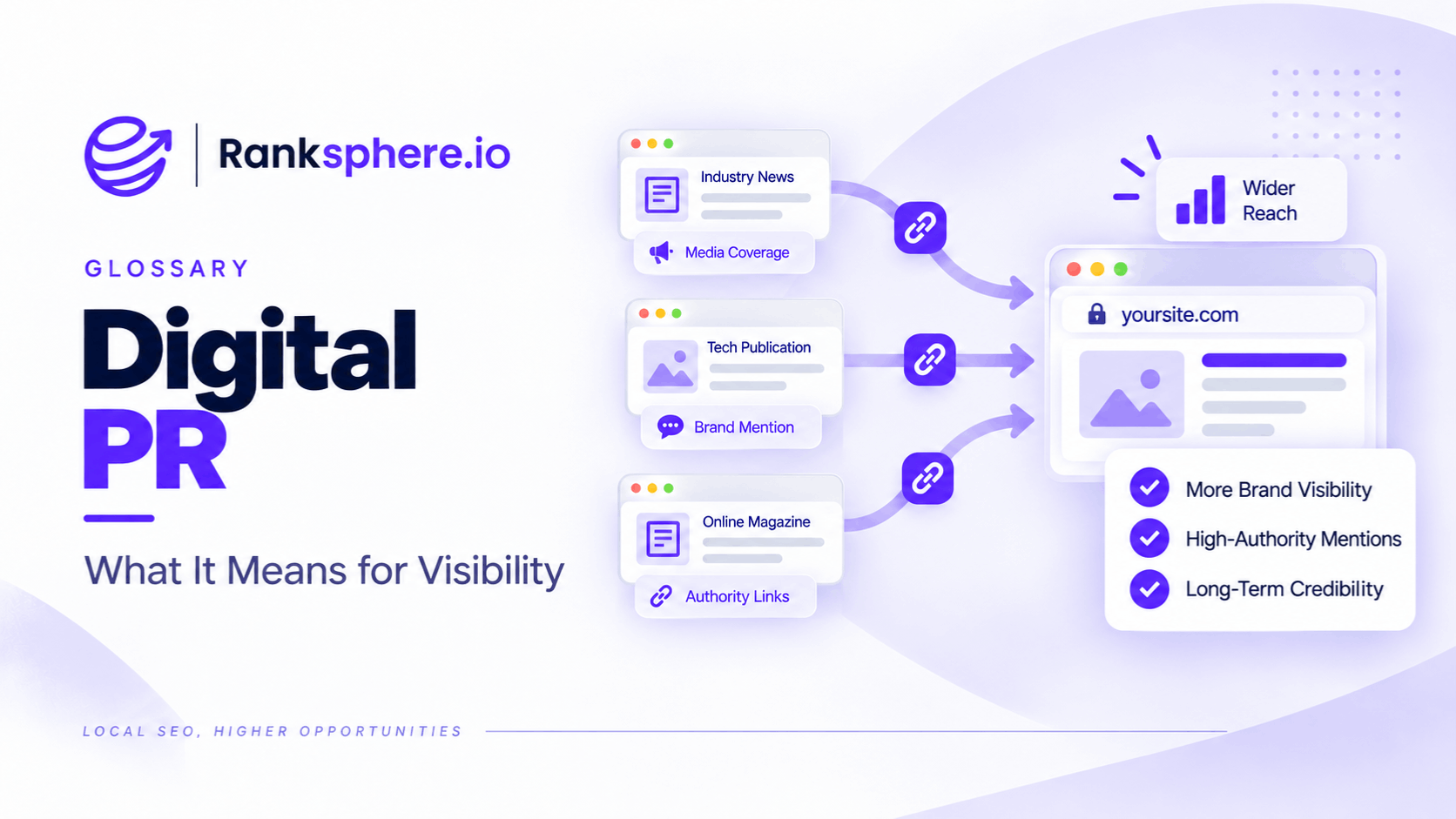
Digital PR is the practice of earning online media coverage, brand mentions and links by giving journalists, publishers and other relevant websites something genuinely worth covering.
That might include:
- Original data
- Expert commentary
- Industry insight
- Timely reaction to breaking news
- Useful research
- A genuinely newsworthy business story
Unlike outreach that begins with:
“Will you link to our website?”
digital PR begins with:
“Is there a story here that this publication's audience would actually care about?”
A backlink may be one result.
But useful digital PR can also produce:
- Brand awareness
- Referral traffic
- Press relationships
- Unlinked brand mentions
- Expert recognition
- Local visibility
That makes digital PR broader than traditional link building.
What is digital PR?
Digital PR applies traditional public-relations principles to online media.
The business provides something useful or newsworthy.
A publisher decides whether it deserves coverage.
For example, a local plumbing company might analyse several years of its own call-out data and notice that burst-pipe enquiries rise sharply during particular weather conditions.
That could support a genuine local news story.
The company is not buying a link.
It is providing information the journalist may find useful.
If the resulting article names and links to the business, the link exists because the publisher chose to reference the source.
Digital PR vs traditional PR
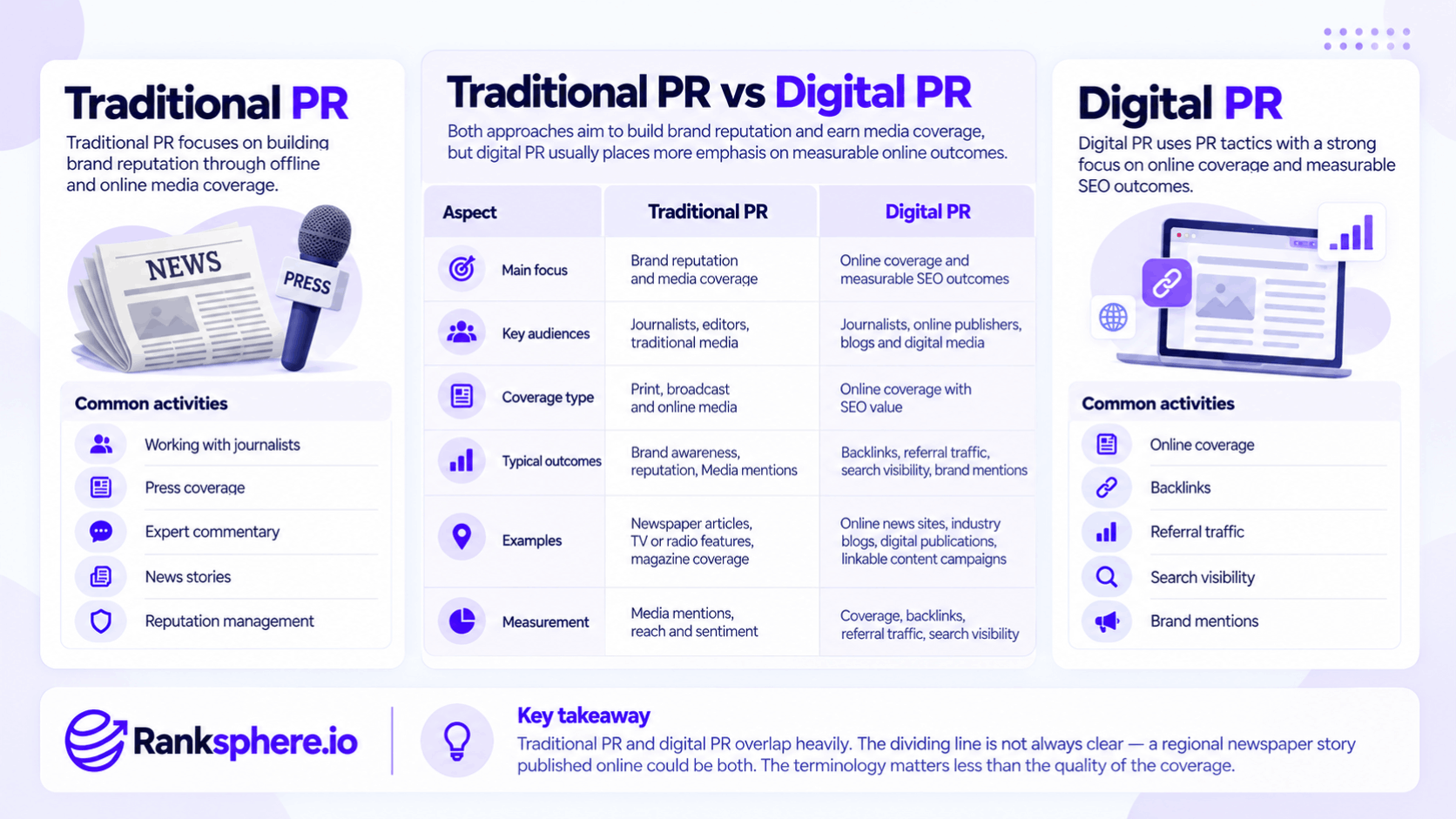
Traditional PR and digital PR overlap heavily.
Both can involve:
- Journalists
- Press coverage
- Expert commentary
- News stories
- Reputation
Digital PR usually places more emphasis on measurable online outcomes such as:
- Online coverage
- Backlinks
- Referral traffic
- Search visibility
- Brand mentions
The dividing line is not always clear.
A regional newspaper story published online could be both traditional PR and digital PR.
That is fine.
The terminology matters less than the quality of the coverage.
Digital PR vs link building
Digital PR can be part of link building, but the two are not identical.
Traditional link-building outreach may begin with:
We want a backlink from this website.
Digital PR normally begins with:
We have a story, source, dataset or expert contribution that may be useful to this publication.
A link may follow.
It may not.
That distinction is useful because good PR coverage can still have value when the publisher mentions the business without linking to it.
Digital PR should not be measured only by backlinks
Suppose a business earns coverage in a respected regional publication.
The article names the company but does not include a website link.
Calling the campaign a failure would miss:
- Brand exposure
- Search demand
- Reputation
- Potential customer discovery
- The third-party reference itself
See brand mentions for why linked and unlinked coverage should be measured separately.
Why digital PR can help SEO
The clearest SEO benefit is straightforward:
good digital PR can earn legitimate editorial backlinks.
Google says the best way to encourage natural links is to create unique, compelling content that other people want to reference, while warning against paid, exchanged or automatically generated links intended to manipulate rankings.
Digital PR fits naturally into that principle when publishers independently decide that:
- The information is useful
- The source is relevant
- A link helps the reader
The editorial decision is important.
A PR link is not automatically a good SEO link
Do not assume:
coverage = valuable backlink
in every situation.
A link may be:
- Editorial
- Sponsored
- Nofollowed
- Irrelevant
- Placed in duplicated syndication
That does not necessarily make the coverage worthless.
It simply means backlinks should be evaluated in context rather than counted blindly.
Sponsored PR is different
Businesses can legitimately pay for:
- Advertorials
- Sponsorship
- Native advertising
- Sponsored features
But that commercial relationship should not be disguised as an independent editorial ranking link.
Google recommends using:
rel="sponsored"
for paid placements, with nofollow also accepted.
Digital PR should not become a way of buying followed links while calling them editorial coverage.
What makes a strong digital PR story?
A useful story normally answers a simple question:
Why would somebody who does not work for this business care?
Strong angles often contain at least one of the following:
- New information
- Useful evidence
- Timeliness
- Expert relevance
- Local significance
- Human interest
- Practical value
The company itself does not always need to be the centre of the story.
Often it is simply the source.
Digital PR tactics that can work
Original data
Original data can give publishers information they cannot easily obtain elsewhere.
Sources might include:
- Anonymised customer trends
- Service records
- Surveys
- Internal operational data
- Public datasets analysed in a new way
- Commissioned research
For example, an electrician might analyse which household faults generated the most emergency call-outs during a period of extreme weather.
That gives the journalist something more useful than:
“Electrician says winter is cold.”
Use real data
Never invent:
- Survey results
- Percentages
- Customer statistics
- Trends
because the number would make the pitch more interesting.
The methodology should withstand basic questions such as:
- Where did this data come from?
- What period does it cover?
- How many records were analysed?
- What was excluded?
- Is it representative?
If you cannot explain the number, do not publish it.
Protect customer information
Operational data should normally be:
- Aggregated
- Anonymised
- Appropriate to disclose
Do not turn customer records into PR material without considering:
- Privacy
- Confidentiality
- Consent
- Applicable data-protection requirements
The story is not worth exposing somebody's personal information.
Surveys
Surveys can work when the research design supports the claim.
A survey of:
32 customers from one branch
might be perfectly useful for understanding those customers.
It would not justify claiming:
“82% of UK homeowners believe...”
The size of the sample is only one issue.
Also consider:
- Who was surveyed
- How they were recruited
- What was asked
- Whether the sample represents the population being described
Use narrow claims where the evidence is narrow.
Expert commentary
Businesses often contain knowledge journalists need.
Examples include:
- Doctors discussing their area of medical practice
- Accountants explaining a tax change
- Engineers discussing infrastructure
- Roofers explaining storm damage
- Solicitors commenting within their legal speciality
The strongest commentary is:
- Relevant
- Specific
- Understandable
- Properly qualified
The journalist needs insight, not an advertisement.
Reactive PR
Reactive PR means responding when a current story creates a relevant opportunity.
For example:
A severe storm hits a region.
A local roofing company may be able to explain:
- The damage it is seeing
- What homeowners should check
- Which repairs are genuinely urgent
Timing matters because news cycles move quickly.
But speed should never come at the expense of:
- Accuracy
- Safety
- Professional standards
A correct quote slightly later is better than a fast quote containing unreliable information.
Seasonal PR
Many stories recur every year.
Examples include:
- Frozen pipes
- Hay fever
- Back-to-school issues
- Heating maintenance
- Holiday travel
- Winter driving
- Garden preparation
This gives businesses time to prepare.
A plumber does not need to wait for the first hard frost before considering a winter-pipe angle.
The data, commentary and media contacts can be prepared beforehand.
Local data
Local businesses often have information that national datasets cannot show.
For example:
A drainage company may know which types of call-outs increase after sustained rainfall in its service area.
A veterinary practice may observe recurring seasonal enquiry patterns.
A property business may have information about common buyer questions in a particular town.
Used responsibly, this can create a genuinely local story.
Useful tools and resources
PR does not always need to revolve around a press release.
A useful resource can attract references over time.
Examples include:
- Calculators
- Local guides
- Interactive maps
- Original datasets
- Checklists
- Reference tools
The important question is:
Would somebody use or cite this if there were no SEO benefit?
If yes, it has a stronger reason to exist.
Digital PR for local businesses
Digital PR does not require a national campaign.
A local business can focus on publications and organisations that cover the community it actually serves.
Potential targets include:
- Regional newspapers
- Local magazines
- Trade publications
- Community publications
- Local radio websites
- Industry organisations
This often aligns naturally with local link building.
Local PR and local SEO
Google says local results are mainly influenced by:
- Relevance
- Distance
- Prominence
and specifically notes that prominence can be informed by factors such as how many websites link to a business and its review profile.
That gives locally relevant editorial coverage an obvious place within a wider local SEO strategy.
But do not turn that into:
“One newspaper link increases local rankings.”
Google does not publish that kind of formula.
Start with information the business already has
Small businesses often overlook their best PR material because it feels ordinary internally.
Potential sources include:
- Call-out records
- Seasonal trends
- Customer questions
- Common mistakes
- Changes in demand
- Local service patterns
What feels routine to the business may be useful information to somebody outside it.
The key is turning it into a claim that is:
- Accurate
- Relevant
- Explainable
Regional journalists
A regional journalist may need a local expert for stories involving:
- Weather
- Housing
- Health
- Business
- Employment
- Consumer issues
Being consistently:
- Responsive
- Accurate
- Easy to quote
can build a useful relationship.
Do not approach that relationship as:
“How many backlinks can this reporter give us?”
The relationship has value because the journalist considers you a credible source.
Journalist request services
Source-request and journalist-query platforms can help businesses find journalists looking for:
- Expert quotes
- Case studies
- Data
- Industry experience
Filter aggressively.
Respond only where:
- The topic is genuinely relevant
- Someone qualified can answer
- You can provide something useful
Ten relevant responses are better than sending generic answers to 500 requests.
Community involvement
Real community work can also generate coverage naturally.
Examples include:
- Sponsoring an event
- Supporting a charity
- Hosting a useful workshop
- Contributing expertise to a community project
Do the activity because it makes sense for the business and community.
Coverage is a possible result.
Do not manufacture meaningless sponsorships purely to purchase ranking links.
Local directories and editorial coverage are different
Ranksphere's citation management tracks listings and mentions across 500+ directories, helping businesses monitor the structured listing side of their local presence.
Digital PR deals with a different part of the picture.
A directory listing is usually:
submitted or managed
while an editorial article normally needs to be:
earned.
Both may contribute to online visibility, but they should not be treated as the same type of asset.
Digital PR and brand mentions
Digital PR frequently creates brand mentions alongside backlinks.
A publication may say:
Carrick Plumbing reported a rise in emergency call-outs during the cold snap.
with no link.
That mention can still create:
- Awareness
- Search interest
- Reputation
- Third-party context around the business
Do not discard it simply because the journalist chose not to link.
Digital PR and AI visibility
This area needs careful wording.
There is growing interest in whether third-party brand mentions affect how businesses appear in:
- AI Overviews
- AI Mode
- ChatGPT
- Other generative systems
Current third-party research suggests a relationship.
Ahrefs analysed 75,000 brands and found branded web mentions correlated strongly with brand visibility across ChatGPT, Google AI Mode and AI Overviews, with reported correlations around 0.66–0.71. The researchers explicitly caution that correlation does not establish causation.
That is interesting evidence for PR and brand building.
It is not proof of a:
digital PR → AI recommendation
ranking formula.
AI systems do not all work the same way
Avoid saying:
“AI systems rank entities rather than pages.”
or:
“AI systems do not follow links.”
Those descriptions are too broad.
Different products may use combinations of:
- Model knowledge
- Search retrieval
- Web indexes
- Live sources
- Other data systems
Google says AI Overviews and AI Mode surface relevant links and use the same foundational SEO best practices as regular Google Search.
So conventional:
- Crawlability
- Indexing
- Content quality
- Search visibility
still matter.
Entity recognition
Consistent third-party references can also provide useful public context about entities such as:
- Businesses
- People
- Organisations
- Places
For example, independent sources repeatedly associating:
Carrick Plumbing
with:
plumbing services in a particular area
provide contextual information about the business.
But avoid claiming that every mention directly:
- Builds entity authority
- Adds to a hidden entity score
- Makes the company eligible for AI recommendations
No public formula like that exists.
Press releases
Press releases are not automatically useless.
The problem is publishing something that is not actually news and expecting journalists to care.
Potentially newsworthy company developments might include:
- Acquisition
- Major expansion
- Significant research
- Important appointment
- New public initiative
A minor logo redesign probably does not need a press campaign unless there is a genuinely interesting wider story.
Press releases are not backlink packages
Do not distribute press releases mainly to obtain keyword-rich followed links across syndication websites.
Google explicitly lists links with optimised anchor text in press releases distributed across other sites among its examples of link spam when done for ranking manipulation.
The press release should communicate news.
Not manufacture anchor text.
Pitching journalists
A strong pitch is normally short.
It should make clear:
- What the story is
- Why it matters now
- Why it suits this publication
- What evidence is available
- Who can comment
Do not spend half the email explaining the history of the company.
The journalist can ask for that if needed.
Lead with the story
Weak:
Carrick Plumbing is the area's leading family-owned plumbing company with more than 20 years' experience...
Stronger:
We logged three times as many frozen-pipe call-outs during last week's cold snap as during a typical January period.
The second gives the journalist something to evaluate.
The first is company copy.
Personalise the target, not every adjective
Personalisation does not mean writing a 400-word introduction praising the journalist's last twelve articles.
It means knowing:
- What they cover
- Whether your story fits
- Why their audience might care
A relevant pitch is more important than performative personalisation.
Avoid indiscriminate mass outreach
Sending the same irrelevant pitch to hundreds of journalists is usually inefficient.
Instead, build a focused list around:
- Geography
- Beat
- Industry
- Story relevance
The aim is not maximum email volume.
It is useful coverage.
Do you ask for a backlink?
Do not make a followed backlink a condition of editorial coverage.
The publisher should decide:
- Whether to link
- Where to link
- How to describe the source
If a published article mentions your original dataset but omits the source link, a polite follow-up may sometimes be reasonable where the link would genuinely help readers verify or explore the information.
That is different from putting:
“Please include a followed backlink with the anchor emergency plumber Manchester”
in the original pitch.
Measuring digital PR
Do not evaluate every campaign only through:
number of backlinks.
Depending on the objective, useful measures might include:
- Relevant coverage
- Referring domains
- Brand mentions
- Referral traffic
- Branded search interest
- Enquiries
- Journalist relationships
- Links to important resources
Keep these separate.
One article can create several different types of value.
Coverage quality
Ten pieces of coverage are not automatically better than two.
Look at:
- Audience relevance
- Geographic relevance
- Publication quality
- Whether the story was genuinely covered
- Referral traffic
- Business impact
A relevant regional publication may be more useful to a local business than a larger publication whose audience has no connection to the service area.
Do not report Domain Authority as the outcome
Avoid:
“We secured three DA 70 links.”
That describes a third-party metric.
A stronger report might explain:
- Where coverage appeared
- Why the audience mattered
- Whether it linked
- Whether it produced referral traffic
- Whether branded demand changed
Digital PR should remain connected to actual business visibility.
What does not work well
Several approaches deserve caution.
Fabricated research
Never invent statistics or inflate findings for coverage.
Weak methodology
Do not make national claims from a tiny unrepresentative dataset.
Irrelevant mass pitching
Sending a plumbing story to technology reporters because their email appears in a media database wastes everyone's time.
Company-first pitches
The fact that the business exists is rarely the story.
Paid links disguised as editorial PR
If money changes hands for placement, handle the link relationship appropriately.
Link-first outreach
If the entire pitch exists because you want a backlink, the story is probably not strong enough yet.
Common digital PR mistakes
- Starting with the business rather than the story.
- Treating every piece of coverage without a backlink as a failure.
- Claiming digital PR links automatically improve rankings.
- Using fabricated or poorly explained statistics.
- Making claims broader than the dataset supports.
- Sending generic pitches to irrelevant journalist lists.
- Being so focused on speed that accuracy suffers.
- Ignoring local and trade publications while chasing famous national outlets.
- Paying for coverage and treating the resulting link as ordinary editorial endorsement.
- Demanding keyword-rich anchor text.
- Using press-release syndication as a link-building scheme.
- Claiming brand mentions guarantee AI citations or recommendations.
- Treating every AI system as though it retrieves information in the same way.
- Measuring campaigns only through backlink totals.
Digital PR best practices
- Start with a story rather than a desired backlink.
- Use real first-party data where it provides something genuinely new.
- Document methodology so statistics can be defended.
- Protect confidential and personal information when using operational data.
- Use qualified experts for commentary.
- Respond quickly to reactive opportunities without sacrificing accuracy.
- Prepare predictable seasonal ideas in advance.
- Target journalists whose beat and audience genuinely match the story.
- Include regional and trade publications where they fit the business.
- Do not make links a condition of editorial coverage.
- Treat unlinked brand mentions as meaningful coverage too.
- Qualify sponsored links correctly.
- Measure links, mentions, referral traffic and business outcomes separately.
- Treat current AI-visibility research as useful evidence of correlation, not proof of causation.
- Build long-term media relationships rather than treating every pitch as an isolated backlink transaction.
Example
“Consider a hypothetical plumbing company called Carrick Plumbing.
During a prolonged cold spell, the company notices an unusual increase in frozen and burst-pipe call-outs.
Instead of sending a press release saying:
Carrick Plumbing provides professional plumbing services
the team reviews its job records.
It compares the cold-weather period with a normal comparable period and verifies that there is a meaningful difference.
Before using the information, it makes sure:
- Customer identities are removed
- The comparison period is clearly defined
- The figures can be verified
- The claim is not exaggerated
The company then sends a short pitch to a relevant regional journalist.
The pitch leads with the finding, explains the comparison and offers the owner as a source who can explain:
- Why pipes are freezing
- What homeowners should check
- When a problem requires professional help
The journalist decides whether the story is useful.
If it is published, the coverage might produce:
- A backlink
- An unlinked brand mention
- Referral visits
- Local awareness
- Future journalist contact
None is guaranteed.
The company also does not claim:
“This link increased our local ranking by three positions.”
There would rarely be enough evidence to isolate that effect.
The more durable benefit is that Carrick Plumbing has become a useful source for a journalist covering local weather and household issues.
Next time a related story develops, the journalist already knows:
this business has useful data and responds with clear information.
That is the asset digital PR is trying to build.
Good digital PR gives publishers a genuine reason to talk about a business. Links can be an important result, but the strongest campaigns create something broader: credible third-party coverage, brand recognition, useful relationships and information that deserves to be referenced in the first place.”
See also
- Link building — the wider practice of earning and acquiring backlinks
- Local link building — earning relevant links within a local market
- Brand mention — when coverage names a business with or without a backlink
- Backlink — an external link pointing to a website
- Entity — how identifiable businesses, people and organisations are represented across the web
- Guest posting — a separate content and outreach tactic that should not be confused with earned media coverage