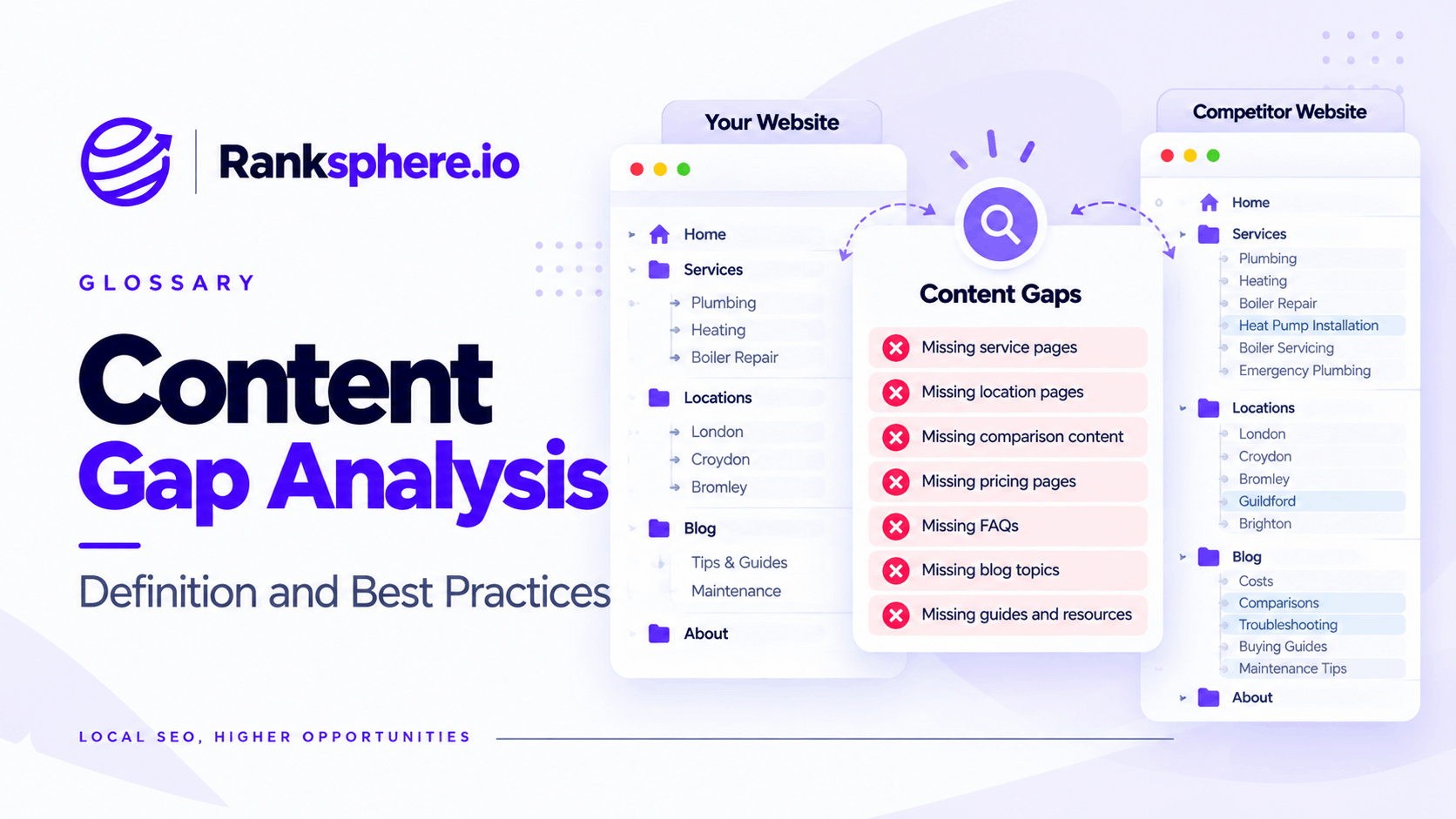
Content gap analysis is the process of comparing your website with competitors to identify important pages, services and topics they cover that your website is missing.
The purpose isn't to copy everything a competitor publishes. It's to find opportunities that are relevant to your business and worth addressing.
For local businesses, some of the most valuable content gaps are commercial pages. A competitor might have dedicated pages for individual services, treatments or pricing information while your website covers everything on one general page.
The goal is not to publish more content than your competitors. It's to identify what your customers need to know that your website currently doesn't explain well enough.
Why Does Content Gap Analysis Matter for SEO?
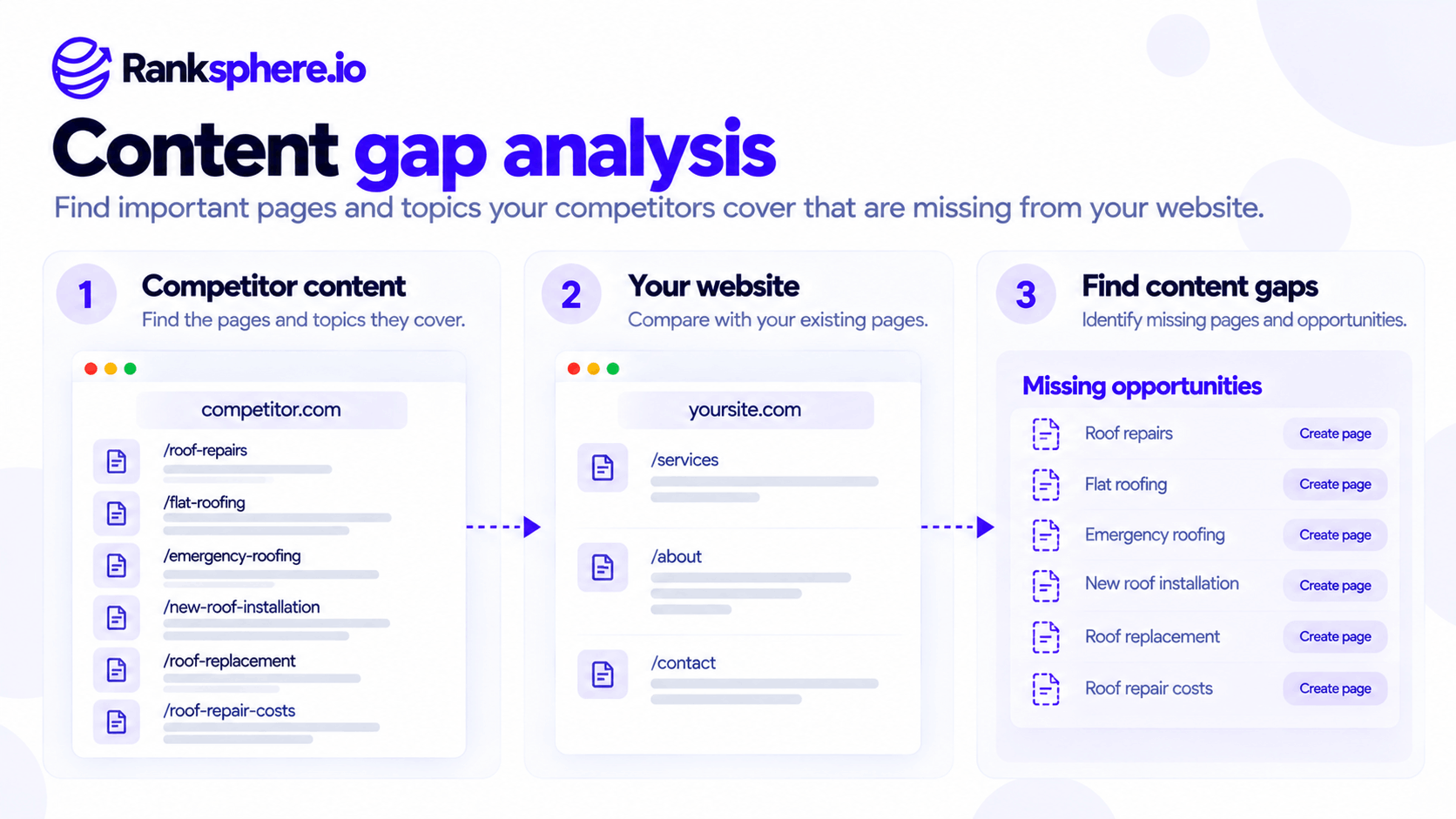
A website can miss valuable searches simply because it doesn't have a page that adequately addresses what people are looking for.
For example, a roofing company might have one page describing all its services.
A competitor may have separate, useful pages covering:
- Roof repairs
- Flat roof installation
- Emergency roofing
- New roof installation
- Roof replacement
- Roof repair costs
Those dedicated pages can answer more specific questions and explain individual services in greater detail.
That doesn't mean Google automatically rewards websites with more pages.
A single comprehensive page can perform well when several topics share the same search intent. Separate pages make more sense when customers have distinct needs that deserve individual answers.
Content gap analysis helps identify where that distinction matters.
Money Pages vs Informational Content
Not every content gap has the same commercial value.
For many local businesses, missing money pages deserve early attention.
These are pages closely related to enquiries, bookings, quotations or purchases.
They may include service pages, treatment pages, product pages, pricing pages and relevant location pages.
For example, a dental clinic that offers Invisalign but has no dedicated Invisalign page may have a more immediate content need than a clinic missing another general oral health blog post.
Informational content still matters.
Guides, FAQs and educational articles can answer customer questions, attract relevant visitors and support commercial pages through internal linking.
The distinction is about priority, not quality.
A well-researched guide can be more valuable than a weak service page. But if customers cannot find clear information about something the business actually sells, that gap is worth addressing first.
How Does Content Gap Analysis Work?
A content gap analysis compares the subjects covered by your website with those found on competing websites.
The process generally involves:
- Choose relevant competitors. Compare businesses offering similar services to the same type of customer.
- Review existing pages. Identify what your website already covers and where information is limited.
- Compare competitor content. Look for services, pricing topics, questions and resources they address.
- Group opportunities by search intent. Distinguish genuinely different topics from close variations.
- Check business relevance. Exclude services and subjects that don't apply to your company.
- Prioritise the gaps. Consider customer demand, commercial importance and the effort required.
The critical step is deciding whether a missing topic deserves a new page.
Sometimes the right action is to improve an existing page rather than create another one.
For example, "roof repair prices" and "how much does roof repair cost" may be better covered together than split into two nearly identical articles.
How to Find Content Gaps in Ranksphere
Ranksphere helps businesses identify content opportunities based on pages published by competitors.
To use the feature:
- Open the location you want to analyse in Ranksphere.
- Go to Website Performance.
- Find the Content Gaps card.
- Enter a competitor's website.
- Review the missing topics identified by the analysis.
Ranksphere compares pages found on your website with pages found on the competitor's site.
It separates opportunities into Money Pages and Blog Content, helping you distinguish commercial gaps from supporting informational topics.
Each suggestion includes a short recommendation and the competitor page on which the opportunity is based.
Importantly, Ranksphere only shows a content gap when it finds an actual competitor page covering that topic.
This makes the results traceable to existing competitor content rather than unrelated page suggestions.
The results are a starting point for editorial decisions, not an instruction to create every suggested page.
Which Content Gaps Should You Fix First?
For many local businesses, a useful order is to review missing service pages, then other commercial topics, followed by supporting informational content.
Ask three questions before creating anything:
Does the business genuinely offer this service or have expertise in the topic?
Does the topic answer a distinct customer need that the existing website doesn't cover sufficiently?
Would creating or improving this page help someone make a decision?
For example, a dedicated emergency roofing page may be useful if the company actually provides emergency repairs and customers need specific availability and response information.
A separate page targeting every variation of "roof repair" is less useful when all the pages say essentially the same thing.
Likewise, create location pages only where they provide genuine, location-specific value. Publishing near-identical city pages simply to capture searches can create doorway-page risks.
Common Content Gap Analysis Mistakes
- Copying every competitor page. Competitors may cover services your business doesn't offer.
- Prioritising publishing volume over usefulness. More content doesn't automatically mean stronger rankings.
- Creating multiple pages with the same search intent. This can result in unnecessary overlap.
- Copying competitor wording or structure too closely. Research the opportunity, then create original content.
- Ignoring existing pages. Improving a weak page may be better than publishing a replacement.
- Comparing only one competitor. A broader sample can reveal more relevant opportunities.
- Assuming a competitor page ranks well. Its existence alone doesn't prove search demand or performance.
Content Gap Analysis Best Practices
Start with commercial topics directly related to the business.
Validate competitor suggestions against real services and customer questions.
Check search intent before deciding whether to create a new URL.
Prioritise original, useful content rather than imitating competitor pages.
Connect related commercial and informational pages with relevant internal links.
Review content gaps periodically, especially when the business adds services or competitors change their websites.
Example of Content Gap Analysis for a Dental Clinic
Consider a hypothetical dental clinic offering dental implants, Invisalign, composite bonding, teeth whitening and emergency appointments.
Its website has a single Treatments page with a short description of each service.
A competing clinic has dedicated treatment pages along with content about implant costs, Invisalign treatment times and composite bonding results.
What the Analysis Finds
The clinic's existing page doesn't provide much information about the individual treatments.
Patients looking for costs, suitability or treatment details may need to contact the clinic before they can make an informed decision.
The competitor analysis identifies those missing subjects.
What the Clinic Prioritises
The clinic first creates detailed pages for its main treatments, explaining what each involves, who it may suit and what patients can expect.
Qualified clinicians review medical information for accuracy.
Next, the team decides where supporting questions belong.
For example, implant costs may be best addressed directly on the implant service page rather than in a separate article, depending on the search intent and amount of information needed.
The clinic links relevant guides to the treatment pages.
Example
“The clinic hasn't copied its competitor's website.
It has used the competitor's content to identify information its own patients were missing.
There is no guaranteed ranking improvement simply because the new pages exist.
The value comes from providing more useful information about services the clinic already offers.
A good content gap analysis should produce a better website, not just a longer list of URLs to publish.”
See Also
- Content Audit — Reviewing the quality and usefulness of existing website content.
- Competitor Analysis — Evaluating competing websites and their search strategies.
- Search Intent — Understanding what users expect from a search result.
- Internal Linking — Connecting relevant commercial and informational pages.
- On-Page SEO — Improving individual pages for users and search engines.
- Local SEO — Improving search visibility in a specific geographic market.