A case study is a detailed account of a real project, customer problem, or piece of work. It explains the situation, what the business did, and the outcome.
For local businesses, case studies are one of the most useful ways to demonstrate experience.
A roofing company can show how it repaired a leaking roof. A dental practice can explain a treatment process through an appropriately consented and anonymised patient case. A landscaping company can document how it transformed a garden.
Unlike a general advice article, a case study is based on work the business actually completed.
It gives potential customers an opportunity to see how the company approaches problems similar to their own.
For SEO, case studies can also make service and location pages more useful by adding specific examples, original photographs, and details that generic content often lacks.
However, publishing case studies doesn't automatically improve Google rankings. Their value comes from demonstrating relevant experience, answering customer questions, and providing evidence of the work performed.
Why Are Case Studies Important for Local SEO?
Many local businesses regularly complete projects that could become useful website content.
A roofing contractor might repair several roofs each week, while a physiotherapy practice may help patients with a wide range of conditions.
Yet much of that experience never appears on their websites.
Instead, businesses often publish general articles covering topics that competitors have already explained.
Those articles can still be helpful, but a genuine case study offers something different: a documented example of the business's own work.
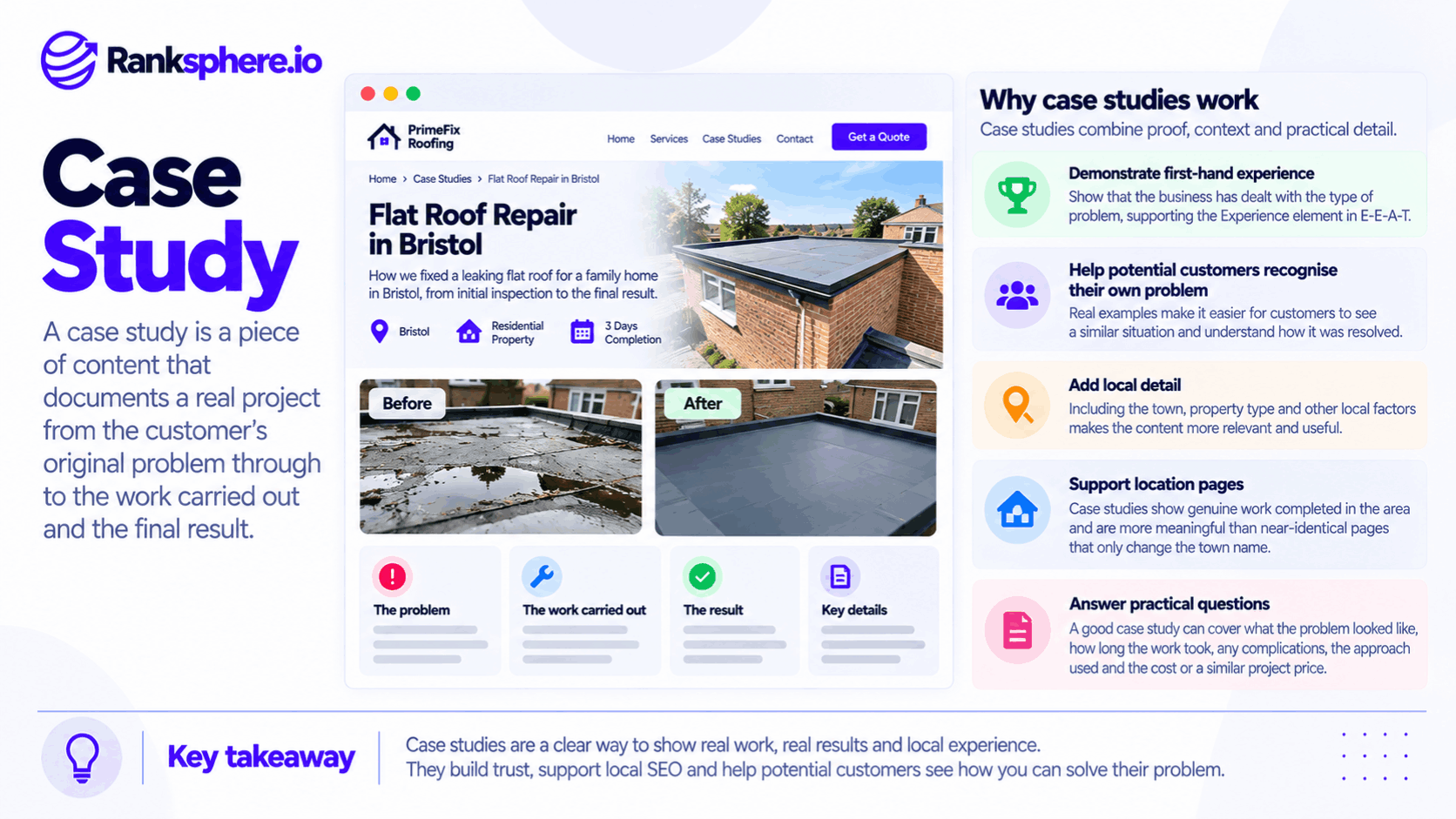
1. They Demonstrate First-Hand Experience
Google's E-E-A-T framework includes experience, expertise, authoritativeness, and trustworthiness.
Experience concerns first-hand familiarity with the topic being discussed.
For example, a roofing company can explain how flat roofs are repaired in a general guide.
But a case study showing a specific flat roof repair, including the original problem, the work completed, and photographs, provides more direct evidence of practical experience.
That distinction can make the content more useful to someone considering the same service.
However, E-E-A-T isn't a single ranking score, and publishing case studies doesn't guarantee better search visibility.
2. They Help Potential Customers Evaluate the Business
Before contacting a business, customers often want reassurance that it can handle their particular problem.
A case study can provide that reassurance.
For example, someone with a leaking flat roof might recognise the symptoms described in a roofing company's previous project.
They can see what the contractor discovered, how the repair was completed, and what the outcome was.
This may help the customer decide whether to enquire.
However, a case study isn't a guarantee that the same outcome will apply to every customer or project.
3. They Add Useful Local Detail
Local businesses can use case studies to document work completed within their service areas.
For example, a roofing company might publish a project involving a Victorian terrace in Bristol or a detached property in a nearby village.
These details help explain the context of the work.
Property type, location, access restrictions, and the condition of the building may all influence how the project was completed.
This can make the content particularly useful to local customers dealing with similar circumstances.
However, location names should only be included when they're accurate, relevant, and appropriate to publish.
4. They Support Location Pages
Businesses serving several towns often create separate location pages.
The challenge is making each page genuinely useful rather than repeating the same service description with a different town name.
Relevant case studies can help.
For example, a roofing company serving Maidstone might link to a documented roof repair completed in that area.
The case study provides a real example of the company's experience working locally.
This can make the location page more informative, although simply mentioning a town in a case study doesn't guarantee rankings for searches in that location.
5. They Answer Practical Customer Questions
Customers often want details that general marketing pages don't provide.
For example:
- What caused the problem?
- How was it identified?
- What work was needed?
- How long did the project take?
- What did it cost?
- Were there unexpected complications?
- What was the final result?
A case study can answer these questions using a real project.
This is particularly valuable for services where cost, duration, and complexity vary.
What Should a Good Case Study Include?
A case study doesn't need to follow a complicated format.
The most important thing is to provide enough detail for readers to understand the problem, the work completed, and the outcome.
1. The Customer's Problem
Start by explaining why the customer needed help.
Use language that reflects the issue they were experiencing.
For example:
A homeowner noticed water stains appearing on an upstairs ceiling after several days of heavy rain.
This is more useful than beginning with a broad statement about the company's commitment to quality.
The opening should help readers understand the situation immediately.
2. Relevant Project Details
Provide context that helps explain the work.
Depending on the industry, this might include:
- Property type
- General location
- Age or condition of the building
- Type of service requested
- Access restrictions
- Time constraints
- Relevant customer requirements
For example, replacing a roof on a listed building may involve different considerations from repairing a modern extension.
Include details that help the reader understand the project without unnecessarily exposing private information.
3. What the Business Discovered
Explain what the inspection, assessment, or initial investigation revealed.
This is often one of the most valuable parts of a case study.
For example, a homeowner may believe their roof is leaking because of damaged tiles.
After inspection, the contractor might discover that the problem comes from failed flashing around a chimney.
That information helps readers understand how the business approached the problem.
It also demonstrates the importance of identifying the cause before choosing a solution.
4. What Work Was Completed
Describe the steps taken to address the issue.
The explanation should be specific enough to be useful without becoming unnecessarily technical.
For example, a roofing case study might explain that the team:
- Removed damaged materials
- Inspected the underlying structure
- Replaced deteriorated components
- Installed suitable replacement materials
- Checked the finished repair
Where relevant, explain why the chosen approach was appropriate.
This gives readers a clearer understanding of the work than statements such as "we completed the project to a high standard."
5. Project Cost
Cost is often one of the first things potential customers want to understand.
Where appropriate and permitted, include the actual project cost or a realistic price range.
For example:
The repair cost approximately £1,200, including materials and labour.
However, the price should be presented with context.
Explain relevant factors such as the size of the job, materials used, access requirements, or additional work discovered during the project.
If the customer doesn't want the exact amount published, a reasonable range may be more appropriate.
Avoid inventing prices or presenting one project's cost as a standard quote for every customer.
6. How Long the Work Took
Include the actual project duration when available.
For example:
The repair was completed over two working days, excluding the initial inspection.
This is more informative than saying the team completed the work quickly.
For projects affected by weather, access, approvals, or other factors, explain those circumstances.
A realistic timeline helps potential customers understand what similar work might involve.
7. The Outcome
Explain what happened after the work was completed.
This might include:
- A completed repair
- A finished installation
- A resolved technical issue
- An improved physical space
- A successful project handover
Use evidence where possible.
For example, before-and-after photographs can show the visible difference between the original condition and the completed work.
However, don't claim results that weren't measured or verified.
For healthcare and other regulated sectors, outcomes should be described carefully and shouldn't imply that every customer or patient can expect the same results.
8. Photographs and Supporting Evidence
Original photographs can make a case study more useful.
For example, a roofing case study might include:
- The original damage
- Materials removed during inspection
- Work in progress
- The completed repair
These images help readers understand the work rather than relying entirely on a written description.
Photographs should accurately represent the project.
Avoid presenting stock images as photographs of completed customer work.
Also make sure that photographs don't reveal private information without appropriate permission.
9. A Customer Quote
A genuine customer quote can add another perspective.
For example, a homeowner might describe why they chose the contractor or how communication was handled during the project.
However, quotes should be accurate and used with permission.
Don't invent testimonials or rewrite a customer's statement in a way that changes its meaning.
A case study can still be useful without a testimonial if the project details are well documented.
10. Advice for Customers with Similar Problems
End with a practical takeaway.
For example, a roofing contractor might explain what homeowners should check when they notice signs of water damage.
This helps the case study provide value beyond promoting the business.
A useful closing section might answer:
What should someone experiencing the same problem know before requesting a quote?
That turns the project into a resource for prospective customers.
How to Collect Information for Case Studies
The biggest obstacle to publishing case studies is often collecting the information while the work is happening.
By the time someone starts writing, photographs may be missing and important details may have been forgotten.
A simple process can make case study creation easier.
Take Photographs During the Job
Make photograph collection part of the normal workflow where appropriate.
For a roofing contractor, a useful set might include:
- One photograph before work begins
- One showing the problem in detail
- One showing the work in progress
- One showing the completed result
These photographs provide useful evidence and reduce the need to reconstruct the project later.
However, obtain any necessary permissions and follow applicable privacy and workplace requirements.
Record Unusual Findings
Not every project needs a case study.
Look for jobs that include something worth explaining.
For example:
- An unexpected cause of damage
- A difficult access problem
- An unusual property type
- A repair requiring a different approach
- A common customer misunderstanding
- A particularly useful lesson
Record these details while they're still fresh.
A brief note from the person completing the work may provide enough information for a writer to develop the case study later.
Record Costs and Timescales Accurately
Don't rely on memory several months after a project.
Where appropriate, record the actual:
- Project duration
- Materials used
- Labour requirements
- Cost
- Unexpected delays
- Additional work
These details make the case study more useful.
If exact information cannot be published, explain the limitation rather than inventing figures.
Ask for Permission
Where customer permission is required, request it before publishing identifiable information.
Be clear about what the business wants to use.
For example:
- Project photographs
- Customer comments
- General location details
- Property information
- Before-and-after images
Keep a record of the permission received.
A customer agreeing to have photographs taken doesn't necessarily mean they've agreed to have those photographs published on the business website.
Maintain a Case Study List
Keep a running list of projects that may be suitable for publication.
For each potential case study, record:
- Project name or internal reference
- Service provided
- General location
- Main problem
- Relevant photographs
- Important details
- Publication permission status
- Person responsible for writing
This helps prevent useful project material from getting lost.
Ranksphere's Smart Tasks can help teams organise and assign work, including tasks related to gathering project information and preparing content.
Customer Privacy and Case Study Permissions
Real project details make case studies more useful, but businesses must consider customer privacy.
This is particularly important in healthcare, legal services, financial services, and other regulated industries.
Get Appropriate Consent Before Publishing
Obtain suitable permission before publishing identifiable customer information.
This may include:
- Customer names
- Photographs of people
- Property addresses
- Patient information
- Personal circumstances
- Direct customer quotations
The exact requirements depend on the information, industry, location, and applicable law.
For sensitive information, businesses should seek appropriate privacy or legal guidance.
Use Anonymous Case Studies When Necessary
A case study doesn't always need to identify the customer.
For example, a physiotherapy practice might describe an anonymised treatment case without publishing the patient's name, photograph, or identifying details.
The content can still explain:
- The initial problem
- The assessment process
- The treatment approach
- The outcome, where appropriate
- Important limitations
However, removing a name isn't always enough to make information anonymous.
A combination of location, age, circumstances, dates, and photographs may still identify someone.
Be Careful with Healthcare Case Studies
Healthcare businesses should take particular care when discussing patient cases.
Medical information is sensitive, and case studies may be subject to privacy rules, professional standards, and advertising requirements.
A clinic should avoid publishing identifiable patient details without a valid basis and appropriate consent.
Treatment outcomes should also be presented accurately.
A positive outcome for one patient shouldn't be described as a result every patient can expect.
Avoid Inventing or Exaggerating Outcomes
A case study should be based on genuine work.
Don't invent:
- Customer testimonials
- Project figures
- Before-and-after results
- Treatment outcomes
- Performance improvements
- Customer experiences
If a project is hypothetical or used for illustration, label it clearly.
Trust is one of the main reasons case studies are valuable, so the evidence needs to be reliable.
How to Use Case Studies for Local SEO
Once published, case studies can support several parts of a local business website.
Link Case Studies to Relevant Service Pages
A case study should connect naturally to the service it demonstrates.
For example, a roofing company might publish a case study about a flat roof repair.
The case study could link to the relevant service page, where visitors can learn more about flat roof repairs or request a quote.
The service page could also link back to the case study as an example of completed work.
This helps visitors move between general service information and specific examples.
Support Location Pages with Genuine Local Work
A business operating across several towns can use case studies to demonstrate completed projects in those areas.
For example, a landscaping company with a location page for Bath might link to a garden renovation completed nearby.
That provides a relevant example of the company's work in the area.
However, avoid creating repetitive case studies simply to target different town names.
The content should describe real projects with meaningful details.
Target Relevant Long-Tail Searches
Case studies may naturally include specific details that people search for.
For example:
- Flat roof repair on a Victorian terrace
- Replacing damaged roof flashing
- Garden drainage installation
- Loft insulation in an older property
These details can make the content relevant to narrower search queries.
However, keyword targeting shouldn't replace the main purpose of the case study.
Start with what happened during the project, then describe it using clear language.
Use Descriptive Image Alt Text
Original project photographs can support the case study.
Use accurate image descriptions when alternative text is appropriate.
For example:
Damaged flashing around a brick chimney before roof repair.
This describes what the image shows.
Avoid stuffing image alt text with repeated service names and location keywords.
Keep the Information Accurate
Case studies should reflect the work that was actually completed.
If the business updates a case study later, make sure the changes don't misrepresent the original project.
For example, a price charged several years ago shouldn't be presented as the current price for the same service.
Where relevant, include the project date and explain that costs can change.
Case Studies vs Testimonials
Case studies and testimonials both help demonstrate customer experiences, but they aren't the same.
A testimonial is usually a short statement from a customer describing their experience with a business.
A case study provides a fuller account of a specific project.
| Feature | Case study | Testimonial |
|---|---|---|
| Main purpose | Explains a project or problem | Shares a customer's opinion |
| Typical detail | Problem, process, and outcome | Customer experience |
| Photographs | Often useful | Optional |
| Costs and timescales | May be included | Usually not included |
| Customer quote | Can support the account | Usually the main content |
| Best use | Demonstrating completed work | Providing customer feedback |
For example, a testimonial might say:
"The team repaired our roof quickly and kept us informed throughout."
A case study would explain what caused the roof problem, how the contractor identified it, what repairs were carried out, and how long the work took.
Both can be useful, but they answer different questions.
Common Case Study Mistakes
Several mistakes can reduce the usefulness or credibility of a case study.
- Being vague about the work. Statements such as "we delivered excellent results" don't explain what actually happened.
- Leaving out costs and timescales. These details are often important to prospective customers when they can be shared accurately.
- Writing a testimonial instead of a case study. A customer quote alone doesn't explain the project.
- Using generic stock photographs. Images unrelated to the completed work provide little evidence.
- Publishing only straightforward projects. More complex jobs can demonstrate how the business handles unexpected problems.
- Sharing identifiable information without permission. Customer privacy must come before marketing.
- Inventing figures or outcomes. Case studies should document genuine work.
- Publishing a case study once and never creating another. Regular documentation can build a useful collection of project examples.
- Forgetting to link related pages. Case studies can help visitors find relevant service information.
Case Study Best Practices
To create useful case studies for a local business:
- Choose real projects that demonstrate relevant services.
- Explain the customer's original problem clearly.
- Include location and property details when relevant and appropriate.
- Document what the business discovered.
- Explain the work completed and why it was necessary.
- Include accurate costs and timescales where possible.
- Use genuine project photographs.
- Obtain appropriate permissions before publishing.
- Include authentic customer feedback when available.
- Explain unexpected complications honestly.
- Give readers practical advice related to the problem.
- Link the case study to relevant service and location pages.
- Make project documentation part of the business's regular workflow.
The strongest case studies aren't necessarily about the largest or most expensive projects.
They're the ones that help customers understand how the business approaches a real problem.
Example of a Case Study for a Local Roofing Business
Consider a hypothetical roofing company called Ashdown Roofing.
The company has been publishing general roofing advice articles for several years.
Its website covers topics such as roof maintenance, common leaks, and signs of damaged roof tiles.
These articles provide useful information, but they don't show many examples of the company's completed work.
The marketing team decides to introduce project case studies.
How the Company Collects the Information
Roofers are asked to document suitable jobs as part of their normal workflow.
For each project, they record:
- Photographs before work begins
- The main problem identified
- Any unexpected findings
- Photographs of the repair process
- The completed work
- Project duration and relevant costs
The office team also keeps a record of customer permissions and identifies projects suitable for publication.
The Flat Roof Repair Case Study
One of the selected projects involves a flat roof on a residential property in a nearby village.
The homeowner had noticed signs of water damage.
During the inspection, the contractor discovers that moisture has affected the decking beneath the roofing membrane.
The issue requires more than replacing the visible roof covering.
The case study explains:
- What the homeowner originally noticed
- How the contractor identified the damaged decking
- Why the affected materials needed replacing
- What work was completed
- How long the repair took
- The factors affecting the final cost
The company includes genuine photographs of the original condition, the repair process, and the finished roof.
It also explains what homeowners should ask contractors when they suspect water has entered beneath a flat roof covering.
How the Case Study Supports the Website
The company publishes the project as a dedicated page and links it to its flat roof repair service page.
Visitors researching similar problems can now see a specific example of completed work.
The content doesn't rely on broad claims about quality or experience.
Instead, it explains what the company did and why.
The business can monitor whether visitors read the case study, follow links to the service page, or submit enquiries.
However, it shouldn't assume that the case study will automatically become its best-performing page or generate a particular number of leads.
What the Example Shows
A general roofing article can explain common problems.
A case study can show how one of those problems was handled in practice.
Both content types can be useful, but they serve different purposes.
The case study gives potential customers a concrete example of the company's work, including details that another business cannot truthfully claim as its own experience.
For local businesses, a good case study turns completed work into useful evidence of experience.
It helps customers understand what the business does, how it approaches problems, and what they might need to consider when facing a similar situation.
See Also
- E-E-A-T — Understanding experience, expertise, authoritativeness, and trustworthiness.
- Content Marketing — Creating useful content that helps attract and inform potential customers.
- Location Page — Creating useful pages for the areas a business serves.
- Service Page — Explaining a specific service and guiding visitors toward an enquiry.
- Content Strategy — Planning which types of content a business should create.
- User-Generated Content — Content contributed by customers, including genuine testimonials and feedback.