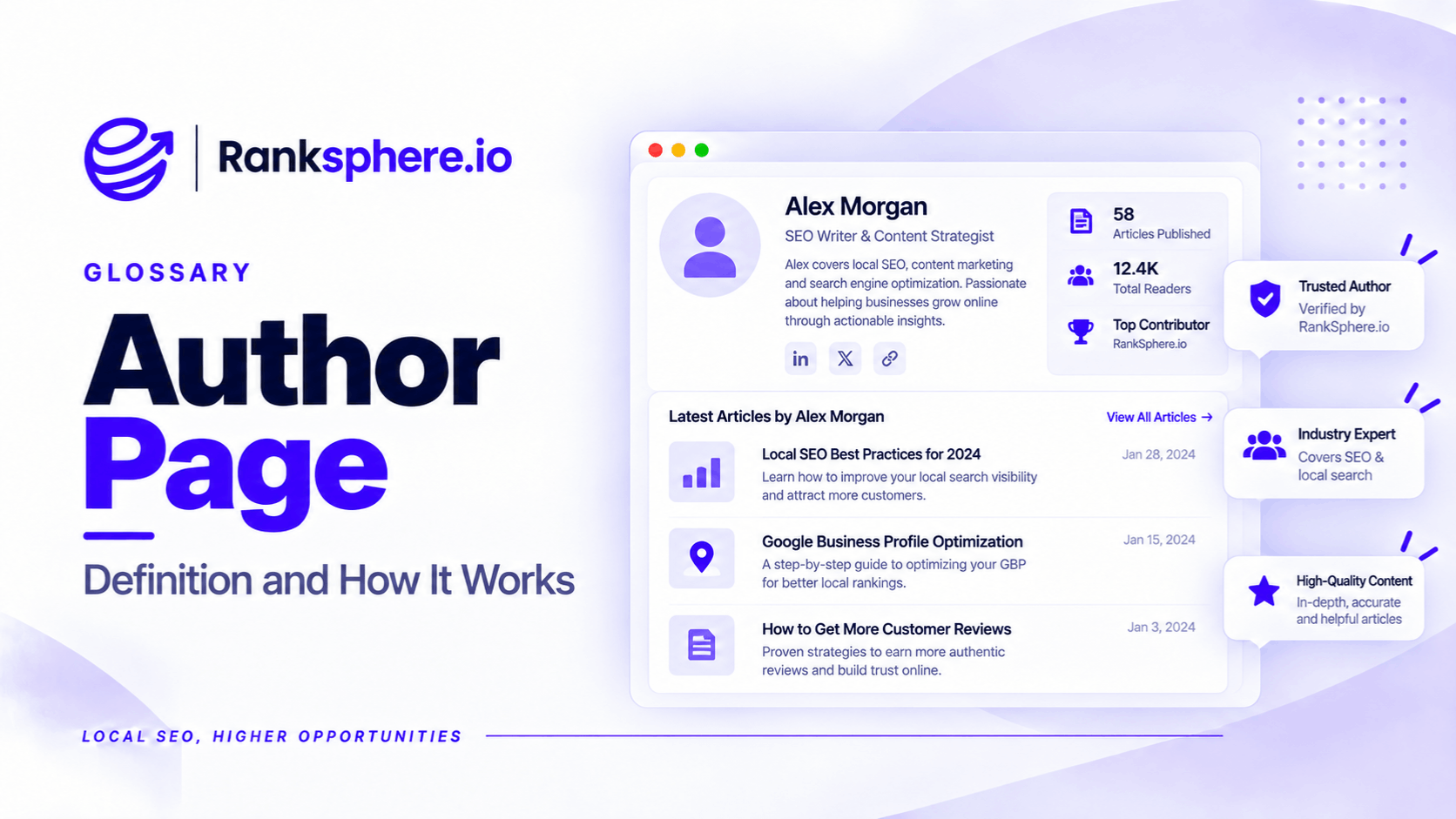
An author page is a dedicated webpage that introduces the person or team responsible for creating content on a website. It typically includes their professional background, relevant experience, qualifications, and links to their published articles.
For example, a dental practice publishing advice about dental implants might link each article to a biography of the dentist who wrote or reviewed it. Readers can then check the dentist's qualifications, professional registration, and experience.
Author pages can support the transparency and trust principles associated with Google's E-E-A-T guidance.
However, simply creating an author page doesn't improve rankings automatically.
What matters is whether the information helps readers understand who created the content and why that source is credible.
A generic biography with an invented name and stock photograph doesn't establish expertise. A genuine professional biography with verifiable details provides readers with something they can check.
Why Are Author Pages Important for SEO?
Google encourages website owners to make it clear who created their content.
Its helpful content guidance asks whether visitors can identify the author and find background information about them.
This is particularly relevant to websites publishing medical, financial, legal, or other information that could influence important decisions.
Author pages can help in several ways.
1. Establish Clear Authorship
Readers should be able to identify who is responsible for the information.
For example, a solicitor publishing an article about property transactions can include their name, role, and professional background.
That gives visitors more context than an article attributed only to "Admin."
However, Google doesn't require every webpage to have a named individual author.
An organisation or editorial team can be a legitimate author when that attribution accurately reflects how the content was produced.
2. Help Readers Verify Expertise
An author page can link to information that supports the person's professional background.
For example:
- Professional registration
- Relevant qualifications
- University or institutional profiles
- Professional association memberships
- Previous publications
These references make it easier for readers to assess the author's expertise.
For regulated professions, verification is especially useful.
A doctor writing about medical treatments can provide a link to an appropriate professional register.
However, qualifications should be relevant to the subject and must never be invented or exaggerated.
3. Connect the Author to Their Published Work
An author page can bring together articles written by the same person.
For example, a financial adviser might have written guides about retirement planning, mortgages, and investment considerations.
Linking those articles to a genuine author profile gives readers a clearer understanding of the person's work.
It also provides a useful internal linking structure.
See entity for how search systems interpret identifiable people, organisations, and other concepts.
However, an author page doesn't automatically establish a recognised entity or provide a guaranteed ranking advantage.
4. Support Reader Confidence
Authorship can also influence how readers evaluate a business.
For example, someone considering a dental procedure may want to know whether an explanation comes from a qualified clinician.
A biography that explains the author's role and relevant professional experience can help answer that question.
However, the actual content must still be accurate.
A qualified author doesn't make an incorrect article trustworthy.
What Should an Author Page Include?
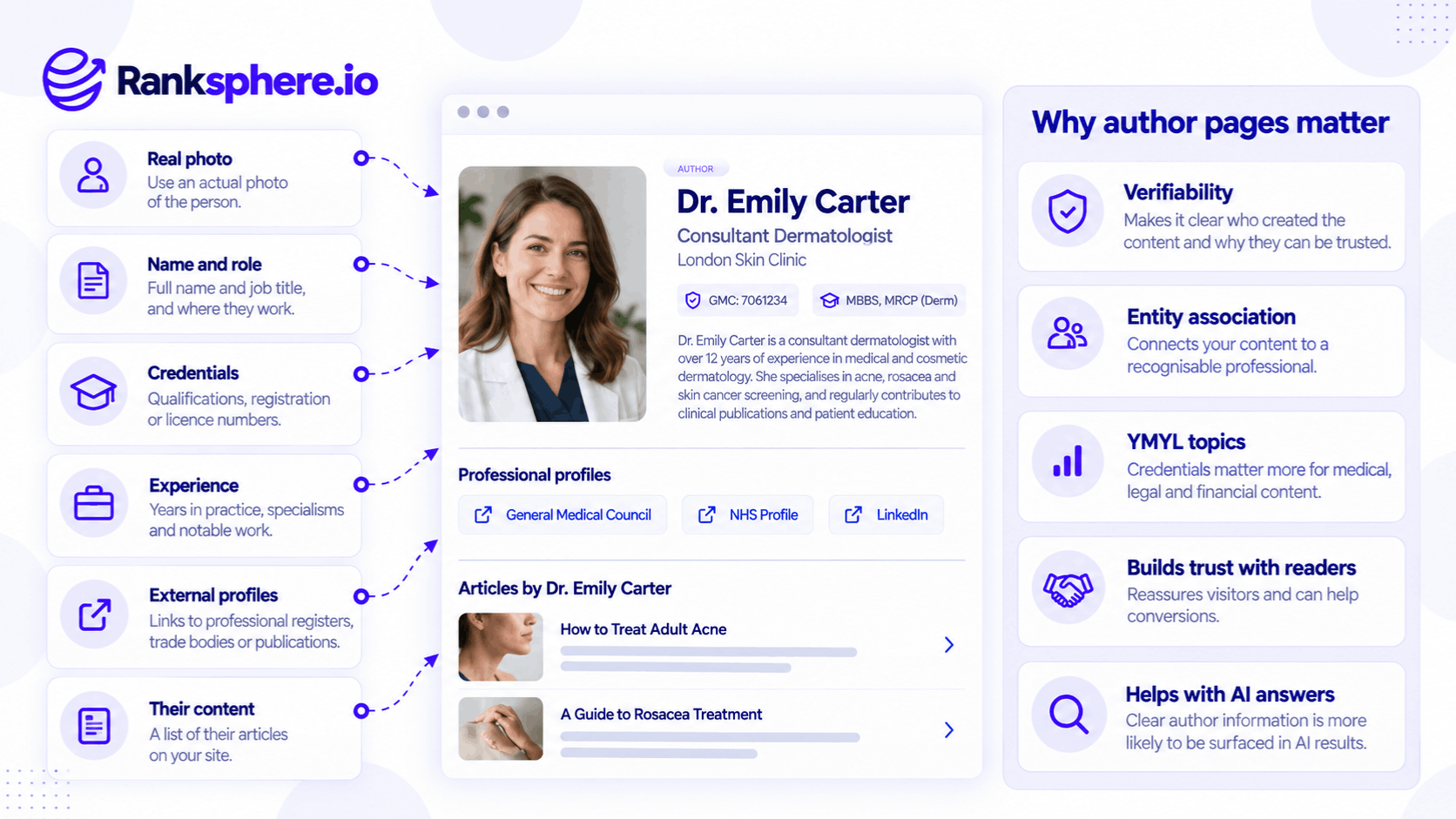
A useful author page should provide enough information to identify the author and explain their relationship to the content.
The most appropriate details depend on the profession and the subject.
| Element | What to include |
|---|---|
| Author name | The real name or professional name used by the author |
| Professional role | Their position and organisation |
| Experience | Relevant work, specialisations, or practical background |
| Qualifications | Genuine credentials relevant to the subject |
| Registration details | Professional registration where applicable |
| Photograph | A genuine photograph where appropriate and with permission |
| External references | Verifiable professional profiles or published work |
| Published content | Articles, guides, or other material attributed to the author |
| Contact information | An appropriate professional contact route, where suitable |
Not every author needs every element.
For example, an experienced roofer writing about repairs may have practical knowledge worth explaining without holding an academic qualification.
A medical author may need much more detailed professional information because of the potential consequences of the advice.
Use Genuine Biographical Information
An author biography should describe actual experience.
For example:
"James Porter has worked in residential roofing for over fifteen years, specialising in flat roof repairs and replacement systems."
This is useful if it accurately describes the author's background.
Avoid generic claims such as "a world-renowned expert" unless there is reliable evidence to support them.
Include Verifiable Credentials
Where credentials matter, give readers a way to check them.
For example, a clinician may link to their entry in a professional register.
However, don't publish personal identifiers or licence numbers unless they are appropriate to disclose.
A public professional register link is often more useful than an unsupported claim.
Show Relevant Published Work
An author page should connect naturally to the content the person has written or reviewed.
For example, an accountant's author page might list articles covering bookkeeping, business tax, and financial reporting.
The articles should also link back to the author's page.
This makes the information useful for visitors rather than creating an isolated biography that nobody can find.
Does Google Use Author Pages as a Ranking Factor?
Google doesn't identify the presence of an author page as a direct ranking factor.
Its systems use many signals to evaluate helpful and reliable content.
Google also states that E-E-A-T itself is not a single ranking factor.
An author page can help visitors understand the person responsible for content, but it doesn't substitute for accurate information, genuine experience, or reliable sources.
For example, adding a biography to a poorly researched medical article doesn't resolve the article's factual problems.
Similarly, a trades business shouldn't expect rankings to improve simply because it creates author profiles for every blog post.
Author pages are most valuable when they provide information readers genuinely need.
Author Pages and Person Schema
Schema markup can help search engines understand authorship information.
Google supports the author property in Article structured data.
The author can be represented as a Person or an Organization, depending on who actually created the content.
For example, an article written by a named professional can reference that person's author page through the author.url property.
Google recommends including a URL or appropriate sameAs reference to help distinguish authors with similar names.
However, structured data isn't a substitute for genuine authorship.
Adding Person schema doesn't automatically establish expertise, authority, or trust.
The information in the markup should accurately reflect the author information presented on the website.
Can an Editorial Team Have an Author Page?
Yes.
A business doesn't always need to attribute every article to an individual.
An editorial team can be a legitimate author when content is produced collectively and the attribution accurately describes the process.
For example, a software company may publish product guides, research, and educational articles through its editorial team.
A useful editorial author page could explain:
- Who is responsible for the content
- The team's relevant experience
- How information is researched
- How articles are reviewed
- How corrections and updates are handled
- Which organisation publishes the content
This is more transparent than using an anonymous "Admin" account with no explanation.
However, an editorial team shouldn't claim professional credentials it doesn't hold.
Where specialist expertise is needed, the article may benefit from a separate named expert reviewer.
The attribution should distinguish between writing, reviewing, and publishing.
For example, a healthcare organisation shouldn't attribute an agency-written article to a doctor who never wrote, reviewed, or approved it.
When Is an Author Page Worth Creating?
The value depends on the website and its content.
Healthcare, Legal and Financial Websites
Author transparency is particularly important for subjects that may affect health, financial stability, or safety.
For example, a physiotherapy practice publishing treatment advice may benefit from linking articles to a qualified physiotherapist's biography.
Readers can then check the professional's background.
This aligns with Google's emphasis on trust for Your Money or Your Life topics.
Businesses Publishing Specialist Advice
An author page can also be helpful when a business regularly publishes detailed educational material.
For example, an architect writing technical guides may want a page explaining their relevant professional experience.
Trades and Local Service Businesses
A separate author page isn't always necessary.
For example, a roofing business may publish photographs, project descriptions, and practical guides based on completed work.
Those examples can demonstrate genuine experience.
A short author biography or a clear business team page may provide enough context for the content.
See case study for another way to demonstrate real work and practical experience.
The decision should be based on what helps readers, not whether an SEO checklist recommends an author page.
Common Author Page Mistakes
- Using invented authors. False identities create a trust problem.
- Publishing generic biographies. A job title alone doesn't explain relevant experience.
- Using stock photographs to represent real people. This can mislead readers.
- Claiming unverified qualifications. Professional credentials should be accurate and checkable.
- Attributing content to someone who didn't contribute. Authorship and review credits must reflect actual involvement.
- Creating author pages with no useful information. An empty biography adds little value.
- Failing to connect articles and author pages. Readers should be able to navigate between them.
- Treating schema as a ranking shortcut. Structured data doesn't confer expertise.
- Assuming organisations cannot be authors. Genuine editorial teams can be credited appropriately.
Author Page Best Practices
- Identify the actual author or responsible editorial team.
- Explain their role and relevant experience.
- Include qualifications when they matter to the subject.
- Link to verifiable professional profiles where appropriate.
- Use genuine photographs if the author is comfortable publishing one.
- Connect articles to the author's biography.
- Keep author information accurate and current.
- Distinguish writers from expert reviewers.
- Use appropriate author structured data.
- Avoid unsupported claims about expertise.
- Make the author page useful to readers rather than creating it solely for SEO.
Example of an Author Page for a Roofing Business
Consider two hypothetical roofing companies publishing guides about flat roof repairs.
Both articles cover common causes of damage, repair options, and when professional help may be necessary.
The First Company
The article is attributed to "Admin."
The website provides no explanation of who prepared the content.
It uses generic stock photographs and contains broad advice without examples of actual roofing work.
Readers have little information about the source of the recommendations.
The Second Company
The article is attributed to a named company director who works in roofing.
The author's biography explains their practical experience and links to relevant, verifiable professional information.
The article contains photographs of genuine projects and explains the types of repairs the business has encountered.
It also includes a real example showing how the team assessed a roof problem and selected a repair method.
What Is the Difference?
The second article provides clearer evidence of practical experience and authorship.
Readers can better understand who prepared the advice and what experience supports it.
However, that doesn't mean Google will automatically rank the second article higher or cite it in AI-generated answers.
The content still needs to meet the searcher's needs, be technically accessible, and compete with other relevant sources.
Example
“An author page can support credibility when it connects published advice to genuine expertise.
But the biography isn't the only evidence.
The accuracy of the content, the examples used, and the author's actual experience also matter.
An author page should make expertise easier to verify, not simply make a website look authoritative.
For businesses publishing specialist advice, clear and accurate attribution helps readers understand who is responsible for the information and whether that person or team is qualified to provide it.”
See Also
- E-E-A-T — Google's framework for considering experience, expertise, authoritativeness, and trust.
- Entity — How search systems understand identifiable people, organisations, and concepts.
- Case Study — Demonstrating practical experience through real examples.
- Schema Markup — Structured data used to describe authors and other information.
- Content Brief — Planning authorship, expertise, and editorial responsibilities.
- AI-Generated Content — Understanding content creation, accountability, and transparency.