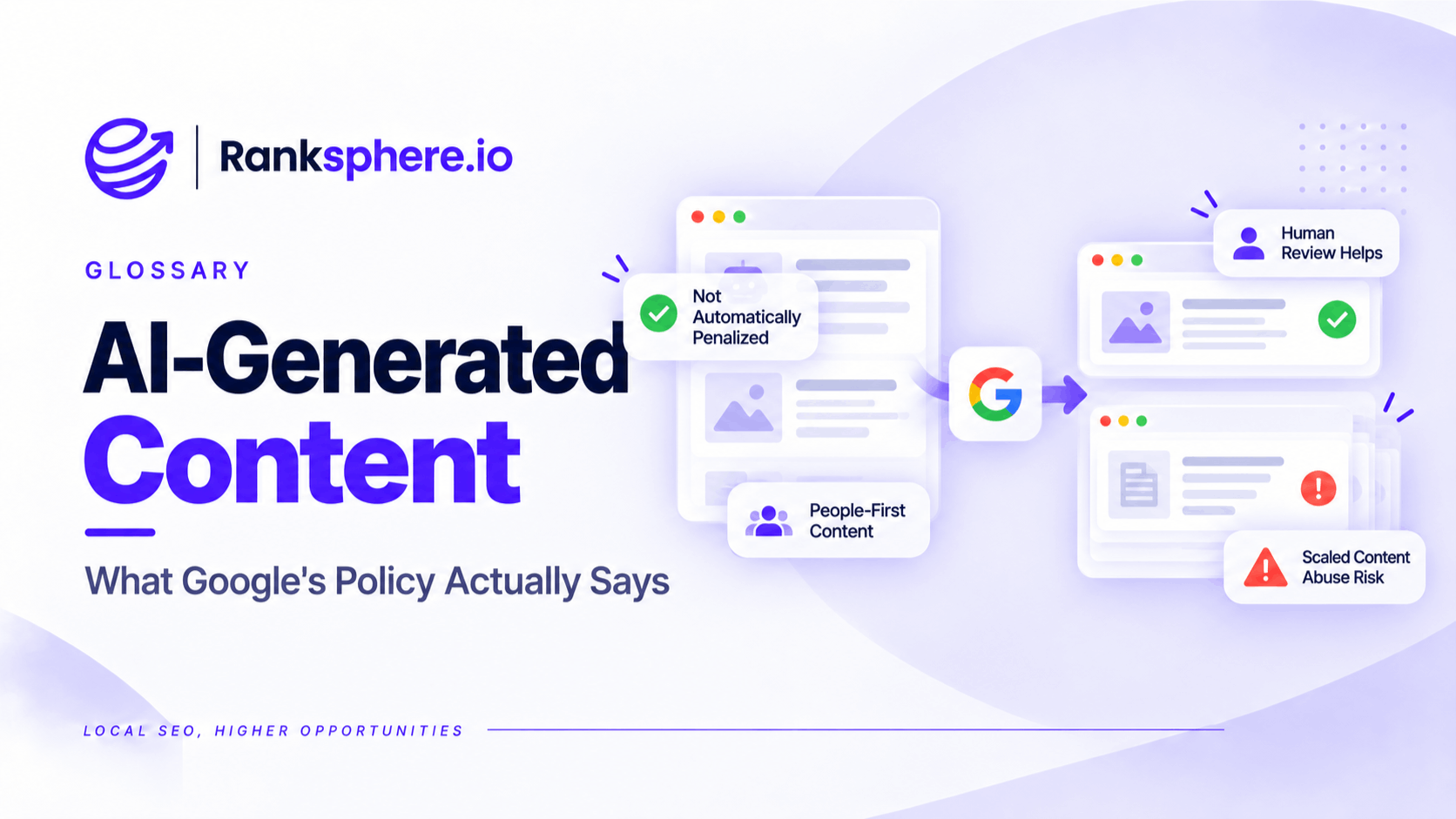
AI-generated content is content created wholly or partly using generative artificial intelligence, including language models that can draft, rewrite, summarise or structure text.
Using AI does not automatically violate Google's guidelines.
Google's position is that useful content should be judged primarily by its quality, purpose and value to users rather than by whether a human or an automated system produced it. Google has explicitly said that appropriate use of AI and automation is not against its guidelines.
The problem begins when automation is used primarily to:
- Manipulate search rankings
- Produce large volumes of low-value pages
- Repackage information without adding anything useful
- Create content for search engines rather than people
That distinction matters because both of these statements are too simplistic:
“Google penalises AI content.”
and:
“AI content is automatically safe because Google cannot tell.”
Neither reflects Google's actual policy.
The question is not simply:
Who—or what—wrote this?
It is:
Why was it created, how useful is it, and what value does it add for the reader?
What Google Says About AI-Generated Content
Google formally clarified its approach to AI-generated content in February 2023.
Its guidance says that the company's ranking systems aim to reward original, high-quality content regardless of how it was produced.
Google also specifically states that automation has long been used to create genuinely useful information, giving examples such as:
- Sports scores
- Weather forecasts
- Transcripts
The use of automation itself is therefore not the issue.
The policy issue arises when AI or another automated system is used primarily to manipulate Search.
AI Content Is Not Automatically Spam
This is the most important point.
Google says:
Appropriate use of AI or automation is not against its guidelines.
Using generative AI becomes a problem when the primary purpose is manipulating search rankings.
So a page does not become spam because:
- ChatGPT drafted it
- Gemini helped restructure it
- An AI tool edited the copy
- Automation created part of the page
Likewise, a human-written page is not automatically high quality simply because no AI was involved.
A poor page is still poor if a person wrote it.
A useful page can still be useful if AI helped create it.
There Is No Special AI-Content Ranking Penalty
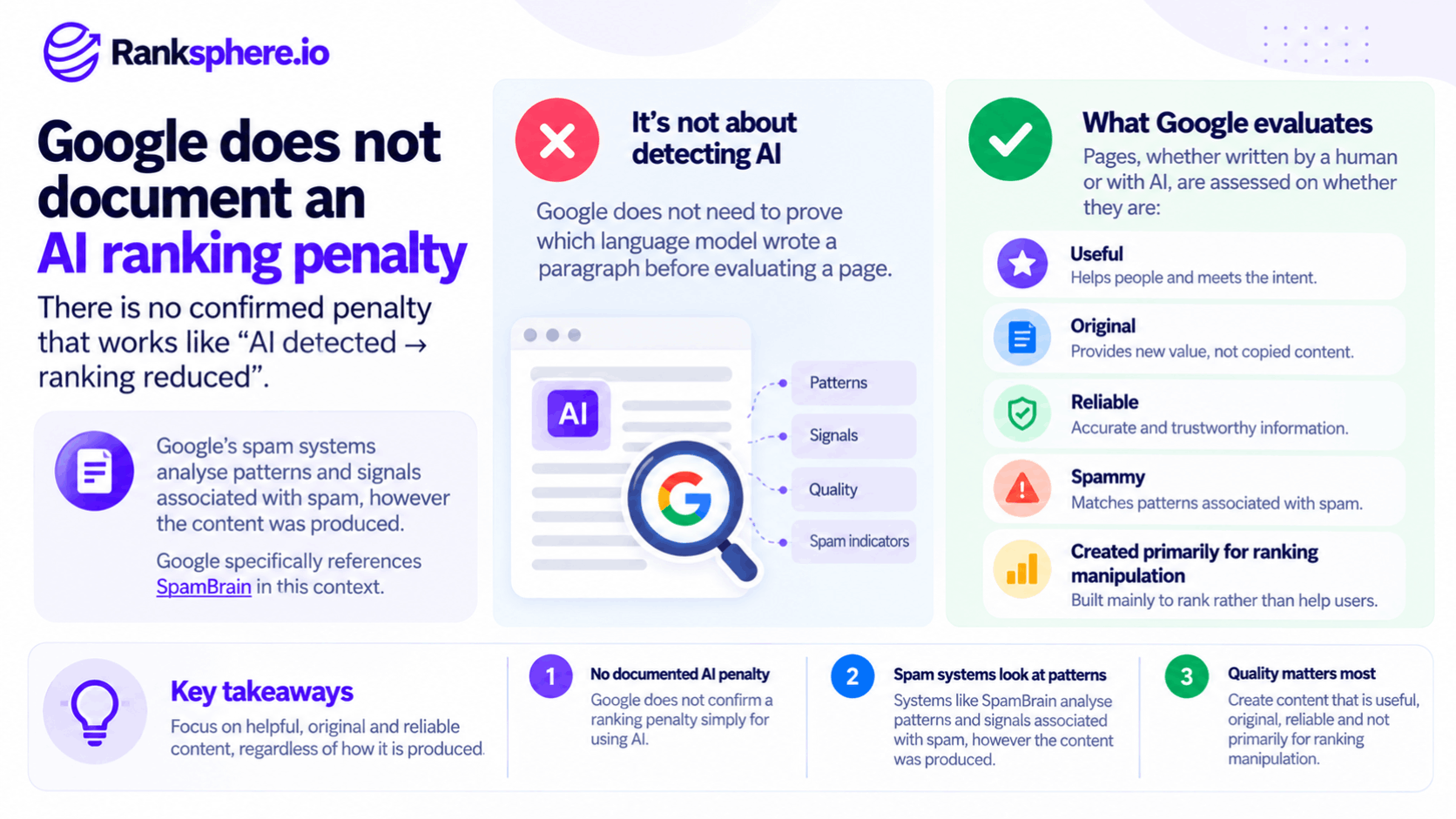
Google does not document a ranking penalty that works like:
AI detected → ranking reduced.
Instead, Google's spam systems analyse patterns and signals associated with spam however the content was produced. Google specifically references SpamBrain in this context.
That means:
“Google cannot detect AI, so we are safe.”
misses the point.
Google does not need to prove which language model wrote a paragraph before evaluating whether a page is:
- Useful
- Original
- Reliable
- Spammy
- Created primarily for ranking manipulation
There Is No Published AI-Content Percentage
Google does not publish a rule such as:
“More than 50% AI-written content is unsafe.”
There is no documented:
- AI percentage threshold
- Safe AI word count
- Number of AI pages allowed per month
The policy focuses on purpose and value.
A site publishing 20 useful automated pages is not automatically violating the rules.
A site publishing 10,000 thin pages to capture keyword variations may have a very different problem.
What Changed in March 2024?
Google's March 2024 core update introduced an important change in how it described low-value scaled publishing.
Two developments matter.
The Helpful Content System Became Part of Google's Core Ranking Systems
Google's standalone helpful content system evolved and became part of its broader core ranking systems in March 2024.
Google now uses multiple systems and signals to surface helpful content rather than relying on one standalone “helpful content” system.
That means site owners should not wait for a named Helpful Content Update before thinking about content quality.
Helpful, reliable, people-first content remains part of what Google's broader ranking systems aim to reward.
Scaled Content Abuse
The second major change was the introduction of Google's scaled content abuse spam policy.
Google defines scaled content abuse as creating many pages primarily to manipulate rankings rather than help users.
The key point is:
The production method does not matter.
The policy can apply to pages created through:
- Generative AI
- Automated systems
- Human writers
- A combination of people and automation
Google explicitly says the policy was expanded so that low-value content produced at scale can be addressed regardless of how it was created.
Human Review, Accuracy and E-E-A-T
Human Review Is a Best Practice, Not a Google Requirement
For a business website, having a knowledgeable person review AI-assisted content is often extremely sensible.
A reviewer can catch:
- Incorrect facts
- Invented details
- Outdated information
- Misleading claims
- Missing context
- Poor advice
That is particularly important for health, legal and financial content, where Google says its systems place greater emphasis on signals of reliability because mistakes can have serious consequences.
But Google does not say:
“AI content must be manually edited by a human.”
The policy line is not:
Human-reviewed vs unreviewed.
It is much closer to:
Helpful, original and people-first vs content created primarily to manipulate Search.
Human Input Can Still Make AI Content Much Better
Even though it is not a formal ranking requirement, human input is often where a local business creates the information competitors cannot easily reproduce.
Consider a roofing company.
A generic AI model can explain:
- What a flat roof is
- Common roofing materials
- General warning signs
But the business itself can provide:
- Actual repair costs
- Real project photographs
- Local property types
- Common failures its team sees
- Examples from completed jobs
- Which materials it actually uses
- Why one repair approach failed
That is where the content becomes harder to replace with another generic summary.
Google's current 2026 guidance for generative AI Search specifically encourages businesses to produce non-commodity content containing genuine expertise, experience and unique perspectives rather than simply recycling information that could easily be generated by AI.
AI Is Often Stronger at Structure Than Experience
For many local businesses, AI can be particularly useful for:
- Outlines
- First drafts
- Editing
- Summaries
- Reorganisation
- Turning notes into readable copy
- Identifying unanswered questions
The information that makes the final piece distinctive should still come from somewhere credible.
That might be:
- The business owner
- A technician
- A clinician
- A solicitor
- Internal data
- First-hand project experience
The useful question is not:
“How little AI can we use?”
It is:
“What does this page contain that genuinely helps the customer?”
AI Cannot Manufacture First-Hand Experience
Google's people-first content guidance asks publishers whether their content demonstrates first-hand expertise and depth of knowledge where relevant.
For example, a model can generate:
“Five common drainage problems in older properties.”
But it cannot truthfully claim:
“In the 47 Victorian properties our team repaired in Maidstone last year, this was the issue we found most often.”
unless the business actually supplies that information.
Inventing first-hand experience is not optimisation.
It is fabrication.
See E-E-A-T.
E-E-A-T Is Not a Score
Avoid talking about AI content as though it needs to:
“Pass the E-E-A-T threshold.”
E-E-A-T stands for:
- Experience
- Expertise
- Authoritativeness
- Trustworthiness
Google's Search Quality Raters use these concepts when evaluating whether Google's systems are producing good results.
The raters themselves do not directly control rankings, and there is no publicly accessible E-E-A-T score.
The framework is useful for asking whether content appears credible and trustworthy.
It is not a number a page can optimise to.
Trust Matters Especially on Sensitive Topics
AI mistakes become much more serious when content affects:
- Health
- Finances
- Safety
- Legal decisions
Google calls these types of subjects Your Money or Your Life (YMYL).
Its systems place stronger emphasis on reliability for topics where inaccurate information could significantly harm people.
That makes verification especially important.
For example:
A private medical clinic should not publish AI-generated dosage information without qualified review.
A law firm should not publish invented statutory requirements.
A financial business should not let a model guess tax rules.
The issue is not that AI touched the copy.
The issue is whether the published information can be trusted.
AI Hallucinations
Generative models can produce information that sounds confident while being incorrect.
That can include:
- Invented statistics
- Fake cases
- Non-existent studies
- Incorrect laws
- Wrong dates
- Fabricated quotations
For a business, every factual claim should therefore have an appropriate source or basis.
Do not let polished wording substitute for verification.
AI-Generated Content and Originality
AI-assisted content is not automatically unoriginal.
But one of the easiest ways to produce weak AI content is:
- Feed the model competitors' articles.
- Ask it to combine them.
- Publish the result.
Google's spam policies specifically identify scraping and lightly transforming existing material without adding value as problematic practices.
Changing:
“Five common roofing problems”
to:
“Five frequent roof issues”
does not create meaningful originality.
AI Rewriting Competitors Is Still Weak Content
Suppose five competitors explain the same service.
Asking a model to:
“Rewrite all five so ours is unique”
may avoid exact copying.
It does not necessarily add value.
Google's current generative AI Search guidance specifically tells publishers not simply to recycle information others have already said or material that could easily be generated by a model.
Originality is not merely different wording.
It can mean:
- New information
- First-hand examples
- Better explanation
- Original analysis
- Useful comparison
- Genuine expertise
AI and Thin Content
AI makes it much easier to produce thin content quickly.
That does not mean AI content is inherently thin.
Thin content is about whether the page provides enough value for its purpose.
A short AI-assisted page can be useful.
A 3,000-word AI article can still be thin in substance if it:
- Repeats basic information
- Adds no experience
- Answers nothing particularly well
Word count is not the distinction.
Programmatic SEO and AI Content
Programmatic SEO is not inherently against Google's rules.
Automation can be useful when it produces genuinely valuable pages from meaningful underlying information.
For example:
A property platform generating pages from accurate market data may provide something useful.
The problem is when automation produces:
Hundreds or thousands of substantially interchangeable pages primarily to capture queries.
Google's scaled content abuse policy specifically applies to large amounts of unoriginal content created primarily to manipulate rankings.
The scale itself is not the only issue.
The purpose and value matter.
Location-Page Generation
This is particularly relevant to local SEO.
Generating:
/plumber-maidstone/
/plumber-canterbury/
/plumber-ashford/
and replacing only the town name is not made safe simply because a human approved the template.
Nor is it automatically spam simply because AI helped produce it.
Ask whether each page provides genuine local value.
That may include:
- Actual service availability
- Real projects
- Local information
- Location-specific considerations
rather than interchangeable paragraphs with a different place name.
Do Not Publish Simply Because Generation Is Cheap
Before generative AI, creating 100 articles was expensive.
Now it can take minutes.
That changes the economics of publishing.
It does not change the reason each page needs to exist.
Before generating a page, ask:
- Is there a genuine audience?
- Does the page answer a useful question?
- Do we have something worthwhile to add?
- Does another page already cover it?
- Would we still publish this if search engines did not exist?
Google's people-first guidance uses similar questions when helping publishers evaluate whether content exists primarily for users or to attract search traffic.
AI-Assisted Content and Google AI Search
There is no separate shortcut for getting cited in:
- AI Overviews
- AI Mode
Google's current 2026 guidance says generative AI Search still relies on its core Search ranking and quality systems.
So:
AI-written content does not receive special treatment because an AI wrote it.
Likewise:
Human-written content is not automatically preferred because a person typed every word.
The fundamentals remain:
- Helpful content
- Original value
- Crawlability
- Clear site structure
- Strong technical SEO
You Do Not Need to Write Differently for AI
Google's 2026 guidance specifically says publishers do not need to rewrite pages in a special style for generative AI Search.
Its systems can understand:
- Synonyms
- Related concepts
- Natural language
without every possible phrase being explicitly included.
So avoid creating:
One page for every AI fan-out query
or:
Tiny answer blocks written purely for AI extraction.
Write for the person using the page.
You Do Not Need Special AI Markup
Google currently says there is:
- No special AI schema
- No special AI text file
- No requirement for llms.txt
to appear in its generative AI search features.
Existing technical SEO fundamentals still apply.
Can AI Content Appear in AI Answers?
Yes.
Google's generative AI features retrieve information from pages in its Search index using its core ranking and quality systems.
Whether the page was drafted with AI is not the deciding condition.
So do not say:
“AI-generated content cannot win AI citations.”
The more accurate statement is:
Creating generic AI content solely to chase AI visibility is unnecessary and unlikely to create a durable advantage.
Google recommends unique, useful, expert-led content rather than AI-specific hacks.
Authorship and AI Disclosure
Google encourages publishers to make it clear who created content where readers would reasonably expect an author.
That might include:
- Medical guidance
- Detailed guides
- Expert commentary
- Editorial articles
Google specifically recommends accurate authorship information when readers may reasonably wonder who wrote the page.
This does not mean:
Every service page needs a named expert author.
Use bylines where they help the reader understand who is responsible for the content.
Do Not Fake Human Authorship
If no named person actually wrote, reviewed or takes responsibility for the content, do not invent:
“Written by Dr Smith”
simply because you believe a human byline improves SEO.
Authorship information should be accurate.
If a subject-matter expert reviewed the page, you might legitimately say:
Reviewed by Dr Smith
if that is genuinely what happened.
Can AI Be the Author?
Google has said that listing AI as the author is probably not the best way to communicate how automation was involved.
A clearer approach is to explain the process where that information would genuinely matter.
For example:
This guide was drafted using AI-assisted research and reviewed for accuracy by our clinical team.
if that statement is true.
AI Disclosure
Google does not require every website to add:
“This page was written with AI.”
Its current guidance says disclosure can be useful where readers would reasonably ask:
“How was this created?”
That might matter more for:
- Automated research
- Data-generated content
- AI imagery
- AI-assisted analysis
than for a routine paragraph where AI merely helped edit grammar.
Use disclosure to build transparency.
Do not treat it as an SEO checkbox.
Disclosure Does Not Make Poor Content Acceptable
This:
“This article was generated by AI.”
does not make a low-value page compliant if it was produced primarily to manipulate rankings.
Conversely, omitting a disclosure does not automatically make useful AI-assisted content spam.
The core question remains:
Why does the page exist and what value does it provide?
What AI Is Useful For
AI can be extremely useful during content production.
For example:
Research Assistance
Identifying areas that deserve verification.
Outlining
Turning a broad subject into a logical structure.
Drafting
Creating a starting point from expert notes.
Editing
Improving clarity, grammar and structure.
Summarising
Turning long internal documents into usable working notes.
Content QA
Spotting repeated ideas, missing sections or unclear explanations.
Those are workflow uses.
The published output is still the publisher's responsibility.
AI Content for Local Businesses
What the Business Should Supply
For local businesses, the most valuable additions are often things a generic model cannot know independently.
Examples include:
- Actual pricing
- Real timelines
- Local experience
- Photographs
- Case studies
- First-hand observations
- Product preferences
- Customer questions
- Process details
That is where E-E-A-T becomes a useful editorial framework.
The goal is not to add details because they are “E-E-A-T keywords”.
It is to make the content more trustworthy and genuinely useful.
Example of AI Content for a Local Business
Consider a plumber.
A generic AI article may say:
“Burst pipes can result from freezing temperatures, corrosion or high water pressure.”
Useful, but generic.
The plumber may be able to add:
“In older properties we work on locally, we most commonly find leaks at ageing compression joints beneath kitchen sinks.”
if that reflects genuine experience.
The second statement gives the page something that cannot simply be reconstructed from generic search results.
That is the kind of contribution Google increasingly describes as:
Non-commodity content.
Verify Facts Before Publication
Every publisher should fact-check important claims, whether the first draft came from:
- AI
- A freelancer
- An employee
Generative AI makes this particularly important because a model can generate plausible but inaccurate information.
Check:
- Statistics
- Dates
- Laws
- Medical information
- Technical specifications
- Prices
- Quotes
- Sources
Do not publish a citation merely because the model supplied one.
Open the source.
Verify it.
Ranksphere and AI-Generated Content
Ranksphere's website audit surfaces thin and near-duplicate pages across a site, which can help identify patterns that deserve review after a site has published content at scale.
An audit finding should still be interpreted carefully.
For example:
50 similar pages
does not prove:
AI spam.
They may be legitimate.
Likewise:
AI generated
does not prove:
Thin.
Assess the pages themselves.
Common AI-Generated Content Mistakes
- Assuming Google penalises content simply because AI created it.
- Assuming AI content is safe because the model cannot be identified.
- Treating human review as an explicit Google ranking requirement.
- Treating E-E-A-T as a numerical score or pass/fail threshold.
- Publishing large numbers of generic pages primarily to capture search queries.
- Using AI to scale thin content.
- Rewriting competitors' pages without adding meaningful original value.
- Inventing first-hand experience, quotations, cases or data.
- Publishing unverified health, legal or financial information.
- Creating one page for every keyword or AI fan-out variation.
- Writing content specifically for AI systems rather than the audience.
- Assuming an AI disclosure makes low-value content acceptable.
- Adding fake expert bylines to make content look authoritative.
- Believing AI-written pages cannot appear in AI Overviews or AI Mode.
- Treating indexing as proof that a page is high quality—or non-indexing as proof Google identified AI content.
AI-Generated Content Best Practices
- Use AI where it genuinely improves the content-production workflow.
- Create content primarily for people rather than to manipulate rankings.
- Add original knowledge, evidence and first-hand experience where relevant.
- Verify important factual claims before publication.
- Use knowledgeable review as a quality-control process, particularly for YMYL subjects.
- Keep authorship information accurate and add bylines where readers would reasonably expect them.
- Disclose significant automation where readers would reasonably want to understand how the content was created.
- Do not publish large quantities of pages simply because AI makes production inexpensive.
- Avoid programmatic SEO that generates near-identical pages without meaningful value.
- Apply the same quality expectations to AI-assisted work that you would apply to human-written work.
- Focus on useful, non-commodity information rather than AI-specific ranking hacks.
Example
“Consider a hypothetical roofing company working with an SEO agency.
The agency's keyword export contains dozens of possible blog topics.
Because AI makes drafting fast, the team generates 40 articles in a short period.
The pages are grammatically sound.
But most contain:
- Generic explanations
- No project experience
- No original photography
- No first-hand data
- No meaningful information beyond what already exists across competing sites
Some pages receive little search visibility.
Others may not be indexed.
That does not prove:
Google detected the AI and penalised the pages.
Google itself makes clear that crawling, indexing and serving are never guaranteed, and a page can remain unindexed for many reasons.
The team changes its approach.
Instead of producing another large batch, it selects a smaller group of subjects that customers genuinely ask about.
AI is still used.
It helps:
- Structure interviews
- Organise notes
- Draft sections
- Edit the final copy
But the roofing company's director supplies:
- Actual project photographs
- Real pricing variables
- Examples of failed repairs
- Materials the company actually uses
- Local building characteristics
- Technical review
One article explaining flat-roof repair, for example, now includes what the company actually checks during an inspection rather than another generic list copied from the wider web.
The team attributes expert review accurately where appropriate and verifies technical claims before publishing.
The lesson is not:
“AI wrote less of the second set.”
Nor should we invent an outcome such as:
“All six pages indexed and two were cited in AI answers.”
Those results would need to be measured.
The meaningful difference is:
The production process is now built around useful information rather than cheap volume.
Google's policy supports exactly that distinction.
Its scaled content abuse policy targets large amounts of low-value content created primarily to manipulate rankings regardless of whether humans or machines produced it. At the same time, Google's current 2026 guidance encourages publishers to create useful, original, expert-led content that adds something beyond what generative AI could easily reproduce.
That is the practical standard for AI-generated content.
AI is a production tool, not an SEO exemption and not an automatic SEO problem. Use it where it saves time, but judge the finished page by the same questions you would ask of any other content: Is it accurate? Is it useful? Is it original enough to deserve publishing? Does it contain something the reader could not get from another generic summary? And was it created primarily for that reader rather than simply to manufacture search traffic?”
See Also
- Thin Content — low-value content regardless of how it was produced
- Programmatic SEO — where automation and scale require particularly careful quality control
- E-E-A-T — a framework for thinking about experience, expertise, authority and trust
- Google Algorithm Update — how Google's broader ranking systems evolve
- Content Brief — defining the expertise, evidence and original information a page needs
- Content Strategy — deciding what deserves to be created before AI makes creating it easy