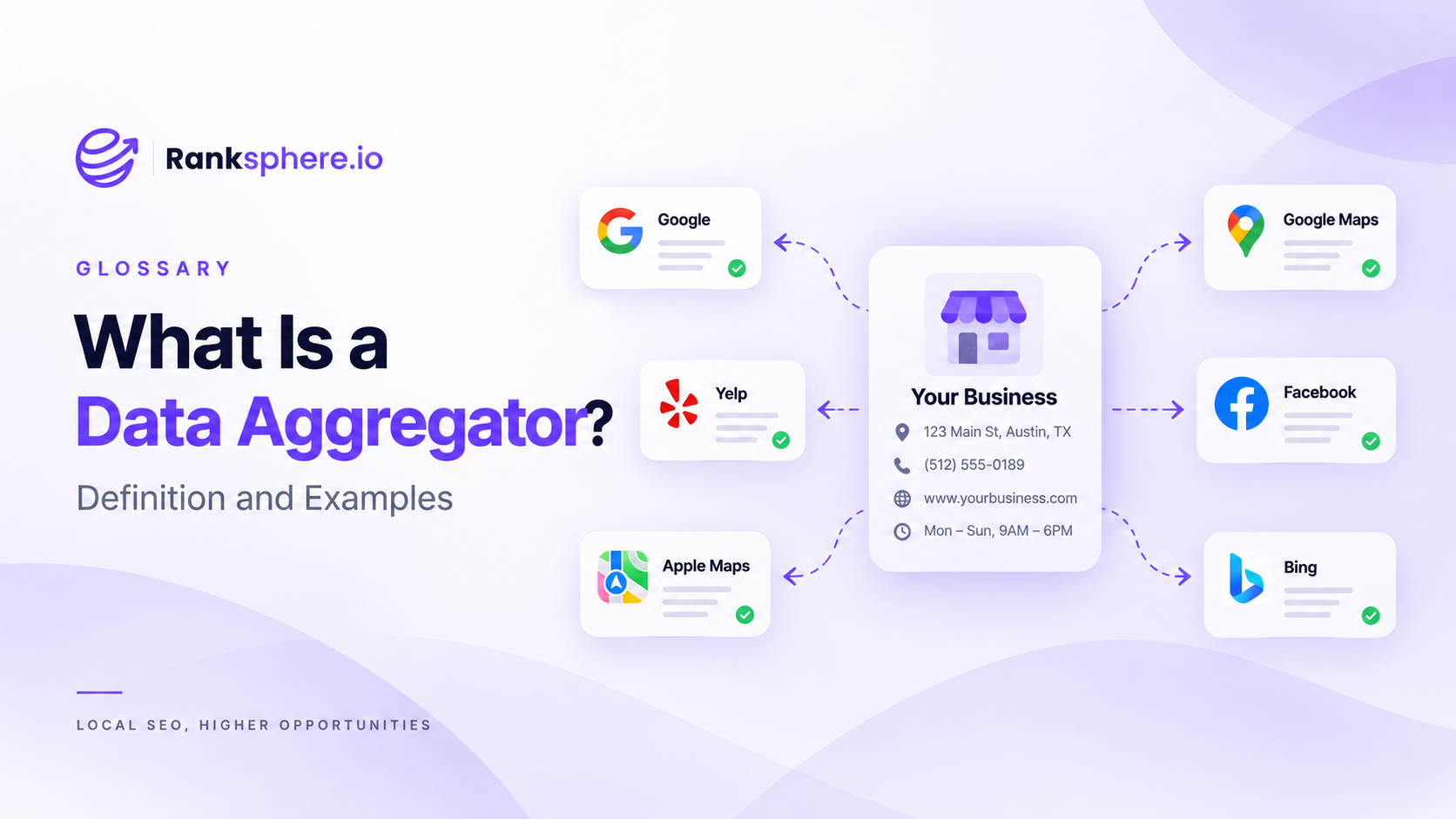
A data aggregator collects business information and supplies it to other platforms such as directories, map services, apps and navigation systems.
For local SEO, aggregators matter because one record can influence several other listings. If the information at the source is correct, that can help keep your business details consistent across multiple platforms. If the information is wrong, the same mistake can spread just as easily.
This is why aggregator records are worth checking when a business moves, changes its phone number or updates other important details.
Why data aggregators matter
Business information does not always stay in one place.
Directories and apps often receive data from third-party providers rather than collecting every business detail directly. That means an old address or phone number can continue appearing across the web even after you have corrected a few individual listings.
This is also why aggregators often sit high on the priority list during a citation audit. Fixing the source can be more effective than repeatedly correcting the same information on downstream sites.
Data aggregators can help:
- Distribute business information to multiple platforms
- Keep local listings aligned when records are accurate
- Supply data to map services, navigation tools and other apps
- Surface information about businesses that may never have submitted a listing directly
- Reduce repeated manual updates when several platforms use the same source
The key is knowing which data providers actually matter in your market.
Which data aggregators matter?
The aggregator landscape changes over time. Providers merge, rebrand and enter or leave different markets, so there is no single permanent list that applies everywhere.
Some well-known providers include:
- Data Axle — a long-established business data provider in the United States
- Foursquare — supplies location and place data to a range of apps and services
- Localeze — a business data provider used by various local search and directory platforms
Other companies may also distribute or syndicate local business information, even if they are not traditional aggregators in the strictest sense.
The important point is not memorising a fixed list. It is understanding which sources feed the directories, apps and map services that matter in your country and industry.
A business in the UK, for example, may need to pay attention to a different set of data sources than one operating in the United States.
How to work with data aggregators
Start by identifying which aggregators are relevant to your market and whether they already have a record for your business.
Then compare what they hold against your correct business information.
A sensible process is to:
- Confirm your correct business name, address and phone number first
- Check which aggregators hold information about the business
- Correct inaccurate records at the source where possible
- Review important downstream listings after the update has had time to spread
- Keep a record of which providers you have updated
- Re-check after a move, rebrand or phone-number change
Updates are not always immediate. Some platforms refresh quickly, while others may take longer to pull new information.
Ranksphere's citation management monitors listings across 500+ directories so you can check whether corrected business information is appearing across the wider citation footprint instead of assuming every platform has updated.
Data aggregators and NAP consistency
Aggregators are closely tied to NAP consistency because they often distribute a business's name, address and phone number to other services.
If your source information is outdated, that can create repeated inconsistencies elsewhere.
Before submitting any changes, make sure you have one reliable reference for each business location. That record should include the current:
- Business name
- Address
- Phone number
- Website
- Opening hours where relevant
The goal is not perfect punctuation on every platform. It is making sure the underlying business information is accurate and clearly refers to the same location.
Common mistakes
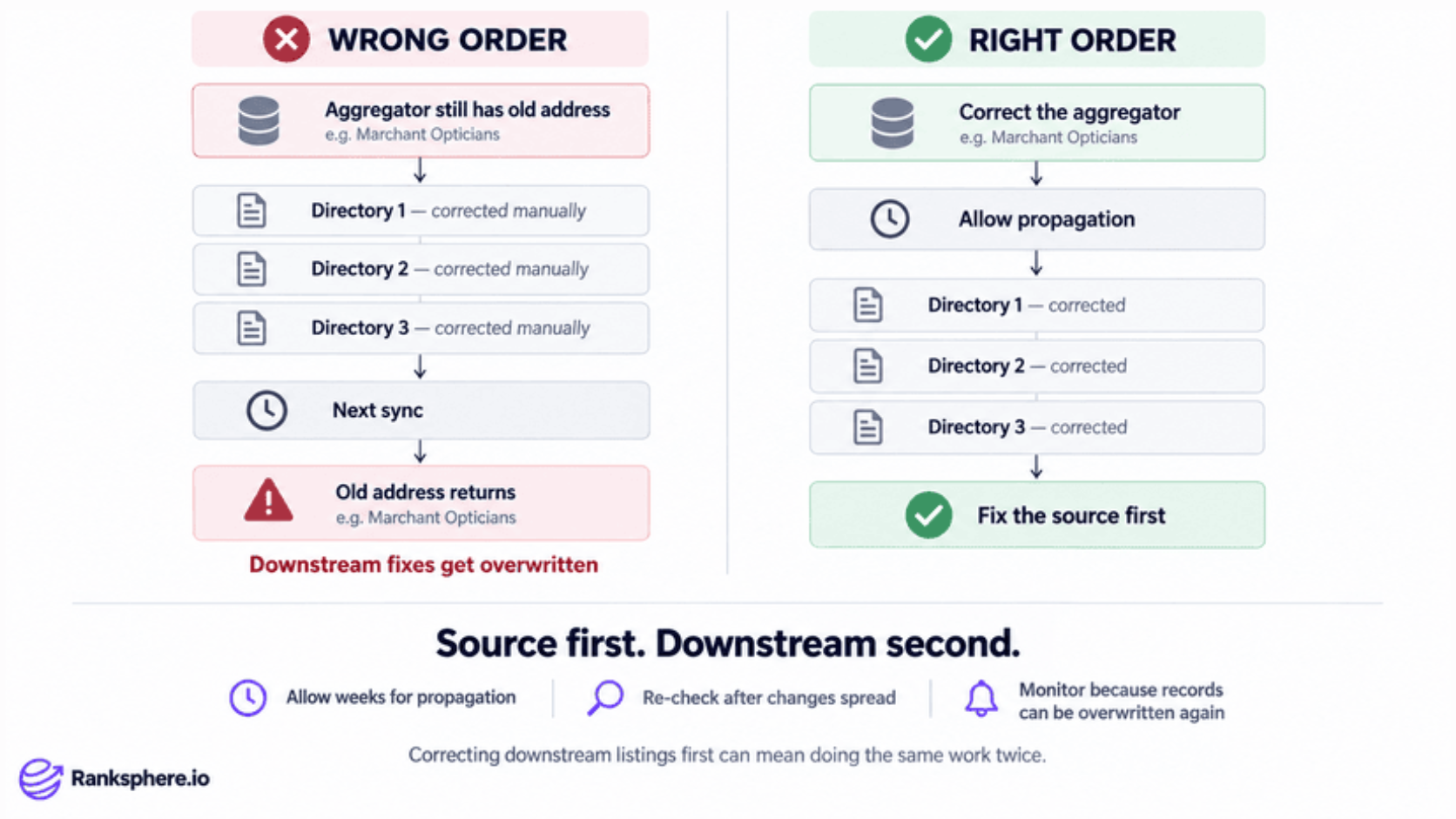
- Correcting individual directories without checking the source. If those platforms pull information from an aggregator, the wrong data may appear again later.
- Expecting every update to appear immediately. Different platforms refresh their data at different speeds.
- Assuming a correction has been applied everywhere. Check important listings after enough time has passed.
- Using a list of US aggregators for every market. The relevant providers vary by country.
- Ignoring aggregator records because you never created them. Business information can be collected from public and third-party sources.
- Only checking aggregators once. A future move or phone-number change may require another update.
- Treating every downstream mismatch as a separate problem. Several incorrect listings may trace back to the same source.
Best practices
- Confirm your NAP before making submissions. Make sure the information you are distributing is correct from the start.
- Fix source-level problems first. When several incorrect listings trace back to the same provider, start there.
- Prioritise aggregators relevant to your market. Do not spend time on providers that have little influence in your country.
- Keep records of your changes. Note what was updated and when so you can check propagation later.
- Allow time for updates to spread. Avoid repeatedly changing the same information simply because a downstream site has not refreshed yet.
- Check important platforms afterwards. Source-level fixes still need to be verified.
- Review records after major business changes. Moves, rebrands and new phone numbers are good reasons to check again.
Example
“Marchant Opticians moves to a new address and updates its details on several major directories.
A few weeks later, some of those listings start showing the previous address again.
Instead of correcting each one repeatedly, the practice looks for a common source and finds that an older business record is still being supplied through a data provider.
The source record is corrected first.
Over time, several of the affected listings begin showing the new address without needing another manual edit. A few platforms still require direct changes, but the repeated
reappearance of the old address stops.
The lesson is simple: when the same incorrect information keeps returning across several listings, it is worth checking where that data is coming from before fixing each platform one by one.”
See also
- Citation — an online mention or listing that carries business information
- NAP — the name, address and phone data being distributed
- Citation audit — where outdated aggregator records are often discovered
- Citation building — adding business information to relevant platforms
- Duplicate listing — multiple records that can create conflicting business data