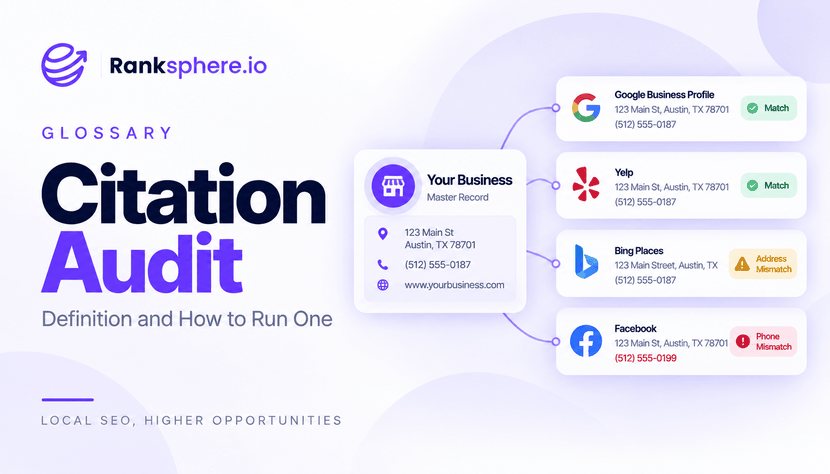
A citation audit is a review of the business information that appears across online directories, maps, review sites and other local platforms. The aim is to find incorrect, outdated or duplicate listings and compare them against the business details you know are current.
For most local businesses, it makes sense to audit first and build citations second.
Without an audit, it is easy to add new listings while an old address, previous phone number or duplicate profile is still circulating elsewhere. That creates more work later and makes it harder to understand which information customers and search platforms are seeing.
A good citation audit gives you a clear list of what is correct, what needs fixing and what is missing.
Why run a citation audit?
Business information rarely stays perfectly clean over time.
A company moves offices, changes its phone system or rebrands. A member of staff creates a listing that nobody else knows about. An old directory copies information from another source and continues displaying it years later.
Most of these changes happen quietly.
That is why a citation audit is useful. Instead of assuming your listings are accurate, you can see exactly where the problems are and deal with them in a sensible order.
A citation audit can help you:
- Find old addresses and phone numbers that are still visible online
- Identify duplicate listings
- Spot incorrect or inconsistent business information
- Find important platforms where the business is not yet listed
- Identify listings that nobody on the team currently controls
- Create a baseline for future citation management
For a business that has moved, rebranded or changed contact details, this kind of review is particularly important.
What should a citation audit check?
A useful citation audit looks at more than whether a listing exists.
There are several types of issue worth checking.
Duplicate listings
A duplicate occurs when the same business has more than one listing on the same platform.
This can happen after a move, a business-name change, an acquisition or simply because someone created a second listing without realising one already existed.
Duplicates are worth investigating because they can split customer reviews, create conflicting information and make the business harder to manage.
NAP mismatches
Compare each listing against the correct NAP for the location.
Look for meaningful differences such as:
- The wrong business name
- An old address
- An incorrect unit or suite number
- A previous phone number
- Contact details belonging to another location
Do not spend too much time worrying about harmless formatting differences. “Street” versus “St,” for example, is much less important than the listing pointing to the wrong physical location.
Outdated information
A listing can have the correct name, address and phone number and still be out of date.
Check for:
- Incorrect opening hours
- Closed or relocated branches
- Old website URLs
- Services that are no longer offered
- Previous branding
- Categories that no longer describe the business
Missing listings
The audit should also show where the business is absent.
This does not mean you need to appear on every directory available. Focus on platforms that make sense for the location, industry and customers.
Unclaimed listings
If a listing contains incorrect information but nobody has access to manage it, claiming or recovering that listing should become part of the cleanup work.
How to run a citation audit
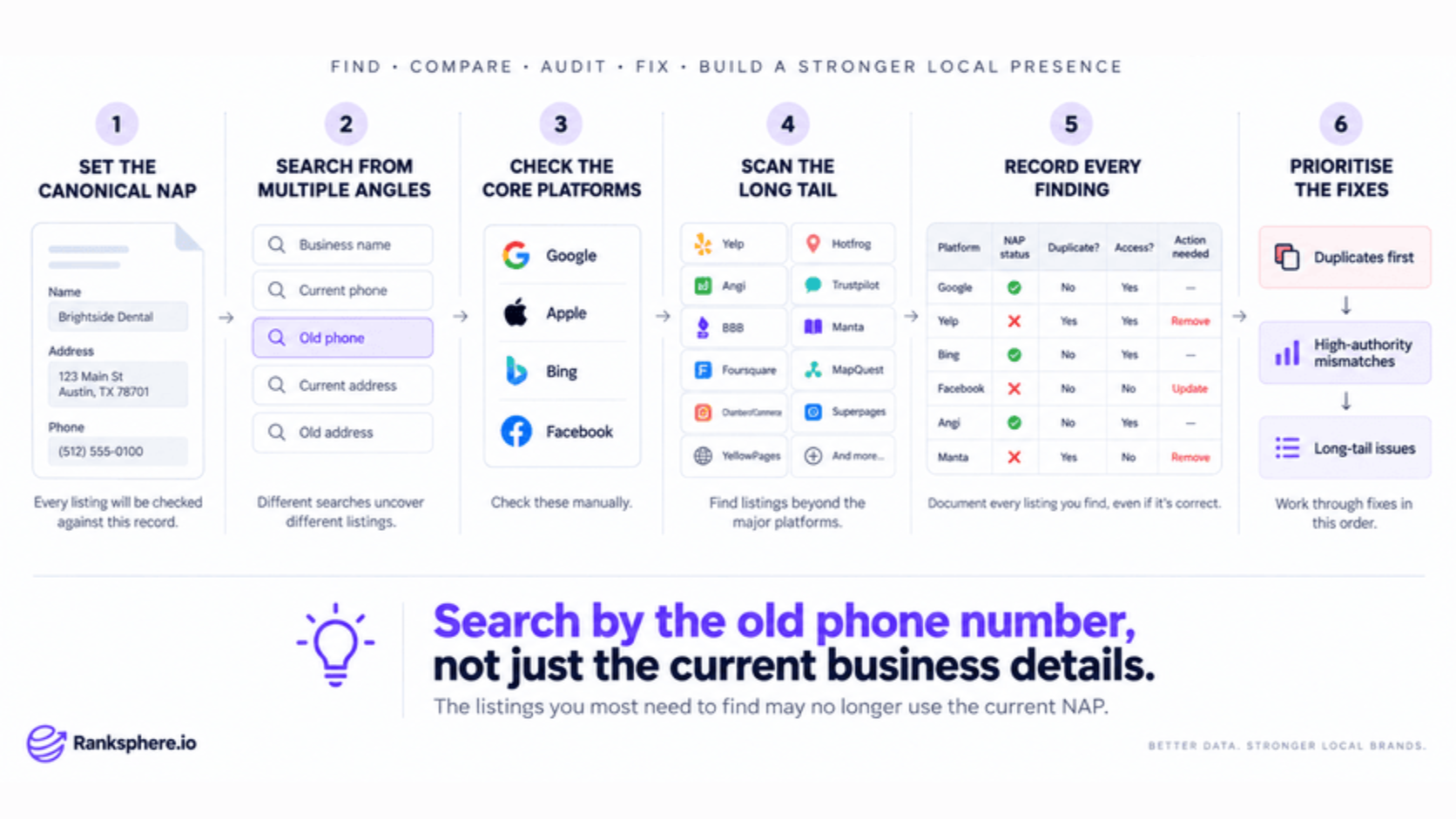
Start with a reliable reference for the business information you want every listing to represent.
For each location, record the current:
- Business name
- Address
- Phone number
- Website URL
- Opening hours
- Main business category
Once that is clear, start looking for existing listings.
Search for the business using more than one piece of information. A name search alone can miss older profiles created before a move or phone-number change.
A practical process is to:
- Search the current business name
- Search the current phone number
- Search any previous phone numbers
- Search the current address
- Search previous addresses where relevant
- Check major platforms manually, including Google, Apple and Bing
- Review important industry and local directories
- Record the status of every listing you find
- Note whether you have access to manage it
- Prioritise corrections based on importance and potential customer impact
Searching old information is especially useful after a move or rebrand. Older listings often continue to exist under details that no longer appear when you search the current business name.
Ranksphere's citation audit checks 500+ directories against one NAP reference and can re-run on a schedule, making it easier to spot mismatches, duplicates and new issues as they appear.
How to prioritise citation audit fixes
Not every problem needs to be treated with the same urgency.
Start with issues that are most likely to confuse customers or spread incorrect business data.
A sensible order is:
- Incorrect information on major search and map platforms
- Duplicate profiles on important platforms
- Old addresses or phone numbers on heavily used directories
- Incorrect records held by important data providers
- Listings with substantial customer reviews or traffic
- Remaining industry, local and general directories
- Missing citations worth adding after the cleanup is complete
This is usually more effective than fixing listings simply in the order you discover them.
Common citation audit mistakes
- Starting without a reference record. You need to know what the correct business information is before you can identify an error.
- Only checking Google. Important mistakes can remain live on map services, directories, review sites and data providers.
- Searching only the current business name. Old addresses and phone numbers can uncover listings that would otherwise be missed.
- Treating every formatting difference as a problem. Focus on errors that actually change or confuse the business information.
- Correcting duplicates as if they were separate legitimate listings. Sometimes they need to be merged, removed or otherwise resolved rather than simply edited.
- Ignoring listings you cannot access. Record them and work out how ownership or management can be recovered.
- Assuming the audit is permanent. Business information changes and new inconsistencies can appear over time.
Citation audit best practices
- Document the correct NAP before you begin. Use it as the reference for every location.
- Search current and historical business information. Previous numbers, names and addresses can reveal older listings.
- Record every important listing you find. Include the URL, status, accuracy and whether the business has access.
- Prioritise by impact. Major platforms and genuine customer-facing errors should be addressed first.
- Claim important profiles. Managed listings are easier to correct when the business changes later.
- Audit each location separately. Multi-location businesses should not assume one branch's data represents the whole company.
- Run another audit after major changes. Moves, rebrands, acquisitions and phone-number changes are good reasons to check again.
- Review citations periodically. You do not need to obsess over them every week, but occasional checks help prevent old information from building up.
Example
“Hollow Lane Veterinary changed its main phone number several years ago.
Its current listings looked fine at first glance. Google, Apple and several major directories all showed the correct number.
During a citation audit, the old phone number was searched separately.
That uncovered a group of older listings that had never been updated. Some were on minor directories, while others appeared on platforms that still received customer traffic. One duplicate profile also contained reviews that staff at the practice had never been monitoring.
Instead of updating everything at random, the practice worked through the issues by priority.
The important duplicate was dealt with first, followed by the listings most likely to send customers to the wrong number. Lower-priority directories were cleaned up afterwards.
The audit did not create more citations. It showed the business which existing ones actually needed attention.
That is the real purpose of a citation audit: find the problems first, then decide what is worth fixing, removing or building next.”
See also
- Citation — an online mention or listing of a business
- NAP — the business information used as the reference during an audit
- Citation building — creating new listings after existing ones have been reviewed
- Duplicate listing — multiple profiles for the same business or location
- Data aggregator — a service that distributes business information to other platforms