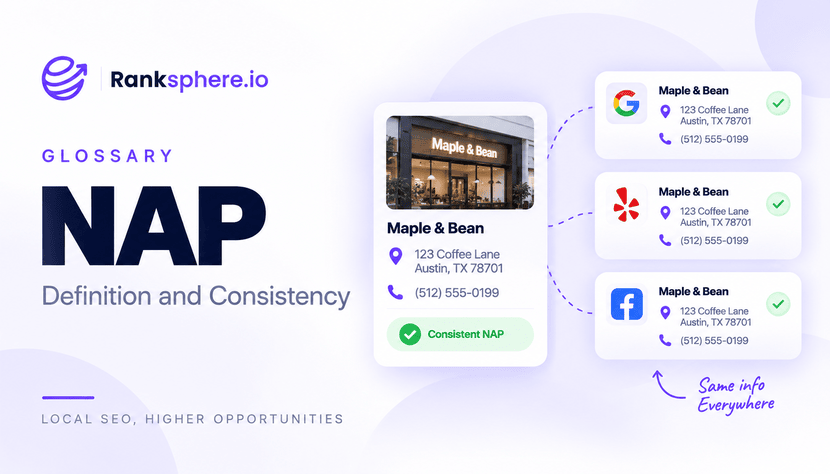
NAP stands for name, address and phone number — the basic details used to identify a business online. NAP consistency means keeping those details accurate and aligned wherever the business appears, from Google Business Profile and directories to review sites and local websites.
For local SEO, the goal is not to make every listing character-for-character identical. Search engines can usually understand common formatting differences. What matters is that each source clearly points to the same business, at the same location, using the correct contact information.
Problems start when the differences are meaningful: an old address is still live, two phone numbers appear across important directories, or the business name has been changed on some listings but not others.
Why NAP consistency is important in Local SEO
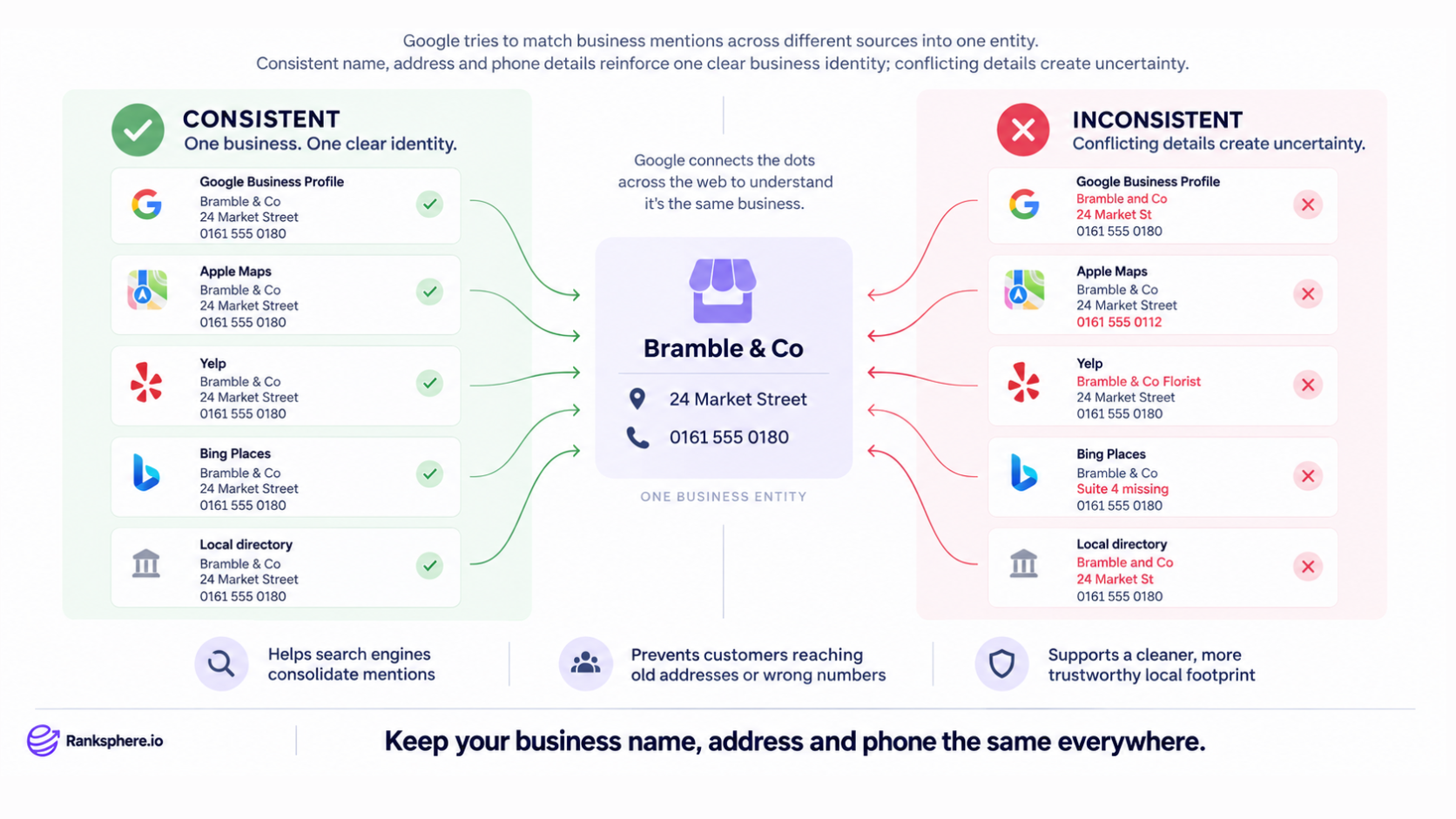
Search engines build a picture of a local business using information from many different sources.
When those sources broadly agree, it is easier to connect the listings and mentions to the same business. When important details conflict, Google and other platforms have to work out which information is current.
There is also a much simpler reason to keep NAP information accurate: customers use it.
An outdated phone number can cost you an enquiry. An old address can send someone to the wrong location. Incorrect opening or location information can create a poor experience before the customer ever speaks to the business.
Accurate NAP information helps:
- Keep your business details clear across the web
- Connect citations and listings to the correct business
- Support the wider signals involved in local ranking factors
- Prevent customers calling the wrong number or visiting an old address
- Keep your Google Business Profile aligned with other important listings
NAP consistency is best thought of as data hygiene. It gives customers and search platforms reliable information about the business wherever they find it.
What counts as a NAP inconsistency?
Not every small formatting difference is a problem.
“24 Market Street” and “24 Market St” can usually be understood as the same address. Likewise, phone numbers may appear with spaces, brackets or country codes without creating genuine confusion.
The issues worth fixing are the ones that change the meaning of the information.
Business name
Examples include:
- Bramble & Co
- Bramble and Co
- Bramble & Co Florist Manchester
- Bramble & Co Ltd
Minor stylistic variations may be understood, but unnecessary keywords, outdated trading names and inconsistent legal suffixes can make business information less clear.
Use the real-world name customers see on the business, rather than changing it from directory to directory for SEO.
Address
Address problems become more important when they could point to a different place.
Watch for:
- Previous business addresses
- Missing or incorrect unit numbers
- Wrong postcodes
- Different building numbers
- Addresses for virtual offices or mailboxes that are not valid business locations
Abbreviations such as “Road” and “Rd” are much less important than having the actual location wrong.
Phone number
Formatting differences are normally harmless. A genuinely different number is not.
Old landlines, numbers from previous locations and incorrectly implemented call-tracking numbers are the main things to look for.
How to improve NAP consistency
Start by deciding which business information should be treated as your reference.
For each location, document:
- Business name
- Street address
- Unit or suite number where relevant
- Postcode
- Main phone number
- Website URL
Then compare your important online listings against that record.
A practical order is:
- Check your Google Business Profile
- Review major map and search platforms
- Check the main data aggregators
- Review important industry and local directories
- Find and correct outdated or duplicate listings
- Repeat the audit whenever the business moves, rebrands or changes phone numbers
You do not need to obsess over punctuation. Focus first on information that could genuinely confuse a customer or cause platforms to associate the listing with the wrong business.
Ranksphere's citation management audits NAP across 500+ directories against a single reference record, making it easier to find outdated information, mismatches and duplicate listings.
NAP consistency and call tracking
Call tracking is useful because it helps businesses understand where enquiries are coming from. The problem comes when tracking numbers are introduced without considering the main business number.
If different directories show completely unrelated phone numbers, it becomes harder to maintain a clean business footprint.
The right setup depends on the platform.
On your website, dynamic number insertion can show different numbers to visitors for attribution while keeping the underlying business information consistent.
On platforms that support additional phone numbers, you can usually preserve the established business number while using tracking in a way that still keeps the genuine number associated with the profile.
The aim is not to avoid call tracking. It is to use it without replacing your core business information everywhere.
Common mistakes
- Adding SEO keywords to the business name. A name such as “Bramble & Co Florist Manchester” should not be used unless that is genuinely how the business is represented in the real world. It can also create problems with Google Business Profile suspension.
- Building new citations before checking existing ones. New listings will not fix old information that is still circulating elsewhere.
- Updating Google and forgetting the rest. Maps, directories and review sites may continue displaying the previous address or phone number.
- Treating harmless formatting differences as emergencies. “Street” versus “St” matters far less than an incorrect building number or an outdated location.
- Using different phone numbers without a tracking plan. Call tracking should be implemented deliberately rather than replacing numbers at random.
- Letting individual branches manage information independently. This is one of the easiest ways for details to drift across a multi-location business.
- Treating NAP cleanup as a one-time project. Business information changes, and listings can become outdated again.
Best practices
- Keep one reference record for each location. Make it easy for anyone managing directories or profiles to find the correct information.
- Use the real-world business name. Avoid adding locations, services or promotional wording purely for SEO.
- Prioritise accuracy over identical punctuation. Search engines can understand normal address and phone formatting variations.
- Correct the most important platforms first. Start with Google, major map services, data providers and directories customers actually use.
- Manage call tracking carefully. Keep the genuine business number associated with the location wherever possible.
- Review listings after major business changes. Moves, rebrands and number changes should always trigger a citation audit.
- Check multi-location businesses individually. Each branch needs its own accurate NAP rather than one set of details reused across the company.
Example
“Fairfield Dental Group operates three practices, each of which was added to directories at a different time by different members of staff.
Over the years, the information has started to drift.
One branch appears as “Fairfield Dental,” another as “Fairfield Dental Group,” while several older directories still use the company’s previous phone number. At the newest practice, some listings are also missing the suite number.
None of the errors looks particularly serious on its own. Taken together, however, they create a poor experience for customers and make the business information unnecessarily difficult to manage.
The group creates one reference record for each practice and works through the most important listings first. Old phone numbers are corrected, missing suite details are added, duplicate profiles are dealt with and the business name is brought back into line with the real-world branding.
The biggest benefit is not a sudden jump in rankings. It is that customers now see the correct details wherever they find the business, and future updates are much easier because every location has a clear source of truth.
That is what good NAP management should achieve: accurate business information that stays dependable over time.”
See also
- Citation — where business name, address and phone information appears across the web
- Citation audit — finding incorrect and outdated business listings
- Duplicate listing — multiple listings that can create conflicting business information
- Google Business Profile — one of the most important sources of local business information
- Multi-location SEO — managing accurate business information across several branches
- Local ranking factors — the broader signals involved in local search visibility