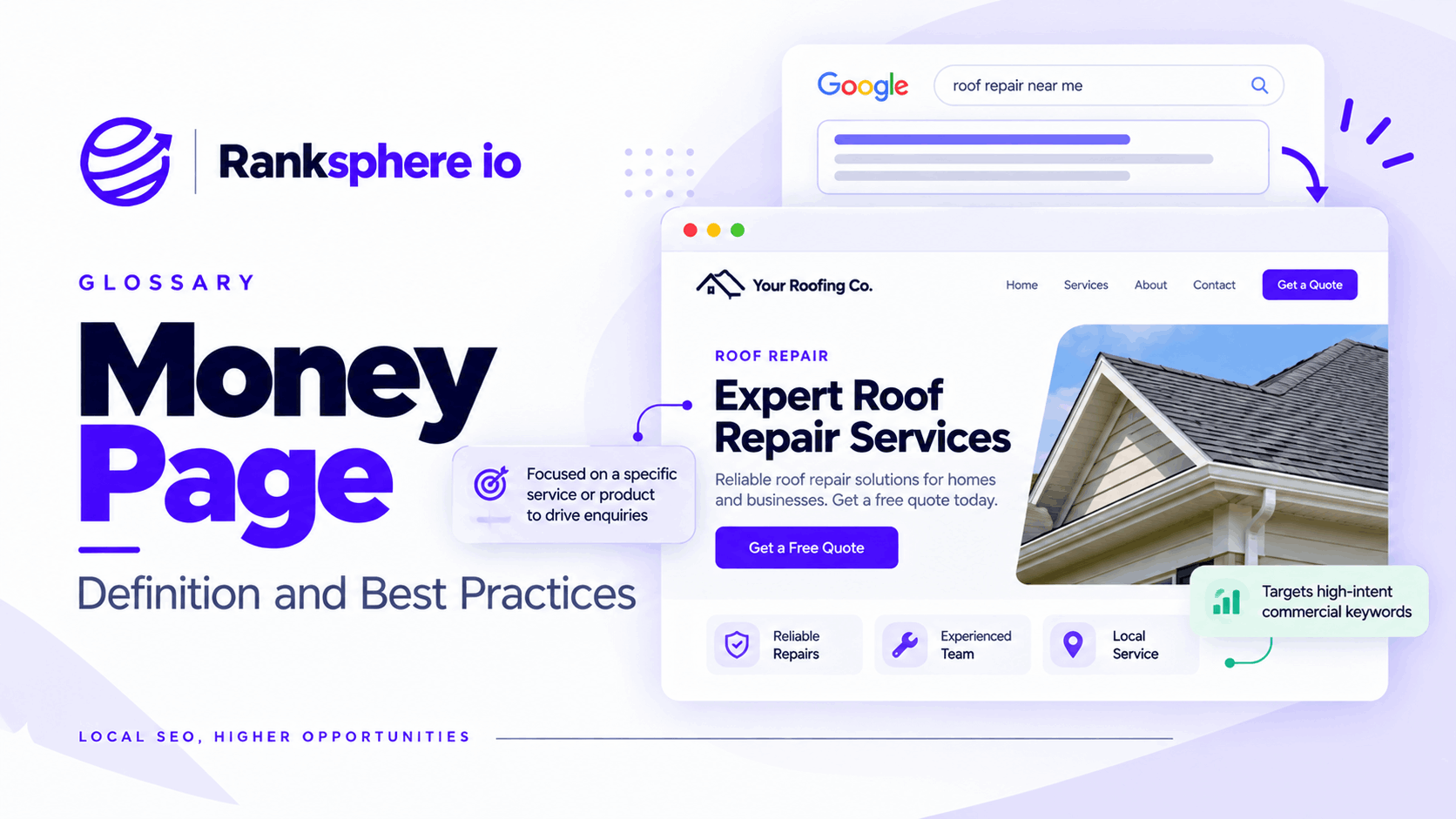
A money page is a webpage designed to attract potential customers and encourage them to take action, such as requesting a quote, booking an appointment, making a purchase or calling a business.
Unlike pages written mainly to answer questions, money pages focus on services, products or offers that customers are actively considering.
For local businesses, money pages typically include service pages, treatment pages, product pages, pricing pages and location pages.
A money page should do more than bring visitors to your website. It should help them decide whether your business is right for them and make the next step easy.
What Are Examples of Money Pages?
The type of money page a business needs depends on what it sells and how customers make purchasing decisions.
| Business | Example money pages |
|---|---|
| Roofing company | Roof repairs, flat roofing, roof replacement |
| Dental clinic | Dental implants, Invisalign, teeth whitening |
| Physiotherapy clinic | Sports injury treatment, physiotherapy appointments |
| Plumbing company | Boiler installation, leak repairs, emergency plumbing |
| Software company | Product features, pricing, subscriptions |
Each page should clearly explain the specific service or product it covers.
For example, a dental implants page might explain the procedure, who it is suitable for, recovery expectations, costs and how to book a consultation.
Someone researching dental implants can find the information they need without searching through a general treatments page.
Money Pages vs Blog Posts
The main difference is the purpose of the page and the search intent it serves.
| Money page | Blog post |
|---|---|
| Targets commercial or transactional needs | Usually targets informational needs |
| Explains a service, product or offer | Answers questions or explains a topic |
| Encourages enquiries, purchases or bookings | Helps visitors research and understand |
| Often includes prices, benefits and next steps | Often includes examples, advice and explanations |
For example:
Money page: Dental Implant Treatment in Manchester
Blog post: How Long Does a Dental Implant Take to Heal?
The first page helps someone evaluate and book a treatment.
The second answers a question someone may have before deciding.
Both can contribute to customer acquisition.
A useful blog post can attract someone during the research stage and direct them to a relevant service page through internal linking.
However, the distinction isn't absolute. Informational articles can generate enquiries, and money pages can answer detailed questions.
A well-structured website uses both according to customer needs.
Why Are Money Pages Important for Local SEO?
Money pages give search engines and customers a clearer understanding of individual services.
Consider a roofing company offering roof repairs, new installations, flat roofing and emergency repairs.
If the website has only one general roofing page, visitors may struggle to find detailed information about the service they need.
Dedicated pages can help when those services have distinct search intents.
For example, someone searching for "emergency roof repair" has different needs from someone comparing the costs of a new roof installation.
The emergency customer may want opening hours, service availability and a telephone number.
The installation customer may need information about materials, pricing and the quotation process.
Separate pages allow the business to address those needs properly.
However, Google doesn't automatically rank a dedicated service page above a broader page.
Creating multiple nearly identical pages for keyword variations can add little value and may create doorway-page problems when their main purpose is manipulating search rankings.
The decision should depend on whether each page serves a genuinely different purpose.
What Makes a Good Money Page?
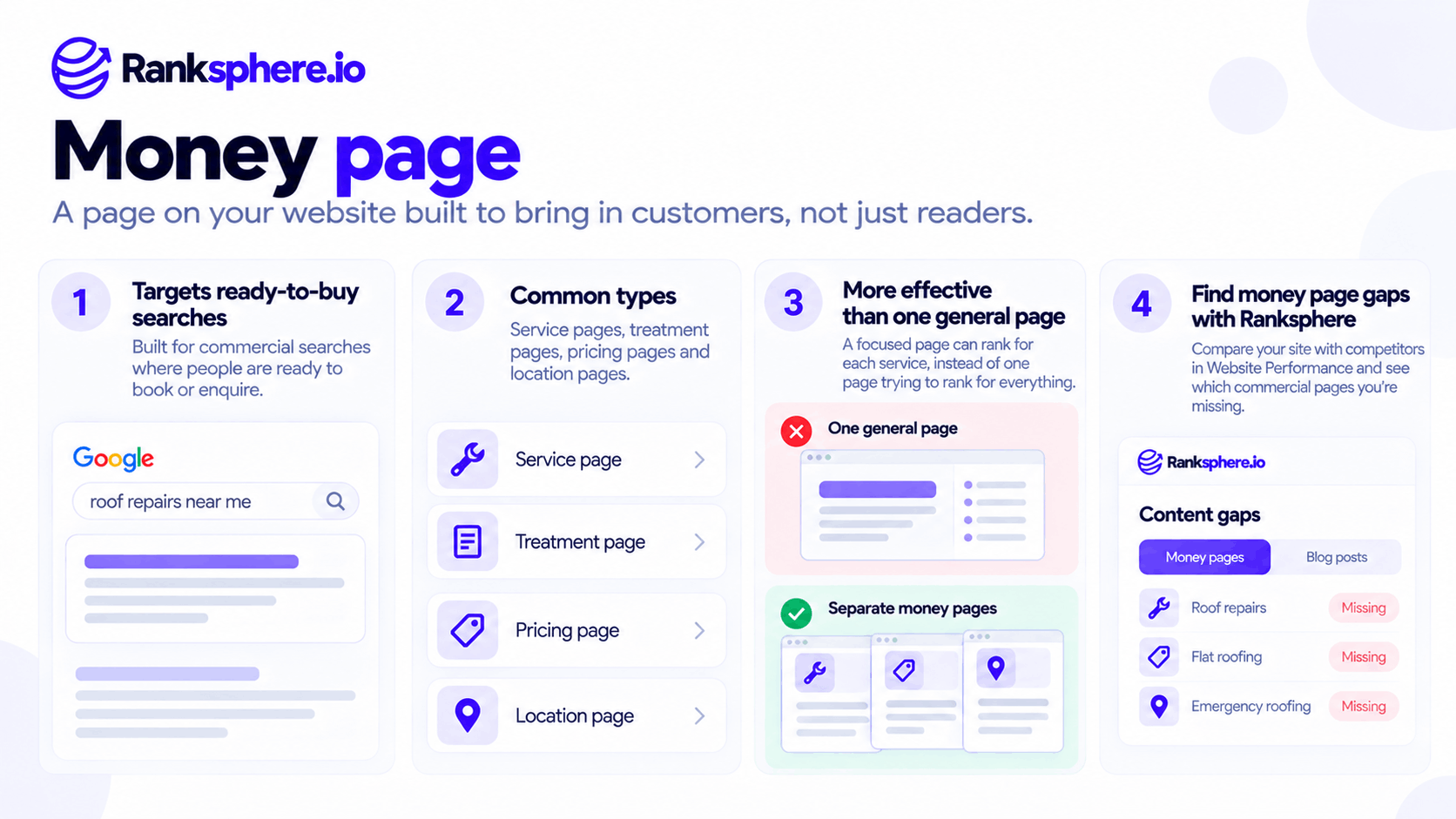
A successful money page should help a potential customer understand what the business offers and what to do next.
Important elements include:
- Clear service or product information. Explain exactly what is included and who it is suitable for.
- Relevant location details. State where the business operates when location affects the service.
- Pricing information where practical. Provide genuine prices, starting prices or explain what affects the cost.
- Evidence and trust. Use authentic examples, qualifications, project photographs or relevant customer feedback.
- Answers to common questions. Address costs, availability, timescales and other concerns.
- A clear call to action. Make it easy to request a quote, book an appointment or contact the business.
The content should be specific to the service rather than reused across every page with only the service name changed.
For businesses providing regulated services, such as medical or financial advice, factual accuracy and appropriate professional review are particularly important.
How to Find Missing Money Pages
One way to identify missing money pages is through content gap analysis.
Compare your website with competitors offering similar services.
Look for important services, treatments or commercial topics they cover that your website doesn't adequately address.
For example, a physiotherapy clinic may have one general Treatments page, while a competitor provides detailed pages for sports injury rehabilitation, back pain treatment and post-operative physiotherapy.
Those pages may represent useful opportunities if the clinic genuinely provides the services.
However, don't create every page a competitor has simply because it exists.
Check whether the topic is relevant, whether customers need a separate page and whether your current website already covers it adequately.
How Ranksphere Helps Identify Money Pages
Ranksphere includes content gap analysis within Website Performance.
To find opportunities:
- Open the relevant location in Ranksphere.
- Go to Website Performance.
- Open the Content Gaps card.
- Enter a competitor's website.
- Review the suggested Money Pages and Blog Content opportunities.
Ranksphere compares discovered pages on your website with pages found on the competitor's website.
It separates missing commercial topics from informational content, making it easier to identify service or product pages worth reviewing first.
Each suggestion includes a recommendation and the competitor page on which the opportunity is based.
This helps you identify genuine competitor content gaps rather than relying on unrelated page ideas.
The final decision about what to publish should still depend on your services, customers and search intent.
Common Money Page Mistakes
- Creating a page for every keyword variation. Closely related searches may belong on one useful page.
- Publishing thin service pages. A heading and two generic paragraphs rarely help customers make decisions.
- Hiding important information. Visitors should be able to understand the service before contacting the business.
- Ignoring pricing questions. Explain actual costs or relevant pricing factors where possible.
- Copying competitor service pages. Use competitor research to find gaps, not reproduce their content.
- Creating location pages without meaningful differences. Near-identical city pages can create doorway-page risks.
- Measuring only rankings. A money page should also be evaluated by relevant enquiries and customer actions.
Money Page Best Practices
Start with the main services or products your business genuinely offers.
Create separate pages where customers have different needs or search intents.
Include original information, useful detail and clear next steps.
Connect relevant informational articles to commercial pages through internal links.
Update prices, service availability and other important details when they change.
Measure performance using relevant organic traffic, enquiries, bookings and sales where that information is available.
Example of Money Pages for a Dental Clinic
Consider a hypothetical dental clinic offering dental implants, Invisalign, composite bonding and teeth whitening.
Its website has one Treatments page containing a brief description of each service.
The clinic notices that competing practices have dedicated pages explaining individual treatments.
What the Clinic Changes
The clinic creates a separate page for each major treatment.
The dental implants page explains suitability, treatment stages, recovery, pricing considerations and the consultation process.
The Invisalign page addresses treatment duration, eligibility, costs and appointment arrangements.
The clinic also publishes helpful informational articles that link to the relevant treatment pages.
Example
“The clinic now gives patients more detailed information about each treatment.
Someone considering Invisalign doesn't need to search through unrelated dental services to find what they want.
The new pages may improve the site's ability to satisfy relevant searches, but rankings and bookings are not guaranteed.
The value of a money page comes from helping the right visitor make an informed decision, not simply from targeting another keyword.”
See Also
- Content Gap Analysis — Finding missing commercial and informational content.
- Service Page — Explaining individual services and their benefits.
- Search Intent — Understanding what customers want from a search.
- Internal Linking — Connecting helpful content with relevant commercial pages.
- Conversion Rate Optimisation — Improving how effectively pages generate customer actions.
- On-Page SEO — Optimising individual pages for search relevance and usability.