Readability describes how easy written content is to read and understand. In SEO, it refers to how clearly a webpage communicates information to its intended audience.
Readability tools often evaluate writing using factors such as sentence length, word length, and syllable count. They then calculate a score or estimated reading level.
These scores can help identify passages that may be difficult to follow, but they don't measure the overall quality of the content.
For example, a medical article may receive a low readability score because it contains specialist terminology. That doesn't necessarily mean the article is poorly written or difficult for its intended audience to understand.
For SEO, there's another important distinction: readability scores such as Flesch Reading Ease are not confirmed direct Google ranking factors.
A page doesn't need to achieve a particular reading level to rank well.
What matters is whether readers can find, understand, and use the information they came for.
How Do Readability Scores Work?
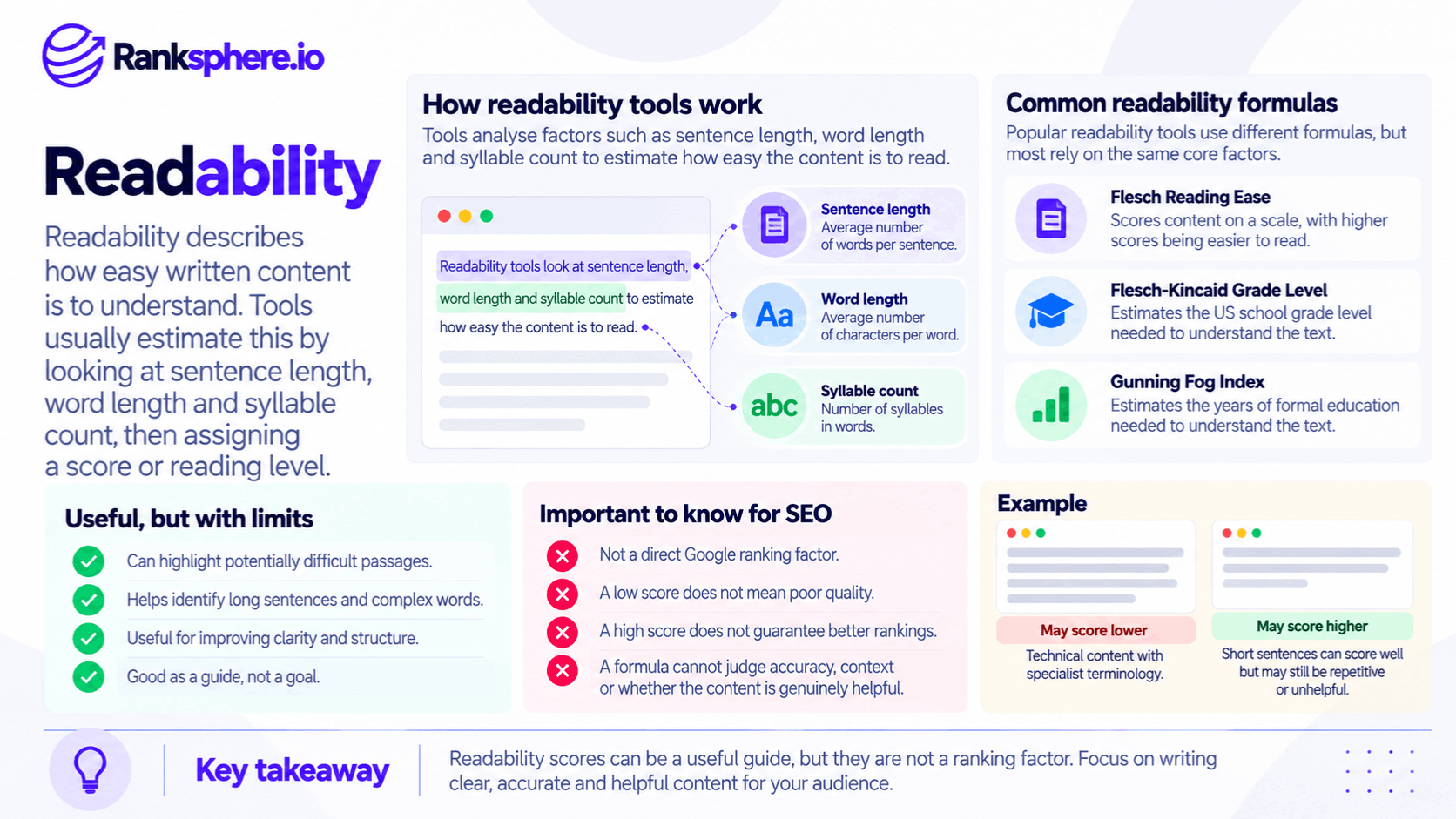
Readability formulas estimate how difficult a piece of writing may be for readers.
Different formulas use different calculations, but many focus on sentence length and word complexity.
Popular readability formulas include:
- Flesch Reading Ease — Produces a score based on average sentence length and syllables per word. Higher scores generally indicate easier reading.
- Flesch-Kincaid Grade Level — Estimates the US school grade level associated with the text's reading difficulty.
- Gunning Fog Index — Estimates reading difficulty using sentence length and the proportion of complex words.
These formulas can be useful for identifying dense passages.
For example, a paragraph containing several long sentences and unfamiliar words may receive a more difficult reading score than one using shorter, more familiar language.
However, a readability formula cannot determine whether an article is accurate, well organised, or genuinely useful.
It doesn't understand why a technical term is necessary or whether an explanation makes sense.
A well-written legal guide may receive a difficult score because the subject requires specific terminology.
Meanwhile, an article containing very short sentences may score well while still being repetitive or confusing.
Readability scores are indicators of potential difficulty, not final judgements on content quality.
Is Readability a Google Ranking Factor?
There is no confirmed evidence that Google uses common readability formulas, such as Flesch Reading Ease or Flesch-Kincaid Grade Level, as direct ranking factors.
This distinction matters because many SEO tools and plugins include readability checks alongside technical SEO recommendations.
For example, a WordPress plugin may display a red warning when an article contains too many long sentences.
That warning can make it seem as though the page has an SEO problem that will prevent it from ranking.
However, a low readability score doesn't automatically mean Google will rank the page lower.
Why Google Doesn't Require One Reading Level
Different topics require different levels of explanation.
A page explaining how to book a dental appointment should be easy for patients to understand.
A technical guide written for dental professionals may need specialist medical terminology.
Both can be appropriate for their intended audiences.
Requiring every page to meet the same reading level wouldn't necessarily make search results more useful.
Instead of writing to satisfy a formula, focus on whether the content answers the reader's question clearly and accurately.
How Readability Supports SEO
Although readability scores aren't direct ranking factors, clear writing can contribute to a better user experience.
When information is easy to follow, visitors may find it easier to:
- Understand a product or service
- Compare available options
- Find answers to specific questions
- Follow instructions
- Decide what to do next
For example, a patient researching dental implants may want to understand treatment costs, recovery time, and what the procedure involves.
If those answers are buried in dense paragraphs filled with unexplained terminology, the page becomes harder to use.
Improving the structure and wording makes the information more accessible.
This aligns with the broader emphasis on helpful, reliable, people-first content discussed in E-E-A-T.
However, E-E-A-T is not a single ranking score, and improving readability doesn't guarantee higher search rankings.
What Makes Content Easy to Read?
Good readability involves more than reducing sentence length.
The organisation of the page, the language used, and how quickly readers can find information all influence how easy content is to understand.
Answer the Main Question Early
People arriving from Google often have a specific question.
They shouldn't need to read several introductory paragraphs before finding the answer.
For example, someone searching for "how long do dental implants take?" probably wants to know the expected treatment timeline.
A useful page should address that question early, then explain the factors that affect the duration.
This doesn't mean removing useful detail.
It means presenting the most relevant information before expanding on it.
Use Clear, Descriptive Headings
Good heading tags help readers understand what each section covers.
They also make longer articles easier to scan.
Compare these two headings:
More Information
How Much Does Dental Implant Treatment Cost?
The second heading tells readers exactly what they can expect to find.
Descriptive headings are particularly useful on service pages, guides, and articles covering several questions.
Headings should reflect the content beneath them rather than exist only to include keywords.
Keep Paragraphs Manageable
Long, uninterrupted blocks of text can be difficult to read, especially on mobile devices.
Breaking content into manageable paragraphs makes it easier for visitors to follow each idea.
For example, a service page explaining treatment preparation, the procedure, and recovery may be easier to understand when those topics are separated.
However, not every paragraph needs to contain only one sentence.
Use natural paragraph breaks whenever the explanation moves to a new point.
Use Language Your Customers Understand
Businesses sometimes describe their services using terminology that customers rarely use.
For example, a dental practice may refer to the "surgical extraction of impacted third molars."
That is medically meaningful, but many patients are more familiar with "wisdom tooth removal."
Using the language customers recognise makes the page easier to understand.
It can also help align the content with the terms people use when searching.
This doesn't mean technical language should always be removed.
Use familiar wording where appropriate and explain specialist terminology when readers need it.
Explain Technical Terms Clearly
Some topics require technical language.
For example, a dental implants page may need to explain osseointegration, the process through which bone bonds with an implant.
Removing the term entirely could make the explanation less accurate.
A better approach is to introduce it clearly:
Osseointegration is the process in which the jawbone grows around and bonds with a dental implant, helping provide a stable foundation for the replacement tooth.
Once readers understand the meaning, the term can be used naturally throughout the article.
The goal is clarity without sacrificing accuracy.
Organise Information in a Logical Order
Content can use simple language and still be difficult to follow if the information appears in the wrong order.
For example, a guide explaining a medical procedure might be easier to understand when it follows this structure:
- What the procedure involves
- Who may need it
- How to prepare
- What happens during treatment
- Recovery and aftercare
- Costs and common questions
The exact order should reflect the reader's needs.
Good organisation often improves readability more than rewriting every long sentence.
Use Lists When They Make Information Clearer
Lists are useful for information readers may want to scan or compare.
For example, a roofing company's service page might use a short list to explain the types of repairs it offers.
However, turning every paragraph into bullet points can make an article feel fragmented.
Use lists when they improve understanding, not simply because an SEO plugin recommends them.
When Are Readability Scores Useful?
Readability tools can be helpful during editing, particularly when content feels unnecessarily complicated.
They can highlight passages worth reviewing.
Identifying Long or Complicated Sentences
A readability checker may flag sentences containing several ideas or unnecessary words.
For example:
Before
"Patients who are considering undergoing dental implant treatment should initially arrange a consultation appointment during which their eligibility for the procedure can be assessed."
After
"If you're considering dental implants, the first step is a consultation to check whether the treatment is suitable for you."
The second version is shorter and more direct without changing the main meaning.
However, not every long sentence needs rewriting.
Sometimes a longer sentence explains a relationship between ideas more clearly than several short ones.
Reviewing Technical Content for General Audiences
Readability scores can be useful when specialist content is intended for customers rather than professionals.
For example, a physiotherapy clinic may have an article written by a practitioner.
The information may be accurate but contain terminology that patients don't understand.
A readability check can highlight areas where explanations need simplifying.
The objective should be to clarify the meaning rather than remove necessary medical terms.
Maintaining Consistency Across Writers
Agencies producing content for multiple clients may use readability tools as part of their editorial review.
For example, a content team can check whether articles contain unusually dense paragraphs or overly complicated sentences.
This can help maintain a consistent writing style.
However, writers should still make editorial decisions based on the topic, intended audience, and purpose of the page.
A readability score should support the editing process, not replace it.
Common Readability Mistakes in SEO
Readability tools can be useful, but following their recommendations too rigidly can make content worse.
Writing Only to Improve the Score
One of the most common mistakes is rewriting content until an SEO plugin displays a green readability indicator.
This can lead to unnatural writing.
Sentences become unnecessarily short. Useful terminology disappears. Explanations lose their detail.
The readability score may improve even when the article becomes less helpful.
Instead of trying to reach a particular number, ask whether the writing is easier for the intended audience to understand.
Treating Plugin Warnings as Google Penalties
A red readability warning doesn't mean Google has penalised the page.
It means the tool has identified characteristics associated with more difficult reading.
That's useful feedback, but it isn't proof that the page has a ranking problem.
Review the flagged section and decide whether the recommended change would genuinely help readers.
Removing Important Technical Terms
Technical terminology can lower readability scores because the words are often longer or less familiar.
However, these terms may be necessary for accuracy.
A medical article shouldn't avoid the word osseointegration simply because a plugin considers it difficult.
Explain the term clearly instead.
Using the Same Reading Level for Every Audience
Not every website serves the same audience.
A plumbing service page written for homeowners should use different language from a technical installation manual written for engineers.
Both can be readable for their intended readers.
Readability should be evaluated in context rather than against a universal target.
Assuming Shorter Sentences Are Always Better
Short sentences can improve clarity.
However, using too many disconnected sentences can make writing feel repetitive and unnatural.
Readers need transitions and explanations that connect related ideas.
Vary sentence length where appropriate and focus on making each point easy to follow.
Ignoring Page Structure
A page can contain simple sentences and still be difficult to use.
For example, important information may be buried near the bottom, headings may be vague, or related topics may appear in different sections.
Improving the structure can make a greater difference than adjusting individual sentences.
Readability Best Practices for SEO Content
When writing or editing content, focus on the people who will read it.
A practical approach includes:
- Identify the intended audience before writing.
- Answer the main search question early.
- Use descriptive headings that reflect the content.
- Keep paragraphs manageable, particularly on mobile.
- Use familiar language where possible.
- Explain specialist terminology when readers need it.
- Organise information in a logical order.
- Use lists and tables when they make information easier to understand.
- Vary sentence length naturally.
- Review passages flagged by readability tools.
- Read the content aloud to identify awkward wording.
- Avoid changing accurate explanations simply to improve a score.
Reading the content aloud can be particularly effective.
If a sentence feels difficult to say naturally, it may also be difficult to read.
However, remember that the most important question is whether the intended reader can understand the information.
Example of Improving Readability on a Local Business Website
Consider a hypothetical dental practice that hires an SEO agency to review its website content.
The agency runs the pages through a readability checker.
Nine of the twelve service pages receive warnings indicating that the content may be difficult to read.
The dental implants page receives one of the lowest scores.
What the Agency Finds
The page contains specialist terms such as:
- Osseointegration
- Abutment
- Bone grafting
- Implant placement
These terms increase the estimated reading difficulty.
However, the page already explains most of them accurately.
The bigger problem is the organisation of the information.
Patients looking for treatment details have difficulty finding answers to two common questions:
How much do dental implants cost?
How long does the treatment take?
Both answers are buried within long sections of technical explanation.
The page contains useful information, but visitors have to work too hard to find it.
How the Agency Improves the Page
Instead of removing the technical terminology, the agency reorganises the content.
It moves important patient questions closer to the beginning of the page.
It also:
- Adds clear, question-based headings.
- Breaks dense paragraphs into more manageable sections.
- Explains technical terms when they first appear.
- Removes repetitive wording.
- Keeps medical information accurate.
- Makes treatment costs and timelines easier to locate.
The content remains detailed enough to answer more complex questions.
However, readers can now find the information they need without working through the entire article.
Example Shows
“The readability score may improve slightly, remain similar, or even become more difficult according to the formula.
That doesn't necessarily reflect the actual improvement to the page.
The content is now better organised, easier to navigate, and more useful to its intended audience.
The difference is simple:
Improving a readability score means changing the characteristics a formula measures. Improving readability means helping people understand the content.
For SEO, the second goal is more valuable.
Readability tools can support that process, but they shouldn't determine how content is written.”
See Also
- Heading Tags — Organising content with descriptive headings.
- On-Page SEO — Improving individual webpages for search engines and users.
- E-E-A-T — Understanding experience, expertise, authoritativeness, and trustworthiness.
- Featured Snippet — How Google may display concise answers from webpages.
- Content Brief — Defining the audience, search intent, and content structure before writing.
- Above the Fold — Understanding the content visitors see before scrolling.