E-E-A-T stands for Experience, Expertise, Authoritativeness and Trustworthiness.
It is a framework used in Google's Search Quality Rater Guidelines to help human quality raters assess whether search results appear useful, reliable and trustworthy.
E-E-A-T itself is not a single Google ranking factor, and websites do not receive a public E-E-A-T score.
Instead, Google says its automated ranking systems use a mixture of signals that can help identify content demonstrating qualities associated with experience, expertise, authoritativeness and trust.
That distinction matters.
You cannot optimise an E-E-A-T score in the same way you might improve a title tag or fix a broken internal link.
The practical goal is to make it clear:
- Who created the content
- Why they are qualified to discuss the subject
- Whether they have first-hand experience
- Whether the information can be trusted
- Who is responsible for the website
- Whether claims can be verified
For real businesses, much of this evidence already exists. The challenge is making it visible.
What does E-E-A-T stand for?
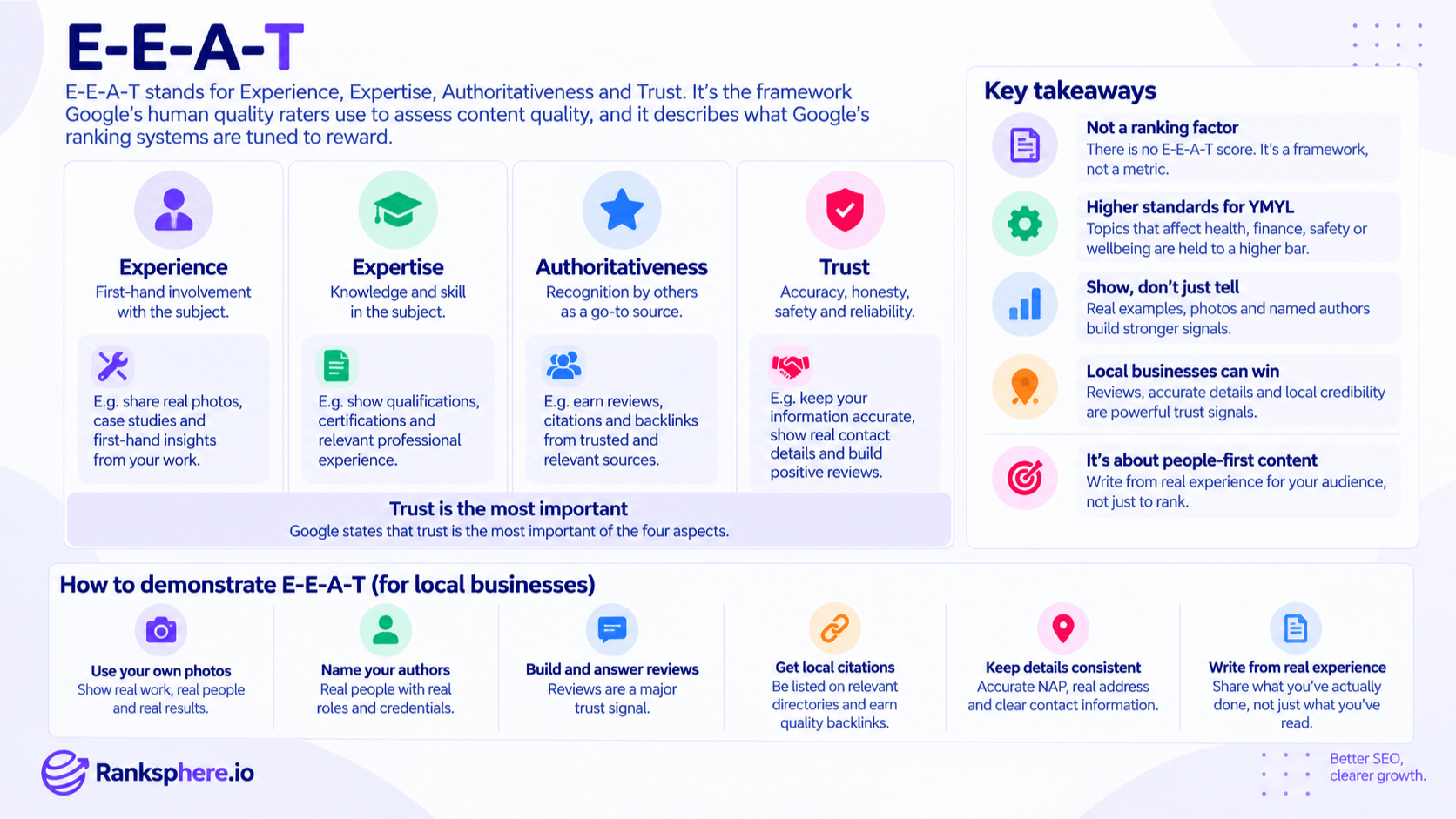
The four parts of E-E-A-T describe different qualities of useful, trustworthy content.
Experience
Experience refers to first-hand or life experience with the subject.
Google added the extra “E” for Experience to its Quality Rater Guidelines in December 2022.
Examples include:
- A roofer explaining a repair they have actually carried out
- A customer reviewing software they genuinely used
- A traveller describing a hotel they personally stayed in
- A mechanic explaining a fault they regularly diagnose
This type of content can contain details that are difficult to reproduce through generic research alone.
For local businesses, experience is often one of the easiest aspects to demonstrate because the business is already doing the work every day.
Expertise
Expertise is the knowledge or skill required to discuss a subject accurately.
What counts as appropriate expertise depends on the topic.
For some subjects, practical experience may be enough.
For others, formal qualifications become much more important.
For example:
A gardener writing about lawn care may demonstrate expertise through years of practical work.
A doctor giving medical treatment advice should have appropriate professional knowledge and credentials.
Expertise is therefore contextual rather than something every author proves in exactly the same way.
Authoritativeness
Authoritativeness relates to whether the creator or website is recognised as a credible source on the topic.
Evidence can come from reputation and recognition beyond the website itself.
That might include:
- Industry references
- Relevant media coverage
- Professional associations
- Genuine backlinks
- Expert citations
- Community recognition
- Relevant business citations
Authority cannot simply be declared in an author biography.
It becomes more credible when other reputable sources recognise the business or individual as knowledgeable in that field.
Trustworthiness
Trust sits at the centre of E-E-A-T.
Google explicitly says trust is the most important aspect because the other elements contribute towards whether a page can ultimately be trusted.
A page may contain genuine experience and impressive credentials but still be poor quality if:
- Facts are misleading
- Sources are misrepresented
- Important risks are hidden
- Contact information is false
- Claims cannot be supported
- The website is unsafe
Trust therefore covers both the content and the business behind it.
Is E-E-A-T a Google ranking factor?
Not in the sense of a single measurable ranking signal.
Google says:
E-E-A-T itself is not a specific ranking factor.
Its systems instead use many signals that can help determine whether content demonstrates qualities associated with good E-E-A-T.
That means there is no:
- E-E-A-T score
- E-E-A-T percentage
- E-E-A-T metric in Search Console
- Schema property that increases E-E-A-T
- Checklist that guarantees better rankings
Avoid SEO tools or audits that present E-E-A-T as though Google assigns every website a score out of 100.
That is not how Google describes it.
How Google uses Quality Raters
Google employs human quality raters to assess the quality of search results.
Their evaluations help Google understand whether changes to its ranking systems appear to be producing better results.
However, raters do not directly control the ranking of individual pages.
Google compares the process to receiving feedback from restaurant customers: the feedback helps determine whether the overall system is working, rather than deciding which individual page should rank tomorrow.
The Quality Rater Guidelines are still useful to website owners because they provide insight into the characteristics Google associates with useful and trustworthy search results.
Why trust matters most
Trust is particularly important because experience, expertise and authority mean little if the information itself cannot be relied upon.
For example, a qualified financial adviser could still publish misleading financial information.
A highly experienced contractor could exaggerate project results.
A popular website could publish inaccurate medical advice.
Credentials alone do not make content trustworthy.
Trust may involve:
- Factual accuracy
- Transparent sourcing
- Genuine authorship
- Clear business information
- Honest claims
- Secure website connections
- Appropriate qualifications
- Clear corrections when mistakes occur
- Reliable customer service information
Google's people-first content guidance explicitly identifies trust as the most important aspect of E-E-A-T.
What is YMYL?
YMYL stands for Your Money or Your Life.
Google uses the term for topics that could significantly affect people's:
- Health
- Financial stability
- Safety
- Welfare or well-being of society
Google says its systems give greater weight to strong E-E-A-T for subjects where poor information could cause significant harm.
Typical YMYL areas can include:
- Medical advice
- Financial guidance
- Legal information
- Safety information
- Some civic and public-interest topics
The standard expected of a page about treating a medical condition is understandably different from the standard expected of a page reviewing a pair of trainers.
E-E-A-T for local businesses
E-E-A-T is particularly relevant to local businesses because they often have real-world evidence that generic publishers cannot reproduce.
A legitimate local business can show:
- Who does the work
- Where the business operates
- What jobs it has completed
- What qualifications the team holds
- What customers say
- How long the business has operated
- What local experience it has
The opportunity is to make those signals visible rather than replacing them with generic marketing copy.
How to demonstrate experience
First-hand evidence is one of the clearest ways for a local business to make its content more useful.
Useful examples include:
Original photographs
Use your own project photographs where possible.
A roofing company can show:
- Damaged roofs
- Repairs in progress
- Finished work
- Materials being installed
A dentist might show its actual practice, equipment or team where appropriate.
Original images provide evidence that there is a real business behind the content.
Real project examples
Instead of writing:
“Flat roofs can fail for several reasons.”
you might explain:
“On a recent repair in Maidstone, water was entering around an incorrectly sealed rooflight rather than through the membrane itself.”
That sort of detail comes from doing the work.
Before-and-after examples
Where suitable, show:
- The original problem
- What was done
- The finished result
Keep the examples genuine and avoid inventing projects purely to make content appear experienced.
Local knowledge
A local business can naturally reference conditions it genuinely encounters.
That might include:
- Property types
- Building materials
- Local regulations
- Weather conditions
- Common customer problems
Specificity is more convincing than repeatedly stating that the company has “years of experience.”
How to demonstrate expertise
Expertise should be visible where it matters.
Name the people behind the content
Avoid publishing specialist advice under:
Admin
or:
Marketing Team
when a genuine expert contributed to it.
Where appropriate, identify:
- Author
- Reviewer
- Professional role
Show relevant credentials
For subjects where credentials matter, provide genuine information such as:
- Qualifications
- Registrations
- Professional memberships
- Licences
- Certifications
Do not add credentials solely because they sound impressive.
They should be accurate and relevant to the subject.
Create useful author pages
An author biography can help when it gives meaningful context.
For example:
Dr Jane Smith is a registered dentist with 14 years of clinical experience in restorative dentistry.
is useful.
Jane is passionate about helping people smile.
tells the reader much less about why they should trust medical information written by her.
How to demonstrate authoritativeness
Authority often develops outside your own website.
Useful signs may include:
- Relevant press coverage
- Professional association listings
- Industry references
- Speaking or training activity
- Community involvement
- Genuine backlinks
- Relevant local and industry citations
The key is relevance.
A roofing company being referenced by a respected construction publication means more contextually than appearing on dozens of unrelated websites.
Authority is built through reputation, not through simply telling visitors that you are an authority.
How to demonstrate trust
Trust extends across the whole website.
Useful trust elements can include:
- Accurate contact information
- Consistent NAP
- Genuine reviews
- Clear terms and policies
- HTTPS
- Transparent pricing where appropriate
- Real team information
- Sources for important claims
- Accurate publication or update dates
- Clear correction of outdated information
For regulated or high-risk services, trust also means not making claims that exceed what the evidence or professional qualifications support.
Ranksphere's review management tracks rating, review volume and responses, helping businesses monitor an important part of their online reputation.
E-E-A-T and online reviews
Customer reviews can provide useful evidence of reputation and real-world experience.
For a local business, reviews may reveal:
- Whether customers received the promised service
- How the company handles problems
- Whether experiences are consistently positive
- How recently customers have used the business
But reviews should not be treated as the only measure of trust.
A business with excellent reviews could still publish inaccurate health or financial advice.
Trust needs to be considered across both the business and its content.
E-E-A-T and author bios
Adding an author box can be useful when the author genuinely matters to the topic.
It is not an SEO trick by itself.
An author section should help answer:
Why should this person be trusted on this subject?
Useful information might include:
- Name
- Role
- Relevant experience
- Qualifications
- Professional registrations
- Links to a fuller biography
Do not invent credentials, exaggerated experience or fake personas.
If the author information cannot be verified, it does little to improve trust.
E-E-A-T and original content
Google's people-first guidance encourages content that adds meaningful value rather than simply copying or rewriting information already available elsewhere.
For a local business, originality does not necessarily mean discovering something nobody has ever known before.
It can mean adding:
- Your own experience
- Your own photographs
- Your own examples
- Your own processes
- Your own observations
- Your own data
A plumber does not need to invent a new explanation of what a leaking pipe is.
But they can explain what they actually see in local homes and how they diagnose the problem.
That makes the content more useful and harder to replace with generic copy.
E-E-A-T and AI-written content
The useful distinction is not simply:
Human-written vs AI-written.
Google's public guidance focuses on the quality and purpose of the content rather than whether automation was involved in its creation.
The problem comes when content is produced primarily to manipulate rankings, adds little original value or is published at scale without sufficient care.
Google's Search Essentials specifically emphasise creating helpful, reliable, people-first content.
For a business using AI to assist with content creation, human expertise should still shape:
- Facts
- Examples
- Experience
- Opinions
- Claims
- Final editing
Generic text becomes much stronger when the person who actually knows the subject adds what only they can know.
E-E-A-T and helpful content
E-E-A-T is related to Google's broader focus on helpful, people-first content, but it should not be treated as a separate algorithm you can optimise.
Google's former standalone helpful content system evolved and became part of its core ranking systems in March 2024. Google now uses multiple systems and signals to assess content helpfulness rather than one standalone helpful-content signal.
Older SEO advice that still describes the Helpful Content System as a separate active ranking system is therefore outdated.
The practical guidance remains similar:
Make content primarily for people and give them information worth finding.
E-E-A-T and backlinks
Backlinks can contribute to the wider reputation of a website, but they should not be described as an E-E-A-T score.
A link from a respected industry source may reinforce that others recognise the business or content.
But authority depends on context.
One genuine reference from a relevant publication can be more meaningful than dozens of links from unrelated sites created purely for SEO.
Build recognition by doing things worth referencing.
E-E-A-T and local citations
Relevant citations can also help establish the real-world presence of a business.
For example, listings on:
- Relevant industry directories
- Local organisations
- Professional associations
- Trusted local platforms
can reinforce accurate business information.
Again, quantity alone is not the goal.
Focus on legitimate sources where a customer might reasonably expect the business to appear.
Common E-E-A-T mistakes
- Treating E-E-A-T as a numerical score. Google does not provide one.
- Trying to optimise every E equally. Different subjects require different forms of evidence.
- Adding generic author boxes. A name and stock photograph do not prove expertise.
- Inventing credentials. False authority damages trust rather than improving it.
- Writing generic content when first-hand experience is available.
- Using stock photography when genuine project imagery would be more useful.
- Assuming reviews alone prove trustworthiness.
- Treating backlinks as a direct E-E-A-T metric.
- Publishing YMYL advice without appropriate expertise or sourcing.
- Still describing the Helpful Content System as a separate active ranking system.
- Assuming E-E-A-T matters only for YMYL topics. Google applies the concepts more broadly, while the standard becomes particularly important for high-impact topics.
E-E-A-T best practices
- Identify who created important content.
- Show relevant credentials where they matter.
- Use genuine first-hand examples.
- Include original photographs and evidence where appropriate.
- Support important claims with reliable sources.
- Keep business details accurate and consistent.
- Build a genuine reputation within your industry and community.
- Monitor and respond appropriately to customer reviews.
- Correct inaccurate or outdated information.
- Apply particularly high standards to YMYL content.
- Write for people rather than trying to manufacture E-E-A-T signals.
Example
“Two roofing companies publish guides explaining why flat roofs fail.
Both articles are detailed.
Both cover subjects such as:
- Drainage
- Membrane damage
- Flashing
- Ponding water
- Poor installation
The first article is technically correct but generic.
There is no named author, all the photographs are stock images and none of the examples come from actual work carried out by the company.
The second guide is written by a named roofing professional.
It contains:
- Photographs from real jobs
- Examples of failures the team has repaired
- Specific materials they commonly encounter
- Explanations of what went wrong
- Details of what they changed during the repair
The difference is not simply that one page contains more keywords.
The second gives the reader clearer evidence about who knows the subject, how they know it and why the information can be trusted.
That is a much more useful way to think about E-E-A-T.
Do not ask:
“How do I increase my E-E-A-T score?”
Ask:
“What would make a real person confident that this information comes from someone who knows what they are talking about and can be trusted?”
That question is much closer to what the framework is actually for.”
See also
- Thin content — pages that provide too little useful value
- Online review — customer feedback and reputation signals
- Google algorithm update — changes to Google's ranking systems
- Content audit — reviewing existing content for quality and usefulness
- Backlink — external links and wider recognition
- Content marketing — creating useful content for an audience