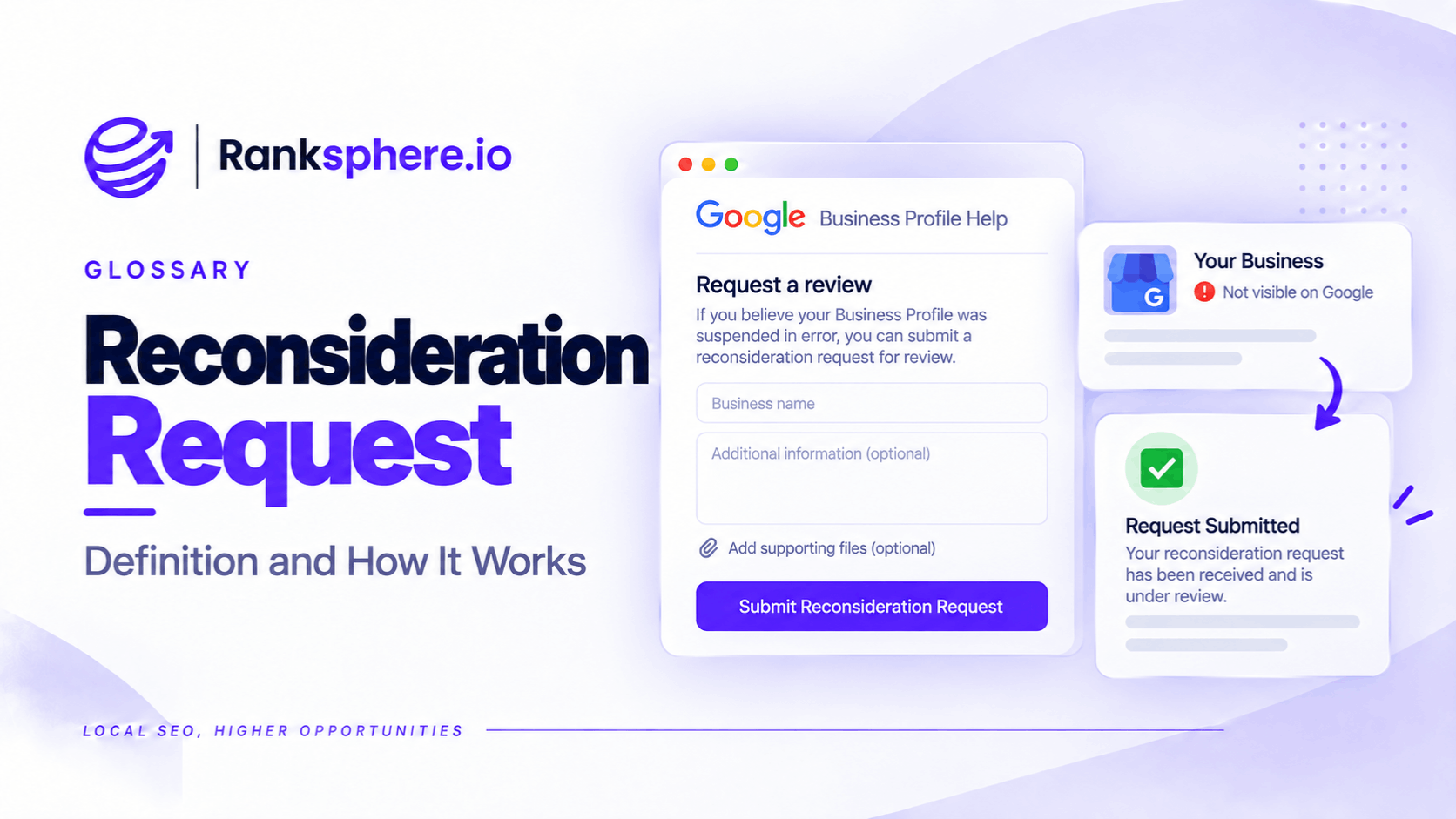
A reconsideration request is a formal request asking Google to review a website after the owner has fixed violations identified in a manual action.
It is submitted through Google Search Console and reviewed by Google's team.
For example, a business might receive a manual action because a previous SEO agency purchased links intended to manipulate search rankings. After addressing those links, the website owner can request that Google review the site again.
The important distinction is that a reconsideration request isn't a way to appeal an ordinary ranking decline.
If Google hasn't issued a manual action, there is no manual action to reconsider.
A website that loses traffic after an algorithm update needs a different investigation. There is no equivalent reconsideration request for ordinary algorithmic ranking changes.
Google also provides review processes for certain security issues, but those should be distinguished from manual action reconsideration.
When Should You Submit a Reconsideration Request?
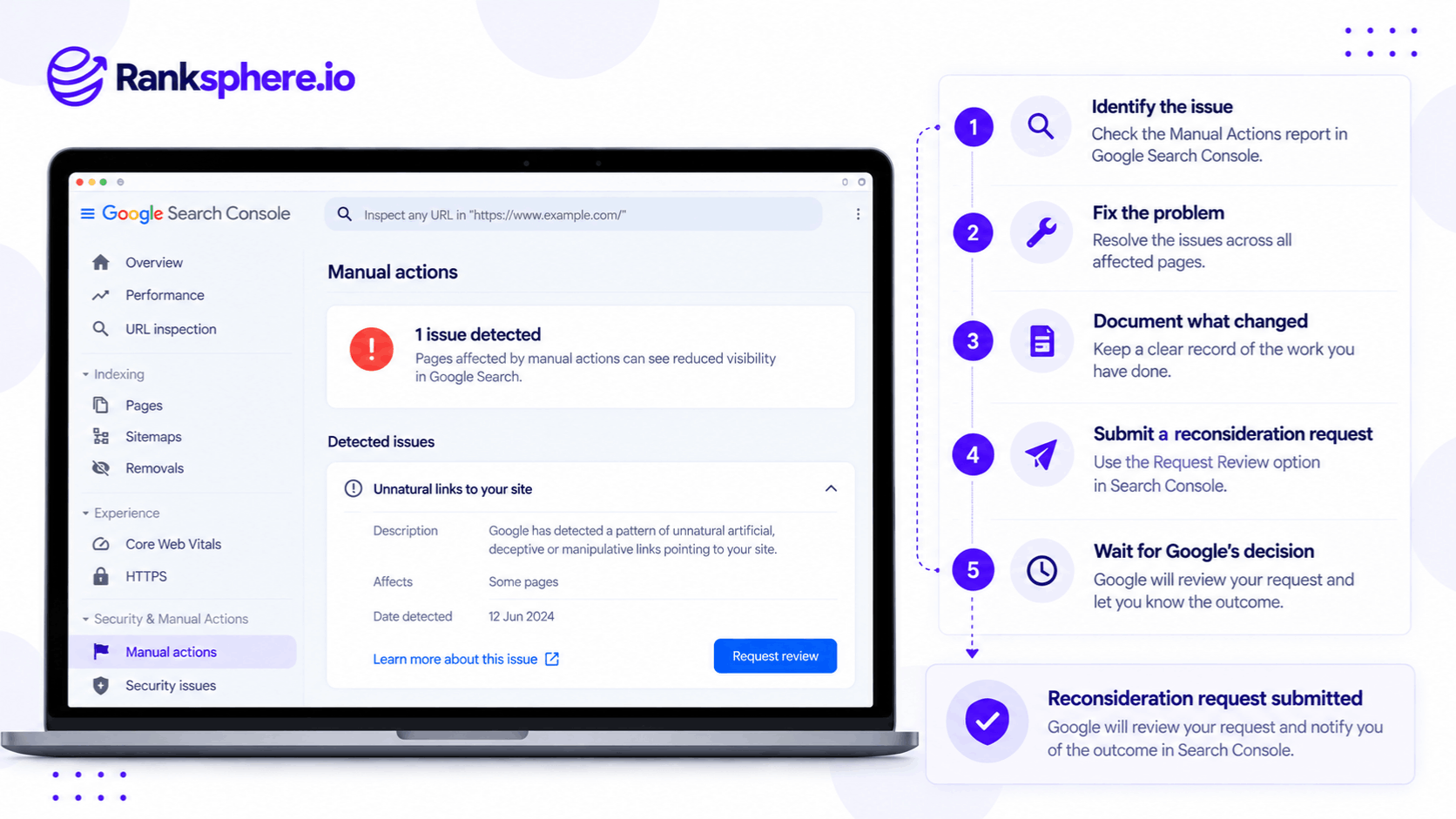
Submit a reconsideration request when Google Search Console confirms a manual action and the underlying violations have been corrected.
For example, Google may issue manual actions involving:
- Unnatural links to a website
- Manipulative outbound links
- Thin content with little or no added value
- Scaled content abuse
- Misleading structured data
- User-generated spam
- Cloaking or deceptive redirects
Each violation requires a different response.
A business with a structured data manual action needs to correct its markup. A website penalised for unnatural inbound links needs to investigate the links involved.
There is no single recovery checklist that resolves every manual action.
The first step is always to understand what Google has reported.
How to Check Whether You Need Reconsideration
Before beginning any recovery work, open Google Search Console.
- Select the relevant verified website property.
- Open Security & Manual Actions.
- Select Manual actions.
- Read the report.
If the report says "No issues detected," there is no active manual action reported for that property.
That doesn't mean the website has no SEO problems. It means a manual action reconsideration request isn't the appropriate response.
If the report identifies a violation, review the action type, affected areas, and Google's recommended steps.
Do this before buying penalty recovery services or making major website changes.
Fix the Problem Before Submitting
The most important part of a reconsideration request happens before it is written.
Google expects the violations to have been corrected.
For example, if an agency discovers hundreds of pages created primarily to manipulate location-based searches, it shouldn't submit a request promising to review them later.
The affected content needs to be addressed first.
A proper remediation process should:
- Identify the full extent of the violation.
- Correct the problem across all affected pages or links.
- Review whether similar problems exist elsewhere.
- Verify that the corrections are live.
- Document what was changed.
- Make sure Google can access relevant pages to review the fixes.
Google doesn't require website owners to wait for every page to be recrawled before submitting. The important thing is that the corrections are complete and accessible.
Submitting while significant remediation work remains unfinished increases the risk that Google will reject the request.
What Should a Reconsideration Request Include?
Google's guidance identifies three essential elements: explain the issue, describe the corrections, and document the outcome.
A useful request should therefore cover the following.
1. Explain the Violation
State what was wrong.
For example:
"The website received an unnatural links manual action following a backlink campaign that included paid placements intended to influence search rankings."
This is more useful than arguing that the links shouldn't have been considered a violation.
However, businesses should describe only what they can establish from the evidence.
2. Explain How the Problem Happened
Provide relevant background.
For example, the website may have inherited manipulative links from a previous agency.
That context helps explain the situation, but it doesn't replace the need to fix the problem.
Simply blaming another provider is not a remediation plan.
3. Describe the Corrective Work
Be specific about what changed.
For example:
- Manipulative backlinks were identified and reviewed.
- Website owners were contacted to request removals.
- Unremovable links were added to a disavow file where appropriate.
- The link purchasing arrangement was terminated.
- Internal procedures were introduced to prevent similar campaigns.
The same principle applies to other manual action types.
For a content-related violation, explain which pages were removed, rewritten, or improved and why those changes resolve the reported problem.
4. Provide Supporting Documentation
Evidence makes the request easier to assess.
Depending on the violation, documentation may include:
- Lists of affected URLs
- Records of link removal attempts
- Before-and-after examples
- Details of removed or updated pages
- Relevant technical changes
- A summary of remaining limitations
Avoid vague statements such as "we fixed the SEO issues."
Explain what was fixed and provide enough information for Google to evaluate the work.
5. Explain How Recurrence Will Be Prevented
Describe any relevant changes to the business's processes.
For example, a company that previously purchased backlinks might introduce a policy prohibiting manipulative link schemes.
A website affected by user-generated spam might introduce moderation controls.
The measures should address the actual cause of the violation.
Reconsideration Requests for Unnatural Links
Link-related manual actions need particular care because the website owner may not control the sites linking to them.
Google recommends making a good-faith effort to remove unnatural backlinks before using the disavow tool for links that cannot be removed.
Identify Manipulative Links
Review links associated with practices that violate Google's link spam policies.
Examples may include purchased links intended to pass ranking signals or links created through manipulative schemes.
Not every unfamiliar or low-quality backlink is necessarily a problem.
A third-party toxicity score alone isn't evidence of a manual action.
Request Removal Where Possible
Contact the relevant website owners and request removal of the unnatural links.
Keep records of the attempts.
For example, an outreach log might include:
| Website | Action | Outcome |
| Example A | Removal requested | Link removed |
| Example B | Removal requested | No response |
| Example C | Removal requested | Removal refused |
The purpose is to demonstrate genuine remediation, not simply produce a large spreadsheet.
Disavow Links That Cannot Be Removed
Google allows website owners to disavow problematic links when removal isn't possible.
For multiple unnatural links from the same domain, domain-level disavow entries may be appropriate.
However, don't disavow every backlink as a shortcut.
Google specifically warns that blindly disavowing links without attempting removals may be insufficient for reconsideration.
It also warns against disavowing legitimate links.
Document the Outcome
The reconsideration request should summarise the investigation, removal attempts, remaining problematic links, and disavow work.
Google needs to understand what was done and why some links could not be removed.
Why Reconsideration Requests Get Rejected
Google may reject a reconsideration request when it determines that the site still violates the relevant policies.
Common problems include:
- Incomplete cleanup. Some affected pages or links remain unresolved.
- Vague explanations. The request doesn't clearly describe the corrective work.
- Insufficient evidence. Google cannot verify the claimed changes.
- Disavowing links without genuine removal attempts. Particularly relevant to unnatural inbound link actions.
- Blaming a previous agency without addressing the violation. Responsibility for correcting the site remains with its owner.
- Submitting before changes are implemented. Planned fixes aren't completed fixes.
- Failing to address all reported manual actions. Resolving only one violation may be insufficient.
A rejected request doesn't necessarily mean the website can never recover.
It means Google hasn't approved the reconsideration based on the site's condition and the information available.
Review the response, investigate unresolved issues, and submit another request only after making meaningful corrections.
Don't assume every rejection includes a detailed explanation of every remaining problem.
How Long Does Google Reconsideration Take?
Google says most reconsideration reviews take several days or weeks.
Some cases, particularly link-related requests, can take longer.
Google sends notifications when it receives the request and when the review is complete.
There is no guaranteed turnaround time.
Once a request is submitted, monitor Search Console and wait for Google's decision.
Don't repeatedly submit the same request while a review is pending.
Will Rankings Return After Reconsideration?
Not necessarily.
If Google approves the request, it revokes the applicable manual action.
That removes the specific enforcement restriction.
However, lifting a manual action doesn't guarantee that the website will return to its previous rankings or traffic levels.
For example, if a website previously benefited from purchased backlinks, removing those links may eliminate ranking signals that had contributed to its visibility.
The site then competes under Google's normal ranking systems without relying on the manipulative links.
Similarly, pages removed because they violated spam policies won't automatically be replaced by equally successful pages.
This distinction should be explained to clients before recovery work begins.
The objective is to resolve the violation and restore normal eligibility for search evaluation, not promise the return of particular positions.
Common Reconsideration Request Mistakes
- Submitting without a manual action. An ordinary algorithmic decline has no manual action reconsideration route.
- Writing the request before fixing the problem. Corrections must come first.
- Providing vague explanations. Google needs to understand what was changed.
- Ignoring similar violations elsewhere on the site. The cleanup needs to address the reported problem comprehensively.
- Disavowing all backlinks indiscriminately. This can harm legitimate link signals.
- Failing to document removal attempts. Google expects a genuine effort in unnatural inbound link cases.
- Submitting repeatedly while waiting. Wait for the outstanding review decision.
- Expecting an approved request to restore rankings. Reconsideration removes the manual action, not the effects of every underlying change.
Reconsideration Request Best Practices
- Confirm the manual action in Google Search Console.
- Read Google's explanation of the violation.
- Identify every affected area.
- Complete the corrective work before requesting review.
- Make sure Google can access the relevant changes.
- Keep clear remediation records.
- Explain the problem and corrections in straightforward language.
- Document link removal attempts where applicable.
- Use disavow carefully and only when justified.
- Describe measures introduced to prevent recurrence.
- Submit through the Manual actions report.
- Wait for Google's decision before submitting again.
- Explain to stakeholders that removal of the action doesn't guarantee ranking recovery.
A successful request depends primarily on resolving the policy violation, not writing a particularly persuasive appeal.
Example
“Consider a hypothetical home improvement company that discovers an unnatural links manual action in Search Console.
The business previously worked with an SEO agency that purchased links from a network of low-quality websites.
After changing agencies, the business decides to address the problem.
The new agency uploads a disavow file and submits a reconsideration request.
It explains that the business wasn't aware of the previous link campaign.
However, the request contains little documentation of link removal attempts.
Google rejects the reconsideration request.
The agency now needs to reassess whether its remediation meets Google's guidance.
The agency reviews the suspected manipulative links more thoroughly.
It contacts the relevant website owners and requests removals.
It records which links were removed, which websites didn't respond, and which refused the request.
For problematic links that cannot be removed, it reviews whether disavowal is appropriate.
The agency also confirms that the previous paid-link arrangement has ended.
The second request explains:
- The original link scheme
- How it was identified
- Which links were removed
- Which removal attempts were unsuccessful
- What was disavowed and why
- How the company intends to prevent similar activity
The agency provides supporting documentation rather than simply claiming that the backlink profile has been cleaned.
Google reviews the request.
If the site no longer violates the relevant policies, Google may revoke the manual action.
However, the company cannot assume that its previous rankings will return.
Some of its former visibility may have depended on links that were removed or disavowed.
The agency therefore separates two objectives: resolving the manual action and building sustainable organic visibility afterward.”
See Also
- Manual Action — The Google enforcement decision that a reconsideration request addresses.
- Disavow — Addressing problematic backlinks that cannot be removed.
- Google Search Console — Where manual actions and reconsideration requests are managed.
- Google Search Essentials — Google's spam policies and search requirements.
- Link Building — Understanding legitimate link acquisition and manipulative practices.
- Thin Content — Low-value content that may contribute to manual action issues.