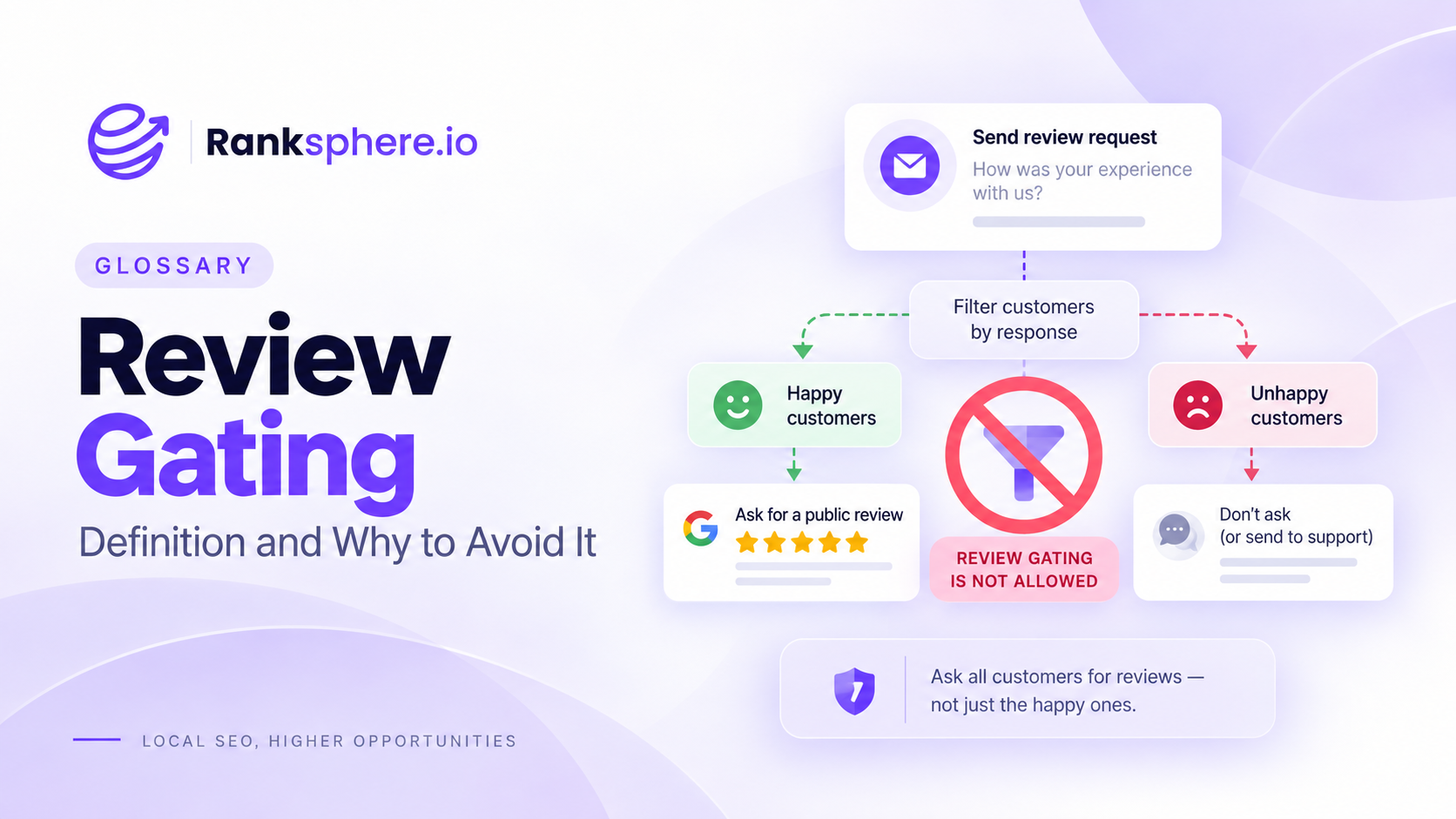
Review gating happens when a business decides who should be asked to leave a public review based on how satisfied they appear to be.
A common example is asking customers to rate their experience first. Happy customers are then sent to Google or another public review platform, while unhappy customers are directed to a private feedback form instead.
The problem is not collecting private feedback. Businesses can and should ask customers what went well and what could be improved. The issue arises when that feedback is used to decide who gets the opportunity to leave a public review.
You may also hear review gating described as sentiment routing, review filtering or a feedback funnel. Whatever name is used, the important question is the same: does the customer's expected opinion determine whether they receive the public review link?
If it does, the process needs to be reviewed.
What does review gating look like?
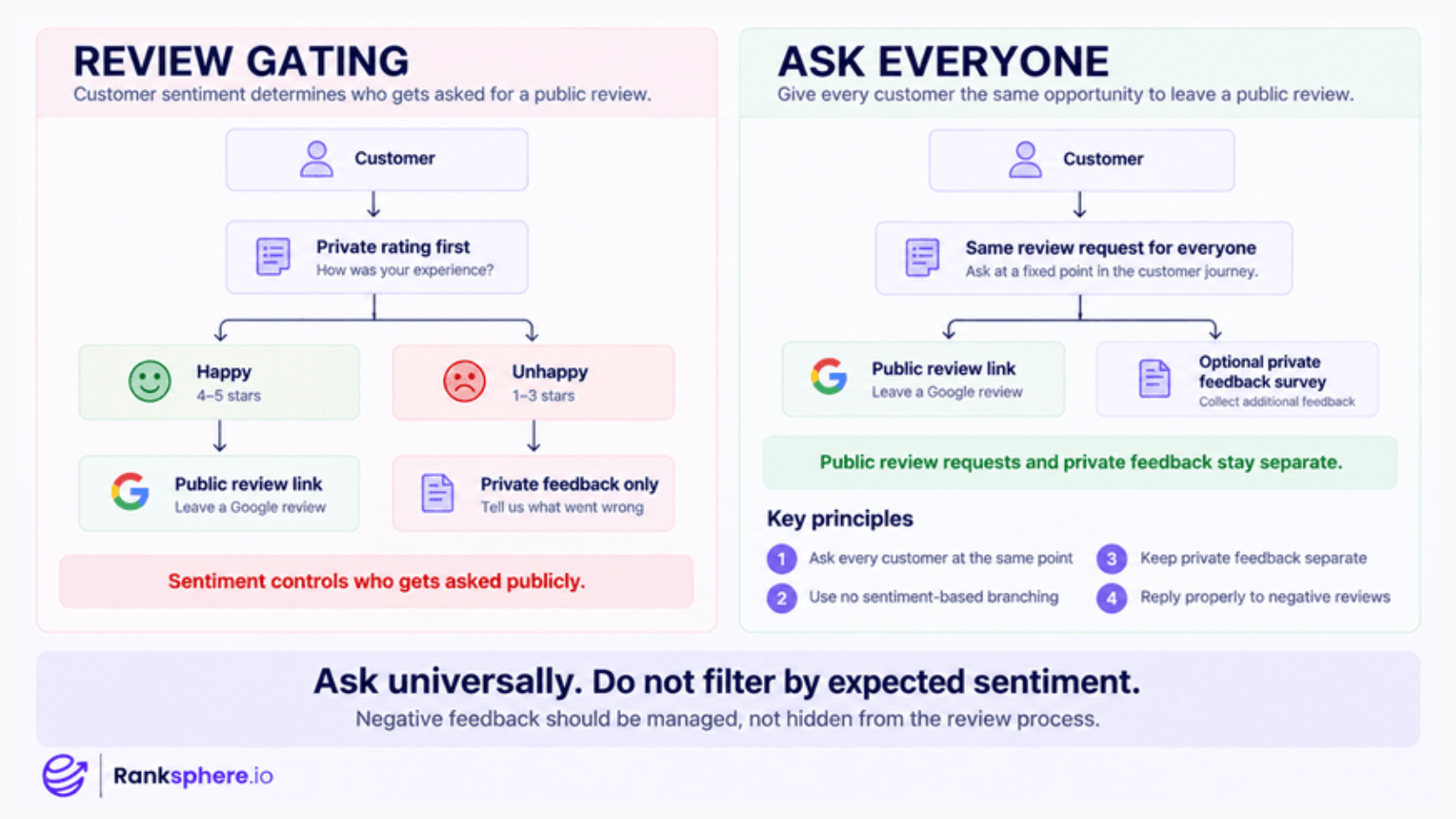
Review gating is not always obvious.
Sometimes it is built into reputation management software. In other cases, it happens informally because staff have been told to ask only customers who seem happy.
Examples include:
- Asking customers to rate their experience before showing them a Google review link
- Sending satisfied customers to a public review site while sending dissatisfied customers to a private form
- Setting software to show a review link only after someone gives a high internal rating
- Asking staff to request reviews only from customers who gave positive feedback
- Excluding customers with complaints from review-request campaigns
- Using previous satisfaction scores to decide who receives a future review request
The issue is not the survey itself.
You can collect private customer feedback and request public reviews. The two simply should not be connected in a way that filters people according to whether their feedback is positive or negative.
Why review gating is a problem
There are several reasons businesses should avoid review gating.
It can breach review platform policies
Google expects businesses to seek genuine customer feedback without selectively encouraging positive reviews.
A review process designed to prevent dissatisfied customers from reaching the public review page can create policy problems for your Google Business Profile.
Platforms want reviews to reflect genuine customer experiences rather than a carefully selected group of the happiest customers.
It can create compliance issues
Review practices can also be subject to consumer protection rules.
In the United States, the FTC's Consumer Review Rule addresses practices involving fake reviews, review suppression and certain incentives connected to customer sentiment.
The FTC's guidance on the rule explains what businesses need to consider when collecting, displaying and managing reviews.
If you are unsure whether a review programme meets the legal requirements in your market, get appropriate professional advice rather than relying solely on software settings or a vendor's interpretation.
It hides useful customer feedback
There is also a practical business problem with review gating.
If unhappy customers are quietly pushed into a private channel while positive experiences are encouraged publicly, the resulting rating does not give you a complete picture of the customer experience.
That can make genuine operational problems easier to overlook.
Negative feedback is not always comfortable to receive, but recurring complaints can tell you where the business needs attention.
Review gating vs asking for reviews
Asking customers for reviews is not the problem.
The difference is who gets asked and how that decision is made.
A straightforward process might send the same review request to every eligible customer after an appointment, purchase or completed service.
A gated process first tries to identify whether someone is happy and only sends the public review request to people likely to leave positive feedback.
That distinction is important.
A fair review process should give customers the same opportunity to leave feedback regardless of whether you expect their review to be positive, neutral or negative.
What to do instead of review gating
Build review requests into the normal customer journey.
Choose an appropriate point to ask — after an appointment, completed job, purchase or other genuine customer interaction — and use the same process consistently.
You can:
- Ask customers for reviews at the same point in the customer journey
- Give everyone the same direct review link
- Use QR codes, email or SMS to make leaving feedback easy
- Run separate customer satisfaction surveys without using the answers to filter review requests
- Monitor negative feedback and respond professionally
- Use recurring complaints to improve the service
- Train staff on how and when review requests should be made
If a negative review appears, a thoughtful response is usually more useful than trying to prevent negative feedback from appearing in the first place.
Ranksphere's review management flags which reviews need a reply and drafts responses, helping businesses manage customer feedback without filtering who gets the opportunity to leave a review.
Can you offer incentives for reviews?
This is an area where businesses need to be particularly careful.
Do not offer a reward specifically for a positive review or make the value of an incentive depend on the rating someone gives.
Platform policies can also be stricter than general consumer protection requirements, so always check the rules of the review platform you are using before introducing any incentive.
If incentives form part of your review strategy, make sure the process is transparent, properly disclosed where required and not designed to influence what the customer says.
Common review gating mistakes
- Using a satisfaction survey as a filter. Surveys are fine, but the answer should not determine whether someone receives the public review link.
- Asking only customers who appear happy. Review gating can happen without any software at all.
- Assuming reputation software must be compliant. Check how the workflow actually works rather than relying on the name of the feature.
- Confusing review requests with review gating. Asking customers for honest feedback is different from selecting only people likely to leave positive reviews.
- Offering rewards specifically for positive feedback. An incentive should never depend on someone giving the business a favourable rating.
- Using historical customer scores to filter future requests. The filtering problem remains even if the satisfaction data was collected earlier.
- Keeping private feedback only as a way to suppress complaints. Private surveys should help improve the business, not simply prevent unhappy customers from speaking publicly.
Review gating best practices
- Give eligible customers the same opportunity to review the business. Do not branch the process according to expected sentiment.
- Keep surveys and public review requests separate. Both can be useful without one controlling the other.
- Audit your review software. Check whether any feature redirects customers based on the rating they select.
- Train staff on the review process. Avoid informal instructions such as “only ask the happy customers.”
- Respond to negative feedback professionally. Your response is often as important to future customers as the original complaint.
- Document how reviews are requested. This is particularly useful when several employees or locations are involved.
- Review platform policies periodically. Rules can change, so your process should be checked from time to time.
- Use criticism as business feedback. Repeated complaints often reveal issues worth fixing.
Example
“Harbour Physiotherapy sends every discharged patient a short satisfaction survey.
Under its original setup, patients who choose a high score are immediately shown a link to leave a Google review. Patients who choose a lower score are sent to a private feedback form instead.
At first, the process appears to work well because the clinic maintains a very strong public rating.
The problem is that the public reviews only represent one part of the customer experience.
When the clinic reviews its private feedback more closely, it discovers that appointment scheduling has been mentioned repeatedly by dissatisfied patients.
The business changes the process.
Patients can still complete the private satisfaction survey, but the survey result no longer determines whether they can access the public review link. Review requests are sent consistently, and the clinic starts responding to public feedback rather than trying to prevent criticism from appearing.
The change gives the clinic something more useful than a carefully protected star rating: a clearer picture of what patients actually experience.
That is the main reason to avoid review gating. A healthy review programme should help customers make informed decisions and help the business learn from genuine feedback.”
See also
- Online review — customer feedback published on Google and other review platforms
- Review response — how businesses should respond to positive and negative reviews
- Review velocity — how consistently new customer reviews are received
- Reputation management — managing reviews and customer perception over time
- Google Business Profile suspension — a possible consequence of serious profile policy issues
- Local ranking factors — where reviews fit within local search visibility