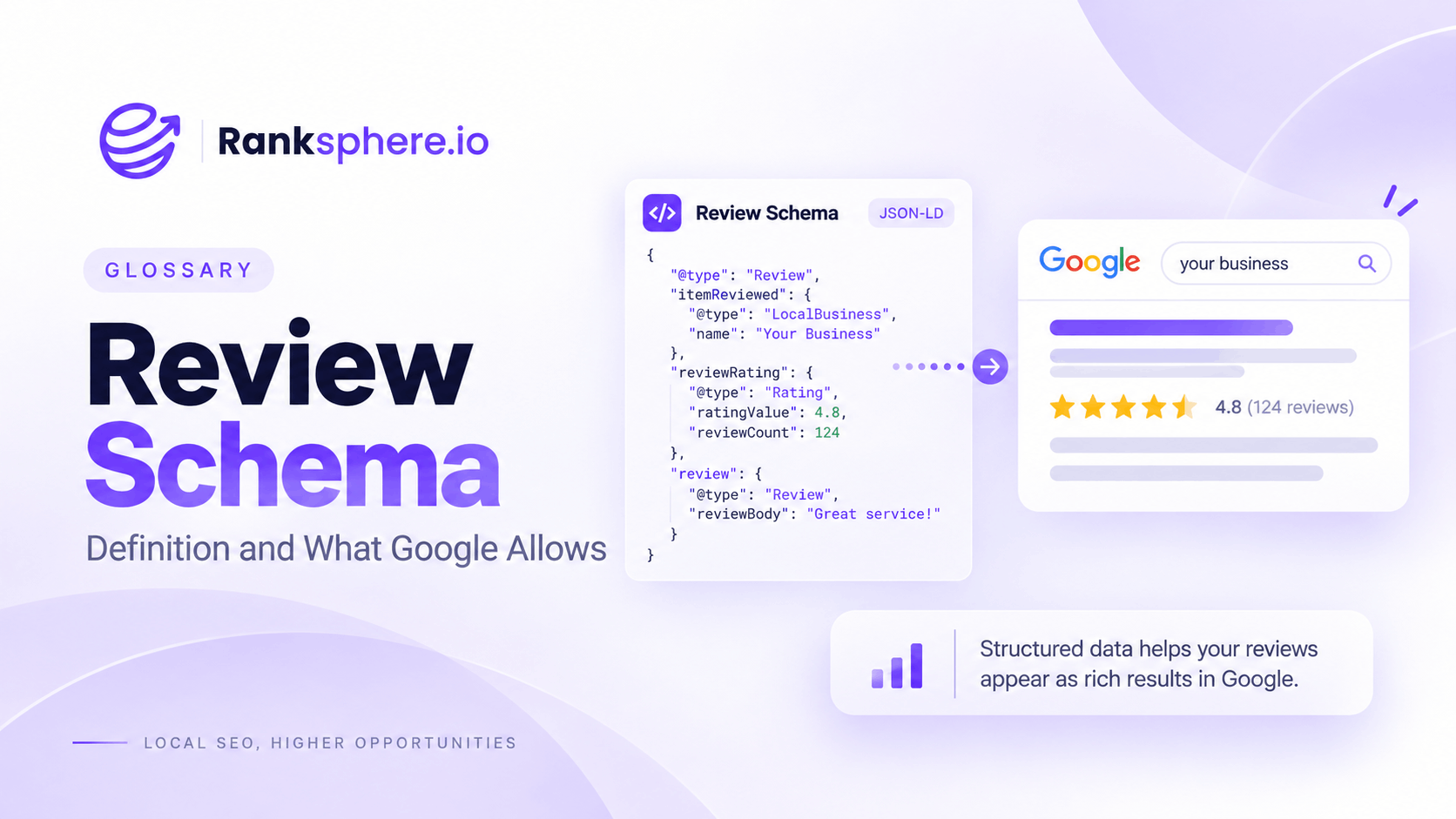
Review schema is structured data that helps search engines understand reviews and ratings shown on a webpage. It commonly uses Schema.org types such as Review and AggregateRating to describe individual reviews or an overall rating.
For local businesses, the important thing to understand is that valid review markup does not automatically mean Google will show review stars in organic search results.
Google changed its review rich result rules in 2019 to limit what it calls self-serving reviews. In practical terms, a business generally cannot mark up reviews about itself on its own LocalBusiness or Organization page and expect those ratings to appear as review stars in Google Search.
That distinction is where much of the confusion around review schema comes from.
How the self-serving review rule works
Google introduced tighter rules for review rich results in September 2019.
The change affected reviews about businesses and organisations when those reviews appear on websites controlled by the business being reviewed.
Google's announcement of the change explains the policy in more detail.
For a local business, there are a few important points to understand.
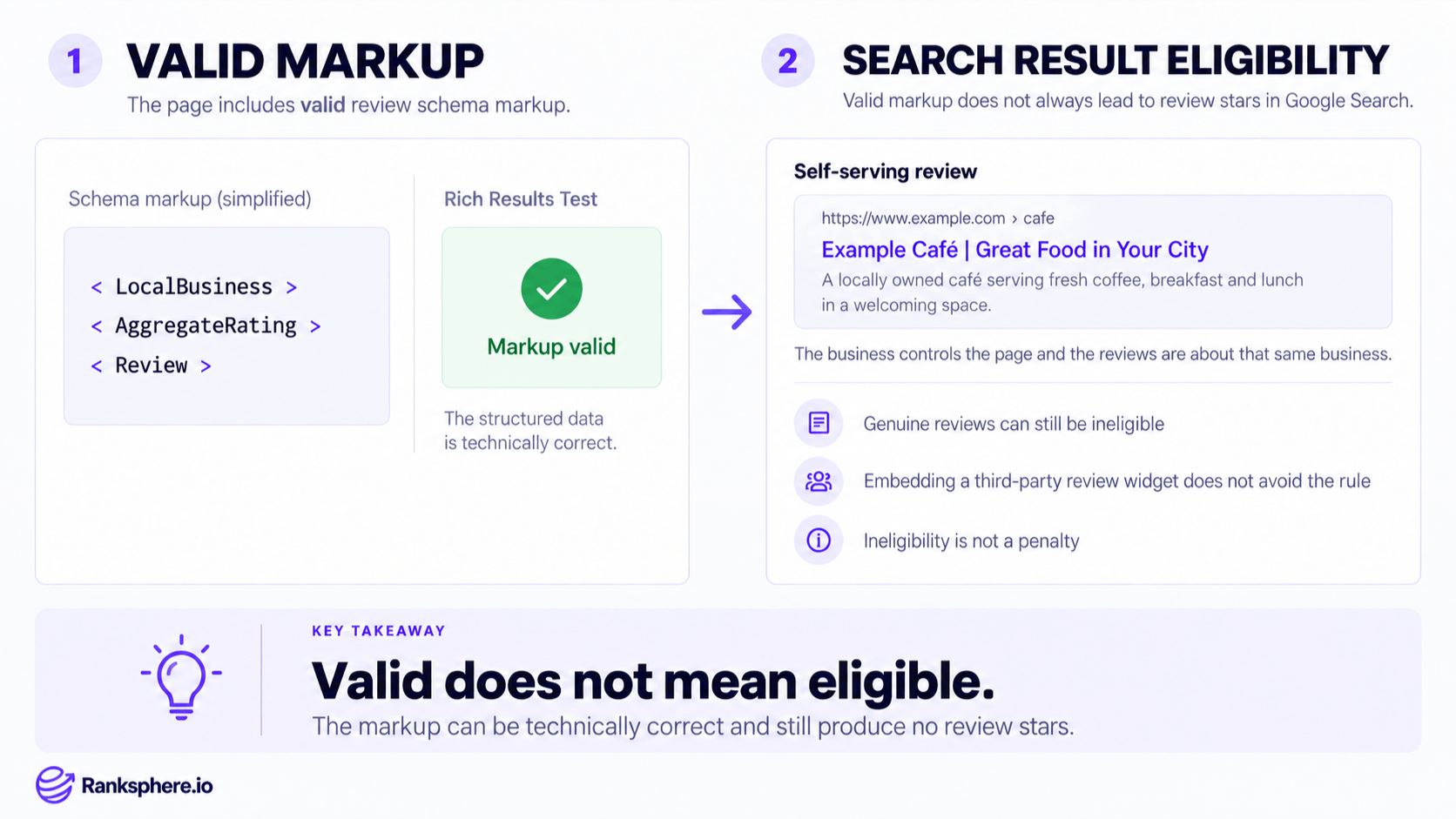
- Genuine reviews can still be self-serving. The issue is not whether the customer feedback is real. It is whether the business being reviewed controls the page displaying it.
- A third-party review widget does not automatically make the page eligible. If the reviews are being displayed on the business's own website, the same eligibility rules can still apply.
- This is not the same as a penalty. A page can contain valid structured data without qualifying for review stars.
- Valid markup and rich-result eligibility are different things. Structured data can be technically correct without Google choosing to display a review snippet.
That last point matters.
A structured data test checks whether the markup is implemented correctly. It does not guarantee that Google will show a particular search feature.
Which review schema can appear in search?
Google supports review snippets for certain types of content and entities.
Examples can include:
- Products
- Books
- Recipes
- Movies
- Events
- Courses
- Software applications
Eligibility depends on Google's current structured data requirements and the way the review content is presented on the page.
For local businesses, the situation is more limited.
A service page should not simply be marked up as a Product because the site owner wants review stars. The structured data type should accurately describe the content on the page.
Using the wrong schema type simply to become eligible for a search feature is not a sound SEO strategy.
Review schema and LocalBusiness markup
A local business website may still use LocalBusiness schema to help describe the business to search engines.
That structured data can contain useful information such as:
- Business name
- Address
- Phone number
- Opening hours
- Website
- Geographic information
- Business type
If reviews or ratings are marked up, the structured data should accurately reflect content that users can actually see on the page.
The important distinction is that adding an AggregateRating property does not mean Google will display review stars for the business in organic results.
Structured data should describe the page accurately first. Search enhancements are a possible result, not something the markup can guarantee.
Ranksphere's schema generator produces valid LocalBusiness markup without requiring you to manually build every property or work out how the different fields fit together.
Where local businesses actually get review stars
For most local businesses, the review stars customers see most often come from the Google Business Profile, not from review schema on the website.
Those ratings can appear in places such as the local pack, Google Maps and other Business Profile surfaces.
Your website's structured data and your Google Business Profile reviews are separate systems.
That means adding review schema to a service page will not increase the rating shown on your Business Profile.
If the goal is to improve the review presence customers see in local search, the practical work is usually around collecting genuine customer feedback, responding to reviews and maintaining the Business Profile rather than trying to force organic review stars through schema markup.
Common review schema mistakes
- Expecting LocalBusiness markup to produce review stars. Technically valid structured data does not override Google's eligibility rules.
- Assuming a review widget changes the rules. Reviews displayed on a business's own website can still be considered self-serving.
- Treating validation as a guarantee. Passing a structured data test means the markup is readable, not that Google will show a rich result.
- Using Product schema on a service page purely to get stars. The schema type should describe the actual content of the page.
- Marking up ratings that users cannot see. Structured data should match the visible content.
- Creating or inflating an AggregateRating. Ratings in structured data need to reflect genuine information shown to users.
- Selling review stars as a guaranteed SEO deliverable. No implementation can guarantee that Google will display a rich result.
Review schema best practices
- Use the correct schema type for the page. Do not choose a type simply because it is eligible for a richer search appearance.
- Keep structured data aligned with visible content. If a rating is marked up, users should be able to see the same rating on the page.
- Use LocalBusiness schema to describe the business accurately. Focus on clean entity information rather than chasing stars.
- Follow Google's review snippet guidelines. Eligibility rules matter just as much as technical implementation.
- Validate your markup after implementation. Testing can catch syntax errors and missing required properties.
- Review schema after major website changes. Templates, plugins and redesigns can introduce structured data errors.
- Keep Google Business Profile reviews separate from website schema strategy. They serve different purposes.
- Avoid guarantees around rich results. Google ultimately decides whether a search enhancement is displayed.
Example
“Whitfield Plumbing adds a testimonials section to its website.
The reviews are genuine and visible to visitors, and the developer adds AggregateRating to the LocalBusiness structured data.
The markup validates correctly.
The business then waits for review stars to appear beside its organic search result, but nothing changes.
There is not necessarily anything wrong with the code.
The issue is eligibility. The reviews are about Whitfield Plumbing and appear on a website controlled by Whitfield Plumbing, which falls under Google's rules around self-serving reviews for LocalBusiness entities.
Instead of continuing to modify the schema in an attempt to force stars into the organic result, the business leaves the website markup focused on accurately describing the company.
Its review strategy is handled separately through the Google Business Profile, where customers can see the business's rating in local search and Maps.
That is the useful distinction to remember with review schema: valid structured data and visible review stars are not the same thing.”
- Schema markup — structured data used to describe website content to search engines
- Online review — customer feedback published on Google and other platforms
- Google Business Profile — where local customer ratings and reviews are managed
- Rich result — enhanced search features that structured data may help a page qualify for
- Local pack — where Google Business Profile ratings are visible in local search
- Reputation management — the wider process of collecting, monitoring and responding to customer feedback