An online review is feedback a customer leaves about a business on platforms such as Google, Yelp or an industry-specific review site. It usually includes a star rating, written feedback, or both.
For local businesses, reviews matter for two reasons. They contribute to the wider signals Google uses when assessing local businesses, and they have a direct influence on whether someone decides to call, visit or book.
A business can appear prominently in search and still lose the enquiry if the reviews look outdated, inconsistent or unconvincing. That is why online reviews sit somewhere between local SEO and reputation management: they help people find confidence in the business once they have found it.
Why online reviews matter
Reviews give potential customers something business copy cannot: feedback from people who have already used the service.
When someone compares several businesses in the local pack, they are likely to notice the overall rating, number of reviews and how recent those reviews are.
A strong review profile can help reassure someone that the business is established, active and consistently serving customers.
Reviews also contribute to prominence, one of the main local ranking factors, although they are only one part of the wider local search picture.
Online reviews can help:
- Build trust before a customer gets in touch
- Support local search visibility
- Show that the business is active and serving real customers
- Give potential customers more context about specific services
- Highlight recurring praise or problems within the customer experience
- Provide useful language around the services customers actually value
Written reviews are especially useful because customers often describe the service in their own words. That can give both people and search platforms additional context about what the business is known for.
What makes a strong review profile?
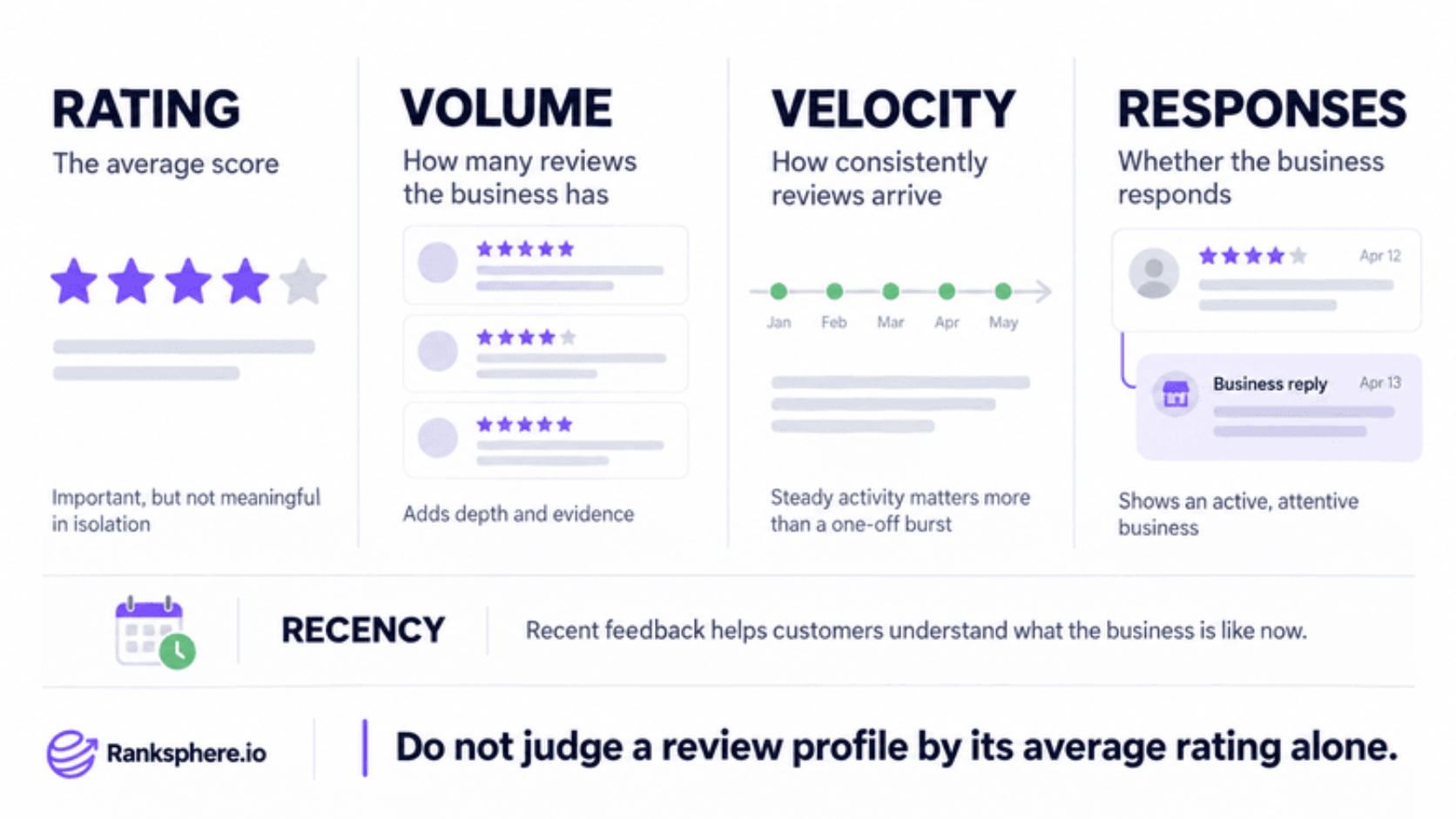
The average star rating is important, but it does not tell the whole story.
A healthy review profile usually has several things working together.
Rating
The average rating gives customers a quick impression of the business.
A high rating can help, but customers usually look beyond the number. They also consider how many reviews sit behind it and whether recent feedback supports the overall score.
Review volume
A larger number of genuine reviews gives people more information to base their decision on.
Ten positive reviews and several hundred positive reviews create very different levels of confidence, even when the average rating is similar.
Review recency
Recent feedback shows that customers are still using the business.
A strong rating made up entirely of reviews from several years ago may not tell someone much about the experience they can expect today.
Review velocity
Review velocity refers to the rate at which new reviews arrive.
For most businesses, a steady pattern of genuine customer feedback is healthier than occasionally running a large review drive and then receiving nothing for months.
Review responses
Review responses show that the business is paying attention to customer feedback.
A thoughtful response can reinforce a positive review and, when the feedback is negative, give the business a chance to show future customers how it handles problems.
How to get more online reviews
The simplest way to generate more reviews is to make asking part of the normal customer journey.
Do not wait for a large campaign. Give customers an easy way to leave feedback shortly after they have dealt with the business.
That might include:
- A review link in a follow-up email or text message
- A QR code at reception, checkout or on printed materials
- A simple request after a completed appointment or service
- A review button within a customer follow-up process
The important part is to ask fairly.
Do not only ask customers you expect to leave positive feedback. Filtering review requests by expected sentiment can become review gating.
You should also avoid buying reviews, creating fake reviews or asking staff, family members or others with a personal connection to the business to present themselves as independent customers.
If incentives are used in connection with reviews, the process needs to follow the relevant platform rules and applicable consumer protection requirements.
Ranksphere's review management generates designed QR codes for the counter or desk and brings reviews into one dashboard with AI replies, rating and reply-rate tracking. This makes it easier to build review requests into the normal customer journey instead of relying on occasional campaigns.
Common online review mistakes
- Only asking happy customers. Review requests should not be filtered according to the feedback you expect to receive.
- Buying or fabricating reviews. Fake feedback can breach platform policies and consumer protection rules.
- Collecting reviews only during occasional campaigns. A consistent process usually creates a more natural review profile.
- Ignoring recent reviews. Customer feedback should be monitored so questions and problems do not sit unanswered.
- Responding defensively to criticism. Remember that your response is also being read by future customers.
- Focusing only on the star rating. Volume, recency, written feedback and responses all contribute to how the profile looks.
- Making the review process difficult. If customers have to search for the right profile themselves, fewer of them are likely to complete the review.
Best practices
- Make review requests part of the normal workflow. A simple, repeatable process works better than occasional pushes.
- Ask customers consistently. Avoid deciding who receives a review request based on whether you think they are satisfied.
- Make leaving a review easy. Use a direct link or QR code so customers can reach the correct profile quickly.
- Respond to feedback regularly. Both positive and negative reviews deserve attention.
- Keep responses human. A short, specific reply is usually better than the same generic message under every review.
- Watch recent review activity. Do not focus only on the lifetime total.
- Use negative feedback as useful information. Repeated complaints may reveal something in the customer experience that needs fixing.
- Keep your review process compliant. Make sure staff understand what they can and cannot ask customers to do.
Example
“Larkspur Dental has a strong average rating, but most of its reviews came from a short campaign several years ago.
The profile still looks positive, yet very little recent feedback appears. Someone comparing the practice with a nearby competitor may naturally wonder which business is serving more customers today.
Instead of running another one-off campaign, the practice changes the process.
Reception staff begin asking every patient for feedback after their appointment. A QR code at the desk links directly to the review page, and the same link is included in follow-up messages.
There is no incentive and no filtering based on whether the patient seems happy.
Over time, new reviews begin arriving more consistently. The practice also starts replying to them, which makes the profile feel current rather than something that was built years ago and left untouched.
That is a better way to approach online reviews: make feedback part of the normal customer experience rather than treating reviews as something you collect only when the profile needs attention.”
See also
- Review velocity — how consistently new reviews are being received
- Review response — how businesses reply to customer feedback
- Review gating — filtering review requests based on expected sentiment
- Reputation management — the wider process of managing how a business is perceived online
- Local ranking factors — the signals that influence local search visibility
- Review schema — structured data for review information, with important eligibility rules