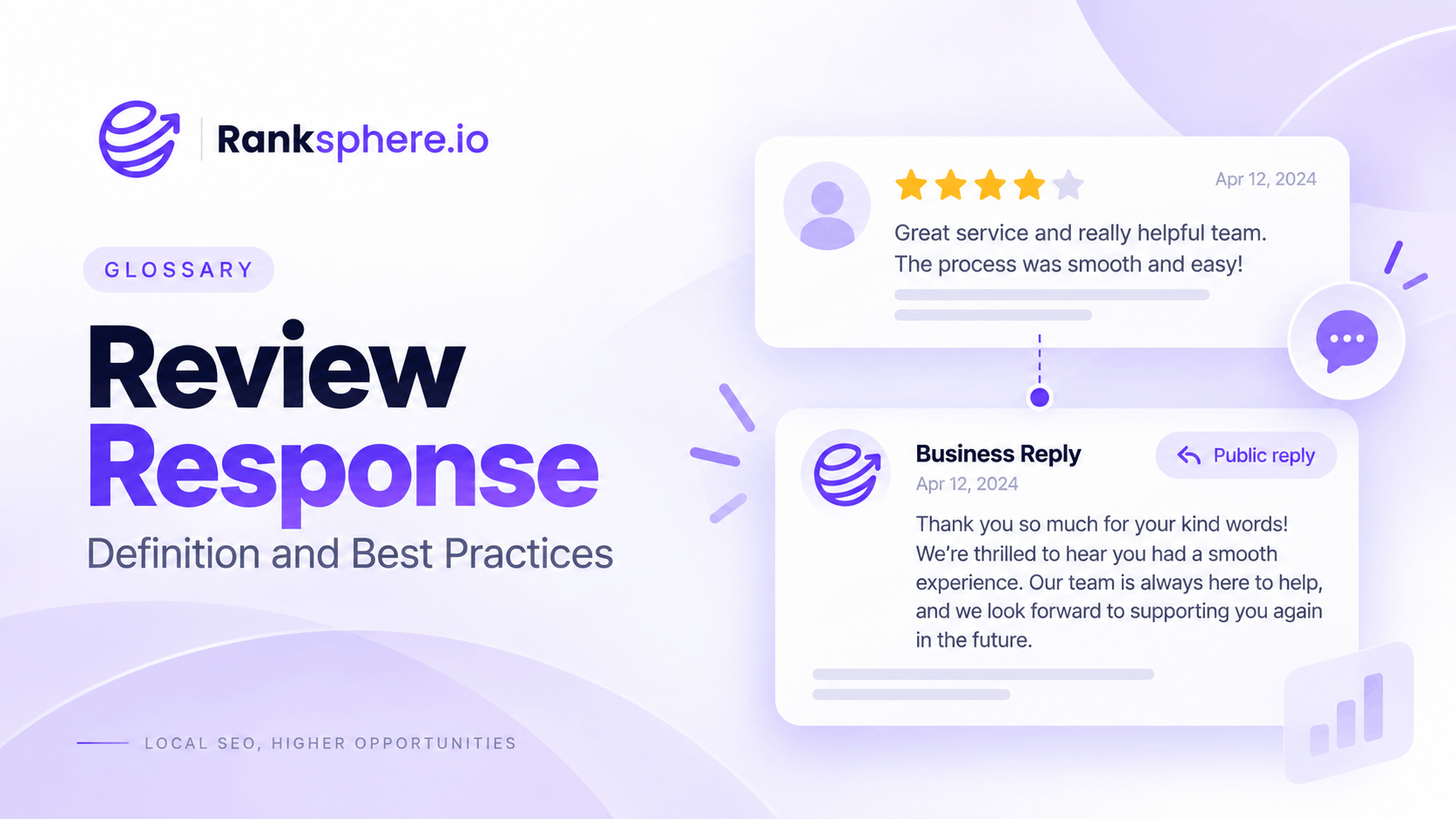
A review response is the public reply a business leaves underneath a customer review. On platforms such as Google, anyone reading the original review can also see how the business responded.
That makes review responses useful for more than simply acknowledging the person who left the feedback. They also show future customers how the business communicates, handles problems and treats people after the sale or service is complete.
This matters most with negative feedback. You may not be able to change what happened, but a calm and useful response can give other readers important context without turning the conversation into a public argument.
Why responding to reviews matters
Customers often read more than the star rating.
They look at what people liked, what went wrong and how the business handled criticism. A profile where recent reviews receive thoughtful responses generally feels more actively managed than one where customer feedback is consistently ignored.
Responding also gives you an opportunity to:
- Thank customers for taking the time to leave feedback
- Address concerns without becoming defensive
- Show future customers how problems are handled
- Clarify general information where appropriate
- Notice recurring complaints that may need attention internally
- Keep your Google Business Profile actively managed
The purpose is not to write an SEO paragraph underneath every review. Responses should first and foremost sound like genuine communication from the business.
How to respond to negative reviews
Negative reviews usually require the most care.
The goal is not to prove that the customer is wrong. Your response will be read by other people who have no knowledge of what happened, so a long defence can sometimes do more damage than the original complaint.
A good approach is to:
- Respond reasonably quickly. You do not need to answer within minutes, but avoid leaving serious concerns unanswered for weeks.
- Acknowledge the issue raised. A specific response feels more genuine than a generic apology.
- Keep the tone calm. Avoid sarcasm, blame or language that could escalate the situation.
- Do not argue through the review section. Detailed disagreements are usually better handled privately.
- Protect customer privacy. Never disclose information that should not be made public.
- Offer a sensible next step. If the issue needs discussion, explain how the customer can contact the appropriate person.
- Keep the response focused. You rarely need several paragraphs to show that a complaint has been taken seriously.
A simple structure works well:
Acknowledge the concern → address what you safely can → offer a way to continue the conversation.
You do not need to accept responsibility for something that did not happen. You can still respond politely without turning the reply into a point-by-point rebuttal.
If a review appears fake or clearly breaches a platform's policies, report it through the proper process. Whether you should respond publicly as well depends on the situation, particularly where privacy or legal issues are involved.
How to respond to positive reviews
Positive reviews deserve more than the same copied thank-you message repeated under every customer.
You do not need to write much. A short response that refers to something the reviewer actually mentioned usually feels more genuine.
For example:
Instead of:
“Thank you for your wonderful review. We appreciate your business.”
you might write:
“Thanks for the kind words about the boiler installation. We're glad the team could get everything completed with minimal disruption.”
When replying to positive reviews:
- Thank the customer naturally
- Mention something specific from their feedback where appropriate
- Keep the response short
- Vary your wording
- Avoid forcing keywords or service names into every reply
- Use the reviewer's name when appropriate and when it is already publicly displayed
The aim is simply to sound like a person responding to another person.
Writing Google review responses
If most of your customer reviews come through Google, it helps to have a simple process for managing them.
Check new reviews regularly and decide who is responsible for responding. For a small business, that may be the owner or manager. For a larger company, reviews may need to be assigned by location or department.
When writing a Google review response:
- Read the full review before replying
- Match the tone to the feedback
- Refer to the customer's actual experience where appropriate
- Avoid copying the same template repeatedly
- Move complicated complaints to a private conversation
- Check spelling, names and factual details before publishing
Do not turn review responses into keyword placement exercises. Mentioning a service naturally can make sense when it directly relates to what the customer discussed, but repetitive SEO wording quickly makes responses look automated.
Using AI for review responses
AI can be useful when a business receives enough reviews that replying manually becomes difficult.
It can help draft responses, organise unanswered reviews and give staff a starting point. The important part is keeping a human involved.
A generated reply should still reflect what the reviewer actually said.
Before publishing an AI-assisted response:
- Read the original review carefully
- Check that the reply addresses the correct issue
- Remove generic or repetitive wording
- Check names, services and details for accuracy
- Review negative responses particularly carefully
- Make sure nothing confidential or inappropriate has been included
Negative reviews should receive extra attention. A response that misunderstands a complaint or uses the wrong tone can make the situation worse.
Ranksphere's review management generates AI replies and flags which reviews are waiting, with reply activity tracked over time. This can make it easier to keep on top of reviews while still allowing someone from the business to review important responses before they are published.
Common review response mistakes
- Copying the same response under every review. Customers quickly notice repeated wording, especially when several reviews appear together.
- Arguing with negative reviewers. A public disagreement rarely reassures the next person reading the exchange.
- Only responding to positive feedback. Negative reviews are often where a thoughtful business response matters most.
- Sharing private information. This is particularly important for healthcare, legal, financial and other sensitive services.
- Writing an essay to defend the business. Long responses can make a relatively small complaint look much larger.
- Waiting too long to respond. Recent feedback is often the feedback potential customers pay the most attention to.
- Making every response promotional. Review replies are customer communication, not advertising copy.
- Publishing AI-generated replies without checking them. Automation should save time without removing oversight.
Review response best practices
- Make someone responsible for reviews. Do not leave responses as a task everyone assumes somebody else is handling.
- Respond consistently. Set a realistic timeframe your team can maintain.
- Refer to the review itself. Even one specific detail can make a response feel much more genuine.
- Keep negative responses calm and concise. Give people confidence that the concern is being handled professionally.
- Take detailed conversations offline. Public responses do not need to contain the full history of the issue.
- Protect personal information. Never reveal customer details simply to prove the business's side of the story.
- Use templates as a starting point, not the finished response. Adjust the wording for the individual review.
- Look for patterns. If several customers mention the same problem, the most valuable response may be fixing the underlying issue.
Example
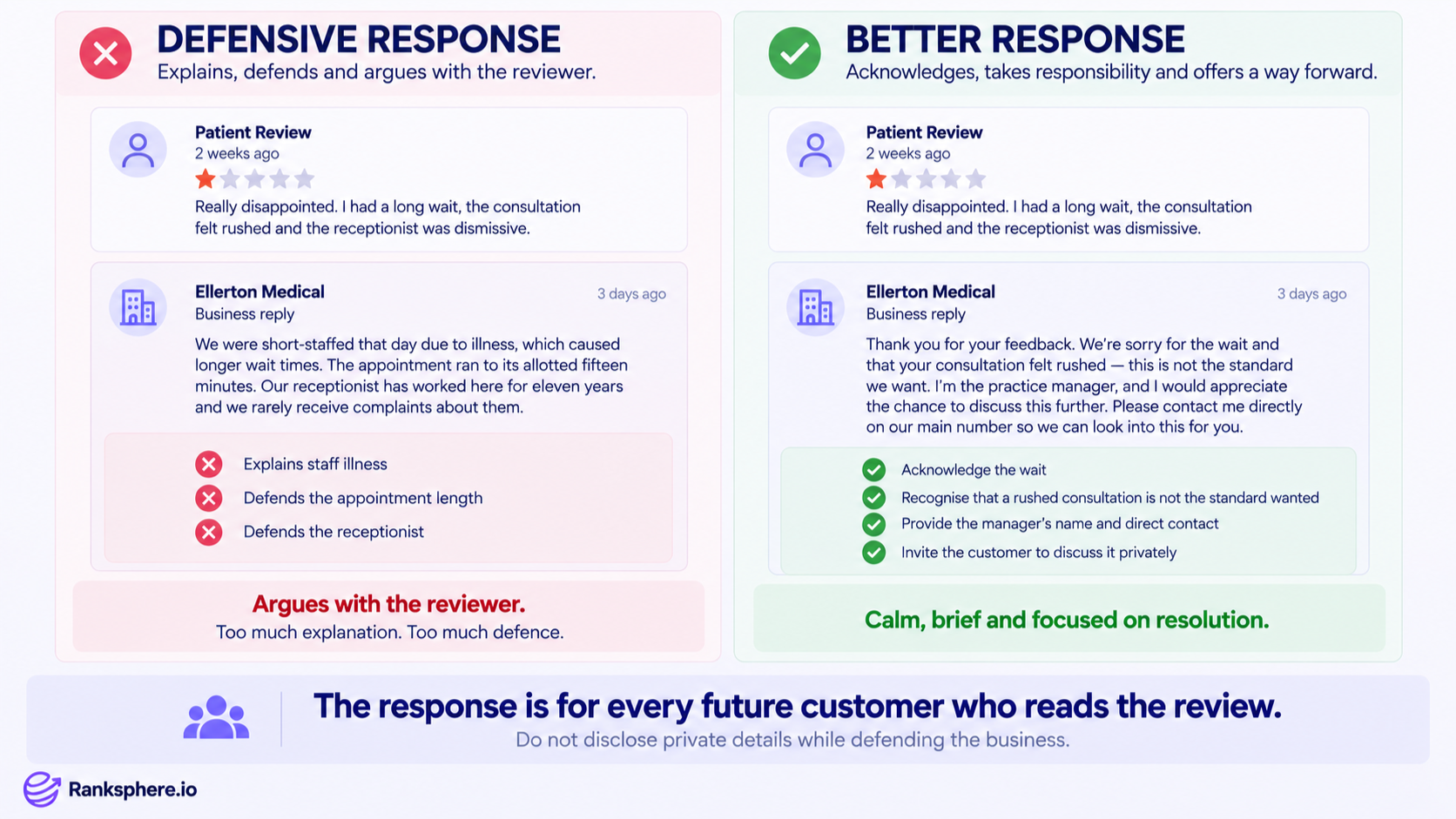
“A patient leaves a one-star review for Ellerton Medical, mentioning a long wait, a rushed appointment and an unhelpful interaction at reception.
The practice manager is tempted to explain what happened that day: the clinic was short-staffed, the appointment ran for its scheduled time and the receptionist involved has worked there for years without previous complaints.
Those details may make sense internally, but publishing them would turn the response into a defence of the practice rather than an acknowledgement of the patient's experience. In a healthcare setting, there is also an additional need to be careful about what information is confirmed publicly.
A better response stays simple.
The practice acknowledges the concerns about the wait and the experience at the clinic, explains that this is not the standard it aims to provide, and gives the patient a way to contact the practice manager privately.
There is no argument and no attempt to disclose what happened behind the scenes.
Whether or not the reviewer contacts the practice again, other patients reading the exchange can see that the complaint was taken seriously and handled professionally.
That is the real value of a good review response. It does not erase negative feedback. It shows people what your business does when something goes wrong.”
See also
- Online review — customer feedback published on Google and other review platforms
- Review velocity — how consistently new reviews are received
- Review gating — why businesses should not filter customers based on expected sentiment
- Reputation management — the wider process of monitoring and managing customer feedback
- Google Business Profile — where Google reviews and business responses appear
- Local ranking factors — the wider signals that influence local search visibility