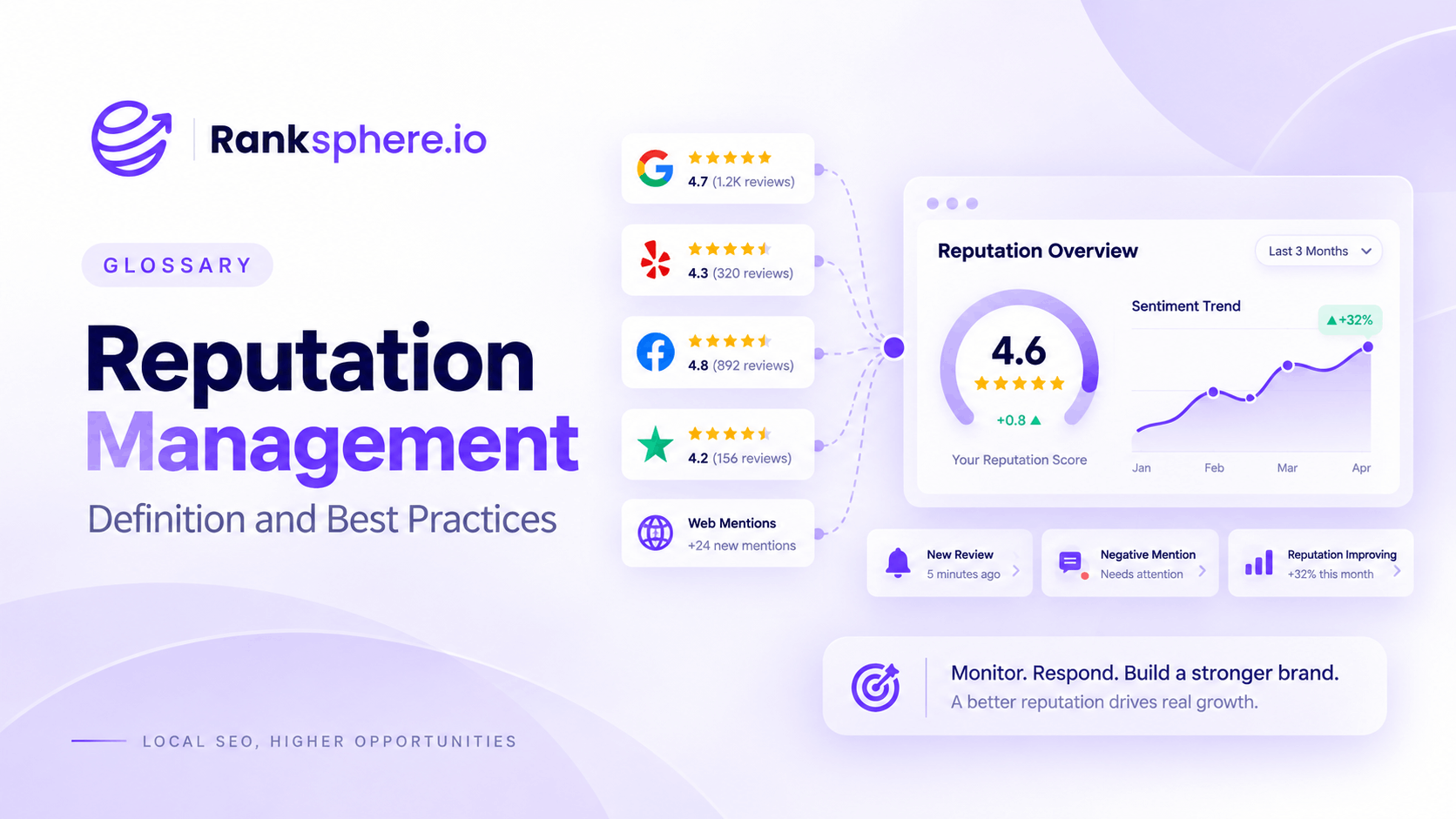
Reputation management is the ongoing process of monitoring and improving how a business is represented online. For local businesses, much of that work revolves around customer reviews, but it also includes search results, directory listings, social mentions, press coverage and other information people find when researching the business.
Good reputation management is not about trying to control every conversation or remove every negative comment. It is about making sure your business information is accurate, listening to customer feedback, responding professionally and dealing with recurring problems when they appear.
For most local businesses, the strongest reputation is built through consistent customer experiences rather than short-term attempts to improve a rating.
What reputation management covers
Customer reviews are usually the most visible part of online reputation management, but they are only one piece of the picture.
A potential customer may look at your Google rating, read a few recent reviews, search your business name, check social media and compare information across several websites before deciding whether to contact you.
That means reputation management can include:
- Customer reviews — collecting genuine feedback, responding to reviews and monitoring rating, volume and velocity
- Branded search results — checking what appears when people search for the business by name
- Business listings — keeping contact details, addresses and other information accurate across citations
- Social and community mentions — paying attention to conversations happening on social networks, local groups and community platforms
- Press coverage — understanding how the business is represented in local or industry media
- Customer feedback trends — identifying complaints or praise that appear repeatedly across different channels
- AI-generated information about the business — checking whether services such as Google's Ask Maps are presenting accurate information based on publicly available sources
The last point is becoming increasingly relevant. Search platforms can now summarise information about businesses from profiles, websites, reviews and other public sources.
You may not control every answer that is generated, but you can improve the information those systems have to work with by keeping your profiles, website and business details accurate.
What good reputation management looks like
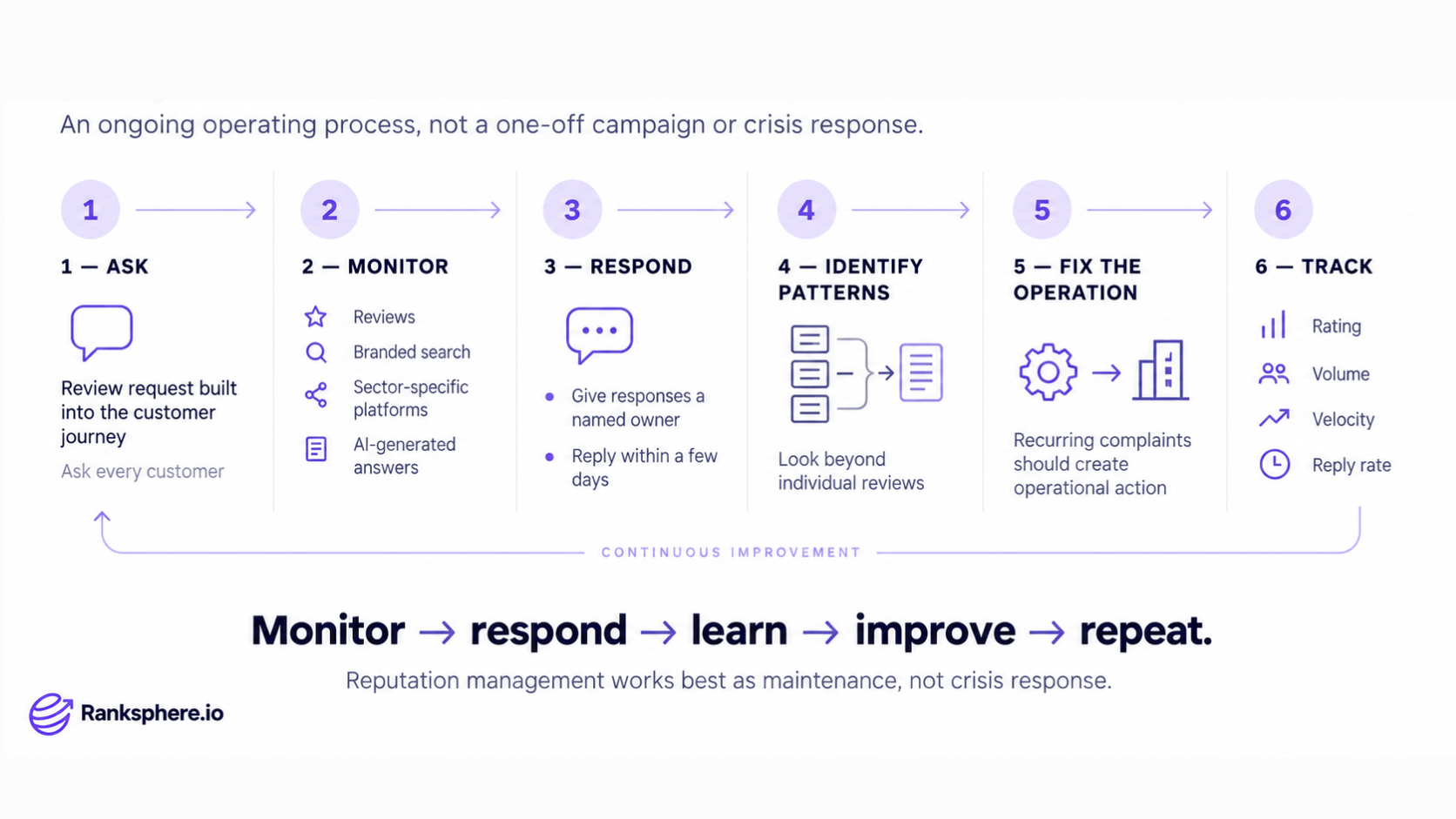
A strong reputation management programme does not need to be complicated.
The most effective approach is usually a set of simple processes that happen consistently rather than only when something goes wrong.
That might include:
- Asking customers for reviews as part of the normal customer journey
- Giving review responses to a specific member of the team
- Monitoring the platforms that customers in your industry actually use
- Checking branded search results periodically
- Watching for incorrect information about the business
- Reviewing recurring complaints with the people responsible for operations
- Tracking review rating, volume, recency and response activity over time
Ranksphere's review management consolidates reviews across locations with AI insights, drafted replies and tracking for rating and reply rate, helping businesses keep review management organised rather than relying on someone to remember to check each platform manually.
Reviews and reputation management
Reviews sit at the centre of local reputation because they are often one of the first things a potential customer sees.
A healthy review profile is not necessarily one with a perfect five-star rating.
Customers also look at:
- How many reviews the business has
- How recently those reviews were posted
- What customers are actually saying
- Whether the business responds
- How complaints are handled
- Whether the overall pattern of feedback feels credible
This is why review management should focus on consistency rather than simply chasing a higher rating.
Ask customers for honest feedback, make the process easy and respond when people take the time to leave a review.
What reputation management cannot fix
There are limits to what reputation management can do.
If customers are repeatedly experiencing the same problem, no review-response template or reputation campaign will solve it.
For example:
- It cannot make legitimate negative feedback disappear. Reviews that follow platform policies may remain visible even when the business disagrees with them.
- It cannot solve poor service. Repeated complaints usually need an operational fix.
- It cannot instantly change what appears in search. Search results and third-party coverage can take time to change.
- It cannot create genuine trust through fake reviews. Manufactured feedback may create a short-term appearance of credibility, but it also creates serious platform and compliance risks.
- It cannot replace good customer experience. Reputation reflects what customers encounter in the real business.
The most useful role of reputation management is to help a business understand how it is being perceived and respond to problems before they become recurring patterns.
Reputation management practices to avoid
Some tactics presented as reputation management can create far bigger problems than the reviews they are intended to solve.
Avoid:
- Buying fake reviews. Purchased or fabricated reviews can breach platform policies and consumer protection rules.
- Review gating — sending review requests only to customers expected to leave positive feedback.
- Offering rewards specifically for positive reviews. Incentives should not depend on the rating or sentiment someone provides.
- Publishing undisclosed insider reviews. Employees, owners, family members or others connected to the business should not pose as independent customers.
- Pressuring customers to remove criticism. Threats or intimidation are not legitimate reputation management.
- Presenting a company-controlled review website as independent. Customers should be able to understand who operates the platform they are reading.
If review generation is handled by an outside provider, ask exactly how the process works. The business still needs to understand what customers are being asked to do and whether the approach follows the relevant platform rules.
Common reputation management mistakes
- Trying to fix the reputation before fixing the customer experience. If the same complaint keeps appearing, look at the cause rather than only the reviews.
- Monitoring Google and nowhere else. Depending on the industry, customers may also rely heavily on specialist review sites, social platforms or local communities.
- Only paying attention during a crisis. Reputation is easier to manage when reviews and mentions are monitored regularly.
- Responding defensively to criticism. Future customers will read your response as well as the original review.
- Outsourcing the process without understanding it. Always know how a provider collects reviews and responds on your behalf.
- Trying to maintain a perfect rating. A credible review profile reflects a range of genuine customer experiences.
- Ignoring inaccurate business information. Wrong addresses, phone numbers and opening hours can damage trust just as easily as a poor review.
- Treating customer complaints as a marketing problem. Sometimes the best reputation work happens inside the business, not online.
Reputation management best practices
- Make review requests part of the customer journey. Do not rely on occasional campaigns.
- Ask customers consistently. Avoid filtering requests according to expected sentiment.
- Give review responses an owner. Someone should be responsible for checking and responding to new feedback.
- Monitor the platforms that matter to your customers. This may include Google, industry sites, social networks and local communities.
- Check branded search results periodically. See what customers see when they search for your business.
- Keep business information accurate. Reputation includes the practical information customers rely on.
- Use negative feedback constructively. Repeated complaints can reveal problems that need attention.
- Keep responses natural and specific. Avoid posting the same generic reply under every review.
- Review your reputation over time. Look at trends rather than reacting to a single rating or comment.
Example
“Kestrel Auto Repair has a low review rating and several recent complaints.
The owner initially treats it as a marketing problem and looks for a reputation company that promises to improve the rating quickly.
But when the existing reviews are read properly, the same complaint appears again and again: customers are being told a repair will be completed on a certain day, then hearing nothing when the work is delayed.
The real problem is communication.
Instead of focusing first on the rating, the business changes its process. Customers now receive an update whenever a job is delayed, and staff are given a clear responsibility for
keeping customers informed.
The garage also starts asking customers for reviews consistently rather than only contacting those who seem happy. New feedback is monitored, and reviews receive a response where appropriate.
Over time, the review profile begins to reflect the improved customer experience.
That is what effective reputation management should do. It should not hide problems. It should help the business see them, respond to them and make sure the online reputation increasingly reflects what customers actually experience.”
See also
- Online review — customer feedback that shapes a local business's reputation
- Review response — how businesses reply to positive and negative feedback
- Review velocity — how consistently new reviews are being received
- Review gating — filtering customers according to expected review sentiment
- Citation — business listings and information that also influence customer trust
- Google Business Profile — one of the main places customers see local reviews and business information