A fake review is a review that falsely represents a genuine customer experience.
That can include a review:
- Written by someone who never used the business
- Purchased from a review seller
- Created by a business pretending to be a customer
- Generated by AI and presented as a real customer experience
- Posted by someone with an undisclosed relationship to the business in circumstances where disclosure is required
- Posted against a competitor without a genuine customer experience
Fake reviews are not simply an SEO problem.
They can breach platform policies, mislead customers and, in the United States, fall within federal rules governing deceptive reviews and testimonials.
The safest approach is straightforward:
reviews should come from real experiences, and businesses should not manipulate what customers say or who gets encouraged to say it.
What is a fake review?
At its simplest, a fake review creates a false impression about somebody's experience with a:
- Business
- Product
- Service
For example:
A person writing:
“Fantastic service. They repaired my boiler the same day.”
when they have never used the company is not describing a genuine experience.
The review is false regardless of whether:
- A person wrote it
- A marketing company wrote it
- AI generated it
The production method is secondary.
The false customer experience is the problem.
Fake reviews and the FTC
In the United States, the Federal Trade Commission's Rule on the Use of Consumer Reviews and Testimonials took effect on 21 October 2024.
The rule covers several deceptive review practices, including:
- Fake or false consumer reviews and testimonials
- Purchasing certain fake reviews
- Compensation conditioned on positive or negative sentiment
- Certain undisclosed insider relationships
- Review suppression
- Company-controlled review sites falsely presented as independent
The FTC specifically says the rule covers fake reviews created by AI when they falsely represent a consumer who does not exist or an experience that did not happen.
Current FTC penalties
In December 2025, the FTC sent warning letters to ten companies regarding potential violations of the Consumer Review Rule.
The FTC said knowing violations can result in civil penalties of up to:
$53,088 per violation.
The letters were warnings, not findings that those companies had broken the rule.
The FTC normally adjusts relevant civil-penalty maximums for inflation. However, it announced that no adjustment would be made for 2026, meaning the 2025 penalty levels continue to apply during 2026.
Because penalty amounts and regulatory guidance can change, businesses dealing with US compliance should check the current FTC position rather than relying permanently on a figure copied into an old article.
What counts as a fake or deceptive review?
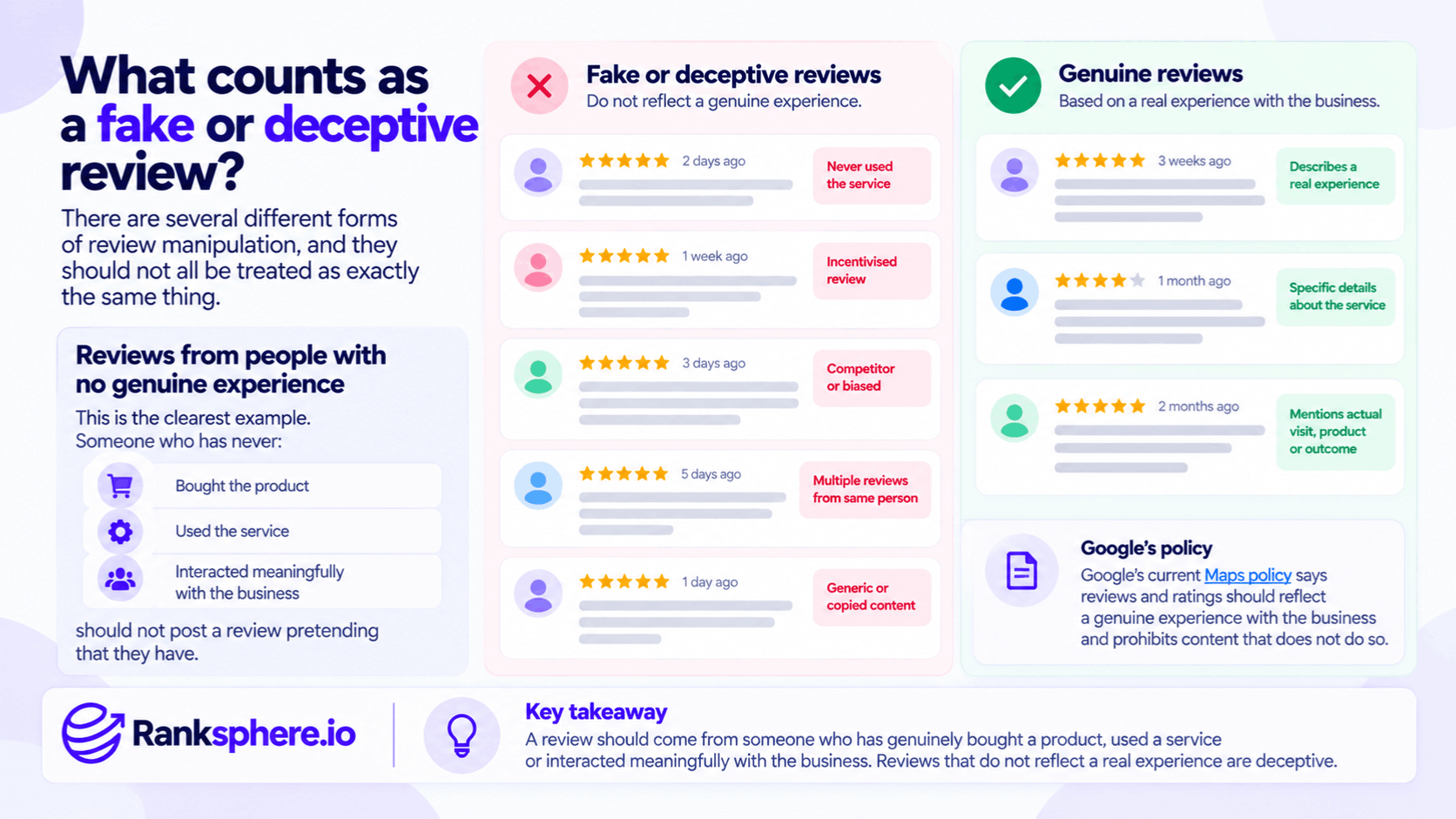
There are several different forms of review manipulation, and they should not all be treated as exactly the same thing.
Reviews from people with no genuine experience
This is the clearest example.
Someone who has never:
- Bought the product
- Used the service
- Interacted meaningfully with the business
should not post a review pretending that they have.
Google's current Maps policy says reviews and ratings should reflect a genuine experience with the business and prohibits content that does not do so.
Bought reviews
A company might be offered:
50 five-star Google reviews for £300.
Buying them does not make the underlying experiences genuine.
The FTC rule prohibits businesses from buying reviews that they knew or should have known were fake or false. Review brokers can also fall within the rule.
Google separately prohibits reviews or ratings that have been paid for, directly or indirectly.
A supplier describing its reviews as:
verified
or:
real-looking
does not remove the business's responsibility to understand how those reviews are actually obtained.
AI-generated fake reviews
AI does not create an exemption from review rules.
For example, asking an AI tool to create:
“Twenty realistic five-star customer reviews for my roofing company”
and publishing them as though they came from genuine customers would misrepresent experiences that never occurred.
The FTC's final rule specifically covers fake reviews attributed to people who do not exist, including AI-generated fake reviews.
The problem is not that AI wrote the words.
The problem is pretending those words describe genuine customers.
AI-assisted genuine reviews are different
There is an important distinction.
Suppose a real customer writes:
“Really pleased, quick service, boiler fixed the same morning.”
and a tool helps them correct grammar before posting.
That is different from inventing the customer or the experience.
The underlying review still needs to represent what actually happened.
Do not use AI to add:
- Experiences that did not happen
- Results the customer did not receive
- Details the reviewer never supplied
Employee reviews
Employee reviews are particularly risky.
Google treats conflicts of interest as prohibited review activity. Its current policy says conflicts can include:
- Current employment
- Former employment
- Contractual relationships
- Professional affiliations
That means employees should not simply leave Google reviews for their employer as though they were ordinary customers.
Family and friends
The legal position is more nuanced than:
“A family review is automatically illegal.”
The FTC's current guidance says a business owner may ask family members for reviews under the federal rule if the relationship to the business is clearly and conspicuously disclosed, although other FTC Act considerations can still apply.
Google's platform policy is stricter about conflicts of interest and specifically includes familial relationships among examples of connections that can create a prohibited conflict.
So the practical recommendation for Google is simpler:
do not use relatives as a way to increase your rating.
Platform rules can be stricter than the minimum legal requirement.
Competitor reviews
Posting negative reviews against competitors without a genuine customer experience is also prohibited.
Google specifically says users and merchants must not post content on a competitor's business in order to undermine its reputation.
That includes arrangements such as:
“You leave one star on them and we'll leave one star on their other location.”
It is review manipulation regardless of which side initiated it.
Review swapping
Review exchanges can create the same conflict.
For example:
Business A gives Business B five stars. Business B gives Business A five stars.
If neither review represents an independent genuine customer experience, the ratings are misleading.
This is especially common in:
- Business networking groups
- Agency communities
- Supplier networks
A professional relationship is not the same thing as a genuine consumer review.
Incentivised reviews need careful distinction
This is an area where legal rules and platform policies differ.
Under the FTC rule
The FTC says a business may offer an incentive for an honest review provided the incentive is not expressly or implicitly conditioned on the review being positive or negative.
However, disclosure may still be required under other FTC guidance.
On Google
Google's current policy is stricter.
Google does not allow businesses to offer incentives such as:
- Money
- Discounts
- Free goods
- Free services
in exchange for posting a review.
So for Google reviews, the practical rule is:
do not incentivise reviews at all.
“Five stars for a voucher” is clearly prohibited
For example:
“Leave us a five-star review and receive £20 off your next visit.”
creates several problems.
The incentive is tied directly to positive sentiment.
That falls squarely within conduct the FTC's rule prohibits, and Google separately prohibits incentivised reviews.
Asking for honest Google reviews is allowed
Google does allow businesses to ask genuine customers for reviews.
Its current policy allows merchants to encourage reviews that reflect genuine experiences, provided they do not:
- Offer incentives
- Pressure the customer
- Demand particular wording
- Selectively request only positive reviews
So:
“If you'd like to share your experience, here's our Google review link.”
is fundamentally different from:
“Leave us five stars for 10% off.”
Review gating
Review gating means treating customers differently depending on their expected sentiment.
For example:
- Ask customers whether they were happy.
- Send happy customers to Google.
- Send unhappy customers to a private feedback form.
Google explicitly prohibits selectively soliciting positive reviews while discouraging negative ones.
A review request process should give genuine customers a fair opportunity to share their experience.
Fake positive reviews hide useful information
Buying positive reviews can create a marketing problem even before enforcement becomes relevant.
Reviews can reveal recurring operational issues.
Suppose genuine customers repeatedly mention:
- Slow response times
- Missed appointments
- Poor communication
Adding fifty fake five-star reviews does not solve those problems.
It simply makes the feedback harder to see.
Good reputation management should help the business learn from genuine patterns rather than cover them up.
Platforms can remove manipulated reviews
Google says fake engagement and rating manipulation are not allowed and can be removed. Its policies also provide for further restrictions in cases of suspicious review activity.
Possible actions documented by Google include:
- Removing suspicious reviews
- Showing warning banners
- Restricting review posting
- Limiting access to certain features
Do not assume a review is permanently safe simply because it stayed live for several months.
Fake reviews and Business Profile enforcement
Manipulated reviews can also form part of a wider Business Profile policy problem.
See Google Business Profile suspension for the broader enforcement context.
But avoid telling businesses:
“Buying one review will automatically suspend your profile.”
Enforcement depends on the circumstances.
The accurate point is that fake engagement breaches Google's Maps policies and can trigger content removal or restrictions.
Fake negative reviews
The opposite problem is receiving a review that appears not to describe a genuine customer experience.
Possible situations include:
- Someone reviewed the wrong business
- A competitor posted it
- An employee with a conflict posted it
- A coordinated attack targeted the listing
- The reviewer never interacted with the business
Do not assume every negative review is fake simply because the business disagrees with it.
Google says negative reviews are not automatically eligible for removal merely because a business dislikes or disputes them. Only reviews that violate policy qualify for removal.
Check the facts before reporting
Before flagging a review, look for evidence.
Check:
- Booking records
- CRM records
- Call records
- Transaction information
A reviewer may use:
- A nickname
- A partner's account
- A different surname
So:
“I cannot find this name in our database”
does not automatically prove that the review is fake.
Investigate first.
Report policy violations
If there is a genuine reason to believe the review violates platform policy, report it using the platform's review-reporting tools.
Google says businesses can report reviews they believe breach its policies, but it will not remove a review simply because the business disagrees with it.
See review removal for the wider process.
Cite the actual policy problem
When escalating a review, identify what is wrong with it.
For example:
- Conflict of interest
- Fake engagement
- Competitor manipulation
- Harassment
- Personal information
That is more useful than simply saying:
“This review is false.”
Platforms evaluate content against their policies.
Respond while a report is pending
A calm public response may still be appropriate while the platform investigates.
For example:
We have been unable to match the details in this review to an experience with our business. We'd like to understand what happened, so please contact us directly with the booking details.
The point is not to win an argument.
It is to show other readers that the business has taken the concern seriously.
Do not publicly accuse the reviewer without evidence
Avoid:
“This is obviously a fake review from our competitor.”
Even if that is your suspicion.
Unless you have strong evidence, that creates another unverified public allegation.
Respond to what can be established.
Use the platform's reporting process for the suspected policy violation.
Protect customer privacy
Do not try to prove a reviewer wrong by publishing:
- Medical information
- Financial details
- Private correspondence
- Home addresses
- Detailed account records
A review response is public.
The fact that a customer posted first does not necessarily make their private information appropriate to publish.
Fake review attacks
Some businesses experience sudden bursts of suspicious negative reviews.
If that happens:
- Record the timing and URLs.
- Screenshot the activity.
- Check whether the accounts or wording show a clear pattern.
- Report individual policy violations.
- Use the platform's available escalation process.
Google also provides special guidance for negative-review extortion scams.
Keep evidence before reviews disappear or accounts change.
Do not buy positive reviews to “balance” fake negatives
Receiving fake negative reviews does not justify adding fake positive ones.
That simply creates a second policy violation.
Continue your normal legitimate online review process while the suspicious reviews are investigated.
The objective should be a review profile that reflects genuine customers.
Not a numerical battle.
Review velocity is not a defence against fake reviews
A steady flow of genuine reviews can make a profile more representative of current customer experience.
That does not mean the goal should be:
generate enough positive reviews to bury the fake one.
Review velocity is better understood as the natural rate at which genuine customer feedback arrives.
Do not manufacture it.
Third-party review vendors
Treat promises such as these as warning signs:
- “Guaranteed five-star reviews”
- “100 verified Google reviews”
- “Reviews from aged accounts”
- “Guaranteed reputation repair”
- “Undetectable AI reviews”
Ask exactly:
Who writes the reviews?
Did those people genuinely use the business?
Are incentives involved?
Which platforms will they be posted on?
How are customers selected?
If the answer is vague, do not assume the service is compliant.
Businesses can be responsible for vendors
Outsourcing review generation does not automatically transfer responsibility away from the business.
The FTC's guidance specifically notes that advertising agencies, PR firms, review brokers and reputation-management companies can themselves face liability under the rule, and businesses can also face liability when they buy reviews they knew or should have known were fake.
“An agency did it” is not a good compliance strategy.
Reused testimonials
Take care when moving testimonials between contexts.
A genuine comment can become misleading if it is presented as though it describes:
- A different service
- A different product
- A different experience
For example:
A customer's praise for:
emergency plumbing
should not be edited and presented as a testimonial for:
bathroom installation
if they never received that service.
The words may originally have been genuine.
The new context is not.
Editing customer reviews
Correcting a typo is one thing.
Changing the substance is another.
Do not turn:
“Good service overall, although it took longer than expected.”
into:
“Great service.”
and present it as a verbatim testimonial.
If a business publishes edited testimonials in its own marketing, the result should not materially misrepresent what the customer actually said or experienced.
Review suppression
Fake-review compliance also includes what businesses do with negative reviews.
The FTC's rule prohibits certain review-suppression practices, including using unfounded legal threats, intimidation or certain knowingly false accusations to force negative reviews to be changed or removed.
That means reputation management cannot become:
“Remove the review or we'll sue you.”
simply because criticism is uncomfortable.
Legitimate legal disputes are more nuanced and should be handled with appropriate professional advice.
Fake reviews and Yelp
Yelp operates under different review-solicitation rules from Google.
Yelp tells businesses not to ask customers for reviews at all.
So even a review process that complies with Google's solicitation rules may not comply with Yelp's platform policy.
That is why review programmes should be designed per platform rather than copied everywhere.
Common fake review mistakes
- Buying reviews to launch a new profile.
- Using AI to invent customer experiences.
- Asking staff to review their employer on Google.
- Using family members to inflate Google ratings.
- Offering discounts or free products in exchange for Google reviews.
- Offering rewards only for positive reviews.
- Using review gating to send only happy customers to public review platforms.
- Hiring a review vendor without understanding how its reviews are obtained.
- Assuming a negative review is fake simply because the business disagrees with it.
- Publicly accusing reviewers of fraud without evidence.
- Disclosing private customer information in a public reply.
- Buying positive reviews to counter a suspected fake-review attack.
- Assuming the FTC rule and individual platform rules are identical.
Fake review best practices
- Only publish or encourage reviews based on genuine customer experiences.
- For Google, never offer payment, discounts, free products or other incentives for reviews.
- Do not ask staff, relatives or connected parties to inflate Google ratings.
- Request reviews fairly rather than selecting only customers expected to be positive.
- Do not provide customers with scripted praise to paste into a review.
- Vet agencies and reputation-management vendors carefully.
- Report suspected fake reviews under the specific platform policy they appear to breach.
- Keep evidence when dealing with coordinated attacks or suspected manipulation.
- Respond professionally while removal requests are pending where a response is appropriate.
- Keep review removal and public response as separate processes.
- Continue building a genuine review profile rather than trying to manipulate the average rating.
- Take qualified legal advice for specific FTC or other regulatory compliance questions.
Ranksphere and fake-review monitoring
Ranksphere's review management brings reviews across platforms into one place with drafted replies, helping businesses spot new feedback and respond without having to check each platform individually.
That can be particularly useful when suspicious negative reviews appear.
The software can help surface the review and organise the response process.
The decision about whether a review actually violates platform policy still requires judgement.
Example
“Kestrel Auto Repair has a 3.4-star rating.
A reputation company approaches the business and promises:
“4.5 stars within 90 days.”
Its strategy combines:
- Purchased five-star reviews
- Review accounts with no genuine customer history
- A voucher offered to customers who leave five-star feedback
The rating rises quickly.
But none of those numbers fixes the underlying customer experience.
Worse, several parts of the programme conflict with Google's current review policies, which prohibit paid and incentivised reviews as well as rating manipulation.
If the business operates in the United States, sentiment-conditioned incentives and knowingly purchased fake reviews can also create exposure under the FTC Consumer Review Rule.
The business changes course.
It reviews its genuine negative feedback and notices one complaint appearing repeatedly:
customers are not being told when repairs run late.
Instead of trying to bury the criticism, Kestrel changes its process.
Whenever a job is delayed, the customer now receives an update.
The business then asks genuine customers for Google feedback using the same neutral request regardless of whether staff expect the customer to be positive or negative.
There is:
- No incentive
- No five-star condition
- No review gating
- No staff review scheme
Over time, the review profile becomes a more accurate reflection of the customer experience.
That is the real objective.
A strong reputation should come from improving the experience and making it easy for genuine customers to describe it — not from manufacturing the appearance of satisfaction.”
See also
- Review gating — selectively encouraging reviews according to expected sentiment
- Review removal — when and how platforms may remove policy-violating reviews
- Online review — building a legitimate review programme
- Reputation management — monitoring and improving how customers experience and describe the business
- Yelp — a review platform with different solicitation rules from Google