Net Promoter Score (NPS)
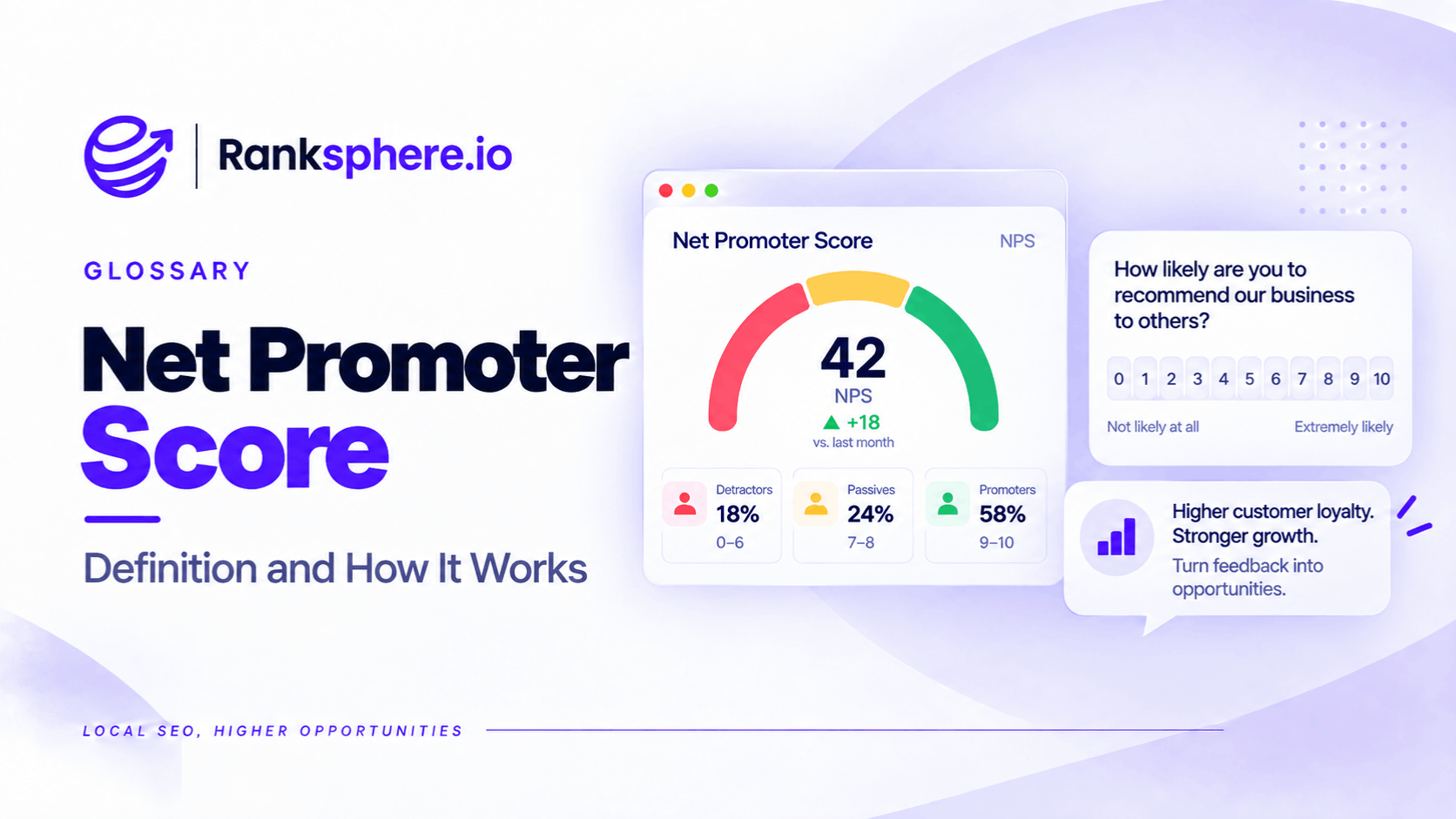
Net Promoter Score (NPS) is a customer loyalty metric that measures how likely customers are to recommend a business, product, or service to someone else.
It is based on one question:
“How likely are you to recommend our business to a friend or colleague?”
Customers respond on a scale from 0 to 10. Their answers are grouped into promoters, passives, and detractors, and the final score is calculated by subtracting the percentage of detractors from the percentage of promoters.
For local businesses, NPS can be a useful way to collect private feedback and identify problems with the customer experience.
However, it becomes a problem when businesses use survey answers to decide who should receive a public review request.
For example, sending customers who score 9 or 10 a Google review link while directing everyone else to a private feedback form is a form of review gating.
That distinction matters because Google prohibits businesses from selectively encouraging positive reviews.
How Is Net Promoter Score Calculated?
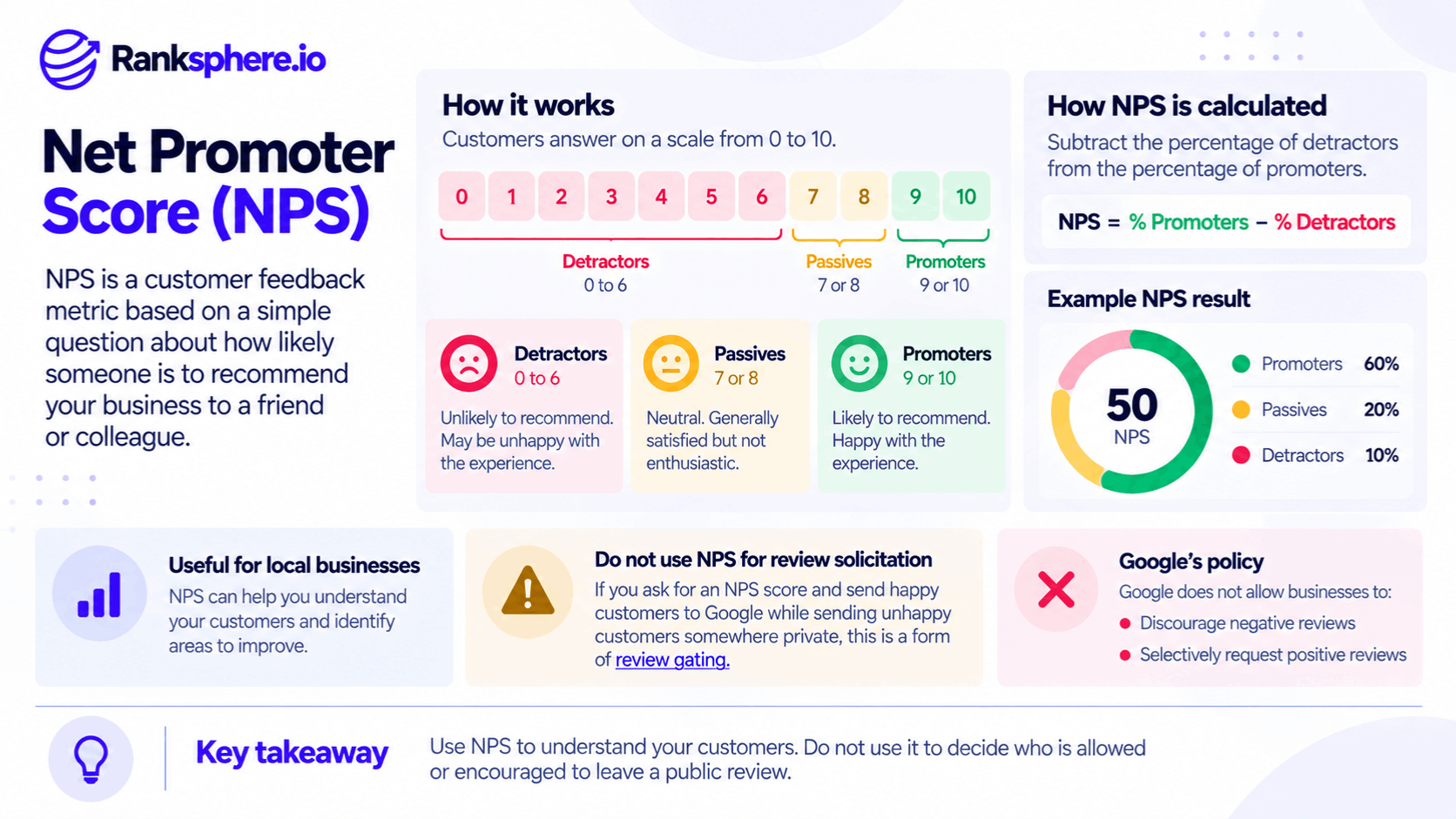
Net Promoter Score divides survey respondents into three groups.
Promoters (9–10)
Promoters give a score of 9 or 10.
They indicate that they are highly likely to recommend the business to someone else.
For example, a patient who had a positive experience with a physiotherapy clinic may give it a 10 because they would confidently recommend the clinic to friends or family.
However, a high score doesn't guarantee that the customer will actually make a recommendation.
Passives (7–8)
Passives give a score of 7 or 8.
These customers may be satisfied with the service, but they aren't classified as promoters.
Their responses are included in the total number of survey responses, but they don't directly add to or subtract from the final NPS.
This is one limitation of the metric.
A business could improve the experiences of several customers, moving their scores from 7 to 8, without seeing any change in its NPS.
Detractors (0–6)
Detractors give a score between 0 and 6.
These customers indicate a lower willingness to recommend the business.
Their responses may reflect problems with service quality, waiting times, communication, pricing, or other aspects of the customer experience.
However, a low score doesn't explain exactly what went wrong.
That's why NPS is most useful when the score is accompanied by written feedback.
Net Promoter Score Formula
The calculation is:
NPS = Percentage of Promoters − Percentage of Detractors
For example, imagine a dental practice receives 100 survey responses:
- 60 customers are promoters.
- 25 customers are passives.
- 15 customers are detractors.
The calculation would be:
60% − 15% = +45 NPS
NPS ranges from −100 to +100.
A positive score means the business has a higher percentage of promoters than detractors.
However, the score alone doesn't explain why customers feel that way or which improvements would make the biggest difference.
Net Promoter Score and Review Gating
The connection between NPS surveys and online review requests is particularly important for local businesses.
Collecting private customer feedback is generally acceptable.
The problem begins when a business uses that feedback to decide which customers should be invited to leave a public review.
How NPS Review Gating Works
Consider a physiotherapy clinic using an automated customer feedback platform.
After each appointment, the clinic sends patients an NPS survey.
The platform then follows two different paths:
- Customers scoring 9 or 10 receive a link asking them to leave a Google review.
- Customers scoring 8 or below are directed to a private feedback form.
This process encourages satisfied customers to post publicly while directing less favourable feedback elsewhere.
It may lead to a public review profile that doesn't fairly represent the range of customer experiences.
Google's review policies prohibit selectively soliciting positive reviews or discouraging negative ones.
The practice is still review gating even if the platform describes it as customer experience management, reputation protection, or feedback routing.
What Businesses Can Do Instead
An NPS survey and a public review request can both be used, provided the review invitation process doesn't depend on the survey response.
For example:
- Acceptable: Collect private NPS feedback and independently invite eligible customers to leave honest reviews using a consistent process.
- Not acceptable: Ask only customers who give high NPS scores to leave Google reviews.
- Not acceptable: Use previous NPS results to remove dissatisfied customers from review invitation lists.
- Not acceptable: Send promoters to Google while sending detractors to a private complaint form instead.
The important point is that customers should not be selected for public review requests based on how positively they are expected to respond.
How FTC Rules Apply
In the United States, businesses also need to consider the Federal Trade Commission's rules and guidance on consumer reviews.
The FTC's Consumer Reviews and Testimonials Rule addresses specific practices, including fake reviews, incentives conditioned on review sentiment, and certain forms of review suppression.
However, not every form of selective review solicitation automatically violates that specific rule.
Depending on the circumstances, misleading review collection practices may also raise concerns under broader consumer protection laws.
For businesses collecting reviews on Google, the safer approach is to invite genuine feedback without filtering customers according to satisfaction scores.
Ranksphere's Google review management tool helps businesses review customer feedback and manage responses.
The purpose of public review management should be to handle genuine customer experiences, not selectively encourage only positive feedback.
What Are the Limitations of Net Promoter Score?
NPS is easy to understand and calculate, but it has several weaknesses.
These are worth considering before making it a primary business KPI.
1. It Doesn't Explain Why Customers Give Their Scores
NPS tells you how willing customers say they are to recommend your business.
It doesn't explain the reasons behind their answers.
For example, a dental practice may see its NPS decline without knowing whether the problem involves:
- Appointment availability
- Waiting times
- Staff communication
- Treatment costs
- Customer service
The score identifies a possible issue, but additional feedback is needed to understand it.
Review sentiment can provide more useful detail when customers explain what they liked or disliked.
2. It Measures Intention Rather Than Behaviour
Someone who gives a score of 10 may never actually recommend the business.
Another customer who gives a score of 7 might regularly recommend it to friends.
NPS measures stated willingness to recommend, not confirmed recommendations.
It shouldn't be treated as a direct count of word-of-mouth referrals.
3. Small Samples Can Produce Unstable Scores
Many local businesses receive relatively few survey responses.
If only ten people respond, one or two ratings can noticeably change the result.
For example, a business might see a large monthly movement in NPS simply because a few more satisfied customers completed the survey.
That doesn't necessarily indicate a significant change in the experience of its wider customer base.
Always consider the number of responses before interpreting changes.
4. Scoring Habits Differ Between Customers
Not everyone uses a 0–10 scale in the same way.
Some people readily give scores of 9 or 10, while others reserve those scores for exceptional service.
Scoring behaviour can also vary across countries, cultures, and industries.
This makes comparisons between different markets less reliable.
5. Industry Benchmarks Can Be Misleading
Published NPS averages can vary significantly depending on how surveys are conducted.
Differences may include:
- Sample size
- Survey timing
- Customer selection
- Industry definitions
- Geographic location
- Response collection methods
For a local business, comparing its current NPS with its own historical results is often more useful than comparing it with a broad industry average.
6. NPS Can Be Manipulated
If staff members are rewarded for achieving high NPS scores, they may encourage customers to give 9s or 10s.
This can distort the results.
The purpose of the survey should be to understand the customer experience, not to encourage customers to select a particular number.
When Is Net Promoter Score Useful for Local Businesses?
Despite its limitations, NPS can be useful when businesses collect enough responses and take action on the feedback.
Tracking Changes in Customer Satisfaction
A business can use NPS to monitor whether customers' willingness to recommend it changes over time.
For example, a veterinary practice may survey customers after appointments.
If NPS declines consistently over several months, the team can investigate whether operational changes or service issues are contributing.
However, the survey method should remain consistent.
Changing when or how customers are surveyed can affect the results.
Identifying Problems Before They Become Widespread
Private feedback can reveal issues customers haven't mentioned in public reviews.
For example, several patients may report difficulty booking appointments.
If the practice reviews those comments regularly, it can investigate the problem before more customers experience it.
NPS can therefore be useful as an early warning system.
However, collecting feedback only helps if the business acts on it.
Asking Customers Why They Gave Their Score
The most valuable part of an NPS survey is often the follow-up question.
For example:
“What's the main reason for your score?”
Or:
“What could we have done to improve your experience?”
These questions give the business information it can actually use.
A score of 6 doesn't tell a practice how to improve.
A comment explaining that appointment reminders are confusing gives the team something specific to investigate.
Comparing NPS with Public Review Sentiment
Businesses receiving a reasonable volume of online reviews can compare NPS feedback with recurring themes in public reviews.
For example, both sources might mention:
- Friendly staff
- Long waiting times
- Easy booking
- Poor communication
- Pricing concerns
If the same complaints appear repeatedly, the business may have stronger evidence of an operational problem.
However, public reviews and private surveys often attract different respondents, so their results shouldn't be expected to match exactly.
For many small local businesses, the written feedback matters more than the NPS number itself.
Common Net Promoter Score Mistakes
Businesses can undermine the value of NPS by collecting it incorrectly or using it for the wrong purpose.
Common mistakes include:
- Routing review requests by NPS score. This can become review gating and violate Google's review policies.
- Using NPS as the main reputation metric. Customers generally see public reviews and star ratings, not the business's private NPS.
- Comparing scores with unrelated industry benchmarks. Different methodologies can make comparisons misleading.
- Overreacting to small changes. A small survey sample can produce large score fluctuations.
- Collecting scores without asking why. A number alone provides limited information about what needs improvement.
- Pressuring customers to give high scores. This makes the survey less reliable.
- Failing to act on feedback. Collecting complaints without reviewing or addressing them does little to improve the customer experience.
- Assuming survey responses represent every customer. People who respond may have different experiences from those who don't.
Net Promoter Score Best Practices
To make NPS useful without creating problems with public review collection:
- Keep NPS surveys separate from public review invitations.
- Never use NPS scores to decide who receives a Google review request.
- Include an open-ended follow-up question.
- Review response counts before interpreting score changes.
- Use a consistent survey process.
- Compare results with your own historical performance.
- Avoid pressuring staff or customers to achieve particular scores.
- Share feedback with the teams responsible for customer experience.
- Track recurring complaints and whether they are being addressed.
- Compare NPS themes with public review sentiment where enough feedback is available.
The goal isn't simply to increase NPS.
It's to understand what customers experience and identify what the business should improve.
Example of NPS and Review Gating at a Local Business
Consider a hypothetical physiotherapy clinic called Harbour Physiotherapy.
The clinic uses a reputation platform that sends every discharged patient an NPS survey.
Patients scoring 9 or 10 receive a Google review link.
Patients scoring below 9 receive a private feedback form instead.
Over time, the clinic builds a strong public star rating.
The practice manager believes the reviews reflect consistently high customer satisfaction.
However, the review collection process has been directing dissatisfied patients away from Google.
What the Clinic Discovers
During an internal review, the manager finds numerous private complaints about appointment scheduling.
Patients have reported:
- Difficulty booking appointments
- Long waiting times
- Problems rescheduling sessions
- Confusing appointment reminders
The feedback has been collected, but it hasn't consistently reached the people responsible for improving the scheduling process.
As a result, the same complaints continue appearing in private survey responses.
Meanwhile, the public review profile contains a disproportionately positive selection of customer experiences.
How the Clinic Changes Its Approach
The clinic separates its NPS programme from its public review collection.
First, eligible patients are invited to leave honest Google reviews through a consistent process that doesn't depend on their survey scores.
Second, the practice keeps its NPS survey for internal feedback.
The survey also includes an open-ended question asking patients to explain their rating.
Finally, the management team begins reviewing recurring feedback with the reception and operations staff.
Instead of treating dissatisfied customers as people whose comments should stay private, the clinic uses their feedback to identify and address service problems.
Example Shows
“The original process used customer satisfaction scores to influence who was encouraged to leave a public review.
That created a misleading picture of the clinic's reputation and conflicted with Google's review solicitation policies.
After separating the processes, the business can collect internal feedback without using it to filter public reviews.
The clinic may receive a wider range of public opinions, but the exact effect on its star rating or review volume cannot be predicted.
More importantly, the team now has a process for identifying recurring customer concerns and making improvements.
Net Promoter Score is most useful when it helps a business improve customer experience, not when it's used to control who leaves public reviews.
For local businesses, NPS can complement reputation management, but it should remain independent of public review solicitation.”
See Also
- Review Gating — Selectively encouraging positive reviews while discouraging negative feedback.
- Online Review — Public feedback customers leave about a business.
- Review Sentiment — Identifying recurring themes in customer feedback.
- Star Rating — The public rating customers see when evaluating a business.
- Reputation Management — Managing public reviews and customer feedback.
- KPI — A metric used to measure progress toward a business objective.