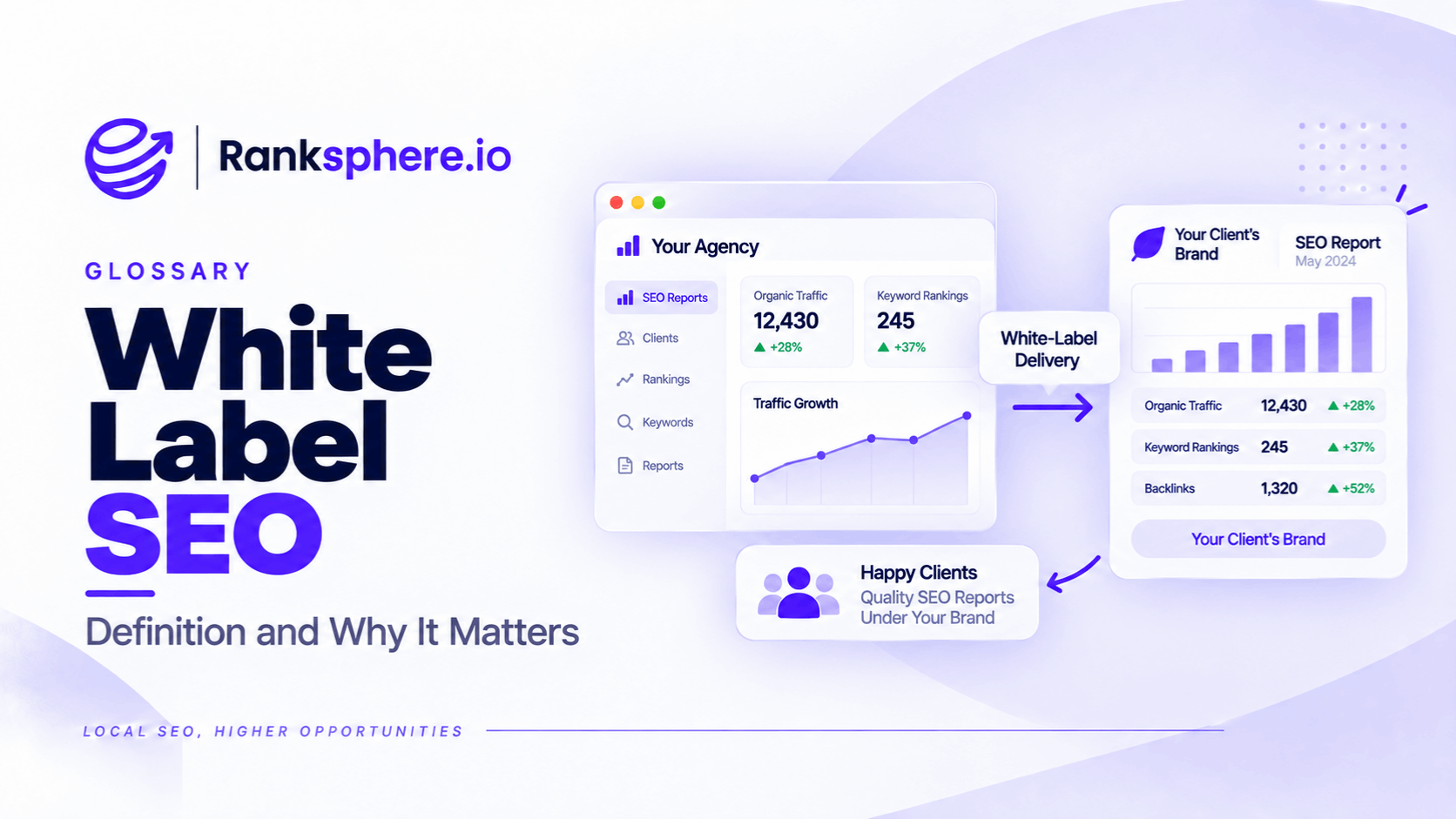
White label SEO is an arrangement where one agency provides SEO services that another agency sells to its clients under its own brand.
The agency selling the service manages the client relationship, while a separate SEO provider handles some or all of the work behind the scenes.
For example, a web design agency may have clients asking for local SEO services but lack the resources to deliver them internally.
Instead of hiring an SEO team, the agency partners with a specialist provider. The provider completes the agreed work, and the web design agency delivers it to the client as part of its own services.
The client may not know which company performs the work, depending on the agreement and how the service is presented.
White label SEO is a common outsourcing model. It allows agencies to expand their services without building every capability in-house.
However, it introduces an operational challenge: the people delivering the SEO work may have no direct relationship with the business receiving it.
If client information, expectations, or feedback doesn't move efficiently between the two agencies, delivery can quickly become difficult.
How Does White Label SEO Work?
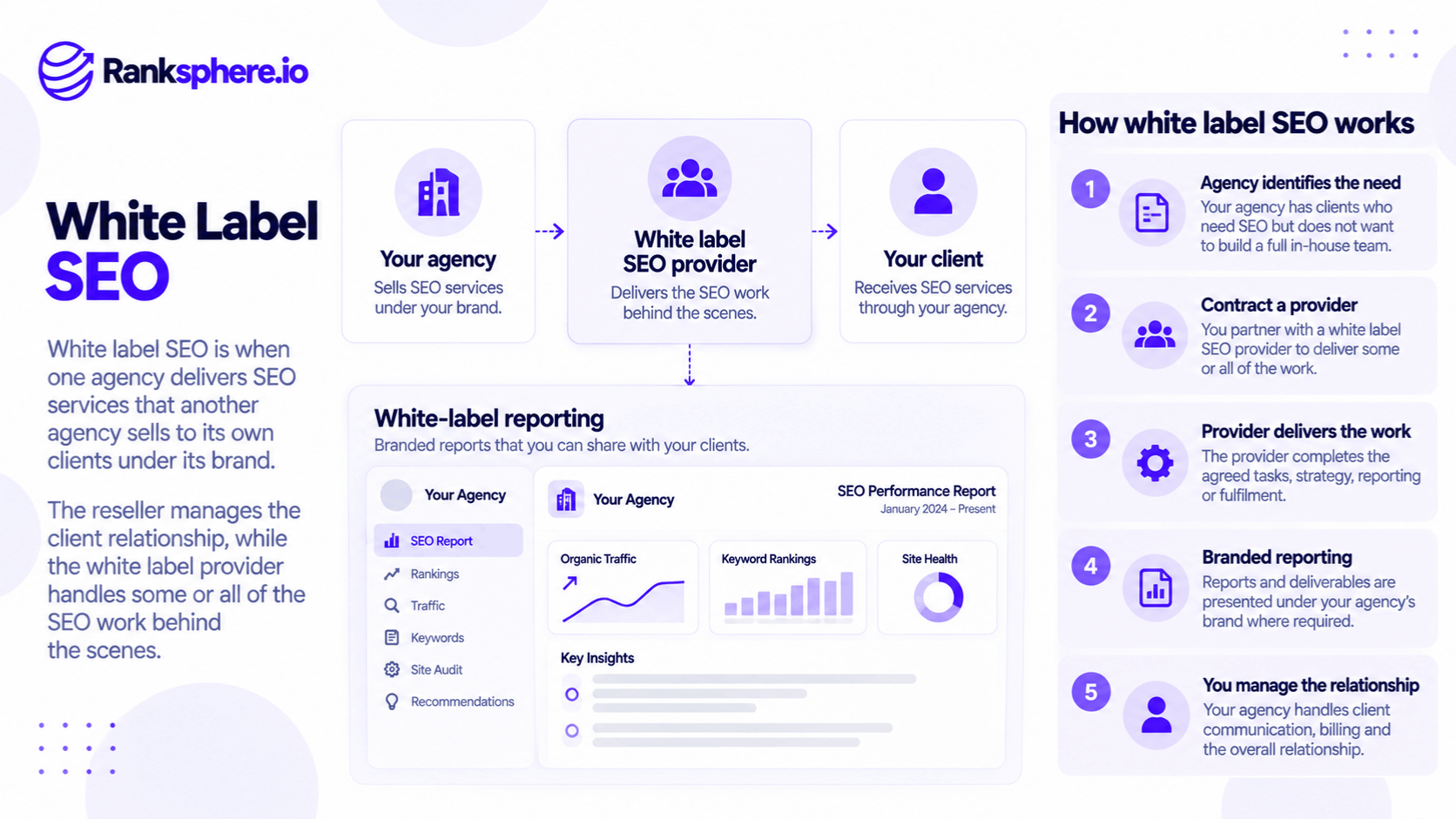
A white label SEO arrangement typically involves three parties:
- The client — the business paying for SEO services.
- The reselling agency — the company managing the client relationship and selling the service.
- The SEO provider — the specialist delivering the work on behalf of the agency.
The process usually works as follows.
- A business hires an agency for SEO services.
- The agency agrees on deliverables, pricing, and reporting with the client.
- The agency assigns some or all of the work to a white label SEO provider.
- The provider completes the agreed SEO activities.
- The provider supplies updates and white-label reports.
- The agency reviews the work, manages communication, and reports progress to the client.
For example, a marketing agency might charge a client a monthly fee for local SEO management.
The agency pays its SEO provider an agreed amount and retains the difference to cover account management, sales, administration, and profit.
Both businesses benefit when the arrangement is properly managed.
The agency gains access to specialist services without hiring a full SEO team, while the provider receives work without managing every end-client relationship.
What Services Can Be White Labelled?
White label SEO can cover individual tasks or complete SEO campaigns.
Common services include:
- Keyword research and keyword mapping
- Technical SEO audits
- On-page SEO
- Content writing and optimisation
- Local SEO
- Google Business Profile management
- Local citation management
- Link-building and digital PR
- Competitor research
- SEO performance reporting
For example, a web design agency may outsource only technical SEO audits while keeping content production in-house.
Another agency may outsource an entire local SEO campaign, including keyword research, Google Business Profile optimisation, and monthly reporting.
The important point is that white label SEO describes the delivery arrangement, not a particular SEO technique.
The same quality standards should apply whether the work is completed internally or by an external provider.
Why Do Agencies Use White Label SEO?
White label SEO can make it easier for agencies to offer services outside their existing expertise.
Expand Services Without Hiring
A web design agency may already have strong relationships with local businesses.
Those clients may also need SEO, but the agency doesn't have an internal specialist.
Working with a white label provider allows the agency to offer SEO without immediately recruiting and training new employees.
This can be particularly useful when demand is uncertain or varies throughout the year.
Access Specialist Expertise
SEO covers several disciplines.
An agency experienced in website design may not have the expertise required for technical audits, local search, or Google Business Profile management.
A specialist provider can support those areas.
However, agencies should assess the provider's actual capabilities rather than assume every supplier offers the same standard of service.
Manage More Clients
A reliable provider may help an agency support more clients than its internal team could manage alone.
However, outsourcing doesn't eliminate the agency's responsibilities.
Someone still needs to manage client expectations, review deliverables, arrange access, and respond when work is delayed.
Deliver Branded Reports
Many agencies want reports that match their own branding.
For example, a client report might include the agency's logo, colours, and contact information rather than the SEO software provider's branding.
Ranksphere's White Label Reports allow agencies to deliver SEO reports under their own branding.
This helps maintain a consistent client experience.
However, branded reporting doesn't replace accurate data or clear communication about campaign performance.
Where White Label SEO Can Go Wrong
The biggest challenge is often communication.
The SEO provider may understand what needs to be done but lack the information or access required to complete it.
Meanwhile, the client communicates only with the reselling agency.
Problems arise when important details fail to reach the right person.
1. The Provider Cannot Get Information From the Client
Consider a roofing company that needs new service pages.
The SEO provider may require:
- Photographs from completed projects
- Accurate service descriptions
- Genuine pricing information
- Locations served
- Details about materials and repair methods
Only the roofing company may have this information.
If the provider cannot contact the client directly, every request must go through the reselling agency.
When nobody takes responsibility for collecting the information, the work stalls.
The provider may be blamed for missed deadlines even though it is waiting for essential details.
2. Sales Promises Don't Match the Actual Service
An agency may promise results or services that its SEO provider has not agreed to deliver.
For example, the agency might tell a client:
"We'll get your business onto Google's first page within six months."
The provider may have agreed only to perform keyword research, content optimisation, and local SEO management.
Google rankings cannot be guaranteed, and the supplier shouldn't be expected to fulfil promises outside its control.
Before work begins, both parties should understand exactly what the client has been sold.
3. Access Requests Get Delayed
SEO providers often need access to tools and business assets.
For local SEO, this may include:
- Google Business Profile
- Google Search Console
- Google Analytics
- Website CMS
- Relevant reporting platforms
If the provider cannot request access directly, the agency must coordinate it.
A missing permission can delay work for days or weeks.
The process should be agreed upon before delivery begins.
4. Reporting Becomes Selective
White label arrangements may involve several layers of reporting.
The provider prepares performance data, and the reseller shares it with the client.
Problems arise when results are presented selectively.
For example, an agency may highlight ranking improvements while omitting declines, incomplete work, or unresolved technical issues.
This can create unrealistic expectations and prevent the client from making informed decisions.
White label reports should remain accurate, even when the results are disappointing.
5. Pricing Leaves Too Little Room for Quality
A reseller needs enough margin to cover its own costs.
However, pushing the supplier's price too low can affect the resources available for delivery.
For example, a contract may include technical SEO, Google Business Profile management, content production, citation work, and monthly reporting.
If the supplier's fee cannot reasonably cover the agreed activities, the arrangement may become difficult to sustain.
The solution is to define a realistic scope rather than continually expand the work without adjusting the budget.
6. Nobody Takes Responsibility for Problems
When campaign performance declines, the agency may blame the provider.
The provider may explain that it never received the required access or client information.
Meanwhile, the client doesn't know why progress has stalled.
A workable white label arrangement needs clear ownership of tasks, approvals, communication, and escalation.
What Should Be Included in a White Label SEO Agreement?
A written agreement should explain what both parties are responsible for.
It should cover more than the monthly price.
Scope of Work
Define the services included and the expected deliverables.
For example:
- Number of pages to optimise
- Number of articles to produce
- Number of locations to manage
- Reporting frequency
- Technical audit responsibilities
- Content review and approval process
A clear scope of work helps prevent disagreements about what is included.
It should also explain how additional work will be requested and priced.
Turnaround Times
Agree on realistic delivery timelines.
For example, a provider may need five working days to complete a content draft after receiving the necessary information.
The agreement should clarify whether timelines begin when a task is assigned or when all required access and materials are available.
Client Information and Approvals
Specify who collects information from the end client.
For example:
- Who requests photographs?
- Who verifies pricing information?
- Who approves content?
- Who follows up on missing information?
- How quickly should questions be answered?
Without clear ownership, simple requests can remain unresolved for weeks.
Direct Client Communication
Some white label agencies don't want suppliers speaking directly with their clients.
Others permit occasional technical or onboarding calls.
Either approach can work, provided it supports effective delivery.
For example, allowing a specialist to join an onboarding call may help resolve technical questions quickly.
The agreement should clarify who can contact the client, under what circumstances, and whether the reselling agency must be present.
Confidentiality and Client Relationships
A white label agreement may include confidentiality and non-solicitation terms.
For example, the reseller may want to prevent the supplier from approaching its clients independently.
The provider may also require protection for its processes, intellectual property, or commercially sensitive information.
These terms should be clear, reasonable, and reviewed according to the relevant legal requirements.
Payment Terms
The provider should understand when payment is due and what happens if an invoice is overdue.
The agreement should also clarify whether payment depends on client approvals, completed milestones, or other conditions.
Avoid leaving the provider exposed to indefinite delays because the reseller has not collected payment from its client.
Client Offboarding
The agreement should explain what happens when the relationship ends.
For example:
- Who transfers files and reports?
- Who removes agency permissions?
- Who hands over unfinished work?
- Who retains access to the website and business profiles?
- What happens to recurring subscriptions?
- How are final invoices handled?
These matters should be agreed upon before they become a dispute.
See client offboarding for more information.
Who Should Own the Client's Google Business Profile?
For local SEO, access and ownership deserve particular attention.
The business should generally retain primary control of its own Google Business Profile.
The agency and SEO provider should receive the permissions needed to perform their work.
This reduces the risk of a business losing access when an agency relationship ends.
For example, a dental practice shouldn't have to contact two former agencies just to update its opening hours.
A sensible arrangement is:
- The client retains primary ownership of its eligible Business Profile.
- The reselling agency receives appropriate management access.
- The SEO provider receives the access required for its agreed responsibilities.
Google Business Profile ownership and management roles should be assigned according to Google's requirements.
For more information, see Google Business Profile ownership.
The same general principle applies to important business assets such as websites, domains, analytics accounts, and other marketing platforms.
The client should understand who controls these assets and how access will be transferred if the relationship ends.
Is White Label SEO Worth It?
White label SEO can work well for both reselling agencies and specialist providers.
However, the commercial benefits depend on the agreement and how effectively the arrangement is managed.
For Reselling Agencies
White label SEO may be worthwhile when an agency:
- Has clients requesting SEO services
- Doesn't want to build a complete internal team
- Can manage client relationships effectively
- Has a reliable provider
- Can maintain realistic profit margins
- Has clear processes for access, approvals, and reporting
However, outsourcing isn't a substitute for understanding the service being sold.
The reseller still needs enough SEO knowledge to evaluate deliverables, set expectations, and explain results to clients.
For White Label SEO Providers
Providing white label services may be worthwhile when the supplier:
- Wants recurring work from agency partners
- Prefers delivery over direct sales
- Has repeatable processes
- Can manage several accounts efficiently
- Has clear scope and payment terms
- Can maintain quality at the agreed price
The trade-off is that the provider may have limited direct contact with the end client.
It may also be unable to publicly use the work as a case study or request testimonials without permission.
That limitation should be considered when pricing the service and negotiating the agreement.
Common White Label SEO Mistakes
Several mistakes repeatedly cause problems in white label partnerships.
- Selling work without a clear scope. The reseller and provider may have different expectations about what is included.
- Promising guaranteed rankings. No provider can guarantee a particular Google ranking or timeframe.
- Failing to secure client access. Work can stall because essential permissions were never arranged.
- Not assigning responsibility for client information. Photographs, pricing, and approvals may sit unanswered.
- Choosing a supplier based only on price. A low fee isn't necessarily good value if it cannot support the agreed work.
- Filtering negative reporting results. Clients need accurate information, including declines and unresolved issues.
- Keeping business assets under agency control. This can create difficulties when the client changes providers.
- Failing to plan offboarding. Access, files, and unfinished work may become disputed.
- Preventing all supplier communication. In some cases, limited direct contact can help resolve technical problems.
- Assuming outsourcing removes accountability. The reseller remains responsible for the service it has sold to the client.
White Label SEO Best Practices
To build a more reliable white label SEO arrangement:
- Define deliverables and quantities before work begins.
- Make sure the provider understands what the client has been promised.
- Assign responsibility for collecting client information.
- Agree on realistic turnaround times.
- Secure necessary access during onboarding.
- Keep client ownership of important business assets clear.
- Establish a process for technical questions and escalations.
- Allow direct specialist communication when appropriate and agreed.
- Review work before delivering it to the client.
- Share accurate reports, including declines and unresolved issues.
- Set prices that support the required quality of work.
- Agree on confidentiality and client relationship terms.
- Document the offboarding process.
- Review the partnership regularly.
The best arrangements make it clear who is doing the work, who is managing the relationship, and who is responsible when something needs attention.
Example of White Label SEO for a Web Design Agency
Consider a hypothetical web design studio that offers local SEO to eleven existing clients.
The studio doesn't have an internal SEO team, so it partners with a white label provider.
The provider handles keyword research, content optimisation, Google Business Profile work, and monthly reporting.
The studio manages client communication and billing.
What Goes Wrong?
After several months, work has stalled on four client accounts.
The provider needs photographs, pricing information, and details from completed projects to write useful service pages.
Those requests have been sent to the studio, but nobody has been assigned to follow up.
The provider is waiting for information.
The clients assume their SEO work is progressing normally.
Meanwhile, the studio has promised first-page rankings within six months to two clients.
The provider only learns about those promises when the clients question their results.
How the Agency Fixes the Process
The studio reviews its agreement with the SEO provider.
Both parties introduce several changes.
A named account manager owns information requests.
The studio assigns one person to collect materials and approvals from clients.
Requests have a defined turnaround expectation.
The agency agrees to respond to supplier requests within five working days or provide an update explaining the delay.
The supplier joins relevant onboarding calls.
With the studio's agreement, an SEO specialist can attend initial meetings to gather technical information.
The sales process becomes more accurate.
The studio removes guaranteed ranking promises and explains the agreed SEO activities, reporting, and realistic expectations.
The reporting process becomes clearer.
Both parties agree to document completed work, outstanding tasks, and performance changes.
Example Shows
“The original problem wasn't necessarily poor SEO work.
It was a delivery process that depended on information moving through an intermediary without anyone taking responsibility for that process.
Once responsibilities were clarified, the provider could work with fewer avoidable delays.
The agency could also communicate more accurately with its clients.
There is no guarantee these changes would produce higher rankings or improve client retention within a particular timeframe.
However, they address the operational problems preventing the service from being delivered properly.
White label SEO works best when the reseller and provider operate as one coordinated team, even if the client only deals with one agency.
The arrangement should make it easier to deliver specialist services, not create unnecessary barriers between the people doing the work and the information they need.”
See Also
- White-Label Reporting — Delivering SEO reports under an agency's own branding.
- Scope of Work — Defining responsibilities and deliverables.
- Google Business Profile Ownership — Managing access and ownership of business profiles.
- Client Onboarding — Collecting information and securing access before SEO work begins.
- Client Offboarding — Managing the handover when an agency relationship ends.
- SEO Retainer — Understanding recurring agreements for ongoing SEO services.