Competitor analysis is the process of identifying the businesses and websites competing with you in search results, then comparing the factors that may help explain why they are more or less visible.
In local SEO, this is especially important because your search competitors are not always the businesses you consider your commercial competitors.
A business owner might name three companies they regularly compete against for customers.
A search of the local results may reveal something completely different.
Another business the owner barely thinks about could dominate visibility across large parts of the target area, while a well-known commercial rival barely appears in Google at all.
That is why good competitor analysis starts with the search results.
Not assumptions.
What is competitor analysis in SEO?
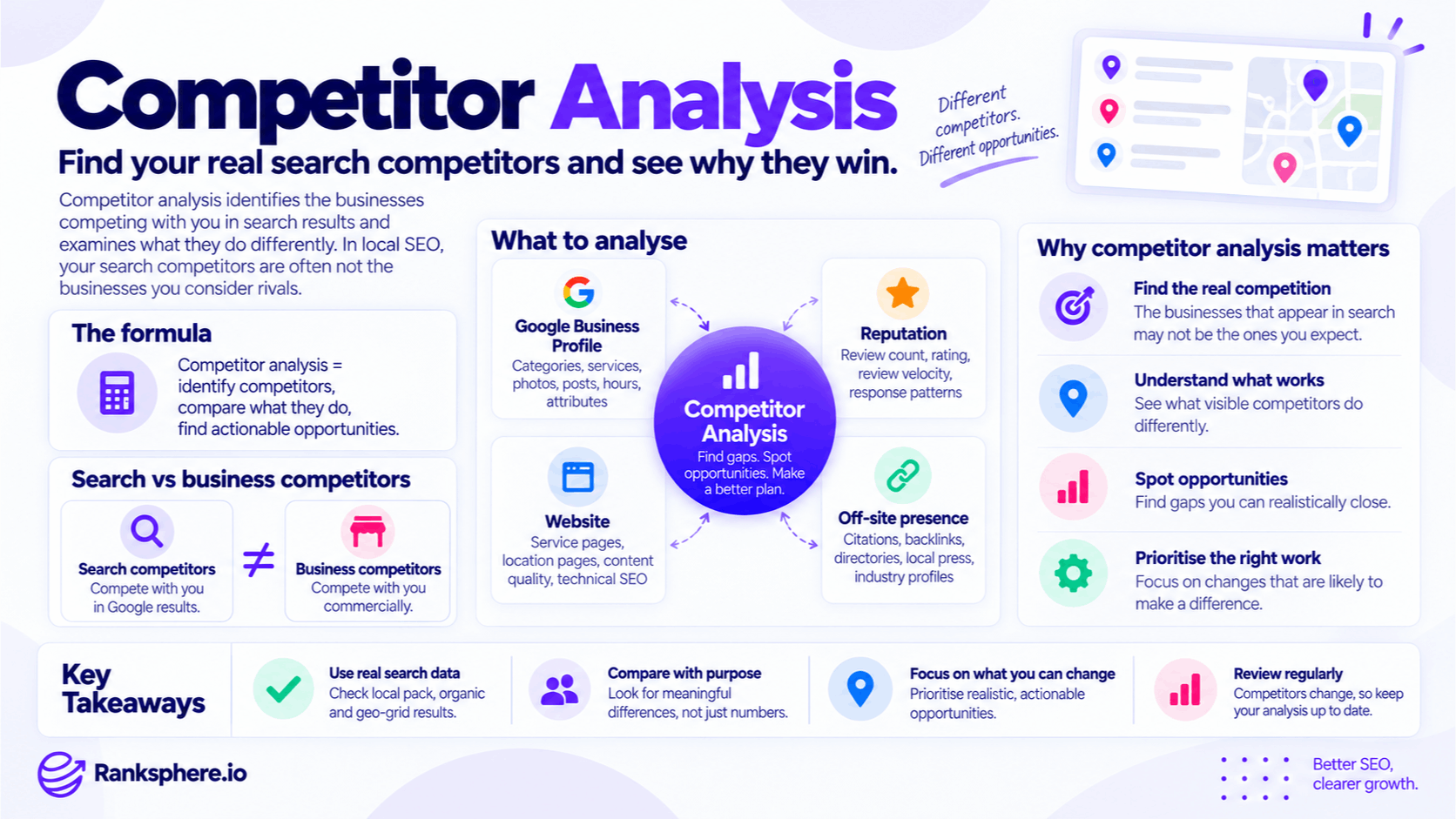
SEO competitor analysis looks at the websites, businesses and pages competing for the same search visibility as you.
The goal is not to copy them.
It is to understand:
Who is actually visible?
Where are they visible?
What are they doing differently?
Which differences are realistically actionable?
For local businesses, this usually means looking at more than one type of competitor.
A company can face one set of competitors in the local pack, another set in organic results and completely different websites for informational searches.
Search competitors vs business competitors
A business competitor is a company competing with you commercially.
A search competitor is a company or website competing with you for visibility in Google.
Sometimes they are the same.
Often they are not.
For example, a veterinary practice may consider two nearby clinics its main commercial rivals.
But when someone searches:
emergency vet near me
Google may consistently show a third practice.
For:
how much does emergency vet care cost?
the organic results may instead be dominated by:
- National veterinary groups
- Insurance companies
- Publishers
- Specialist health websites
All of these are search competitors for different parts of the customer journey.
That is why competitor analysis should be done query by query and surface by surface.
Local pack competitors
Local pack competition is highly geographic.
The businesses competing with you close to your premises may not be the same businesses competing with you three miles away.
That happens because local results can vary with factors including:
- Searcher location
- Business location
- Query
- Relevance
- Prominence
This is one reason a single search from your office gives such a limited view.
A geo-grid rank tracking scan gives a much better picture.
Ranksphere's rank tracker tracks competitors alongside you across the grid, helping show where each competitor is strong rather than simply whether they appeared in one search.
Competitors can change across the map
Imagine three plumbing companies:
Company A dominates close to the town centre.
Company B appears more often in northern neighbourhoods.
Company C has better coverage around the southern edge of the area.
It would be misleading to call one business:
“the competitor.”
Local SEO competition is often spatial.
Different businesses can dominate different parts of the same market.
That makes geographic competitor analysis more useful than simply writing down the three companies appearing in one local pack.
Organic competitors are different
Organic search follows a different competitive landscape.
A local dentist might compete with other practices for:
dentist Bristol
but compete with:
- Health publishers
- Universities
- National dental chains
- Medical information websites
for:
how long do dental implants last?
The optimisation work needed for those two searches is different.
Do not combine local pack and organic competitors into one vague comparison.
Analyse them separately.
Competitors also change by service
A business may not have one consistent competitor across every service.
For example, a roofing company could compete with:
Company A for roof replacement.
Company B for flat roofing.
Company C for emergency repairs.
This matters because one competitor may have excellent topical coverage around one service and almost nothing around another.
Competitor analysis should therefore start with the searches and services that matter commercially rather than with a generic list of nearby companies.
How to identify SEO competitors
Start with actual search visibility.
Use:
- Geo-grid scans for important local searches
- Standard organic searches
- Search Console data
- Rank-tracking data
- Competitor visibility across priority services
Then compare that with the businesses the client already considers commercial rivals.
Both perspectives are useful.
The client's list tells you who matters in the real market.
Search data tells you who currently matters in Google.
Use geo-grid data for local competitors
A grid scan can reveal:
- Which businesses repeatedly appear
- Where each competitor is strong
- Where your business loses visibility
- Whether competitive pressure changes with distance
- Whether one competitor dominates a particular part of the area
This is much more informative than:
Competitor A ranks second.
Second where?
From which search location?
For which keyword?
A local ranking without geographic context can be misleading.
Use share of local voice
Share of local voice can help summarise competitive visibility across a defined grid and keyword set.
Instead of looking only at:
your position
you can look at:
how much of the tracked local visibility each business captures.
This is useful when several competitors overlap across the same area.
But remember that share of local voice is based on the:
- Keywords selected
- Grid used
- Search locations
- Tracking methodology
Keep those settings consistent when comparing periods.
What should you compare?
A useful local SEO competitor analysis normally looks across four areas: Google Business Profile, reputation, website and off-site presence.
The purpose is not to collect every possible metric.
It is to find differences that are relevant to the specific search result you are trying to understand.
A practical comparison might include:
- Google Business Profile: primary and secondary categories, services, products where relevant, opening hours, attributes, photos and Google Posts.
- Reputation: review count, rating, review velocity, response patterns and recurring themes in review text.
- Website: service pages, location pages, content quality, internal linking, mobile usability, technical condition and LocalBusiness schema where appropriate.
- Off-site presence: important citations, relevant backlinks, industry profiles, local press and other legitimate references.
Do not treat every difference as a ranking explanation.
Some are meaningful.
Some are merely coincidental.
Google Business Profile categories
Categories are worth checking early because they describe what the business is.
The primary category can have an important relationship with relevance for local searches.
For example, if a genuine veterinary clinic has selected an unnecessarily broad or inaccurate category while competing businesses use a more precise category that correctly describes their business, that deserves investigation.
But do not change categories simply because a competitor ranks higher.
The correct category is:
the category that most accurately describes the business.
Not:
the category used by whoever ranks first.
Using inaccurate categories can create profile-quality and compliance problems.
Secondary categories
Secondary categories can describe additional genuine aspects of the business.
Again, accuracy matters.
Do not add every category a competitor uses.
A competitor may:
- Offer services you do not
- Have a different business model
- Be using an inappropriate category
Competitor research gives you questions to investigate.
It does not give you instructions to copy.
Services
Compare the services competitors have represented in their Google Business Profile and on their website.
Look for meaningful gaps.
For example:
A veterinary practice may provide:
rabbit care
but barely mention it anywhere.
A competitor may have:
- The service listed in its profile
- A dedicated service page
- Reviews mentioning rabbit treatment
That does not prove those items caused the competitor's ranking.
It does show that Google and potential customers have more explicit information connecting that competitor with the service.
Photos
Photo quantity by itself is not a useful ranking target.
A competitor having:
300 photos
does not mean your business needs:
301.
Instead, look at whether their visual content is:
- Current
- Genuine
- Relevant
- Helpful
For local businesses, useful photography can also improve the customer experience.
The goal is not to win a photo-count competition.
Google Posts
Google Posts can be useful for communicating:
- Offers
- News
- Events
- Updates
But posting frequency should not be treated as a simple ranking explanation.
If a competitor publishes every week and outranks you, that does not prove posting caused the ranking difference.
Evaluate Posts as part of profile quality and customer communication rather than as a magic local-ranking lever.
Opening hours and attributes
Check whether competitors have:
- Accurate hours
- Appropriate attributes
- Relevant business details
These can affect whether a result is useful for a particular search.
For example, if a customer searches for a business that is open at a certain time, accurate hours clearly matter.
Do not add attributes that do not genuinely apply simply because competitors display them.
Competitor reviews
Reviews can be useful for both SEO analysis and customer research.
Compare:
- Total review count
- Average rating
- Recent review activity
- Responses
But go beyond the numbers.
Read what customers actually say.
Reviews may reveal recurring associations such as:
emergency appointments
dental implants
same-day service
rabbit care
Those themes can show which services customers strongly associate with the business.
Do not manufacture review wording to imitate a competitor.
The useful insight is understanding what customers value.
Review count is not a ranking formula
A competitor having more reviews does not mean:
more reviews caused the ranking.
Google says reviews can contribute to local prominence, but local ranking also considers relevance and distance alongside many signals.
A business with fewer reviews can still outrank one with more.
Review analysis should therefore look at the overall reputation picture rather than chasing a raw number.
Review velocity
Review velocity can show how frequently a business is receiving new feedback.
That is useful operationally.
A competitor consistently receiving new reviews may simply have a better review-request process.
It does not mean Google has a published:
reviews per month
ranking threshold.
Use the observation to improve your own customer-feedback process, not to imitate a number mechanically.
Competitor websites
Do not stop at the Google Business Profile.
A competitor's website can help explain why it performs well organically and may also strengthen its relevance to important local services.
Look at whether they have:
- Clear service pages
- Useful location information
- Genuine supporting content
- Helpful internal links
- Original evidence
- Good mobile experience
Quality matters more than the number of pages.
Service pages
Compare the way competitors describe important services.
Ask:
Do they answer questions we do not?
Do they provide practical detail we lack?
Do they show real examples?
Is their page easier to use?
Do not simply count words.
A competitor having a 3,000-word service page does not mean yours should be 3,001 words.
Look for useful information gaps.
Location pages
Location pages deserve particular attention for businesses serving several areas.
Check whether competitors have:
- Genuine branch pages
- Useful service-area pages
- Local project examples
- Accurate location information
Do not copy a competitor's city-page strategy blindly.
They may have dozens of thin pages that are not helping them.
Competitor analysis should identify what appears useful, not replicate everything that exists.
Content depth
For informational organic search, compare how well competitors cover the subject.
For example, a dental implant competitor might have useful content about:
- Costs
- Recovery
- Suitability
- Bone grafts
- Maintenance
If your site has only a short treatment page, that may reveal a genuine content gap.
But depth should follow customer need.
Do not publish twenty articles simply because a competitor has twenty-one.
Technical SEO
Technical differences can matter, particularly when one website has obvious problems.
Review areas such as:
- Crawlability
- Indexing
- Internal links
- Mobile usability
- Page performance
- Structured data
But do not assume a competitor ranks because:
its site loads 0.4 seconds faster.
Technical SEO is important, but ranking differences rarely reduce neatly to one performance score.
Schema markup
Check whether competitors use LocalBusiness schema and other relevant structured data correctly.
This may expose implementation gaps on your own site.
But schema itself is not a direct shortcut to higher local rankings.
It helps describe information more clearly.
Use it because it accurately represents the business, not because a competitor has more markup.
Citations
Review important citations, particularly:
- Major local directories
- Industry directories
- Professional registers
- Important data sources
Look for:
- Missing listings
- Wrong addresses
- Old phone numbers
- Duplicate profiles
Do not turn the analysis into:
Competitor has 120 citations, therefore we need 121.
Citation quality and accuracy matter more than raw quantity.
Local backlinks
Backlinks can reveal useful competitive opportunities.
A competitor may have links from:
- Local newspapers
- Suppliers
- Associations
- Community organisations
- Industry publications
The useful question is not:
How do we copy every link?
It is:
Why did that source link to them, and is there a legitimate reason it might reference us too?
Some links will be replicable.
Others will not.
Do not assume correlation means causation
Competitor analysis is observational.
Suppose the highest-ranking competitor has:
- 500 reviews
- 100 backlinks
- 40 service pages
You cannot conclude that one of those caused the ranking.
The business may also:
- Be closer to the searcher
- Have existed longer
- Have stronger relevance
- Have a different profile category
- Have stronger brand recognition
Competitor analysis identifies patterns and opportunities.
It does not reveal Google's ranking formula.
Proximity can explain part of the gap
Distance is one of Google's publicly stated considerations in local results.
That means sometimes the main explanation is geography.
A competitor close to a searcher may be more likely to appear than a business much farther away.
This is particularly important when examining geo-grid results.
If a competitor dominates the area immediately surrounding its premises, that does not necessarily mean its SEO is dramatically better.
It may simply have a geographic advantage there.
Does proximity make an area unwinnable?
Avoid treating geography as an absolute.
A distant business can sometimes appear because relevance and prominence also matter.
But some areas may be much harder to compete in because:
- Several relevant businesses are physically closer
- Search intent is strongly proximity-sensitive
- The target area is far outside the business's natural market
The correct conclusion is often:
This area is substantially more difficult.
not:
This area can never be won.
Separate controllable and uncontrollable factors
This is one of the most useful parts of competitor analysis.
You can change:
- Website content
- Business information
- Categories when inaccurate
- Review-request processes
- Internal linking
- Citations
- Technical issues
You generally cannot change:
- A competitor's physical proximity
- How long they have existed
- Their existing customer base
This helps prevent wasted effort.
Look for gaps, not just strengths
Competitor analysis should also ask:
What are they missing?
Perhaps every local competitor has weak information about:
- Pricing
- Emergency service
- Accessibility
- Recovery
- Commercial work
That may represent an opportunity.
The goal is not always to become more like competitors.
Sometimes the best opportunity is to do something useful that none of them are doing well.
Do not copy competitors blindly
Ranking does not mean every decision a competitor made was correct.
A business can rank despite:
- Poor content
- Incorrect schema
- Weak design
- Thin pages
because other factors compensate.
Copying everything from the top-ranking site can reproduce its weaknesses along with its strengths.
Use competitors as evidence.
Not templates.
How often should competitor analysis be updated?
There is no requirement to perform a complete competitor audit every month.
For many businesses, reviewing competitive visibility every few months is enough.
Revisit sooner when:
- Rankings change significantly
- A new competitor appears
- A major business opens or closes
- You enter a new service area
- You launch an important new service
Ongoing rank tracking can help identify when a deeper analysis is necessary.
Competitor analysis and local SEO audits
Competitor analysis fits naturally within a broader local SEO audit.
An audit asks:
What is wrong or missing on our side?
Competitor analysis adds:
How does that compare with the businesses currently visible?
Together, the two give more context.
For example:
An audit may tell you:
Your dental implant page is thin.
Competitor research may reveal:
Every consistently visible competitor has a strong implant service page supported by useful information around cost, recovery and suitability.
That makes the opportunity much easier to prioritise.
Common competitor-analysis mistakes
The most common problems are starting with assumptions rather than search data, analysing only one location, mixing local-pack and organic competitors, copying competitors without understanding why something exists, treating correlation as causation, changing Google Business Profile categories simply because competitors use them, comparing raw review or citation counts without context, ignoring proximity, and conducting the analysis once and never revisiting it.
A good analysis should narrow the field rather than create an enormous checklist.
Competitor analysis best practices
Start with the searches and services that matter commercially. Identify competitors from real local and organic results, then compare them with the rivals the business already knows. Use geo-grid data where location affects rankings. Keep local-pack, organic and informational competitors separate. Look for meaningful differences in profile relevance, reputation, website quality and external presence. Distinguish factors you can influence from factors you cannot. Investigate the largest plausible opportunities first, but do not assume one difference explains the ranking. Finally, repeat the analysis often enough to notice meaningful changes without turning it into a monthly copying exercise.
Example
“Kelsall Veterinary considers two nearby practices its main competitors.
Both are well known locally, and both compete for customers offline.
A geo-grid scan tells a different story.
A third veterinary practice, several miles away, appears much more consistently across many of the areas Kelsall wants to reach.
That makes it the more relevant search competitor for several priority queries.
The comparison reveals several differences.
The competing practice has a strong review-acquisition process, with regular new customer feedback.
Its Google Business Profile uses categories and services that accurately reflect the areas it promotes.
Its website also gives several important treatments clearer dedicated coverage.
Kelsall reviews its own setup.
Rather than copying the competitor, it corrects areas where its own information is genuinely incomplete.
The team checks whether the primary category remains the most accurate one for the practice.
It improves several underdeveloped service pages.
It introduces a consistent process for asking customers for genuine reviews.
It also begins tracking both practices across the same grid rather than relying on searches from the surgery.
Over the following months, Kelsall's visibility improves in several parts of the target area.
The competitor remains strong.
That is not a failure.
A local pack contains multiple businesses, and the goal was never to make a competitor disappear.
The useful result was discovering that the businesses Kelsall worried about commercially were not necessarily the businesses limiting its search visibility.
That is the value of competitor analysis:
it replaces assumptions with evidence, shows where the real competitive pressure comes from and helps you focus on improvements that are both relevant and realistically within your control.”
See also
- Geo-grid rank tracking — identifying how competitors change across a local market
- Share of local voice — comparing local visibility between businesses
- Local ranking factors — understanding the factors associated with local visibility
- Google Business Profile categories — describing what a local business actually is
- Local SEO audit — assessing your own local search foundation
- Online review — an important part of local reputation and customer decision-making