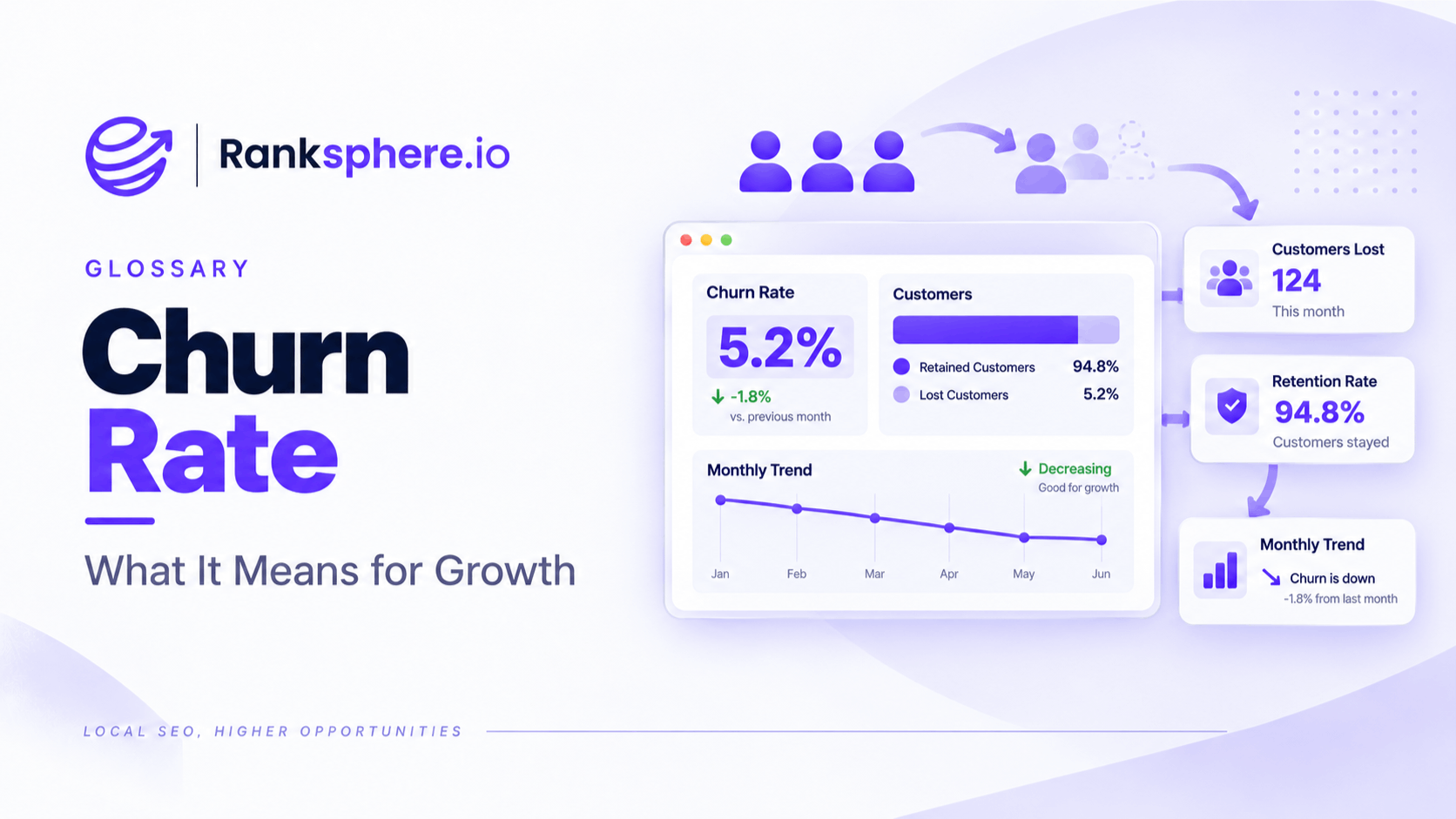
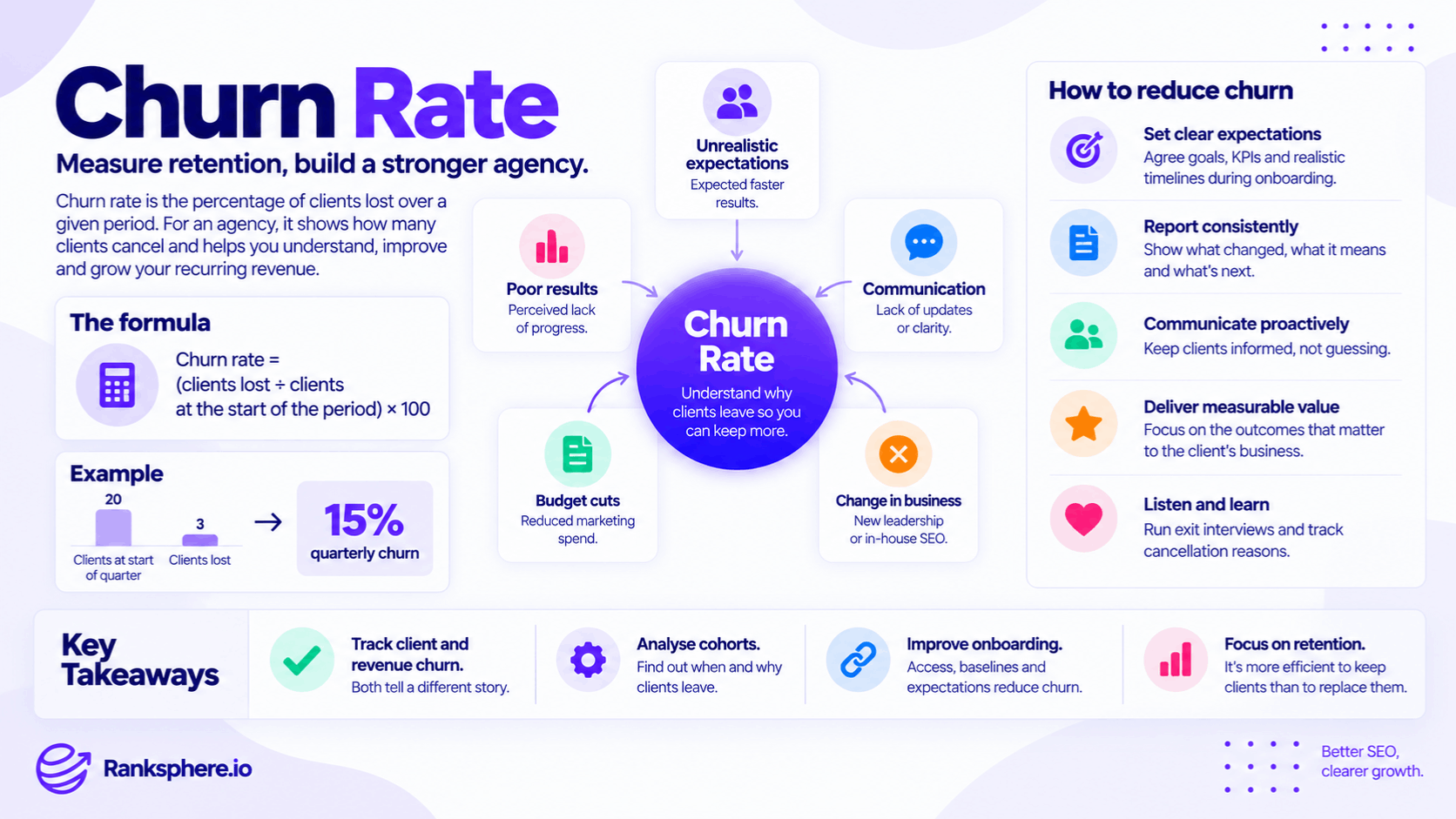
Churn rate is the percentage of customers or clients who stop using a service during a given period.
For an agency, it usually measures how many clients cancel their retainers or contracts compared with the number of clients the agency had at the beginning of that period.
A simple formula is:
Churn rate = (clients lost ÷ clients at the start of the period) × 100
For example, if an agency begins a quarter with 20 clients and loses 3:
3 ÷ 20 × 100 = 15% quarterly churn
Churn matters because replacing lost clients takes:
- Sales time
- Proposals
- Calls
- Onboarding
- Account setup
- Strategy work
An agency can appear to be growing quickly while much of its new business is simply replacing accounts that have left.
That is why churn should be monitored alongside new-client acquisition rather than treated as a secondary metric.
What does churn rate mean?
Churn tells you how quickly customers are leaving a recurring service.
For an SEO agency, this might include clients who:
- Cancel a monthly retainer
- Choose not to renew a contract
- Move SEO in-house
- Switch to another provider
- Stop SEO activity altogether
A high churn rate does not automatically mean the agency is doing poor work.
Clients can leave because of:
- Budget cuts
- Business closure
- Internal restructuring
- Acquisition
- New leadership
But when cancellations form a pattern, churn becomes a useful diagnostic tool.
The important question is not only:
How many clients left?
It is:
Why are they leaving?
How to calculate client churn
The standard client churn formula is:
Clients lost during period ÷ clients at beginning of period × 100
Suppose an agency starts January with:
50 clients
and 4 of those clients cancel during January.
The monthly churn rate is:
4 ÷ 50 × 100 = 8%
New clients gained during the month are normally kept separate from the basic churn calculation.
That helps avoid hiding retention problems behind new sales.
Monthly, quarterly or annual churn?
Churn can be measured across different periods.
Monthly churn
Useful for businesses with:
- Monthly subscriptions
- Short contracts
- Larger client bases
It can reveal problems quickly, but small agencies may see large percentage swings from a single cancellation.
Quarterly churn
Often useful for service businesses because it smooths some of the month-to-month noise.
Annual churn
Helpful for understanding overall retention.
But annual figures alone can hide important patterns.
An agency might have:
20% annual churn
without knowing whether clients usually leave after three months or after three years.
That is why cohort analysis matters.
Client churn vs revenue churn
Not every client is worth the same amount financially.
Losing a client paying:
£500 per month
is different from losing one paying:
£5,000 per month.
Client churn measures the number of accounts lost.
Revenue churn measures the recurring revenue lost.
For example:
An agency begins the month with:
£40,000 monthly recurring revenue
and loses clients worth:
£4,000 per month.
Its gross revenue churn is:
10%
even if only two clients left.
Tracking both gives a clearer picture.
Gross revenue churn vs net revenue churn
Revenue churn can also be measured in different ways.
Gross revenue churn looks only at revenue lost through:
- Cancellations
- Downgrades
Net revenue churn can also account for expansion revenue from existing clients.
For example, one client might cancel while three others increase their retainers.
The agency has still experienced client churn, but its recurring revenue may remain stable or even grow.
This is why one churn metric rarely tells the whole story.
What is cohort churn?
Cohort analysis groups clients according to something they share, usually when they joined.
For example:
January 2026 clients
February 2026 clients
March 2026 clients
You can then track how many remain after:
- 3 months
- 6 months
- 12 months
- 24 months
This can reveal patterns that an overall churn percentage hides.
For example, perhaps clients acquired through referrals stay for three years while clients acquired through cold outreach often leave within six months.
That is commercially useful information.
Why churn matters for agencies
Agency growth depends on both:
acquisition
and:
retention.
Suppose an agency signs:
5 new clients every month
but loses:
4 existing clients.
Gross acquisition looks strong.
Net growth is only one client per month.
The sales team is spending considerable time replacing revenue that already existed.
Reducing avoidable churn can therefore make growth much more efficient.
Churn and customer acquisition cost
Winning a new client usually requires work before any revenue is received.
That might include:
- Marketing
- Sales calls
- Proposals
- Follow-ups
- Discovery meetings
- Audits
Once the client signs, the agency may also invest heavily in:
- Onboarding
- Access setup
- Baseline reporting
- Research
- Strategy
If the client leaves after only a few months, there may not have been enough time for the relationship to generate an attractive return.
This is why churn is closely connected to customer lifetime value.
Churn and customer lifetime value
Customer lifetime value estimates how much revenue or profit a customer produces during the relationship.
If clients stay longer, lifetime value generally increases.
For example:
Client A
£1,000 per month × 6 months = £6,000 revenue
Client B
£1,000 per month × 36 months = £36,000 revenue
The monthly fee is identical.
The economics are completely different.
Reducing churn can therefore increase the value of every client the agency acquires.
When do SEO clients churn?
There is no universal cancellation point.
Churn can happen at any stage.
However, certain moments deserve attention.
Early in the relationship
Clients can lose confidence when expectations set during sales do not match what happens after signing.
For example, they may have expected:
first-page rankings within weeks
when the actual strategy requires substantial technical and content work first.
That is primarily an expectation problem.
At the end of a minimum contract
Some clients reassess the relationship as soon as a fixed term expires.
That does not necessarily mean they were unhappy.
They may simply be asking:
Do we still need this?
The agency should be able to explain what has been achieved and what work remains valuable.
After a performance decline
A ranking or traffic drop can trigger cancellation anxiety.
This is particularly common around a significant Google algorithm update.
The correct response is not to invent an explanation immediately.
It is to communicate quickly, explain what is known, acknowledge what is uncertain and investigate properly.
When the business changes
Clients may also leave because:
- Leadership changes
- Budgets are cut
- Marketing is brought in-house
- The company is acquired
- Priorities change
Not all churn is preventable.
A useful retention strategy separates avoidable churn from unavoidable churn.
Churn often begins before the cancellation email
Clients rarely make a cancellation decision the moment they send the email.
Warning signs may appear earlier.
They might:
- Stop attending meetings
- Stop replying quickly
- Question invoices more often
- Stop providing approvals
- Ask repeatedly what SEO is achieving
- Reduce engagement with reports
None of these guarantees cancellation.
But together they can indicate that confidence is weakening.
Onboarding and churn
Client onboarding can have a significant effect on retention.
A good onboarding process should clarify:
- What is being delivered
- What success looks like
- How performance will be measured
- Who is responsible for what
- How communication works
- What timelines are realistic
- What is outside scope
Many future disputes start with assumptions that were never corrected.
For example:
The agency thinks:
Content production begins in month two.
The client thinks:
New content will be live within two weeks.
Neither side may realise the mismatch until confidence has already been damaged.
Set SEO expectations carefully
SEO results do not follow a fixed timeline.
Avoid statements such as:
“Results take four to six months.”
That may be a reasonable broad expectation in some circumstances, but it should not become a guarantee.
Performance depends on:
- Starting position
- Competition
- Website condition
- Market
- Resources
- Type of work
Explain the likely process rather than promising a date.
For example:
The first phase focuses on fixing technical and local-foundation issues. We will report those changes immediately, while ranking and lead improvements may take longer to become measurable.
That is more defensible.
Reporting and churn
Poor reporting does not automatically cause cancellations, but it can make a client feel disconnected from the work.
A client paying every month needs to understand:
- What happened
- What improved
- What declined
- What was completed
- What happens next
A report should reduce uncertainty.
It should not exist simply to prove that the agency was busy.
Ranksphere's white-label reports keep monthly reporting sustainable across a client base, allowing agencies to maintain consistent client reporting without manually assembling every report.
Report the metrics clients care about
A local business usually cares more about:
- Calls
- Leads
- Bookings
- Local visibility
- Reviews
than about:
- Domain Authority
- Raw backlink counts
- Number of keywords in a tracking tool
That does not make technical SEO metrics useless.
It means the report needs to connect SEO activity to the client's objectives.
Do not hide declines
If:
- Rankings fall
- Traffic drops
- Calls decline
the report should show it.
Trying to hide every negative number may protect the conversation for one month, but it can damage trust when the client eventually sees the full picture.
A stronger explanation might be:
Local visibility declined in the southern part of the service area this month. There was no equivalent decline in branded searches or calls. We are reviewing competitor movement and recent profile changes before deciding whether action is required.
That is more useful than simply removing the chart.
Show early progress carefully
Before large business outcomes become visible, clients can still see evidence of work.
Examples might include:
- Technical errors resolved
- Google Business Profile information corrected
- Important pages improved
- Citations cleaned up
- New content published
- Reviews gained
These are useful progress indicators.
But do not confuse:
work completed
with:
business results.
For example:
20 listings corrected
is an output.
It does not automatically mean:
local rankings increased because of those 20 listings.
Communication matters
Reporting alone is not always enough.
Some accounts benefit from:
- Monthly calls
- Quarterly strategy reviews
- Email updates
The appropriate frequency depends on:
- Account size
- Complexity
- Client preference
A client does not necessarily need constant communication.
They do need to know:
- Who is responsible
- How to reach them
- When meaningful updates will happen
Long unexplained periods of silence can make ongoing work feel invisible.
Underpricing can create churn
A cheap retainer can work perfectly well when the scope is appropriate.
Problems begin when an agency sells more work than the fee can support.
Over time:
- Content gets delayed
- Strategy time disappears
- Reports become rushed
- Communication drops
- Technical work remains unfinished
The client experiences under-delivery.
The agency experiences an unprofitable account.
Both sides become dissatisfied.
This is one reason pricing and retention are connected.
Churn and SEO retainers
An SEO retainer should be sustainable for both parties.
That means:
The client receives enough useful work to justify the investment.
and:
The agency receives enough revenue to deliver the agreed work properly.
If either side of that equation fails, churn risk increases.
Good results do not eliminate churn
A client can cancel even when SEO is working.
They might conclude:
We rank well now, so SEO is finished.
The right response is not:
Stop and everything will collapse.
Existing:
- Content
- Links
- Reviews
- Rankings
do not vanish the moment an agency contract ends.
A more accurate explanation is that the environment continues changing.
Over time:
- Competitors improve
- Content ages
- Business information changes
- Technical problems appear
- Search features evolve
The client can then decide whether ongoing work is worth the cost.
That is a commercial decision, not a fear tactic.
Churn is a diagnostic metric
The overall percentage is useful.
The pattern behind it is often more useful.
Ask questions such as:
- How long had the client been with us?
- What package were they on?
- Who managed the account?
- How were they acquired?
- Which industry were they in?
- What reason did they give?
- What did recent reports show?
- Were agreed outcomes improving?
- Had communication changed?
Patterns can reveal operational issues.
Segment churn by service
Different services may have different retention profiles.
For example:
- Local SEO
- National SEO
- PPC
- Web design
- Social media
If one service consistently produces higher churn, investigate why.
Possible causes include:
- Poor positioning
- Weak delivery
- Incorrect pricing
- Wrong clients
- Unrealistic expectations
Do not assume the service itself is inherently bad.
Segment churn by acquisition channel
Clients gained through:
- Referral
- Organic search
- Cold email
- Paid advertising
- Partnerships
may behave differently.
For example, referral clients might arrive with more trust already established.
Again, do not assume a pattern before measuring it.
Track it.
Revenue churn can reveal hidden problems
Imagine an agency loses:
5 clients
but all are small accounts.
Client churn looks worrying.
Revenue churn may be modest.
Now imagine the agency loses:
1 client
but that account represents 20% of monthly recurring revenue.
Client churn looks low.
Financial impact is severe.
Track both.
Exit interviews
When a client cancels, ask why.
Keep the conversation simple.
Useful questions include:
- What influenced your decision?
- Was there anything we could have done differently?
- Did the service match your expectations?
- What could have made the relationship more useful?
Do not turn the conversation into an argument or a final sales pitch.
The goal is information.
Clients may reveal issues that dashboards never will.
Cancellation reasons should be categorised
Instead of saving cancellation notes as:
Client unhappy
use consistent categories such as:
- Price
- Results
- Communication
- Scope mismatch
- Business closure
- Budget cut
- In-house hire
- Competitor
- Strategy disagreement
Over time, those categories become measurable.
That allows the agency to distinguish:
avoidable churn
from:
structural churn.
Not all churn is bad
Sometimes losing a client is healthier than retaining them.
For example, the account may:
- Be consistently unprofitable
- Require work far beyond scope
- Refuse necessary cooperation
- Be a poor strategic fit
Retention should not become:
keep every customer at any cost.
The goal is healthy long-term client relationships.
Discounting to prevent cancellation
A discount can occasionally solve the problem if price is genuinely the only issue.
But it will not fix:
- Poor results
- Weak communication
- Broken trust
- Scope mismatch
Before reducing price, understand why the client wants to leave.
Otherwise, the agency may simply keep an unhappy client for slightly longer at a lower margin.
Benchmarking churn
There is no universally useful churn benchmark for every agency.
A healthy rate depends on factors such as:
- Contract length
- Agency size
- Service
- Client size
- Market
- Pricing
A freelancer serving five large clients cannot interpret churn the same way as a software platform serving thousands of subscribers.
Your own historical trend is often more useful than an arbitrary industry percentage.
Common churn rate mistakes
- Focusing on acquisition while ignoring retention.
- Looking only at client count and ignoring revenue churn.
- Treating every cancellation as preventable.
- Assuming churn occurs at one predictable stage of an SEO contract.
- Promising fixed SEO timelines to reduce anxiety.
- Hiding poor performance from reports.
- Reporting outputs as though they were outcomes.
- Ignoring client communication until renewal time.
- Underpricing accounts and then under-delivering.
- Assuming good rankings guarantee retention.
- Using fear to explain why clients must continue SEO indefinitely.
- Discounting without understanding the reason for cancellation.
- Failing to collect cancellation reasons consistently.
- Comparing against a generic churn benchmark without considering the business model.
Churn rate best practices
- Track client churn and revenue churn separately.
- Analyse cohorts to see when cancellations occur.
- Segment churn by service, account type and acquisition source where useful.
- Set clear expectations during onboarding.
- Define success metrics before work begins.
- Report regularly and include meaningful declines.
- Keep activity separate from business outcomes.
- Maintain predictable client communication.
- Price retainers so the agreed scope can actually be delivered.
- Record cancellation reasons in consistent categories.
- Hold exit conversations where appropriate.
- Review churn patterns regularly rather than looking only at the headline percentage.
Example
“An SEO agency begins the year with 34 local clients.
Over the next 12 months, 11 leave.
The headline number tells the agency that retention needs attention.
But it does not explain why.
Instead of immediately investing more money in lead generation, the agency analyses the cancellations.
It looks at:
- Client tenure
- Acquisition source
- Retainer size
- Account manager
- Cancellation reason
- Recent performance
- Reporting history
A pattern appears.
Several of the clients who cancelled had entered the relationship expecting rapid ranking improvements.
Their proposals had emphasised outcomes but explained very little about:
- Initial technical work
- Local profile improvements
- Content timelines
- Measurement
The agency changes the process.
During onboarding, every new client now receives:
- A baseline
- Agreed KPIs
- A clear scope
- A summary of early priorities
- Realistic expectations around uncertainty and timing
Monthly reporting also separates:
work completed
from:
performance outcomes
so clients can see both without one being used to disguise the other.
The agency continues measuring churn by cohort to see whether retention improves.
That is the useful way to approach churn.
The percentage tells you that clients are leaving. The real value comes from understanding who leaves, when they leave, why they leave and which of those causes the business can actually fix.”
See also
- Client onboarding — where scope and expectations are established
- SEO retainer — the recurring commercial model behind many agency relationships
- White-label reporting — communicating ongoing performance clearly
- KPI — deciding which results matter
- SEO ROI — connecting SEO investment with commercial outcomes
- Customer lifetime value — the long-term value affected by client retention