A scope of work defines what an engagement includes, what is outside it, what each party is responsible for and how delivery will be managed.
In an SEO retainer, it turns a broad promise such as:
“We will manage your SEO.”
into something both sides can actually understand and review.
A useful scope answers questions such as:
- What work will be carried out?
- How much work is included?
- How often will it happen?
- Who is responsible for approvals and access?
- What is specifically excluded?
- How will progress be reported?
- What happens when a request falls outside the agreed scope?
Without that detail, expectations can drift quickly.
The client may reasonably believe something is included.
The agency may reasonably believe it is additional work.
A good scope reduces that ambiguity before it becomes a problem.
What is a scope of work?
A scope of work is the operational part of an agreement.
It describes the work to be delivered.
For an SEO engagement, that might include:
- Google Business Profile management
- Content
- Technical SEO
- Citations
- Review support
- Reporting
- Meetings
- Implementation
It should also make clear where those responsibilities stop.
That distinction matters because terms such as:
technical SEO
or:
content creation
can mean very different things to different agencies and clients.
Scope of work vs contract
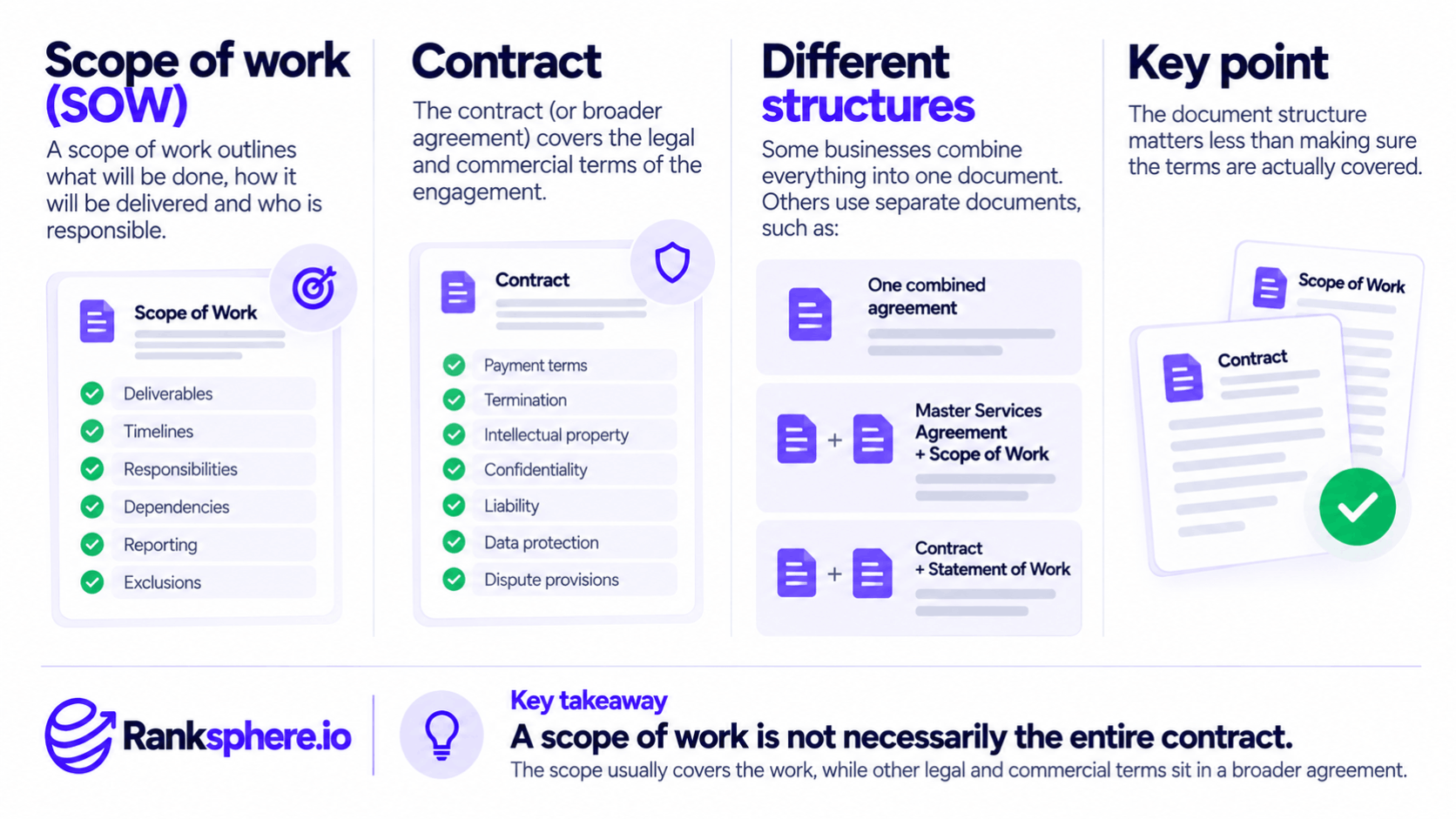
A scope of work is not necessarily the entire commercial agreement.
The scope usually covers things such as:
- Deliverables
- Timelines
- Responsibilities
- Dependencies
- Reporting
- Exclusions
Other legal or commercial terms may sit in a broader agreement, including:
- Payment terms
- Termination
- Intellectual property
- Confidentiality
- Liability
- Data protection
- Dispute provisions
Some businesses combine everything into one document.
Others use:
Master Services Agreement + Scope of Work
or:
Contract + Statement of Work
The document structure matters less than making sure the terms are actually covered.
Be specific about deliverables
The most useful scopes make the work measurable.
For example:
Content creation
is vague.
It could mean:
- One blog post
- Four service pages
- Copy edits
- Full content strategy
A clearer scope might say:
Up to two new service pages or content refreshes per month, each up to 1,200 words.
Now both parties know what is included.
Quantities help prevent ambiguity
Where practical, define:
- Number
- Frequency
- Size
- Location count
- Turnaround
- Responsibility
For example:
Too vague
Google Business Profile management
Clearer
Manage up to four Google Business Profiles, including weekly monitoring, agreed profile updates and up to four posts per location per month.
The exact quantities will vary.
The important part is making the commitment understandable.
Google Business Profile management
If Google Business Profile work is included, specify exactly what that means.
Possible scope items include:
- Number of locations
- Profile optimisation
- Business information updates
- Category reviews
- Service updates
- Photo management
- Post creation
- Review-response support
- Performance reporting
Do not leave:
GBP management
as a single unexplained line.
Specify monitoring frequency
For example:
Profile information reviewed weekly
is clearer than:
Profiles monitored regularly.
If urgent issues such as suspensions are handled differently, state that too.
For example:
Suspension or verification work is quoted separately.
That prevents an unexpected profile issue from silently becoming a large unplanned project.
Review management
If reviews are part of the retainer, define the agency's role.
For example:
- Drafting review responses
- Publishing approved responses
- Creating review-request templates
- Advising on the review process
Clarify whether the agency:
runs the review-request programme
or merely:
provides the process and materials.
Those are different workloads.
Define turnaround
If review responses are included, specify a reasonable target such as:
Responses drafted within three working days of receiving access and any required client information.
Avoid vague promises such as:
prompt responses.
Different people interpret “prompt” differently.
Citation work
If citations are included, clarify whether the work involves:
- Initial citation audit
- Existing listing corrections
- New listings
- Duplicate cleanup
- Ongoing monitoring
Then quantify where possible.
For example:
Initial citation audit at onboarding, followed by correction of up to 15 agreed listings during the first 90 days.
That is much clearer than:
citation building included.
Content scope
Content is one of the easiest areas for expectations to expand.
Specify:
- Quantity
- Content type
- Approximate length where relevant
- Research responsibility
- Writing responsibility
- Client approval process
- Revision allowance
For example:
Two service pages or existing-page refreshes per month, up to 1,200 words each, including one consolidated revision round.
That defines what the monthly commitment actually means.
New content vs content refreshes
Also clarify whether:
one new page
and:
one existing-page rewrite
consume the same monthly allocation.
Otherwise a client may reasonably expect both.
A simple wording might be:
The monthly content allowance can be used for new pages, page refreshes or a combination of both.
Content approvals
Specify who signs content off.
For example:
Client to review submitted content within five working days.
Also state what happens if the approval is delayed.
Possible approaches include:
- Delivery schedule moves accordingly
- Work proceeds to the next approved task
- Unused allocation expires
- Unused allocation rolls over under defined conditions
There is no universal correct model.
The scope should simply make the model clear.
Technical SEO
Technical SEO needs particularly careful wording because:
identifying a problem
and:
fixing the problem
can require completely different resources.
For example, an SEO consultant may identify:
- Redirect problems
- Canonical issues
- Rendering problems
- Broken templates
but implementation might require a developer.
So distinguish:
Technical analysis
Auditing, prioritising and recommending fixes.
Technical implementation
Actually changing the website code or CMS.
Audit frequency
If technical audits are included, say how often.
For example:
Full technical review at onboarding, followed by quarterly health checks.
But do not choose quarterly simply because it sounds standard.
The correct frequency depends on:
- Website size
- Development activity
- Risk
- Retainer scope
Large or frequently updated sites may need more frequent technical monitoring.
Is development included?
This should be explicit.
For example:
Technical recommendations are included. Development and code implementation are quoted separately unless specifically listed in this scope.
That one sentence can prevent a large amount of confusion.
If some implementation is included, define the limit.
For example:
Up to two hours of minor CMS implementation per month.
Reporting
Reporting should also be scoped.
Specify:
- Frequency
- Format
- Delivery method
- Metrics
- Commentary
- Meeting inclusion
For example:
Monthly performance report covering agreed KPIs, delivered by the fifth working day of the following month.
That is clearer than:
monthly reporting included.
Name the KPIs
If possible, agree the important KPIs during scoping.
For a local SEO engagement, they might include:
- Qualified leads
- Local visibility
- Search Console clicks
- Business Profile actions
- Conversion rate
The right metrics depend on the objective.
Do not wait until several months into the engagement to decide what success is supposed to mean.
Meetings and communication
Specify the communication commitment.
For example:
- One monthly strategy call
- Email support during business hours
- Named account manager
- Expected response time
Avoid promises such as:
unlimited support
unless the service genuinely operates that way.
A more practical wording might be:
Routine enquiries answered within two working days.
Exclusions matter as much as inclusions
A strong scope does not only describe what the agency will do.
It also defines what is not included.
Common exclusions might include:
- Website development
- Website redesign
- Photography
- Graphic design
- Paid advertising
- Legal review
- Major site migrations
- Additional locations
- Premium directory fees
- Third-party software
- Major development projects
The purpose is not to make the agreement restrictive.
It is to make pricing and responsibility clear.
Website development
This is one of the most important boundaries to define.
For example:
SEO audit identifies a page-speed issue.
Does the retainer include:
- Identifying the issue?
- Writing a developer brief?
- Implementing the code change?
- Testing the change?
Those are four separate pieces of work.
The scope should say where the agency's responsibility ends.
Design and photography
SEO projects frequently uncover a need for:
- New photographs
- Graphics
- Page redesign
- Video
If those services are not included, say so.
For example:
Photography, video production and custom graphic design are excluded unless separately quoted.
That is better than discovering the assumption during production.
Paid media
SEO and paid advertising may support each other.
They are still different services.
If Google Ads, paid social or other media buying is not included, state it explicitly.
This becomes especially important when reporting spans both paid and organic channels.
Third-party costs
Some SEO work may involve external costs.
Examples include:
- Premium directory listings
- Specialist software
- Stock photography
- Developers
- Hosting
- PR distribution
State whether:
- The agency absorbs them
- The client pays directly
- Prior approval is required
Do not leave that decision until after the cost has already been incurred.
Additional locations
For local SEO, the number of locations can dramatically change the workload.
A scope covering:
one Google Business Profile
is not equivalent to:
25 locations.
Define the included number.
For example:
Scope includes management of four physical locations. Additional locations require a revised scope and fee.
Site migrations
A site migration is often substantial enough to be treated as separate project work.
If migrations are not part of the normal retainer, say so.
For example:
Website migrations, domain changes and major platform rebuilds are excluded and will be scoped separately.
That protects both parties when a large unexpected project appears midway through the engagement.
Client responsibilities
A scope should not describe only the agency's obligations.
SEO often depends on things only the client can provide.
These might include:
- Account access
- Business information
- Pricing
- Subject-matter expertise
- Photography
- Legal approval
- Content approval
Without those inputs, delivery can stall.
Access requirements
Specify the access required.
For example:
- Google Business Profile
- GA4
- Search Console
- CMS
- Call tracking
- CRM where relevant
Then state when it should be provided.
For example:
Required account access should be supplied within five working days of project commencement.
Approval turnaround
If content needs client approval, specify the expected timeframe.
For example:
Feedback or approval to be provided within five working days.
Then define the dependency:
Delays in approval may move the associated delivery date.
This is more useful than blaming either party after the deadline moves.
Information supply
The client may need to provide:
- Pricing
- Service details
- Qualifications
- Images
- Locations
- Availability
- Compliance information
Specify these responsibilities where they materially affect delivery.
For example:
Client is responsible for verifying technical, legal and commercial accuracy of service information before publication.
Named decision-maker
A single main approver can make delivery much smoother.
For example:
Client will nominate one primary contact authorised to approve routine SEO work.
That reduces conflicting feedback from multiple stakeholders.
It does not mean other people cannot contribute.
It simply clarifies who gives the final operational approval.
Dependencies and delays
Good scopes explain what happens when a dependency is missed.
For example:
Where delivery depends on client-provided material, the associated delivery date may move by the length of the delay.
This is better than automatically treating the situation as:
agency failure
or:
client failure.
The dependency is documented and both sides know what happens next.
What happens when the client is delayed?
Suppose two location pages require new photographs.
The agency requests them on Monday.
The photographs arrive three weeks later.
If the scope clearly stated that production depends on client-supplied photography, the delay is easy to explain.
If the dependency was never mentioned, the situation becomes much less clear.
That is why client obligations belong in the scope.
Priorities can change
An SEO retainer should also allow some room for prioritisation.
Suppose the planned work for the month is:
- Two new pages
- Citation corrections
but a serious technical issue appears.
The team may need to redirect effort.
The scope can explain how that works.
For example:
Monthly allocations may be reprioritised where higher-impact SEO issues arise, subject to client agreement.
That provides flexibility without making the scope meaningless.
Scope does not need to mean rigid task completion
A retainer should not become:
we promised exactly 12 tasks, therefore we will complete them even if they no longer matter.
SEO priorities change.
The scope should define:
- Capacity
- Deliverable types
- Responsibilities
while still allowing reasonable reprioritisation where the business benefits.
Scope creep
Scope creep occurs when additional work gradually enters the engagement without the original:
- Timeline
- Budget
- Capacity
being adjusted.
An isolated small request is not necessarily a problem.
The problem is when temporary exceptions quietly become permanent expectations.
Handle out-of-scope requests when they happen
If a request is outside the agreement, explain it at the time.
Possible responses include:
- Swap it with another scoped deliverable
- Quote it separately
- Add it to the next scope revision
- Decline it
Do not silently absorb months of additional work and then surprise the client with a complaint later.
Not every extra needs a formal change order
A small accommodation may be perfectly reasonable.
For example:
Can you correct this phone number while you are updating the page?
may not require legal paperwork.
Use judgement.
Formal scope change becomes more important when the request materially affects:
- Cost
- Hours
- Timeline
- Responsibilities
- Risk
Change control
For larger engagements, include a simple change-control process.
For example:
Requests materially outside the agreed scope will be reviewed for impact on timing and cost before work begins.
The wording does not need to be complicated.
It simply prevents:
“Can you also...”
from turning into an undefined second project.
Scope of work and KPIs
The scope should identify how performance will be evaluated.
But be careful not to confuse:
deliverables
with:
outcomes.
For example:
Deliverable
Optimise four Google Business Profiles.
KPI
Increase relevant local visibility.
The agency can control completion of the first much more directly than the second.
That distinction matters in SEO.
Do not guarantee rankings
Avoid commitments such as:
“We will rank you number one within six months.”
Search rankings are influenced by systems and competitors outside an agency's direct control.
A scope can commit to:
- Research
- Implementation
- Monitoring
- Reporting
and can establish performance objectives.
It should not turn uncertain search outcomes into guaranteed deliverables.
Targets vs guarantees
There is nothing wrong with having a target.
For example:
Target: improve top-three grid coverage for agreed priority terms.
That is different from:
Guaranteed: reach the top three.
Targets guide the work.
Guarantees imply control over the result.
Keep those concepts separate.
Delivery measures
A good scope should make delivery checkable.
For example:
Content
2 agreed content items per month.
GBP
Weekly profile monitoring across four locations.
Technical
Quarterly technical review.
Reporting
Monthly report and strategy call.
Now the client can see whether the service was delivered.
That does not mean every month needs to follow the same checklist indefinitely.
Priorities can still change within the agreed boundaries.
Make dependencies visible
Ranksphere's smart tasks turn findings into a prioritised, assignable queue, helping show:
- What has been identified
- What is in progress
- What has been completed
- What is waiting on someone else
That visibility is particularly useful in retainers where agency and client actions are interdependent.
Instead of:
“Why wasn't this done?”
the team can see:
Waiting on pricing approval since 8 May.
Review the scope when the engagement changes
A scope should evolve when the work materially changes.
Common triggers include:
- New business locations
- New services
- New website
- Major CMS change
- Acquisition
- Expansion into another market
- Significant strategy change
Do not wait for a calendar date if the underlying engagement has already changed.
Periodic scope reviews
It is still useful to review longer-running retainers periodically.
Some businesses do this annually.
Others review:
- Every six months
- At renewal
- After major changes
There is no universal SEO rule requiring an annual review.
The principle is simpler:
make sure the written scope still reflects the actual service.
Pricing changes may require scope changes
If the client adds:
- Six locations
- Three service lines
- Another website
the existing scope may no longer match the workload.
That should trigger a commercial discussion.
Trying to fit substantially more work into the same capacity can reduce service quality.
Scope and onboarding
The agreed scope should feed directly into client onboarding.
For example, onboarding should collect:
- Required access
- Contacts
- Approval process
- Brand information
- Business information
that the scope says the client will provide.
A scope that never connects to the delivery workflow is just a document.
Scope and reporting
The same applies to reporting.
If the scope says performance will be measured against four agreed KPIs, those KPIs should actually appear in the report.
Do not promise:
lead reporting
and then send only:
- Rankings
- Traffic
- Impressions
The operational documents should match one another.
Common scope-of-work mistakes
- Using broad activities without explaining the actual deliverables.
- Leaving quantities or frequency unclear where they matter.
- Failing to define whether technical implementation is included.
- Leaving exclusions out entirely.
- Failing to specify the number of locations included.
- Ignoring client responsibilities and dependencies.
- Not defining approval responsibilities.
- Using vague response-time promises.
- Treating every client delay as an agency responsibility or every agency delay as the client's fault.
- Guaranteeing rankings or other outcomes the agency cannot control.
- Confusing KPIs with guaranteed deliverables.
- Never updating the scope after the engagement changes.
- Repeatedly absorbing substantial extra work without discussing its effect on capacity or price.
- Turning the scope into such a rigid checklist that higher-priority work cannot be addressed.
Scope-of-work best practices
- Describe each important service clearly enough that both parties understand what is included.
- Use quantities, frequencies and limits where they improve clarity.
- Give exclusions the same attention as inclusions.
- Clarify whether recommendations, implementation or both are included.
- Specify the number of sites, profiles and locations covered.
- Document client responsibilities, access needs and approval times.
- Explain what happens when a dependency delays delivery.
- Agree the main KPIs before reporting begins.
- Separate performance targets from guaranteed outcomes.
- Create a straightforward process for material out-of-scope requests.
- Allow reasonable reprioritisation when higher-value SEO work appears.
- Review the scope whenever the business or engagement changes materially.
Example
“Consider a hypothetical local dental group.
Its agency proposal says the retainer includes:
- Profile optimisation
- Content creation
- Technical SEO
- Link building
- Monthly reporting
The wording looks comprehensive.
But almost nothing is defined.
The dental group operates four locations.
The client assumes:
Google Business Profile management
means weekly activity across all four profiles.
The agency had priced the account assuming one main location would receive regular profile work.
The client expects:
one new article each week.
The agency intended:
one content item per month.
The agency's technical audit identifies several development issues.
The client assumes:
technical SEO
means the agency will implement every fix.
The agency intended to provide recommendations to the client's developer.
Neither interpretation is unreasonable.
The scope simply did not answer the questions.
So the engagement is rewritten.
The revised scope includes:
Management of four named locations, including defined monitoring and content activity.
Up to two new pages or existing-page refreshes per month, each up to an agreed length.
Scheduled technical reviews, prioritised recommendations and implementation boundaries clearly stated.
Response responsibilities and turnaround times defined.
Monthly reporting against a fixed set of agreed KPIs.
The dental group supplies:
- Pricing
- Photographs
- Service changes
- Approvals
within agreed timeframes.
Major development, redesign, photography and migrations are separately scoped.
Now when the client asks:
“Can you rebuild the booking page this month?”
there is no argument about whether the request is legitimate.
The team simply checks the agreement.
If the rebuild sits outside the retainer, they can:
- Quote it separately
- Swap it for agreed work
- Add it to a revised scope
No fabricated claim that the relationship then ran for three years without a disagreement is needed.
The improvement is the clarity itself.
A good scope of work does not prevent change. It makes change manageable. Everyone knows what has been agreed, what depends on the other party, what is outside the current engagement and how new requests will be handled when priorities evolve.”
See also
- SEO retainer — the ongoing service the scope defines
- Client onboarding — where access, responsibilities and working processes are established
- KPI — the measures used to assess performance
- Churn rate — a business metric that can be affected by expectation and delivery problems
- White-label reporting — the reporting commitment that may form part of the scope
- Local SEO audit — often an early diagnostic deliverable in a local SEO engagement