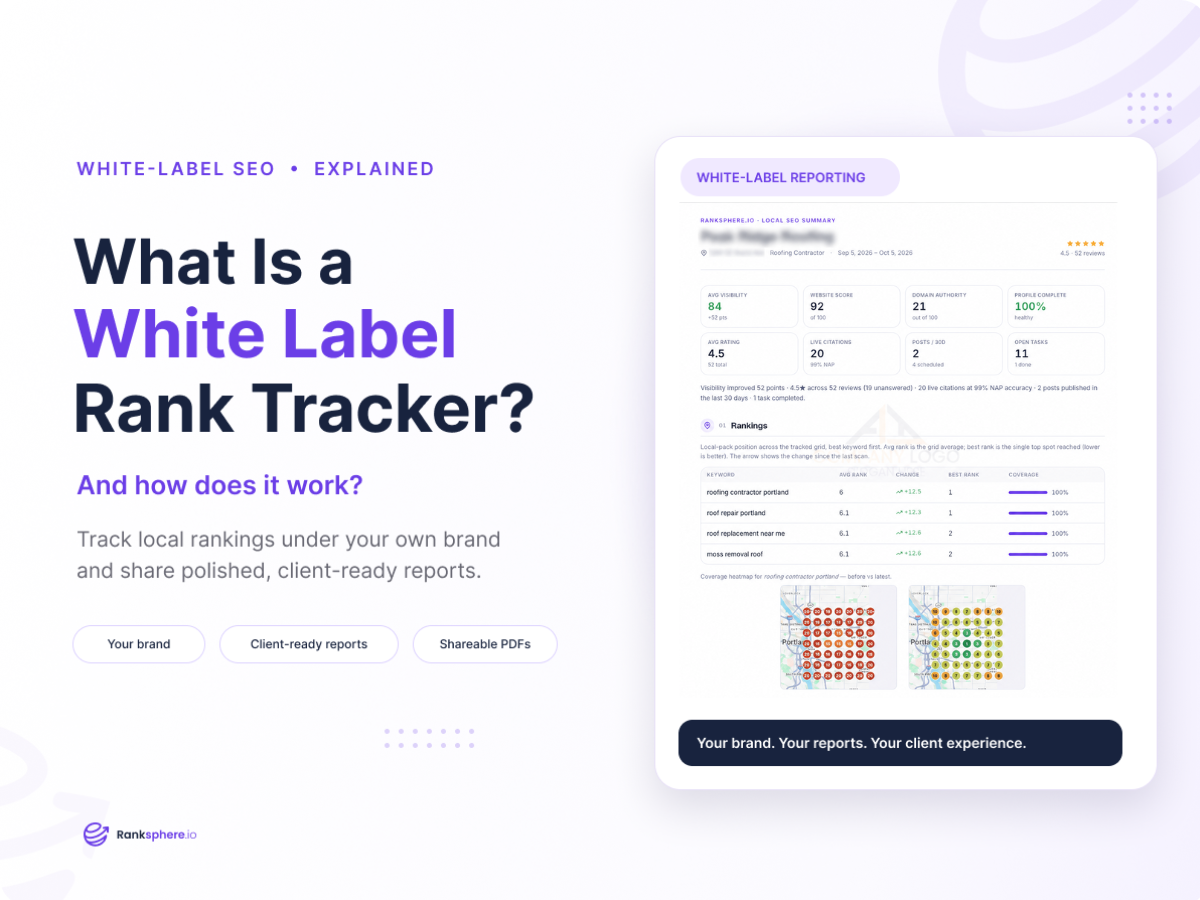
If you manage SEO for clients, tracking rankings is only part of the job. You also need to turn that data into something clients can understand and present it professionally under your agency's brand.
That's where a white label rank tracker comes in.
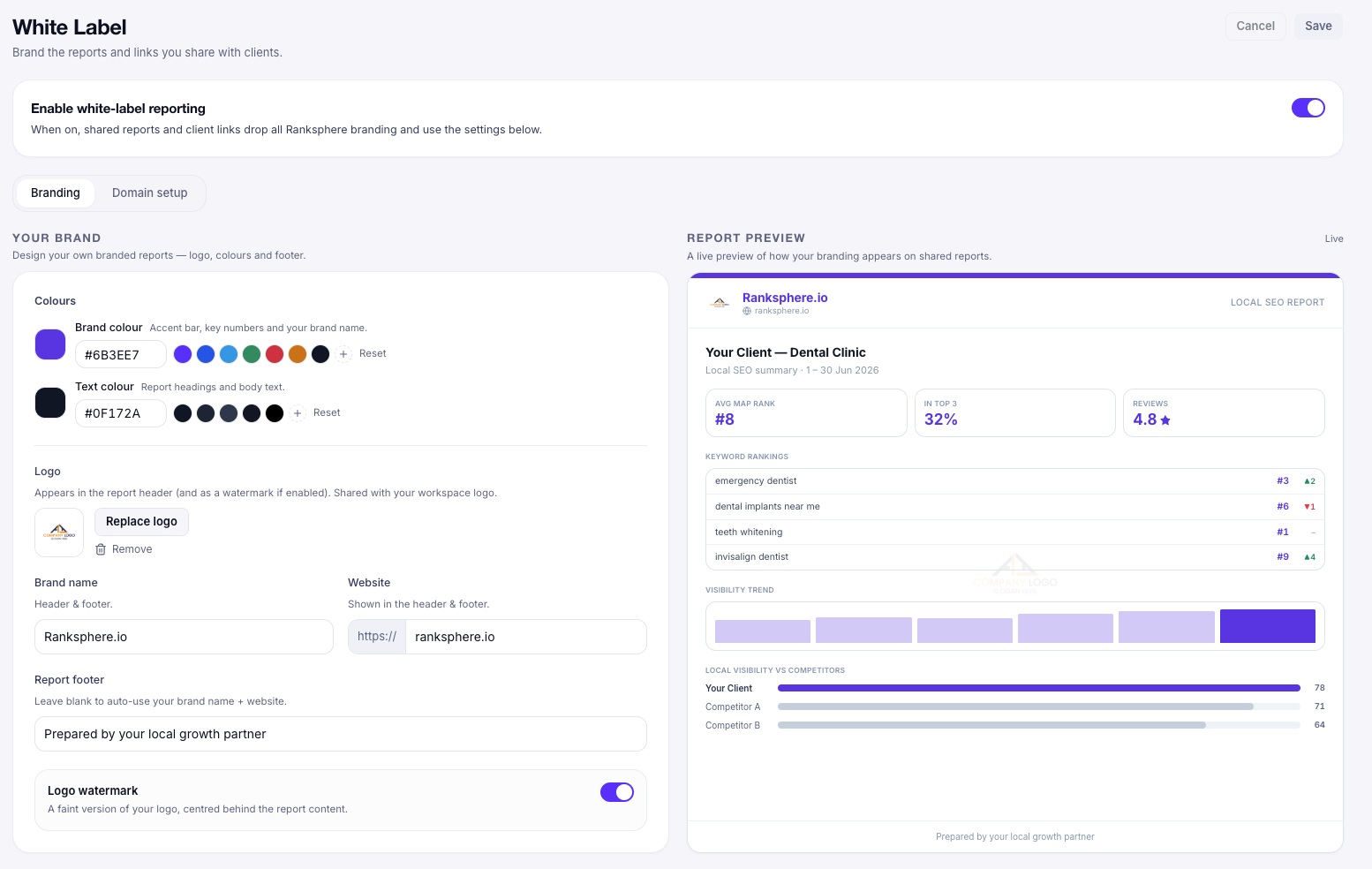
A white label rank tracker monitors search rankings like a regular rank tracking tool, but lets agencies customize client-facing reports with their own branding. Depending on the platform, this can include your logo, colors, company information, report links, and even your own custom report domain.
For agencies, the benefit goes beyond appearance. White label rank tracking can create a more consistent client experience and reduce the manual work involved in turning ranking data into client-ready reports.
What Is a White Label Rank Tracker?
A white label rank tracker is an SEO tool that tracks search rankings while allowing an agency to present the results under its own brand.
The underlying software still collects and processes the ranking data. The difference is what your client sees.
Instead of sending a client a generic report carrying another software company's branding, you can provide a report that looks like part of your own service.
White-label capabilities can include:
- Your agency logo
- Brand colors
- Company name and website
- Branded PDF reports
- Shareable online reports
- Custom report domains
This is why two tools that both advertise "white label reporting" may offer very different experiences.
One may simply let you add a logo to a PDF. Another may let you deliver reports from a subdomain such as:
reports.yourdomain.comWhen comparing tools, check exactly what can be white labeled, rather than treating white labeling as a simple yes-or-no feature.
How Does White Label Rank Tracking Work?
The process usually begins like ordinary rank tracking.
You add the business, location, or website you want to monitor and choose the keywords that matter to the campaign. The software checks where the business appears in search results and stores those results so you can monitor changes over time.
The white-label layer comes when you turn that data into something the client can see.
A typical workflow looks like this:
Track rankings → compare performance → create a report → apply agency branding → share it with the client
For local SEO, the tracking stage can be more detailed because rankings can vary depending on where the searcher is located.
Google explains that local results are primarily based on relevance, distance, and prominence. Distance considers how far a potential search result is from the location used in a search.
That means one rank check from one location doesn't necessarily represent what potential customers see across an entire service area.
A local rank tracker can address this by checking rankings from multiple points across an area. This creates a geo-grid showing where the business has strong visibility and where rankings are weaker.
Why Do Agencies Use White Label Rank Trackers?
Branding is one reason, but workflow is often the bigger benefit.
Without integrated reporting, an agency might need to collect ranking data in one platform, export it, move it into a spreadsheet or reporting tool, add screenshots, apply branding, write an explanation, and then create the final client report.
Multiply that process across 10, 20, or 50 clients and reporting can become a significant recurring task.
A white label rank tracking tool can reduce some of those steps by keeping measurement and reporting closer together.
It can also create a more consistent client experience. Instead of introducing clients to every tool your agency uses behind the scenes, you can deliver the information they need as part of your own service.
The goal isn't simply to hide the software provider. It's to make your reporting process easier to repeat and easier for clients to understand.
What Should You Look for in a White Label Rank Tracker?
Start with the quality of the rank tracking itself.
A polished report isn't particularly useful if the underlying data doesn't match the campaign you're running.
For local SEO agencies, several capabilities are especially worth considering.
Localized Rank Tracking
Local search results can change based on where someone searches.
A business may perform well close to its location but have much weaker visibility only a few miles away.
Google's own local ranking documentation identifies distance as one of the main factors influencing local results, alongside relevance and prominence.
That's why a single ranking position can give an incomplete picture of local performance.
Geo-grid tracking addresses this by checking rankings from multiple points across an area and displaying those positions on a map.
Ranksphere's Local Rank Tracker uses this approach to measure Google Maps visibility across a geographic grid, allowing agencies to see where a business is performing strongly and where visibility is weaker.
Historical Comparisons
Clients rarely care about an isolated ranking number.
They want to know whether visibility is improving.
Historical tracking can help answer questions such as:
- Where did the business rank previously?
- Which areas improved?
- Where did visibility decline?
- Is the business appearing in the top three more often?
Comparing equivalent scans over time makes a ranking report more informative than simply showing the latest positions.
Ranksphere allows agencies to compare local ranking scans over time, including changes in the ranking grid and metrics such as average map rank, top-three pins, and share of voice.
Client-Friendly Reports
A useful report shouldn't require an SEO specialist to explain every chart.
Clients generally need a clear picture of what changed, where they're visible, where they're struggling, and what deserves attention.
That might mean showing ranking movement, local visibility, competitor performance, or top-three coverage rather than overwhelming the report with every available metric.
For broader organic SEO reporting, ranking data should also be considered alongside other performance information. Google Search Console provides data about how a website performs in Google Search, including queries, impressions, clicks, and indexing information.
Rank tracking and Search Console therefore answer different questions and can complement each other in client reporting.
White-Label Custom Domains
If you share reports online, check whether the platform supports a white-label custom domain.
A custom report domain allows an agency to use an address such as:
reports.yourdomain.cominstead of sending clients to a URL branded by the underlying software provider.
Ranksphere supports white-label reports and custom report domains for eligible workspaces. Agencies can customize elements such as their logo, brand colors, brand name, website, and report footer.
This creates a more consistent experience between your agency website, communication, and reporting.
Multi-Location Management
If you manage multiple clients or businesses with several locations, check how the platform organizes them.
Each location should have its own rankings and reporting context without forcing your team to maintain an increasingly complicated collection of spreadsheets or separate accounts.
This becomes especially important for agencies managing franchises, dental groups, law firms, healthcare providers, home-service businesses, and other multi-location organizations.
Can a White Label Rank Tracker Track Multiple Locations?
It depends on the platform, but multi-location tracking is particularly valuable for local SEO agencies.
Imagine managing SEO for a plumbing company with locations in several cities.
Tracking "emergency plumber" from one location won't tell you how each branch performs in its own market.
Instead, each business location can be tracked separately using keywords and geographic areas relevant to that location.
This helps answer a much more useful question:
Where is each location actually visible to nearby customers?
Ranksphere organizes businesses by location, allowing agencies to manage separate local SEO data for each business location. Its location management documentation explains how locations function within a workspace.
What Should a White Label Local Ranking Report Include?
More metrics don't automatically make a better report.
A good white label local ranking report should help the client understand performance quickly.
For local SEO, useful information can include:
Local visibility: Where does the business appear across the target area?
Ranking movement: How have rankings changed compared with a previous scan?
Top-three coverage: How often does the business appear among the first three local results?
Competitors: Which businesses are appearing alongside or above the client?
Areas of weaker visibility: Which parts of the target market may need further attention?
The exact report will depend on the campaign, but the principle is simple: show information that helps the client understand what happened rather than dumping raw ranking data into a document.
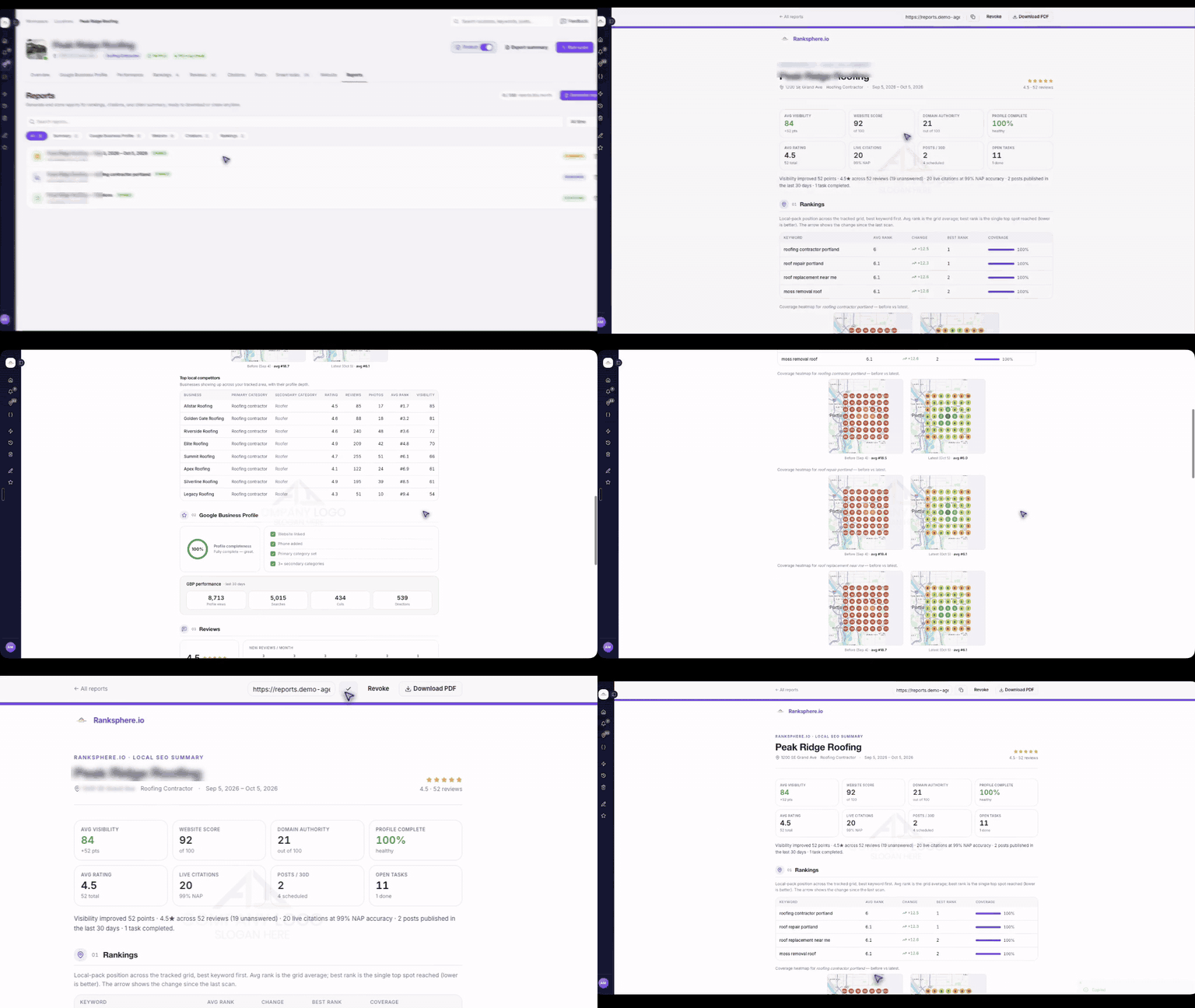
Ranksphere's Rankings reports can include local ranking heatmaps, scan comparisons, competitor information, and other ranking data. Reports can then be shared through a public view-only link or downloaded as a PDF.
Can You Use Your Own Domain for White Label Rank Reports?
Yes, if your chosen rank tracking platform supports custom report domains.
With Ranksphere, Growth and Agency workspaces can configure white-label branding and a custom report domain.
The report subdomain is connected separately, so the agency doesn't need to move or replace its main website.
This is an important distinction when comparing white label reporting tools. Adding your logo to a PDF and providing a fully branded reporting experience through your own domain aren't the same thing.
How Does White Label Rank Tracking Work in Ranksphere?
Ranksphere combines local rank tracking with client reporting and white-label customization.
With the Ranksphere Local Rank Tracker, an agency can scan Google Maps rankings from multiple points across a selected geographic area.
Each search point becomes part of a heatmap, making it possible to see where a business has strong or weak local visibility.
Scans can be repeated on daily, weekly, every-two-weeks, or monthly schedules, allowing agencies to build historical ranking data over time.
Previous scans can then be compared to identify changes in local visibility.
Once you have the ranking data, you can create a Rankings report in Ranksphere and share it with a client through a public link or downloaded PDF.
Eligible workspaces can then apply white-label branding and a custom domain to the reporting experience.
One distinction is important: ranking scans can currently be scheduled automatically, while automatic report scheduling is listed as coming soon. Reports currently need to be generated from the Reports section.
So the current workflow is:
Schedule ranking scans → review ranking changes → generate the client report → apply agency branding → share the report
For agencies that want local ranking data and branded client reporting in the same platform, this keeps more of the workflow connected.
Is a White Label Rank Tracker Worth It for an SEO Agency?
It depends on how your agency works.
If you manage one or two businesses and rarely send formal ranking reports, extensive white-label functionality may not be necessary.
The calculation changes when you're managing multiple clients and reporting regularly.
Ask how much time your team currently spends collecting data, creating screenshots, building reports, applying branding, and preparing something clients can understand.
Then compare that workflow with what the rank tracking platform can handle directly.
Also consider how costs change as you add clients, locations, keywords, or scans. A tool that works for five locations needs to remain practical when you're managing 50.
Ultimately, the value of a white label rank tracker isn't determined by how many features it offers.
It's determined by whether it helps your agency collect useful ranking data and turn that information into a professional client deliverable without creating unnecessary work.
White Label Rank Tracking Is More Than Adding a Logo
White labeling can sound like a branding feature, but for agencies it can be much more useful than that.
A good white label rank tracker connects the work happening behind the scenes with the experience your client sees.
You track the keywords that matter. You monitor how visibility changes. You identify where the business performs well or poorly. Then you turn those findings into a report delivered under your own brand.
For local SEO agencies, geo-grid tracking makes that process particularly useful because local visibility isn't one fixed ranking.
As Google's documentation on local ranking explains, distance is one of the primary factors affecting local results. Measuring rankings across multiple locations can therefore provide additional context that a single rank check can't.
When tracking, reporting, branding, and client delivery work together, rank tracking becomes more than another internal SEO tool. It becomes part of the service your agency provides.
Explore Ranksphere's Local Rank Tracker to see how geo-grid rank tracking, historical comparisons, reporting, and agency workflows can work together.
Turn this post into action.
Everything above becomes automated inside Ranksphere. 14-day free trial, no credit card, first insight in 90 seconds.