Local link building is the process of earning backlinks from websites that are relevant to a business’s geographic area, industry or community.
These links can come from:
- Local newspapers
- Community organisations
- Chambers of commerce
- Trade associations
- Suppliers
- Event websites
- Local charities
- Business partners
For a local business, the strongest link opportunities are often much closer to home than people expect.
A plumber may never need a mention from a national publication to improve local visibility. A link from a respected regional newspaper, supplier, trade body or community organisation may be far more relevant to the people the business actually serves.
That is what makes local link building different from broader link building.
The goal is not to collect links from anywhere.
It is to build genuine connections with websites that make sense for the business, location and audience.
What is local link building?
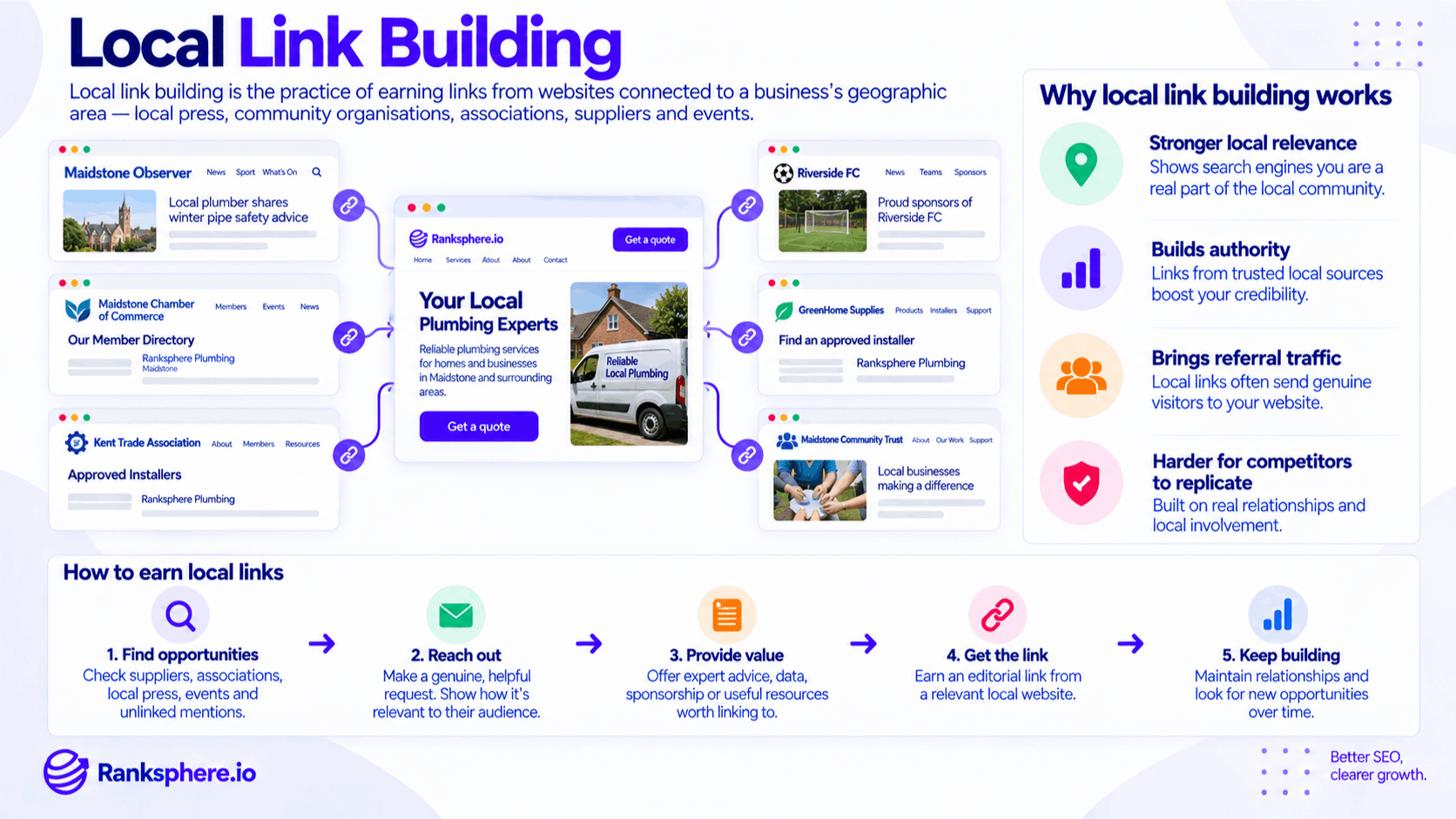
Local link building focuses on earning backlinks from websites connected to your:
- Town
- City
- Region
- Industry
- Local customer base
For example, a roofing company might earn links from:
- A local construction supplier
- A community news site
- A regional builders’ association
- A sports club it sponsors
- A manufacturer that lists approved installers
These links are useful because they have an understandable reason to exist.
A local customer could realistically encounter the business through those sources.
That is very different from paying for a link on an unrelated blog simply because an SEO tool gives the site a high authority score.
Why local links matter
Local backlinks can support both SEO and wider business visibility.
They provide geographic context
A link from a local publication or organisation can reinforce the fact that the business is active in a particular area.
For example, a mention from:
Maidstone Business Association
has obvious local relevance to a Maidstone-based company.
That does not mean every local link automatically improves rankings.
It means the source provides geographic context that makes sense.
They can support prominence
Google describes local results in terms of:
- Relevance
- Distance
- Prominence
Links can contribute to the wider prominence of a business, alongside factors such as:
- Reviews
- Brand recognition
- Citations
- Mentions
- General reputation
See local ranking factors for the broader picture.
They can send relevant referral traffic
A local backlink can also send real customers.
For example:
A roofing supplier may list recommended installers.
A local newspaper may link to a plumber in an article about frozen pipes.
A sports club may link to a sponsor.
These links can generate visits and enquiries independently of any SEO effect.
They can be harder to replicate
Some local links are built around genuine relationships.
A competitor can copy a directory submission.
They cannot instantly copy:
- Years of community involvement
- A supplier relationship
- Local press coverage
- A professional membership
- A long-standing sponsorship
This makes relationship-based links more defensible than links anyone can buy or generate automatically.
Local relevance vs authority
SEO often focuses heavily on authority metrics.
But a link should not be judged by one number.
For a local business, a smaller but highly relevant website may be a better opportunity than a much larger site with no connection to the business or its audience.
For example:
A local newspaper covering your town may have more practical relevance than a large national lifestyle blog that has nothing to do with your location.
That does not mean local relevance always beats authority.
The best link opportunities often combine:
- Local relevance
- Topical relevance
- Genuine readership
- Source quality
- Editorial context
Judge the actual website and why the link exists.
Do not reduce the decision to Domain Authority or another third-party score.
Where local backlinks come from
Most local businesses already have several potential link opportunities before they start cold outreach.
The best place to begin is usually with existing relationships.
Suppliers and manufacturers
Suppliers are one of the most overlooked sources of local and industry-relevant links.
Depending on the business, they may have:
- Approved installer directories
- Stockist pages
- Customer showcases
- Case studies
- Project galleries
- Partner listings
For example, a boiler manufacturer may maintain a list of approved engineers.
A building supplier may feature a customer's project.
A software vendor may publish a case study about a local business using its product.
The relationship already exists, so the link has a natural reason to exist too.
Trade associations and professional bodies
Membership organisations often provide:
- Member directories
- Business listings
- Individual professional profiles
- Regional chapter pages
These can be useful when the organisation is genuinely relevant to the business.
Do not join an association purely for a backlink.
But if membership makes sense professionally, make sure the online listing is complete and accurate.
Chambers of commerce and business groups
Local chambers and business improvement districts may offer:
- Member profiles
- Business directories
- Event listings
- News coverage
These can create useful local references while also offering networking benefits outside SEO.
Partner businesses
Think about companies you already work with.
For example:
A wedding venue may work with:
- Photographers
- Florists
- Caterers
- Entertainment companies
A builder may work with:
- Architects
- Surveyors
- Suppliers
- Interior designers
Where a genuine partnership exists, there may be a natural reason to reference one another.
Do not manufacture reciprocal links simply to influence rankings.
Let the link reflect the real relationship.
Unlinked brand mentions
An unlinked mention is a webpage that mentions your business but does not link to your website.
For example:
Carrick Plumbing provided emergency repairs after last winter’s cold snap.
If the article already references the company, asking the publisher whether they would consider linking to the official website can be reasonable.
The publisher may say yes.
They may also decide a link is unnecessary.
Keep the request polite and useful rather than treating the mention as something you are entitled to turn into a backlink.
Local sponsorships
Local sponsorship can create legitimate backlinks when the relationship is real.
Examples include:
- Football clubs
- Cricket teams
- School events
- Charity runs
- Community festivals
- Local arts groups
A sponsor page may include:
- Your business name
- Logo
- Website link
But sponsorship should make sense independently of SEO.
If the entire reason for spending money is:
“We need a backlink”
then the strategy is backwards.
Support something the business genuinely wants to support.
Treat the link as an additional benefit.
Local charities
Businesses that already support charities may find legitimate opportunities for recognition.
That might include:
- Sponsor acknowledgements
- Partner pages
- Event pages
- Fundraising reports
Do not turn charitable involvement into aggressive SEO outreach.
If a charity naturally lists supporters, make sure your information is accurate.
The relationship matters more than the link.
Local events
Events can create several legitimate link opportunities.
For example:
- Event calendars
- Venue pages
- Speaker profiles
- Sponsor listings
- Local news coverage
If your business:
- Hosts workshops
- Gives talks
- Attends trade events
- Sponsors community events
make sure relevant event information includes an appropriate link where useful.
Local business awards
Genuine business awards may create:
- Entry profiles
- Shortlist pages
- Finalist pages
- Winner announcements
These can be valuable for reputation as well as links.
Be cautious with schemes where every applicant becomes an “award winner” after paying a fee.
The award should have real credibility beyond the backlink.
Schools, colleges and community groups
Local organisations sometimes invite businesses to:
- Give talks
- Support careers days
- Sponsor activities
- Provide expert advice
Those activities can sometimes lead to mentions or links on:
- News pages
- Event pages
- Resource sections
Again, the activity should come first.
The backlink is secondary.
Local press
Local press can be one of the most useful sources of local backlinks because it combines geographic relevance with real readership.
Many small businesses assume journalists are only interested in major companies.
That is not always true.
Regional reporters regularly need:
- Local statistics
- Expert comments
- Case examples
- Seasonal advice
- Community stories
A business that responds quickly and provides something useful can become a reliable source.
How to earn local press links
The goal is not to send constant press releases.
It is to become useful to journalists.
Respond quickly
Journalists often work to short deadlines.
A useful quote today may be far more valuable than a perfect response next week.
Give them something specific
Instead of:
We are experts in plumbing and would love to be featured.
offer something useful, such as:
We have seen a sharp increase in burst outdoor pipes since temperatures dropped below freezing this week, particularly in older properties.
Specific information creates a story.
Generic promotion does not.
Offer real expertise
The strongest contributions often come from something the business knows first-hand.
Examples include:
- Seasonal repair patterns
- Common customer mistakes
- Changes in demand
- Local property issues
- Industry regulations
Journalists need usable information, not advertising copy.
Build relationships
If one reporter covers:
- Property
- Local business
- Consumer issues
- Community news
and your business regularly has useful expertise in that area, a professional relationship can develop over time.
Do not contact them only when you want a backlink.
Be useful when they need a source.
Original local data
Local data can be highly linkable because national publications often do not have it.
A business may have useful anonymised information about:
- Common repair types
- Seasonal demand
- Local property issues
- Appointment patterns
- Service trends
For example, a roofing company might analyse:
The most common storm-damage repairs completed across Kent during winter.
A veterinary practice might publish:
The most common seasonal hazards seen in local pets.
The information needs to be accurate, responsibly presented and genuinely interesting.
Do not invent statistics purely to attract links.
Useful local resources
Another approach is creating something people in the area genuinely need.
Examples might include:
- A local homeowner maintenance guide
- A directory of community resources
- A guide to planning rules relevant to a particular service
- A seasonal safety checklist
- A local accessibility resource
The strongest resources are difficult for a generic national website to create because they depend on real local knowledge.
That gives other local organisations a reason to reference them.
Local directories
Local directories can still be useful.
The important distinction is between:
Legitimate directories
and:
Bulk directory submission schemes
Useful directories may include:
- Local business associations
- Professional organisations
- Established local directories
- Relevant industry platforms
Low-value opportunities often include:
- Thousands of automatically generated directories
- Sites with no real audience
- Directories covering unrelated countries or industries
- Networks created mainly for SEO links
Do not measure success by the number of directories submitted to.
Choose the ones that make sense.
Ranksphere's citation management tracks listings across 500+ directories, helping manage the structured listing side of local visibility alongside broader local link-building work.
Local links and citations
Local link building overlaps with citation building, but they are not the same thing.
A citation is generally a mention of business information such as:
- Name
- Address
- Phone number
A citation may also include a backlink.
Local link building is broader.
It includes editorial and relationship-based references from:
- News websites
- Suppliers
- Community organisations
- Partners
- Associations
The two strategies can complement each other.
Local links and Google Business Profile
A backlink does not replace a properly maintained Google Business Profile.
Local visibility depends on several things working together.
Before investing heavily in link outreach, check that the basics are sound:
- Correct business information
- Appropriate categories
- Accurate opening hours
- Genuine reviews
- Useful website pages
- Consistent citations
- Strong internal linking
Link building should support a healthy local SEO foundation rather than compensate for one that has not been built yet.
Local backlinks and internal links
External links get a lot of attention because they are harder to control.
But internal linking is equally worth reviewing.
Suppose a local newspaper links to your homepage.
That is useful.
But if your main service pages receive almost no internal links, some of that external attention is not being supported by a clear website structure.
Make sure your own site connects:
- Service pages
- Location pages
- Guides
- Case studies
before assuming the answer is always more backlinks.
How many local backlinks do you need?
There is no ideal number.
A small business may only earn a few strong local links each year.
That can be perfectly normal.
The appropriate level depends on:
- Industry
- City
- Competition
- Existing reputation
- Business activity
Do not set arbitrary goals such as:
50 local backlinks this quarter
A better target is:
Build more legitimate relationships and earn mentions from sources that matter locally.
Link numbers should be an outcome, not the strategy.
How to find local link opportunities
Start with what already exists.
Ask:
- Which suppliers do we use?
- Which associations do we belong to?
- Which organisations do we sponsor?
- Which events have we attended?
- Which charities do we support?
- Which businesses regularly refer customers to us?
- Which publications have already mentioned us?
This often uncovers more realistic opportunities than cold outreach to hundreds of websites.
You can also search for:
- Local business directories
- Industry associations
- Event calendars
- Community groups
- Local media
- Supplier partner pages
- Existing mentions
The best opportunities usually have a genuine connection to the business.
Common local link-building mistakes
- Buying bulk local directory packages. A large number of irrelevant listings is not the same as local relevance.
- Sponsoring something solely for the backlink. Support organisations because the relationship makes sense.
- Judging every opportunity by authority score. Local and topical relevance matter too.
- Ignoring suppliers and manufacturers. Existing commercial relationships often create natural opportunities.
- Assuming every unlinked mention will become a link. Ask politely, but let the publisher decide.
- Sending generic press releases. Give journalists an actual story or useful expertise.
- Pursuing national publications while ignoring local opportunities.
- Creating fake local stories or statistics to attract links.
- Building links before fixing basic local SEO issues.
- Focusing on backlink count instead of business relevance.
Local link-building best practices
- Start with relationships the business already has.
- Look for unlinked mentions periodically.
- Prioritise local and industry relevance.
- Choose sponsorships the business would support regardless of SEO.
- Become a useful source for local journalists.
- Create local resources or data worth referencing.
- Use legitimate professional and community directories.
- Keep anchor text natural.
- Do not chase arbitrary link quotas.
- Measure referral traffic and enquiries as well as backlink counts.
- Treat local link building as a long-term relationship activity.
Example
“Carrick Plumbing wants to improve its local backlink profile.
Rather than buying a monthly link package, the company starts by reviewing relationships it already has.
It discovers several opportunities.
Its boiler manufacturer has an approved installer directory.
The company is eligible for membership in a regional trade association.
It already sponsors a junior cricket team.
A local newspaper has previously asked the owner for advice during periods of cold weather.
Over time, those relationships lead to several genuine online mentions and links.
The manufacturer lists the business as an installer.
The trade association creates a member profile.
The cricket club includes the company on its sponsor page.
When frozen pipes become a local story the following winter, the newspaper contacts the company again because it has already been a useful source.
None of those links was created simply to increase a backlink counter.
They came from real work, relationships and community involvement.
Some also send direct referrals.
That is the point of local link building: build a stronger presence within the places and organisations your customers already recognise. The best local backlinks usually reflect relationships the business genuinely has, rather than links created only because an SEO report says you need more of them.”
See also
- Link building — the wider practice of earning backlinks
- Backlink — a link from another website to yours
- Citation — local business mentions and listings
- Local ranking factors — relevance, distance and prominence in local search
- Reputation management — managing how the business is perceived online
- Anchor text — the clickable wording used in a link