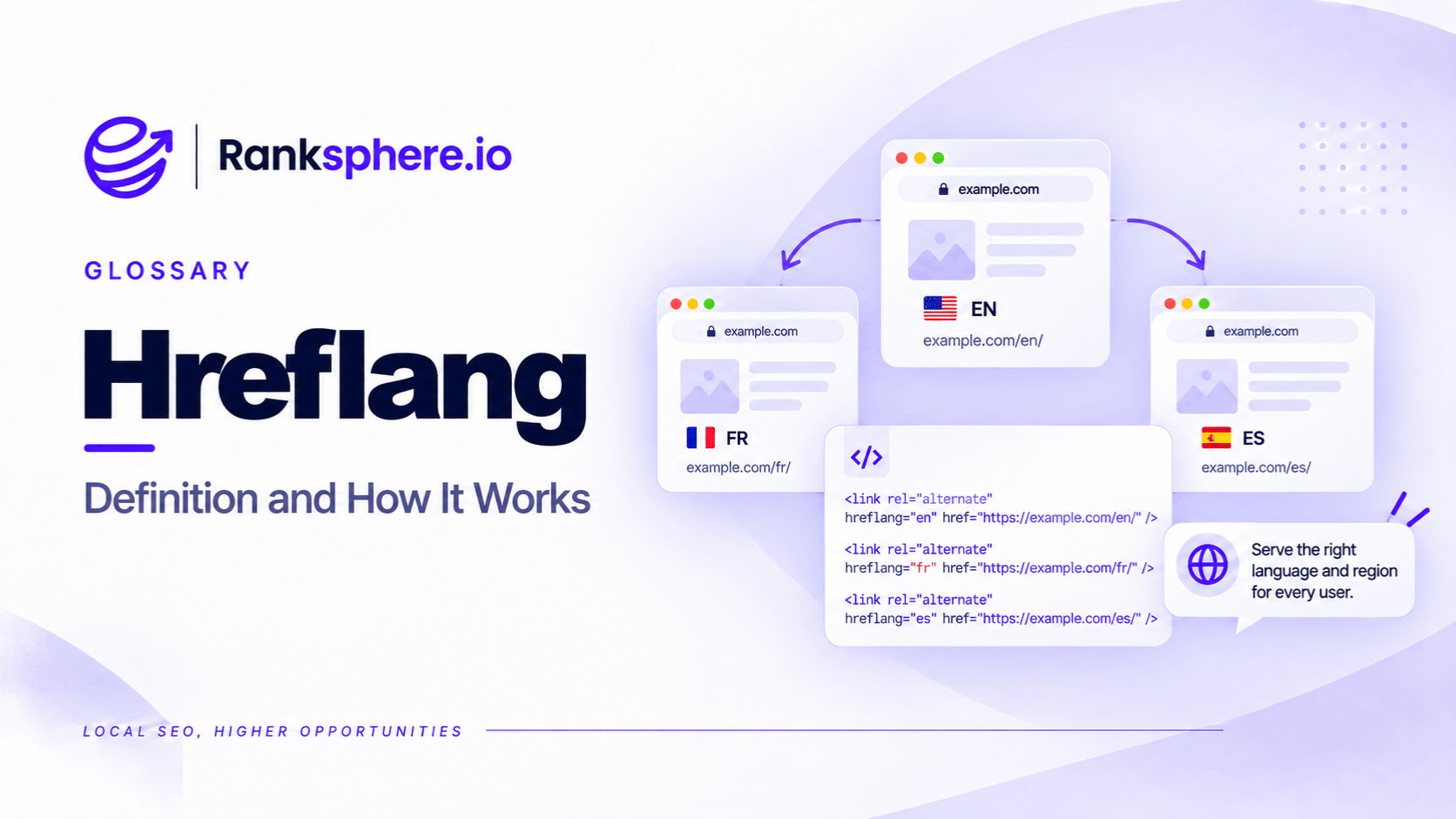
Hreflang is an HTML attribute that helps search engines identify the language and regional versions of a webpage. It is used on websites that provide equivalent content in multiple languages or different versions of the same content for different countries.
For example, a business might have one service page written in English for customers in the United Kingdom and another version for customers in the United States.
Hreflang helps Google understand which version is intended for each audience.
It can also be useful for websites offering the same services in different languages, such as English and French.
However, most single-location businesses don't need hreflang.
If your business serves one city and your website is written in one language, implementing hreflang is unlikely to provide any benefit.
The attribute doesn't improve rankings by itself, and it isn't a way to target different towns or neighbourhoods.
Its purpose is to help search engines serve the appropriate language or regional version when multiple versions of a page exist.
When Should You Use Hreflang?
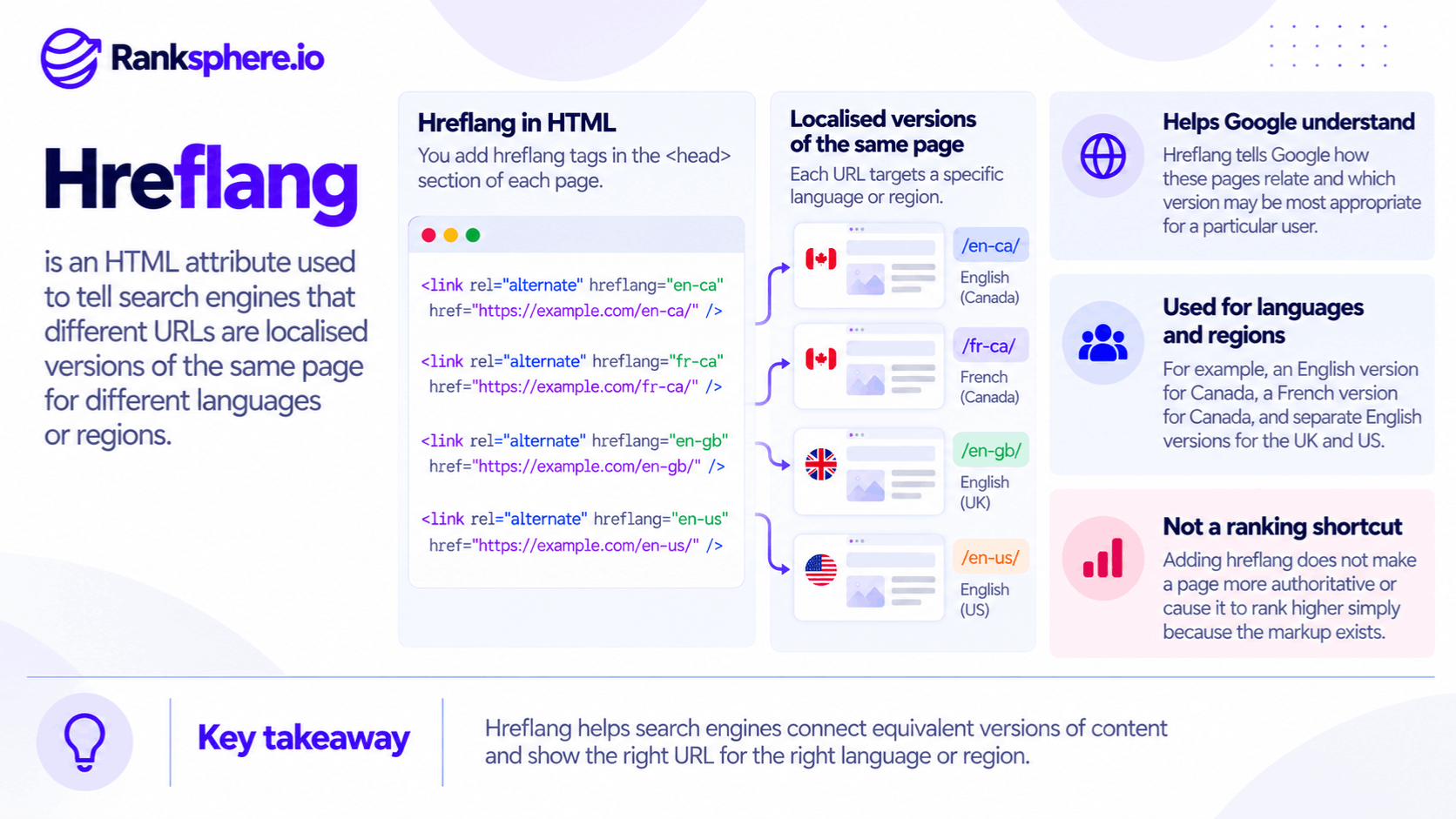
Hreflang is useful when a website serves audiences in different languages or countries and provides equivalent pages for those audiences.
There are three common situations.
1. Websites Offering Multiple Languages
If a business publishes the same information in different languages, hreflang can help Google understand the relationship between those pages.
For example, a dental clinic might offer:
- An English-language dental implants page
- A French-language version of the same dental implants page
Both pages explain the same service, but each is written for a different language audience.
Hreflang helps Google identify the alternatives so it can show a suitable version to users.
The pages don't need to be word-for-word translations, but they should serve substantially the same purpose.
2. Websites Targeting Different Countries
Hreflang also supports regional versions written in the same language.
For example, a company operating in the United Kingdom and United States may have:
- An English page for UK customers
- An English page for US customers
The pages might use different spelling, currencies, contact details, or service information.
Hreflang can help distinguish the intended regional audience.
Other examples include Spanish-language pages intended for Spain and Mexico.
However, creating multiple country versions only makes sense when the business genuinely serves those markets.
3. Local Businesses Serving Bilingual Markets
This is where hreflang becomes relevant to some local businesses.
For example:
- A dental clinic in Montreal offering English and French webpages
- A law firm in Miami serving English- and Spanish-speaking clients
- A healthcare provider in Switzerland publishing content in multiple languages
- A business in Belgium offering Dutch- and French-language versions
These businesses may benefit from hreflang because they serve customers who search in different languages.
However, publishing multilingual content and implementing hreflang are separate tasks.
Hreflang helps search engines understand the relationship between the language versions. It doesn't translate the content or guarantee that every user sees the intended page.
When Do You Not Need Hreflang?
Hreflang isn't necessary for every website.
Adding it without a clear purpose can create unnecessary technical work and configuration errors.
Single-Language Local Business Websites
A plumbing company serving one city with an English-only website generally doesn't need hreflang.
There are no alternative language or regional versions for Google to choose between.
Adding hreflang in this situation doesn't make the website more relevant to local searches.
Different Pages That Aren't Language Variants
Hreflang is intended for equivalent content targeting different language or regional audiences.
It isn't designed to connect unrelated pages.
For example, a roofing services page and a roof maintenance article may discuss similar topics, but they aren't alternate versions of the same content.
They shouldn't be connected using hreflang.
Location Pages Within the Same Country
A common misunderstanding is that hreflang can help businesses target different cities.
For example, a roofing company might create separate location pages for Maidstone and Ashford.
Those pages target different local areas, not different languages or country versions.
Hreflang doesn't help Google distinguish which town each page serves.
Local relevance, business information, distance, and other local ranking factors are more relevant to that purpose.
How Does Hreflang Work?
Hreflang identifies alternate versions of a page using language codes and, where appropriate, regional codes.
For example, a website could use:
- en — English
- en-gb — English for the United Kingdom
- en-us — English for the United States
- fr-ca — French for Canada
- es-mx — Spanish for Mexico
The language code comes first, followed by an optional regional code.
Google supports standard language codes based on ISO 639-1 and regional codes based on ISO 3166-1 Alpha 2.
For example, en-gb is valid for English content intended for the United Kingdom.
Using uk alone is not a valid substitute for that combination.
The Three Ways to Implement Hreflang
Google supports three implementation methods.
1. HTML link elements
Hreflang annotations can be added to the head section of each HTML page.
This is often practical for smaller multilingual websites.
2. HTTP response headers
Hreflang information can also be provided through HTTP headers.
This is particularly useful for non-HTML resources, such as PDFs, that cannot contain HTML link elements.
3. XML sitemap annotations
Hreflang relationships can be declared through an XML sitemap.
This can be convenient for larger websites because the alternate URL relationships are managed within the sitemap rather than repeated in each page's HTML.
Google treats these three methods as equivalent for communicating hreflang relationships.
You don't need to implement all three. Choose the method that is easiest to maintain accurately.
What Is x-default in Hreflang?
The x-default value identifies a fallback URL for users whose language or regional preferences don't match one of the specified alternatives.
For example, an international website might have:
- An English version
- A French version
- A language selection page
The language selection page could be designated as x-default.
Google can use this information when deciding which version to present to users who don't match the specified alternatives.
However, x-default isn't required for every multilingual website.
It's particularly useful when the website has a default page or language selector intended for audiences outside the listed language and regional combinations.
Hreflang Implementation Rules
Hreflang works best when every language or regional version is configured consistently.
Small mistakes can cause Google to ignore some annotations or fail to recognise the intended relationship between pages.
1. Hreflang Links Must Be Reciprocal
One of the most important rules is that alternate pages should reference one another.
For example, suppose an English page identifies a French version as an alternative.
The French page should also identify the English page as an alternative.
These are called reciprocal or return links.
If the French page doesn't reference the English page, Google may ignore that incomplete relationship.
This is one of the most common hreflang implementation mistakes.
2. Each Page Should Reference Itself
Every page in the hreflang group should include its own language or regional annotation alongside its alternatives.
For example, the English page should reference:
- Itself as the English version
- The French page as the French version
The French page should also reference both versions.
This helps maintain a complete and consistent set of alternate URLs.
3. Use Absolute URLs
Hreflang annotations should use complete URLs.
That includes the protocol and domain.
For example, use a complete HTTPS address rather than only a relative path.
This helps avoid ambiguity and follows Google's hreflang implementation guidance.
4. Use Valid Language and Region Codes
Hreflang values must follow the supported language and region formats.
Examples include:
- en-gb — English for the United Kingdom
- en-us — English for the United States
- fr-ca — French for Canada
- es-es — Spanish for Spain
Common mistakes include using a region without a valid language code or assuming that the United Kingdom's country code is UK rather than GB.
A regional code doesn't replace the language code.
5. Keep Canonical Tags Consistent
Hreflang and canonical tags serve different purposes.
A canonical tag identifies the preferred version of a page when duplicate or substantially similar URLs exist.
Hreflang identifies language and regional alternatives.
These signals need to work together.
For example, an English-language page shouldn't normally canonicalise to a French-language page if both are intended to remain independently available in search results.
That creates conflicting signals.
Where separate language versions should be indexed, they should generally have appropriate canonical URLs within their own language or regional versions.
6. Make Sure Alternate Pages Are Indexable
Hreflang doesn't override indexing restrictions.
If an alternate page is blocked from crawling, marked noindex, or redirects to another URL, Google may be unable to use it as intended.
Check that the URLs referenced by hreflang:
- Return successful responses
- Are accessible to Googlebot
- Aren't unintentionally marked noindex
- Have appropriate canonical settings
- Contain the intended content
Ranksphere's website audit tool can help identify technical issues such as indexing restrictions and other page-level problems that may affect URLs used in a multilingual setup.
Does Hreflang Improve Google Rankings?
Hreflang isn't a ranking boost.
Adding it doesn't automatically improve a page's position in Google Search.
Its purpose is to help Google select an appropriate language or regional version from a group of alternate pages.
For example, a French-speaking user in Canada may be better served by a French-Canadian page than an English-language version.
Hreflang helps Google understand that relationship.
However, Google can also use other signals when determining which results to show, and hreflang doesn't guarantee that the preferred version will always appear.
For local businesses, the main benefit is providing a more relevant language experience for people searching in different languages.
The benefit comes from matching users with appropriate content, not from receiving an additional ranking advantage.
Common Hreflang Mistakes
Common implementation problems include:
- Missing return links. One page references an alternative, but the alternative doesn't reference it back.
- Using hreflang for different cities. Location pages targeting towns within the same country aren't automatically language or regional alternatives.
- Using incorrect country codes. For example, using UK instead of GB in an English-language regional code.
- Using region codes without language codes. A country code alone isn't a valid hreflang language-region value.
- Conflicting canonical tags. A page may point to a different language version as canonical while also declaring itself as a separate hreflang alternative.
- Referencing non-indexable pages. Blocked, redirected, or noindex URLs may prevent annotations from working as intended.
- Adding hreflang to a single-language website without alternate versions. This creates unnecessary configuration without a meaningful benefit.
- Updating one language version but not the others. Adding or removing translated pages requires maintaining the relationships across the group.
- Assuming valid syntax means a correct implementation. A tag can be written correctly while still referencing the wrong URL or missing reciprocal relationships.
Hreflang Best Practices
To manage hreflang correctly:
- Use it only when your website has genuine language or regional alternatives.
- Make sure alternate pages serve equivalent purposes.
- Include reciprocal annotations between related pages.
- Include self-referencing annotations in each group.
- Use complete, absolute URLs.
- Follow Google's supported language and country code formats.
- Keep canonical tags consistent with the intended language versions.
- Make sure alternate URLs are crawlable and indexable.
- Use x-default when a fallback or language selection page is appropriate.
- Choose one maintainable implementation method.
- Review hreflang whenever translated pages are added, removed, or changed.
- Test the actual relationships between pages rather than checking syntax alone.
For most local businesses, these steps are only necessary if the website genuinely serves customers through multiple language or regional versions.
Example of Hreflang for a Local Business
Consider a hypothetical dental clinic in Montreal.
The clinic serves both English- and French-speaking patients and publishes its main service pages in both languages.
For example, it has an English page explaining dental implants and a French-language version covering the same treatment.
The clinic wants Google to understand that the two URLs are alternatives for different language audiences.
What Goes Wrong
The website developer adds hreflang annotations to the English pages, pointing to the corresponding French versions.
However, the French pages don't contain return annotations pointing back to the English pages.
The configuration is incomplete.
A basic syntax check may show that the annotations are correctly formatted, but that doesn't confirm the relationships are reciprocal.
As a result, Google may ignore the incomplete hreflang relationships.
The clinic cannot rely on these annotations to help Google select the appropriate language version.
How the Clinic Fixes the Problem
The developer reviews the English and French pages as matched pairs.
For each pair, the team:
- Confirms that both pages cover equivalent content.
- Adds reciprocal hreflang annotations.
- Includes self-referencing language annotations.
- Checks that the URLs use valid language codes.
- Reviews the canonical tags.
- Confirms that both pages are crawlable and indexable.
The updated configuration provides Google with a clearer relationship between the English and French versions.
Example Shows
“The correction doesn't guarantee that every French-speaking user will immediately see the French page.
Google still needs to discover and process the annotations, and it may consider other signals when choosing results.
However, the website now follows the technical requirements for identifying alternate language versions.
The lesson is that hreflang is only useful when the relationships between pages are implemented consistently.
Adding an annotation to one language version without maintaining the corresponding pages can leave the implementation incomplete.
For a multilingual local business, proper hreflang helps search engines understand which pages serve different language audiences.
For a business operating in one language with no alternative versions, it usually isn't needed.”
See Also
- Canonical Tag — Identifying preferred URLs and avoiding conflicting indexing signals.
- XML Sitemap — Managing alternate language URLs through sitemap annotations.
- Technical SEO — Improving the technical setup that helps search engines crawl and index websites.
- Location Page — Creating pages for individual business locations or service areas.
- Indexing — How eligible webpages enter a search engine's index.
- Duplicate Content — Understanding similar content across multiple URLs.