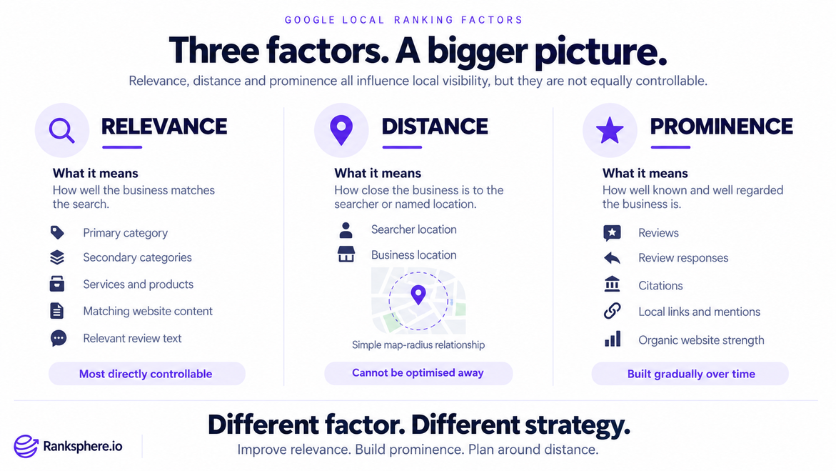
Local ranking factors are the signals Google uses to order business listings in local results. Google names three: relevance, or how well a business matches the search; distance, or how close it is to the searcher; and prominence, or how well known and well regarded it is.
Those three are Google's own framing, published in its local ranking guidance, and they are more useful than the long correlation studies that circulate every year. They are also unequal. One you can improve directly, one you can barely influence, and one takes months of consistent work. Knowing which is which prevents most wasted local SEO effort.
Relevance
Relevance is how well your business matches what was searched. It is the factor you control most directly, and the one most often left half done.
It is driven by the information on your Google Business Profile — above all the primary category, which carries more weight than any other single field. A practice listed as “Law Firm” competes for every legal search and wins few; the same practice listed as “Personal Injury Attorney” becomes a strong match for the searches it actually wants.
- Primary category — the highest-leverage edit available on any profile
- Secondary categories for genuine additional services
- The services and products lists, which increasingly feed AI-generated results
- Website content that matches what the profile claims
- Review text, which often mentions specific services by name
Distance
Distance is how far the business is from the searcher, or from the location named in the query. It is the factor people most want to beat and least can.
There is no setting that makes a business closer. What varies is how heavily Google weights distance, which depends on the query and the density of options. In a city with forty dentists inside two miles, distance dominates. In a rural area with one dentist in thirty miles, it barely applies. Google tightened proximity weighting for competitive categories in 2026, which narrowed the radius further in dense markets.
This is why measuring with geo-grid rank tracking matters. Distance is the reason a single reported rank is misleading, and the reason some parts of a service area are simply not winnable.
- You cannot optimise distance; you can only work out your realistic radius
- A service area business is still ranked from its registered address, not its declared service area
- Additional locations, where genuine, are the only real way to extend reach
Prominence
Prominence is how well known and well regarded the business is, online and offline. It is the slowest factor to move and the most competitive.
Reviews carry much of it — volume, average rating, and how steadily they arrive. A consistent flow over months outperforms a burst of fifty followed by silence. Beyond reviews, prominence draws on links, citations, mentions across the web, and the business's general standing.
- Review count, rating and velocity
- Responses to reviews, which signal an active business
- Consistent citations across directories
- Links and mentions from local sources — press, associations, sponsorships
- Organic strength of the website for related searches
How to Prioritise Local Ranking Factors
The honest ordering for most businesses is: fix relevance first because it is fast and controllable, build prominence steadily because it compounds, and plan around distance because you cannot change it.
- Audit categories and services before anything else — it is a same-day fix
- Establish a review generation routine and keep it running
- Correct listing inconsistencies before building new ones
- Map your realistic radius and stop chasing points outside it
- Measure coverage across a grid so you can tell which factor is limiting you
Google's guidance on improving local ranking sets out the three factors in its own words. Ranksphere's smart tasks turn scan data into a prioritised list so the highest-impact fix is visible rather than buried.
Common mistakes
- Treating all three as equally controllable. Effort spent fighting distance is effort wasted.
- Leaving the primary category generic. The single most common relevance failure.
- Buying reviews or gating them. Both violate policy and both get caught.
- Chasing review count in bursts. Velocity matters more than a one-off spike.
- Assuming a service area business ranks across its whole declared area. It does not.
- Reading correlation studies as instructions. They describe what successful profiles have in common, not what caused it.
Best practices
- Get the primary category right, then keep secondaries tight and accurate
- Complete services and products, since AI results draw on them
- Build reviews at a steady, sustainable pace
- Keep name, address and phone identical across every listing
- Accept the radius distance gives you and work the area inside it
- Reassess after every core update, since weighting shifts
Example
“Two roofing companies sit four miles apart in the same city. Ridgeline Roofing has 180 reviews at 4.8, but its primary category is the broad “Contractor” and only two services are listed. Summit Roof Co has 60 reviews at 4.6, the primary category “Roofing Contractor”, and eleven services filled in.
For “roof repair”, Summit outranks Ridgeline across most of the shared middle ground despite far weaker prominence, because relevance is doing the work Ridgeline left undone.
Ridgeline changes its primary category and completes the services list. Within roughly six weeks it takes back most of that ground — its prominence was always stronger, it simply was not being read as a roofer. The fix took twenty minutes. The reviews took three years.”
See also
- Local pack — the result these factors order
- Google Business Profile categories — the main relevance lever
- Geo-grid rank tracking — how to see distance working
- Online review — the largest component of prominence
- Citation — consistency signals that support prominence
- Local SEO — the discipline built around these three factors0