
Monthly recurring revenue (MRR) is the predictable revenue a business expects to receive each month from ongoing subscriptions, retainers, or recurring service agreements.
For an SEO agency, MRR typically comes from clients paying a fixed monthly fee for ongoing services such as search engine optimisation, Google Business Profile management, content optimisation, and reporting.
For example, an agency with ten clients paying £500 per month has £5,000 in monthly recurring revenue.
MRR doesn't include one-off projects such as website builds, standalone SEO audits, or migration work.
The distinction matters because recurring revenue provides a clearer picture of an agency's ongoing income than total monthly sales alone.
An agency might generate £20,000 in revenue during a particularly busy month, but if £12,000 came from one-off projects, only £8,000 represents recurring revenue.
MRR also shows whether an agency is genuinely growing or simply replacing revenue lost when existing clients leave.
That makes it particularly useful for SEO agencies built around monthly retainers.
How to Calculate Monthly Recurring Revenue
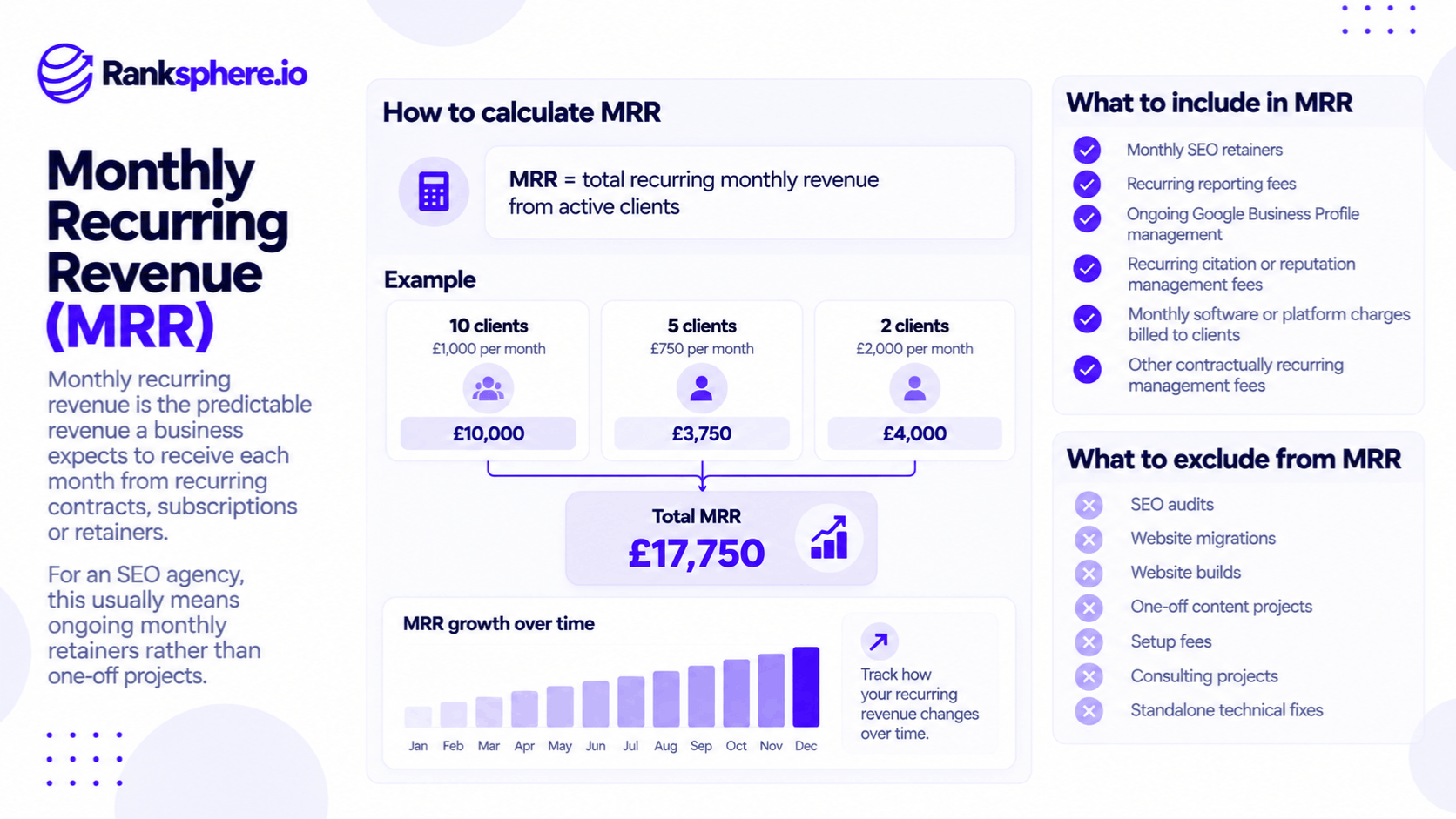
The basic MRR formula is:
MRR = Total monthly recurring contract revenue
For example, consider an SEO agency with the following clients:
| Client | Monthly retainer |
|---|---|
| Client A | £500 |
| Client B | £750 |
| Client C | £1,000 |
| Client D | £1,250 |
| Client E | £1,500 |
| Total MRR | £5,000 |
The agency has £5,000 in monthly recurring revenue.
If these contracts remain active at the same rates, the agency can expect £5,000 in recurring revenue each month.
However, MRR isn't guaranteed cash flow.
Clients can cancel, downgrade, pay late, or fail to renew their agreements.
What Counts Toward MRR?
For an SEO agency, recurring revenue may include:
- Monthly SEO retainers
- Ongoing Google Business Profile management fees
- Recurring content management agreements
- Monthly citation management charges
- Recurring reporting or software fees billed to clients
- Ongoing website maintenance agreements
The important question is whether the revenue comes from an active, recurring arrangement.
For example, a client paying £600 every month for ongoing local SEO management contributes £600 to MRR.
What Should Be Excluded?
One-time revenue shouldn't be included in MRR.
Examples include:
- Standalone SEO audits
- Website builds
- Website migration projects
- One-off content writing
- Setup fees
- Individual consulting sessions
- Non-recurring technical fixes
These projects still contribute to the agency's revenue and profitability.
However, they shouldn't be counted as recurring income.
Including them would make future revenue appear more predictable than it actually is.
How to Calculate MRR for Annual Contracts
Some agencies offer annual agreements paid upfront.
For example, a client might pay £12,000 for twelve months of SEO services.
For MRR reporting, the recurring contract value can be normalised:
£12,000 ÷ 12 = £1,000 MRR
The agency records £1,000 as the monthly recurring contract value.
However, this doesn't mean the client pays £1,000 every month.
MRR and cash received are different measures.
An agency should track payment timing separately when managing cash flow.
The Four Types of MRR Movement
Total MRR tells an agency how much recurring revenue it has.
However, the changes behind that total are often more useful.
There are four main movements to track.
1. New MRR
New MRR is recurring revenue gained from new clients.
For example, an agency signs four new clients, each paying £1,000 per month.
Its new MRR is £4,000.
This measures how much recurring revenue the agency has added through new customer acquisition.
2. Expansion MRR
Expansion MRR comes from existing clients increasing their recurring spending.
For example, a roofing company already paying £500 per month adds another location to its SEO agreement.
The monthly fee increases to £800.
The additional £300 is expansion MRR.
Other examples include existing clients adding services, increasing their monthly scope, or moving to higher-priced plans.
3. Contraction MRR
Contraction MRR occurs when an existing client reduces its recurring spending without cancelling completely.
For example, a client paying £1,200 per month reduces its SEO package to £800.
The agency loses £400 in MRR through contraction.
Contraction can be an early warning sign of dissatisfaction, changing business priorities, or budget pressure.
However, not every downgrade means a client is unhappy.
Some businesses simply need a smaller service package.
4. Churned MRR
Churned MRR is recurring revenue lost when clients cancel their agreements.
For example, an agency loses two clients paying £750 per month.
Its churned MRR is £1,500.
This differs from customer churn, which measures the number or percentage of clients lost.
A business can lose relatively few clients while experiencing substantial revenue churn if those clients have high-value contracts.
See churn rate for more information.
How to Calculate Net New MRR
Net new MRR shows how much recurring revenue has actually increased or decreased during a period.
The formula is:
Net New MRR = New MRR + Expansion MRR − Contraction MRR − Churned MRR
Consider this example:
| MRR movement | Amount |
|---|---|
| New MRR | +£4,000 |
| Expansion MRR | +£1,000 |
| Contraction MRR | −£400 |
| Churned MRR | −£3,600 |
| Net New MRR | +£1,000 |
The agency added £4,000 in recurring revenue from new clients.
However, its total MRR increased by only £1,000 after accounting for expansion, contraction, and cancellations.
If management reports only the £4,000 in new MRR, it may give the impression that the agency is growing much faster than it actually is.
This is why net new MRR is often more informative than new client revenue alone.
Why MRR Matters for SEO Agencies
SEO agencies often work with clients through ongoing monthly agreements.
Unlike one-off website projects, SEO involves continuous work such as technical maintenance, content improvements, local search management, and performance reviews.
This makes recurring revenue particularly relevant.
More Reliable Revenue Forecasting
Monthly retainers can make future revenue easier to estimate.
For example, an agency with £30,000 in active MRR has a clearer starting point for forecasting than an agency relying entirely on occasional website projects.
However, the forecast should still account for expected cancellations, contract renewals, payment risks, and potential changes in scope.
Better Hiring and Capacity Planning
MRR can help agencies plan the resources needed to support their clients.
For example, an agency with twenty ongoing SEO accounts may need additional content writers, SEO specialists, or account managers.
Recurring agreements help management understand the likely workload.
However, revenue alone doesn't measure capacity.
A client paying £1,000 per month may require substantially more work than another client paying the same amount.
The agency should track both contract value and delivery requirements.
Understanding Revenue Stability
An agency relying heavily on project work may experience substantial changes in revenue from month to month.
Recurring retainers can reduce some of that uncertainty.
However, recurring contracts are not automatically stable.
Short cancellation terms, dissatisfied clients, and client concentration can still create significant revenue risk.
Evaluating Business Performance
MRR helps agencies distinguish between growth from new customers and growth from existing relationships.
For example, an agency may win several new clients while losing almost the same amount of revenue through cancellations.
Total MRR might barely change.
That suggests the agency should investigate retention rather than focusing exclusively on sales.
Business Valuation
Recurring revenue can make an agency more attractive to potential buyers because it may provide greater visibility into future income.
However, MRR alone doesn't determine the agency's value.
Buyers may also consider:
- Profit margins
- Customer retention
- Contract terms
- Client concentration
- Revenue growth
- Owner dependency
- Delivery costs
- Quality of earnings
An agency with high MRR but weak profitability or poor retention may be less valuable than its headline revenue suggests.
How Can SEO Agencies Increase MRR?
Increasing MRR doesn't always require winning more clients.
Agencies can also grow by expanding existing relationships and reducing unnecessary cancellations.
Win New Retainer Clients
New clients increase MRR when they sign recurring service agreements.
For example, an agency might offer ongoing local SEO management to businesses that need help with search visibility and Google Business Profile optimisation.
The agreement should define the included services, reporting, and responsibilities.
Avoid relying on guaranteed ranking promises to secure contracts.
Expand Existing Client Accounts
Expansion is an important source of recurring growth.
For example, a client may initially hire an agency to manage one business location.
As the business grows, it may open additional branches.
The agency can offer multi-location SEO services for the new locations.
Other expansion opportunities may include:
- Additional Google Business Profile locations
- Ongoing review management
- Local citation monitoring
- Content management
- Technical SEO maintenance
- Reporting for additional websites or locations
However, expansion should reflect a genuine client need.
Adding unnecessary services simply to increase MRR can damage the relationship.
Review Pricing Regularly
Agencies should periodically review their pricing against delivery costs, service scope, and the value of the work.
For example, an SEO agreement created several years ago may no longer cover the resources required to deliver the same service.
A price review can help maintain sustainable margins.
However, price increases should be communicated clearly and follow the terms of the client agreement.
Higher prices increase MRR only if the revenue gained outweighs reductions or cancellations.
Reduce Client Churn
Keeping existing clients is an important part of maintaining recurring revenue.
For example, an agency may consistently win three new clients each month but lose two existing clients.
That creates pressure on sales and onboarding.
Understanding why clients leave can reveal problems such as:
- Unclear expectations
- Poor communication
- Incomplete onboarding
- Delayed deliverables
- Weak reporting
- Services that no longer meet client needs
Reducing avoidable churn can improve net new MRR without requiring the same level of new customer acquisition.
MRR vs Revenue vs Profit
MRR, total revenue, and profit are different financial measures.
Confusing them can lead to misleading reporting.
Monthly Recurring Revenue
MRR represents the normalised monthly value of active recurring agreements.
For example:
MRR = £20,000
This is the agency's recurring revenue base.
Total Monthly Revenue
Total revenue includes recurring and non-recurring work recognised during the month.
For example:
- £20,000 in recurring SEO services
- £5,000 from a website build
- £2,000 from a standalone audit
The agency's total monthly revenue is £27,000.
However, its MRR remains £20,000.
Profit
Profit accounts for the costs involved in running the business.
These may include:
- Employee salaries
- Freelancers
- Software subscriptions
- White label suppliers
- Hosting
- Sales and marketing
- Other operating expenses
For example, an agency may have £20,000 in MRR but spend £14,000 each month delivering and supporting those services.
The difference represents £6,000 before considering any additional costs not included in that calculation.
Supplier costs should not be deducted from MRR.
If an agency sells SEO services through a white label SEO provider, the full recurring amount charged to the client is generally counted as revenue when the agency is the principal responsible for delivering the service.
The supplier's fee is treated as a cost.
However, accounting treatment can differ when an agency acts only as an intermediary rather than the principal service provider.
For that reason, agencies should apply the appropriate revenue recognition rules and seek accounting advice where necessary.
What Is Net Revenue Retention?
Net revenue retention (NRR) measures how much recurring revenue an agency retains from its existing client base after accounting for expansion, contraction, and churn.
It excludes new clients acquired during the measurement period.
For example, an agency starts the month with £20,000 in MRR.
During the month:
- Existing clients add £2,000 in recurring services.
- Other clients reduce spending by £500.
- Cancellations remove £1,000.
The agency finishes with £20,500 in recurring revenue from its original clients.
Its net revenue retention is:
NRR = (£20,000 + £2,000 − £500 − £1,000) ÷ £20,000 × 100
NRR = 102.5%
This means expansion from existing clients more than offset the revenue lost through contraction and churn.
NRR can be useful for agencies because it separates the performance of existing client relationships from new customer acquisition.
Common MRR Mistakes
Several reporting mistakes can make an agency appear healthier than it is.
Counting One-Off Projects as Recurring Revenue
A £10,000 website build may significantly increase total revenue during one month.
However, it shouldn't be added to MRR unless it represents an ongoing recurring commitment.
Reporting Only New MRR
An agency may celebrate £5,000 in new retainers while losing £4,500 through cancellations.
The actual net increase is much smaller.
Track new MRR alongside churn and contraction.
Ignoring Expansion Opportunities
Some agencies focus almost entirely on finding new clients.
However, existing clients may have legitimate needs for additional services or locations.
Reviewing those opportunities can support growth.
Failing to Track Contraction
Client downgrades reduce MRR even when the client relationship continues.
A series of downgrades may indicate that the service no longer matches client expectations or budgets.
Never Reviewing Pricing
As delivery costs rise, an unchanged retainer may become less profitable.
Regular pricing reviews help agencies understand whether their agreements remain commercially sustainable.
Ignoring Client Concentration
An agency with £50,000 in MRR may appear financially stable.
However, if one client contributes £20,000, losing that relationship would remove 40% of the recurring revenue base.
Client concentration should be monitored alongside total MRR.
Confusing MRR With Cash Flow
Annual payments, late invoices, and payment terms can create differences between recurring revenue and cash received.
Track both separately.
MRR Best Practices for SEO Agencies
To manage monthly recurring revenue effectively:
- Separate recurring revenue from one-off project income.
- Calculate MRR consistently each month.
- Normalise annual recurring agreements appropriately.
- Track new, expansion, contraction, and churned MRR.
- Monitor net new MRR rather than new sales alone.
- Review client retention and cancellation reasons.
- Identify relevant expansion opportunities.
- Review retainer pricing periodically.
- Track profitability separately from MRR.
- Monitor dependence on individual high-value clients.
- Compare MRR growth with staffing and delivery capacity.
- Use consistent revenue reporting definitions.
MRR is most useful when the agency can explain not only the total, but also why it increased or decreased.
Example of MRR Growth in an SEO Agency
Consider a hypothetical SEO agency reporting an 18% increase in MRR over twelve months.
At first glance, the result looks positive.
The agency has won fourteen new clients during the year, and management believes its sales process is performing well.
However, a closer look at the revenue movements reveals a different picture.
What the MRR Breakdown Shows
During the year:
- Fourteen new clients joined.
- Eleven existing clients cancelled.
- Several cancellations occurred within the first five months.
- Three existing clients increased their retainers by adding business locations.
The agency generated substantial new recurring revenue.
However, much of that growth was offset by cancellations.
A significant share of the net increase came from the three existing clients expanding their services.
Those expansions weren't part of a planned account growth strategy.
The clients had approached the agency themselves.
What the Agency Changes
Management reviews the reasons clients are leaving.
The team finds that some clients had different expectations about the work included and how quickly results would appear.
The agency improves its onboarding process.
It introduces:
- Clearer explanations of SEO timelines
- Written deliverables
- Agreed reporting expectations
- More consistent communication
- Earlier reviews of client satisfaction
The agency also begins reviewing existing accounts for genuine expansion opportunities.
For example, clients opening new branches may need additional location management and reporting.
How the Agency Measures Improvement
Instead of focusing only on the number of new contracts signed, management begins reviewing:
- New MRR
- Expansion MRR
- Contraction MRR
- Churned MRR
- Net new MRR
- Customer retention
- Revenue concentration
This helps the team understand whether its recurring revenue is growing sustainably.
The agency can evaluate whether retention improvements and account expansion contribute to better results over time.
Example Shows
“New clients were joining, but existing clients were also leaving.
Expansion from a small number of established relationships accounted for an important part of growth.
Without tracking the individual MRR movements, management might have continued investing heavily in acquisition while overlooking retention.
MRR shows how much recurring revenue an agency has. Net new MRR shows whether that revenue is actually growing.
For SEO agencies, the most useful approach is to track both, understand why clients increase or reduce spending, and avoid mistaking new sales activity for sustainable growth.”
See Also
- Churn Rate — Understanding how client cancellations affect recurring revenue.
- SEO Retainer — Ongoing agreements that generate recurring agency revenue.
- Customer Lifetime Value — Estimating the financial value of a customer relationship.
- White Label SEO — Outsourcing SEO delivery while managing client relationships.
- Client Onboarding — Setting expectations and securing access before work begins.
- Multi-Location SEO — Managing SEO for businesses with multiple locations.