
Review velocity is the rate at which a business receives new reviews over time. A steady, consistent flow signals an active business and is generally more valuable than a large number of reviews arriving in a short burst and then stopping.
It is the review metric businesses track least and should track most. Total count is a vanity figure that only goes up; average rating moves so slowly it tells you almost nothing month to month. Velocity is the one that reflects whether the programme is actually running, and it is the one that shows immediately when it stops.
Why velocity matters
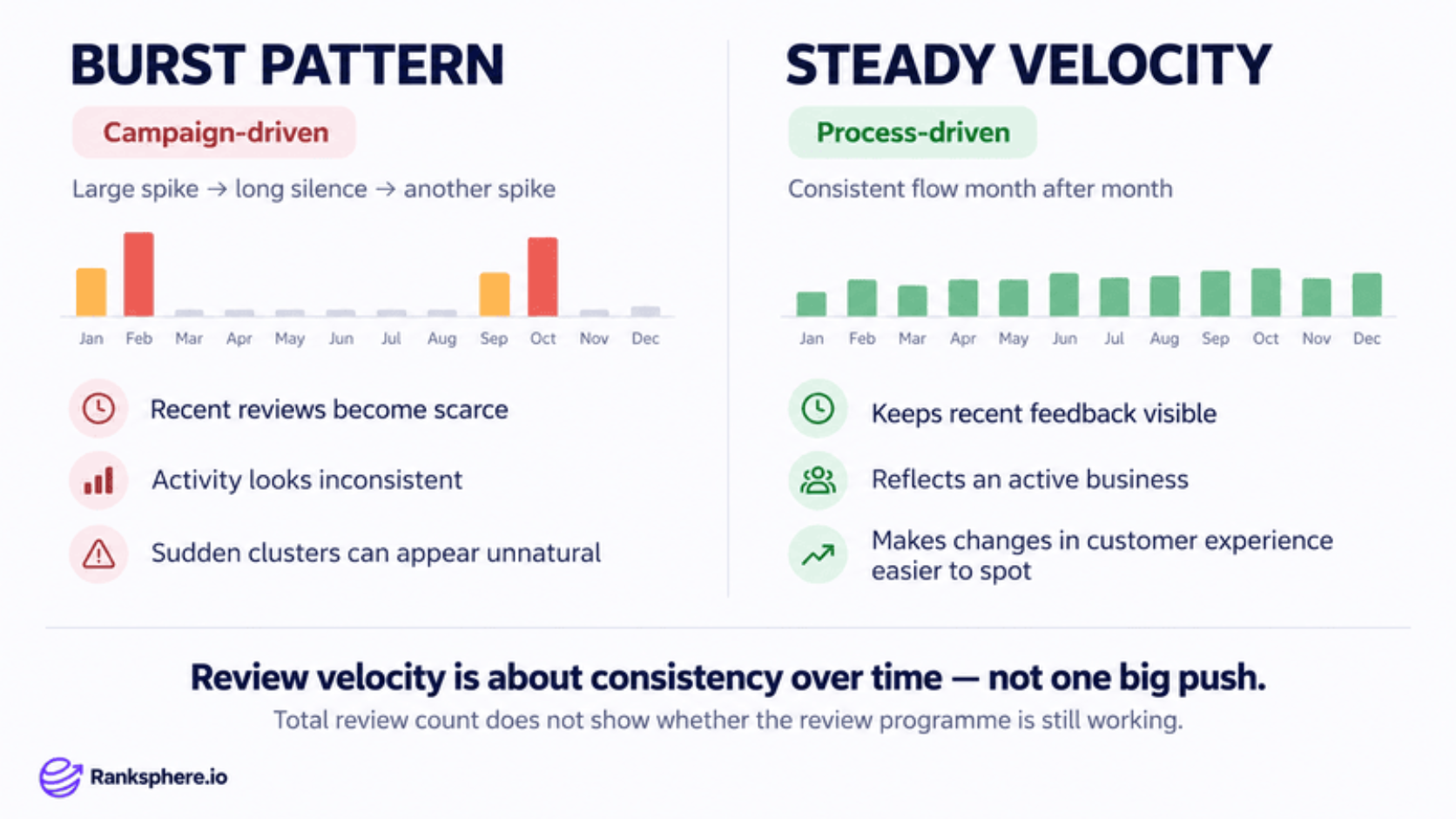
A profile with 300 reviews, all from 2023, and a profile with 300 reviews arriving steadily since 2023 have identical counts and identical averages. They read completely differently, to customers and to Google.
Consistency implies an operating business with a working process. Bursts imply a campaign. Bursts followed by silence imply a campaign that ended, and platforms treat unnatural spikes with suspicion — sudden clusters are among the patterns review filters look for.
- Signals an active, currently trading business
- Keeps the visible reviews recent, which customers notice
- Avoids the spike patterns that trigger platform filtering
- Makes the rating responsive to current performance rather than history
- Gives you an early warning when service quality slips
What a healthy rate looks like
There is no universal number, because it depends on how many customers you actually serve. The useful framing is a conversion rate, not an absolute.
A reasonable target for most local businesses is somewhere between 5% and 15% of customers leaving a review when asked properly. A dental practice seeing 400 patients a month and asking each one should expect considerably more reviews than a roofing company completing twelve jobs.
- Work from your customer volume, not from a competitor's review count
- Aim for a rate you can sustain indefinitely rather than a target you hit once
- Compare against direct competitors in your market, not national averages
- Watch the trend line; a declining rate is a problem well before the average moves
Ranksphere's review management tracks new reviews by day, week or month alongside rating and reply rate, and generates a designed QR code for the counter — which covers both halves of velocity: seeing it stall, and removing the friction that stalls it.
How to build steady velocity
The answer is nearly always process rather than campaign. Anything that depends on someone remembering will decay.
- Build the ask into a fixed point in the customer journey — checkout, job completion, follow-up email
- Make it a staff routine with a named owner, not an occasional initiative
- Use a short link or QR code so there is no friction
- Ask every customer, with no filtering by expected sentiment
- Automate the follow-up where you can, while keeping it personal
- Review the rate monthly and fix the process when it dips
Common mistakes
- Running review drives. A spike followed by nothing is worse than a steady trickle.
- Tracking total count only. It cannot go down, so it never tells you anything is wrong.
- Setting a target from a competitor's total. Their customer volume may be five times yours.
- Stopping once the rating looks good. The rating decays in relevance as it ages.
- Letting velocity drive gating. Chasing a rate is how businesses start filtering who gets asked.
- Ignoring a sudden increase. If reviews spike without a process change, check they are genuine.
Best practices
- Measure velocity monthly and treat it as the headline review metric
- Build the ask into an existing workflow rather than adding a new one
- Ask everyone, always — velocity is not a reason to filter
- Set a rate you can sustain for years
- Track it per location in multi-location businesses, where it varies enormously by branch
- Investigate both sharp drops and unexplained spikes
Example
“Two window-fitting companies in the same city. Pane & Frame has 180 reviews at 4.8. Clearview has 175 at 4.7. On paper they are level.
Pane & Frame's reviews arrived across two concentrated periods: 90 in early 2024 when they ran a push, 70 in late 2024 when they ran another. Eleven since. Clearview's arrive at four to six a month, every month, because every completed job ends with the fitter handing over a card with a QR code.
In the local pack, Clearview's most recent review is from last week. Pane & Frame's is from eight months ago. Customers comparing the two read one as currently busy and one as possibly winding down.
The counts will diverge too. At the current rates, Clearview passes 250 within a year while Pane & Frame stays near 190 until someone remembers to run another push. The difference is not effort. It is that one company has a process and the other has campaigns.”
See also
- Online review — the broader topic
- Review response — the other half of an active review profile
- Review gating — the temptation velocity targets create
- Reputation management — the programme velocity sits inside
- Local ranking factors — prominence, which velocity feeds
- Multi-location SEO — where velocity varies most by branch