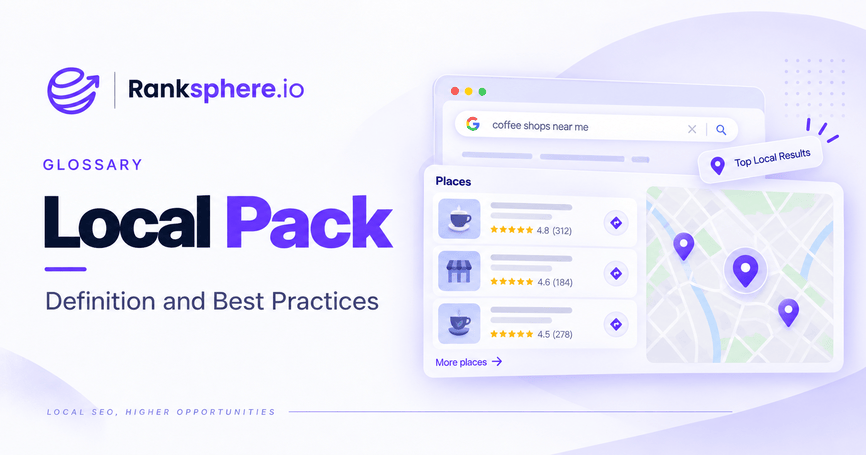
The local pack is the block of business listings shown with a map near the top of Google's results for searches with local intent. It has traditionally held three listings, which is why it is also called the map pack or three-pack, and it sits above the organic results.
For any business that serves a local market, the local pack is the most valuable position on the page. It appears above the organic links, it carries the details a customer actually needs — rating, hours, distance, a call button — and it is often the only thing a phone user sees without scrolling. Ranking first organically and missing the pack usually means losing the click.
Why the local pack matters
The pack sits where attention is. It also answers the question directly: a searcher looking for a nearby locksmith gets three options with ratings and a tap-to-call button, and frequently never visits a website at all.
That last point is worth sitting with. Pack visibility produces calls and direction requests rather than sessions, so judging it by website traffic understates it badly. The conversion happens inside the search result.
- Occupies the highest-attention position for local-intent queries
- Produces calls and direction requests, not just clicks
- Dominates mobile results, where most local searching happens
- Drives Maps visibility at the same time
How Google decides who appears
Pack results are drawn from Google Business Profiles, not from web pages. Your site influences the outcome, but the listing itself comes from the profile, which is why an excellent website with a neglected profile underperforms.
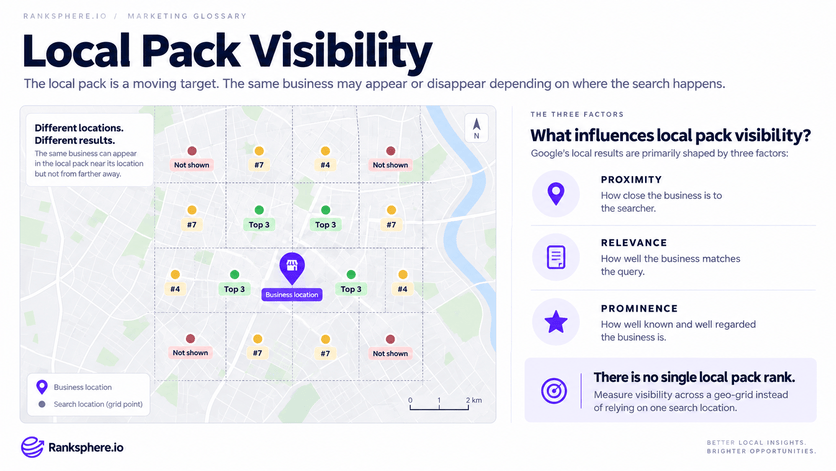
Google weighs three things, covered fully in local ranking factors: how close the business is to the searcher, how well it matches the query, and how well known and well regarded it is. Proximity is the one people underestimate. It is also why the pack is a moving target rather than a fixed position — the same business appears and disappears depending on where the search happens.
Because of that, a single reported rank for a pack keyword is close to meaningless. Geo-grid rank tracking exists precisely to show the shape of pack visibility across an area instead of a flattering single point.
What changed in 2026
The three-listing pack is no longer a safe assumption. Through late 2025 and into 2026, Google began replacing the traditional unit with AI-generated local results for a growing share of queries, and independent tracking has repeatedly found these AI-driven packs surfacing one or two businesses where three used to appear.
The pattern that has emerged is roughly this. Straightforward transactional and navigational searches — “dentist near me”, “hardware store” — still tend to return the familiar three-listing pack. More complex or comparative phrasing — “best dentist near me for implants” — is far more likely to trigger an AI summary that names fewer businesses and constructs an answer rather than listing options.
The practical consequence is that fewer slots exist for the queries where a customer is comparing, which raises the value of the signals AI results draw on: a complete and accurate profile, review content that says something specific, and website pages that answer questions in plain language.
These are fast-moving figures. Check current data before quoting specific percentages in client-facing work.
How to improve pack visibility
There is no way to buy into the organic pack, and no single switch that puts you there. What moves it is the accumulated quality of the profile and the reputation behind it.
- Choose the narrowest accurate primary category — usually the highest-leverage single edit available
- Complete every profile field: services, hours, attributes, description, photos
- Build reviews at a steady pace and reply to them
- Keep name, address and phone consistent across directories
- Publish Google Posts regularly to keep the listing active
- Make sure the website backs up what the profile claims, with real service and location pages
Ranksphere's local rank tracker shows pack position across a grid rather than a single point, so you can see which parts of your service area you actually hold.
Common mistakes
- Assuming one rank exists. Pack position varies street by street; a single number hides the gaps.
- Reading average position alone. Top-three coverage across the grid is the more honest metric.
- Judging pack performance by website traffic. Calls and direction requests are where the value lands.
- Confusing the pack with organic results. They are separate systems and move independently.
- Keyword-stuffing the business name to force relevance. It works until it triggers a suspension.
- Chasing the pack from outside the service area. Proximity is a hard limit, not an obstacle to optimise around.
Best practices
- Treat the Google Business Profile as a product you maintain, not a form you filled in once
- Track coverage across a grid and compare scans over time
- Separate local pack tracking from organic tracking in reporting
- Watch for AI-driven local results replacing the standard pack on your money keywords
- Fix the profile fundamentals before spending on anything more exotic
Example
“Harbourview Physio ranks first in the local pack for “physiotherapist” when the search happens at the clinic. The owner reports this to the practice partners as a win.
A grid scan tells a different story. Across a 5×5 sweep of the service area, the clinic holds a top-three position in five of twenty-five points, all clustered around the clinic itself. North of the river it does not appear at all, and a competitor with double the review count holds most of that ground.
The team stops reporting the single rank and starts reporting coverage. Over four months they push review volume, add three missing services to the profile, and publish weekly posts. Coverage climbs to fourteen points out of twenty-five. The rank at the front door never changed — it was already first — but the business became visible to four times as many searchers.”
See also
- Local SEO — the broader discipline aimed at this result
- Google Business Profile — where pack listings are drawn from
- Local ranking factors — proximity, relevance and prominence
- Geo-grid rank tracking — how to measure pack position honestly
- Near me search — the query type most likely to trigger a pack
- AI Overviews — the AI summaries increasingly appearing alongside or instead of the pack