A geo-modifier is a location-related word or phrase added to a search query to make the results geographically specific. It can be a city, town, neighbourhood, postcode, ZIP code, or phrase such as "near me."
For example, someone searching for "plumber in Maidstone" is using a geographic modifier to specify where they want to find a plumbing service.
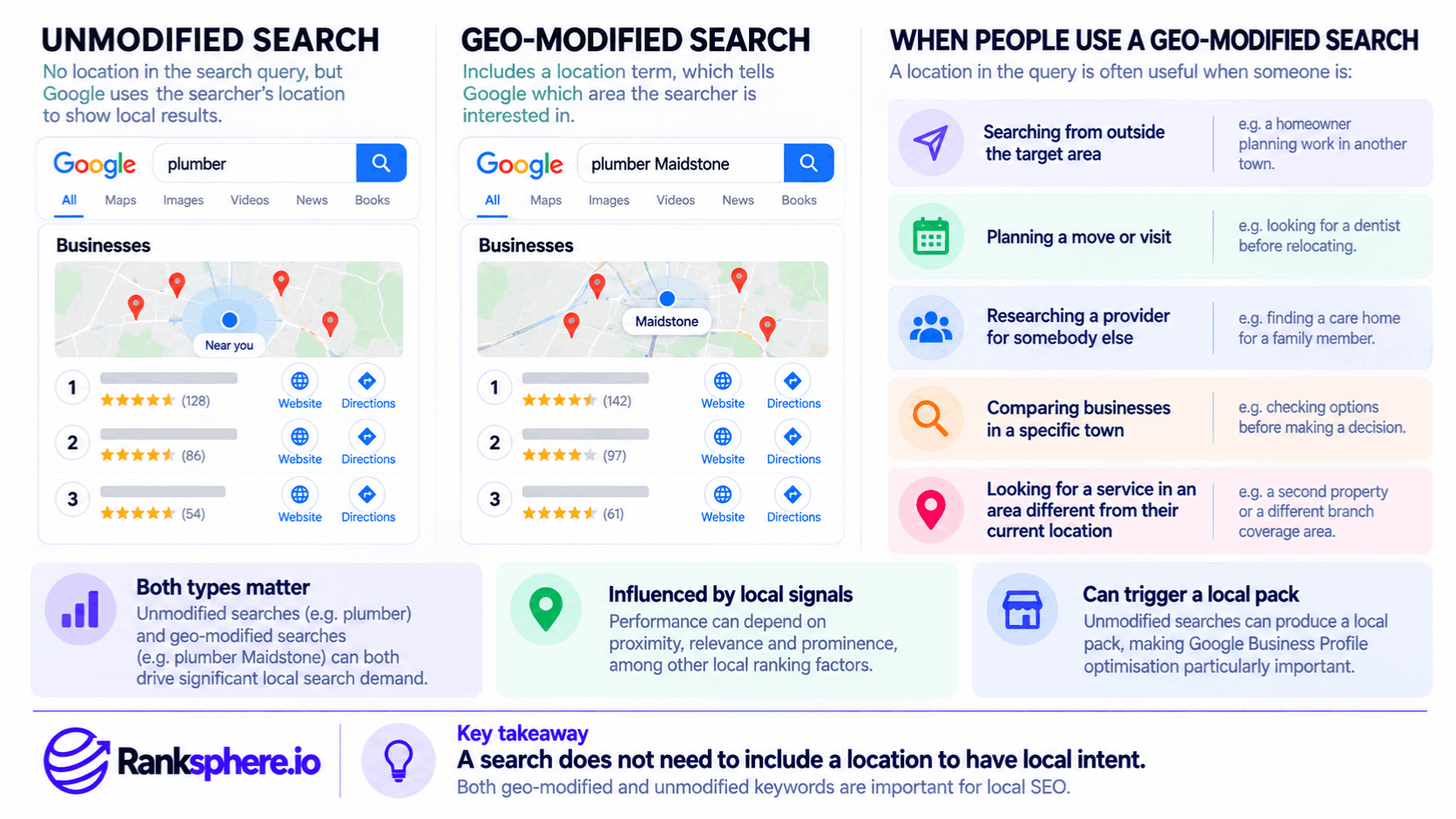
However, people don't always need to include a location for Google to show local results.
If someone standing in Maidstone searches for "plumber," Google can use their estimated location to show nearby plumbing businesses.
Both searches may return local businesses, even though only one contains an explicit location.
This distinction matters for local SEO because businesses can miss valuable search opportunities when they focus exclusively on keywords containing town or city names.
Understanding geo-modifiers helps businesses choose relevant keywords, plan location pages, and measure how their Google Business Profile performs across different parts of their service area.
How Do Geo-Modifiers Work in Local Search?
Google uses several signals to understand whether someone is looking for a local business.
These can include the words in the search query, the user's estimated location, and the type of service being searched for.
For example, consider someone searching for a dentist.
Search 1 — Dentist
Google may interpret this as a local search and show nearby dental practices based on the user's estimated location.
Search 2 — Dentist in Ashford
Google can use the specified location to show results relevant to Ashford, even if the person searching is somewhere else.
Search 3 — Dentist near me
Google interprets the query as a request for nearby providers and uses available location signals to determine what "near me" means.
These searches may produce overlapping results, but they aren't guaranteed to return the same businesses or rankings.
The location specified in the query and the location of the person searching can both influence the results.
Why Unmodified Keywords Matter for Local SEO
An unmodified keyword is a search query that doesn't contain an explicit location.
Examples include:
- Plumber
- Dentist
- Roof repair
- Landscaping
- Physiotherapist
These terms may still trigger local search results when Google determines that the user is looking for a nearby service.
Google Can Identify Local Intent Without a City Name
Someone searching for "emergency plumber" is often looking for a nearby business.
They may not need to type "emergency plumber in Manchester" because Google can already estimate their location.
As a result, local businesses should consider unmodified service keywords as part of their keyword research.
However, not every unmodified query has local intent.
For example, a search for "roofing materials" may produce shopping or informational results rather than a prominent local business listing.
The actual search results should guide the decision.
Unmodified Keywords May Have Higher Search Volume
Broad service keywords often have more reported searches than individual city-specific variations.
For example, a keyword research tool may report more searches for "plumber" than for "plumber Maidstone."
However, this varies by service, location, competition, and how the tool measures searches.
The broader keyword's national search volume shouldn't be interpreted as the number of people looking for plumbers in Maidstone.
A national figure combines searches from many locations and may include different search intentions.
For a local business, the important question is how much relevant demand exists within its actual service area.
Unmodified Keywords Can Trigger the Local Pack
The local pack displays businesses relevant to certain location-based searches.
For example, someone searching for "landscaping" may see local landscapers near their estimated location.
However, a local pack isn't guaranteed for every unmodified keyword.
Whether one appears depends on Google's interpretation of the query and the search context.
Local Rankings Change by Search Location
A business may rank well for an unmodified keyword near its address but appear lower when someone searches from another part of the city.
For example, a landscaping business could appear prominently for "landscaping" near its premises but have less visibility several miles away.
This happens partly because distance is one of the factors Google considers in local rankings.
Google describes local results as primarily based on relevance, distance, and prominence, as discussed in local ranking factors.
However, distance isn't the only consideration.
Business relevance, profile information, reviews, reputation, and other signals may also influence visibility.
This is why checking a single ranking from one location may not provide a complete picture.
When Should You Target Geo-Modified Keywords?
Geo-modified keywords are particularly useful when searchers explicitly identify the area where they want a service.
These searches can help businesses reach customers who are researching a particular town, neighbourhood, or region.
Searches From Outside the Area
Someone planning to move to another city may search for services before arriving.
For example:
"dentist in Canterbury"
The person may currently be in London but wants information about dental practices in Canterbury.
An explicit location tells Google which area the search concerns.
This makes geo-modified keywords useful for reaching people who aren't physically near the business when they search.
Comparing Businesses in a Specific Location
Some people use geographic modifiers when researching their options.
For example:
- Best dentist in Ashford
- Roofing companies in Maidstone
- Physiotherapy clinics in Canterbury
These searches may indicate that the person wants to compare providers in a particular area.
A business should consider whether its existing service and location pages adequately answer these searches.
However, the appropriate page depends on search intent.
A general service page, local landing page, or detailed comparison resource may be suitable in different situations.
Targeting Genuine Service Areas
Businesses often serve locations beyond the town where they're physically based.
For example, a roofing contractor based in Maidstone may also provide services in nearby towns.
A well-developed location page can explain the services available in a particular area.
Useful information may include:
- Services offered in the town
- Areas genuinely covered
- Relevant completed projects
- Local customer questions
- Travel or availability considerations
- How customers can request a quote
However, creating a location page doesn't guarantee local pack visibility in that town.
Local pack rankings depend on business-level signals, including distance, and are not determined solely by a website's location-specific content.
The business may still have opportunities to appear in organic search results for relevant geo-modified queries.
Types of Geo-Modifiers
Geographic modifiers can describe locations at different levels of detail.
City or Town Modifiers
These are among the most common geo-modifiers.
Examples include:
- Plumber in Manchester
- Dentist in Maidstone
- Roof repair in Bristol
They indicate that the searcher wants results associated with a particular city or town.
City-level keywords can be useful for primary service pages and relevant location pages.
Neighbourhood and District Modifiers
These specify smaller areas within a city or town.
Examples include:
- Dentist in Didsbury
- Plumber in Northern Quarter Manchester
- Physiotherapist in Clifton Bristol
Neighbourhood modifiers can be valuable for businesses serving specific communities.
They may have lower reported search volumes than city-level terms, but that doesn't necessarily mean demand is insignificant.
Some keyword tools have limited visibility into very small or low-volume queries.
Include neighbourhood names when they're genuinely relevant to the service and useful to customers.
Postcode and ZIP Code Modifiers
Some searches use postal codes to identify a precise area.
Examples include:
- Plumber SW11
- Dentist M20
- Roofer 10001
These queries can indicate a preference for businesses serving a particular locality.
However, search demand varies, and postcode-targeted content isn't automatically necessary for every business.
Near Me Modifiers
"Near me" is a geographic modifier that indicates the searcher wants results close to their current or estimated location.
For example:
- Dentist near me
- Emergency plumber near me
- Roofing contractor near me
Google commonly uses location signals to interpret these searches.
However, a "near me" query isn't necessarily identical to an unmodified search.
Google may interpret the two queries differently, and the resulting rankings can vary.
For more information, see near me search.
Regional Modifiers
Regional modifiers identify a broader geographic area.
Examples include:
- Roofing companies in Kent
- Landscaping services in Greater Manchester
- Dental clinics in South London
These keywords may be relevant for businesses serving multiple towns or a larger region.
However, broad location terms can also be competitive and may have different search intent from town-specific queries.
Landmark-Based Modifiers
Some searches refer to familiar landmarks rather than administrative locations.
Examples include:
- Dentist near the train station
- Coffee shop near the shopping centre
- Physiotherapy clinic near the university
These searches can be relevant when a business is genuinely close to the named landmark.
Use landmark references accurately rather than adding them simply to target additional keywords.
How to Use Geo-Modifiers in Website Content
Geographic keywords can help explain where a business operates.
However, they should appear naturally within useful content rather than being repeated excessively.
Include the Location in Relevant Page Titles
A location may be appropriate in the page's title tag.
For example:
Roof Repairs in Maidstone | Business Name
This clearly identifies the service and location.
However, not every title needs to include several geographic variations.
Avoid titles that repeat multiple towns or similar phrases without adding value.
Use Clear Headings
A service or location page should have a heading that accurately describes its purpose.
For example:
Emergency Plumbing Services in Ashford
This helps visitors confirm they've reached a relevant page.
Supporting headings can then cover specific services, availability, pricing, and customer questions.
Mention Genuine Service Areas Naturally
It's useful to explain where a business works.
For example:
We provide roof repairs across Maidstone and nearby areas, including Bearsted and Allington.
This gives customers practical service-area information.
However, avoid repeating the same location names in every paragraph.
The purpose is to inform visitors, not fill the page with keywords.
Use Real Local Experience
A location page becomes more useful when it includes information specific to the area.
For example, a landscaping company may show photographs from a garden project completed in a particular neighbourhood.
A roofing contractor might explain a completed repair on a common local property type.
These examples add context that generic location pages often lack.
However, don't invent projects, addresses, testimonials, or customer experiences.
Avoid Keyword Stuffing
Keyword stuffing involves using keywords unnaturally in an attempt to influence rankings.
For example:
Looking for a plumber in Ashford? Our Ashford plumber provides plumbing in Ashford for customers needing an Ashford plumbing company.
The location is relevant, but the repetition makes the writing unnatural.
A clearer version would be:
Need a plumber in Ashford? We handle leaks, blocked drains, and general plumbing repairs across the area.
The second example communicates the same service without unnecessary repetition.
Avoid Long Lists of Town Names
Some websites place extensive lists of locations in their footers or service pages.
For example, a roofing company might repeat dozens of towns on every page.
A short, useful service-area list can help customers understand where the business operates.
However, large blocks of location names added primarily to capture search traffic may provide little value and can resemble keyword stuffing.
If a town deserves its own page, that page should offer genuinely useful information about the service available there.
Geo-Modifiers and Google Business Profile
Geo-modifiers are relevant to both organic website results and Google Business Profile visibility.
However, website optimisation and profile optimisation aren't separate activities with completely different keyword responsibilities.
Both can contribute to local search performance.
Optimising for Unmodified Local Searches
Unmodified service keywords can trigger local results based on the searcher's location.
For example, someone searching for "electrician" may see nearby electricians.
Businesses should make sure their Google Business Profile accurately reflects their services and operations.
Relevant areas include:
- Correct primary and secondary categories
- Accurate business information
- Relevant services
- Genuine customer reviews
- Accurate opening hours
- Appropriate photos
- A useful, relevant website
Google's local ranking systems also consider distance and prominence, so improvements to the profile don't guarantee specific positions.
Optimising for Geo-Modified Searches
For searches containing city or town names, the website can help explain the business's relevance to those locations.
For example, a service-area business may publish a page describing its roofing services in Ashford.
The page can include relevant services, completed projects, and useful local information.
However, website content alone can't remove the effect of geographic distance in local pack rankings.
Don't Add Keywords to the Business Name
A common mistake is adding service or location keywords to the Google Business Profile business name when they aren't part of the actual business name.
For example, a company officially named Ashgrove Landscaping shouldn't rename its profile:
Ashgrove Landscaping Best Garden Services Maidstone Kent
unless that wording genuinely reflects its eligible real-world business name.
Google requires business names to accurately represent the business.
Adding unnecessary keywords or location terms can violate Google Business Profile guidelines and may result in profile restrictions or suspension.
See Google Business Profile for more information.
How to Track Geo-Modified and Unmodified Keywords
Local businesses should monitor both keyword types where relevant.
For example, a landscaping company in Maidstone might track:
- Landscaping
- Landscaping Maidstone
- Garden landscaping
- Garden landscaping Maidstone
- Landscaping near me
However, rankings for these terms may vary depending on where the search is performed.
Understand the Limitations of Search Volume
Keyword tools commonly report estimated search volumes for a selected geographic market.
A broad keyword such as "landscaping" may have substantial national search volume.
That doesn't mean all those searches come from the business's service area.
Likewise, a low reported volume for "landscaping Maidstone" doesn't mean local demand is limited to that phrase.
People searching from Maidstone may use the unmodified term instead.
This is why search volume should be interpreted alongside location, search intent, and actual visibility.
Track Rankings Across Different Locations
A single ranking position doesn't always represent how a business appears throughout its service area.
For example, a landscaping company might rank in the local top three near its business address but lower several miles away.
Geo-grid rank tracking helps visualise these differences.
A grid places multiple search points across a geographic area and checks rankings from each location.
Ranksphere's Local Rank Tracker helps businesses monitor local keyword positions across a selected area using geo-grid heatmaps.
This can show where a business has stronger visibility and where competitors appear more prominently.
However, rank tracking doesn't directly measure search demand or guarantee that improvements will produce enquiries.
Compare Rankings With Business Outcomes
Keyword rankings are useful, but local businesses should also monitor whether search visibility contributes to customer actions.
Depending on available reporting, this may include:
- Website clicks
- Calls
- Direction requests
- Booking actions
- Enquiry submissions
- Qualified leads
A keyword that ranks well but receives little relevant search demand may contribute less business value than another term with stronger local intent.
The objective is to understand which searches help people find and choose the business.
Common Geo-Modifier Mistakes
Several mistakes can lead businesses to focus on the wrong local SEO opportunities.
Targeting Only Keywords Containing Locations
A business may track only phrases such as "plumber Maidstone" and ignore the broader term "plumber."
However, Google may show local businesses for both searches.
Ignoring unmodified keywords can leave important local visibility unmeasured.
Assuming Every Unmodified Keyword Is Local
Not all broad searches trigger local results.
For example, someone searching for "roofing materials" may want product information rather than a contractor.
Always check the actual search results and intent.
Repeating City Names Excessively
Adding the same town name to every heading and paragraph doesn't make a page more useful.
Use location information where it helps explain the service.
Creating Pages for Every Nearby Town
Businesses sometimes publish dozens of nearly identical location pages.
If each page changes only the town name, it may provide little unique value.
Create location pages when they serve a genuine customer need and offer useful information.
Expecting a Location Page to Guarantee Local Pack Rankings
A page targeting another town may help a business appear in organic results.
However, the local pack depends on several factors, including distance from the search location.
A website page doesn't guarantee visibility in the local pack for that town.
Treating National Search Volume as Local Demand
A national keyword volume estimate doesn't represent the number of potential customers within one service area.
Local businesses need to interpret keyword data in the context of the locations they serve.
Adding Location Keywords to the Google Business Profile Name
Adding keywords that aren't part of the real business name can violate Google's guidelines.
The business name should reflect the business's actual name, not become a list of services and locations.
Geo-Modifier Best Practices
To use geographic keywords effectively:
- Research both modified and unmodified versions of important service keywords.
- Check whether the queries trigger local results.
- Consider the searcher's location and intent.
- Interpret search volumes within the appropriate geographic market.
- Use city and neighbourhood names naturally.
- Create location pages only when they provide genuine value.
- Include relevant local projects and experience where available.
- Avoid repeated location keywords and excessive town lists.
- Keep Google Business Profile information accurate.
- Never add unauthorised keywords to the business name.
- Track local rankings from multiple geographic points.
- Compare ranking visibility with actual customer actions.
The goal isn't to include as many location names as possible.
It's to understand how people search for local services and make the business's information relevant to those searches.
Example of Geo-Modifiers in a Local SEO Strategy
Consider a hypothetical landscaping company called Ashgrove Landscaping.
The company serves Maidstone and several nearby towns.
Its agency creates eighteen location pages targeting phrases such as:
- Landscaping Maidstone
- Landscaping Bearsted
- Landscaping Aylesford
- Landscaping West Malling
The pages are largely similar, with only minor changes to the location references.
What the Agency Discovers
The agency initially tracks only keywords containing town names.
Some of those pages appear in organic search results, but the reporting doesn't provide a complete picture of local visibility.
The team then checks the unmodified keyword "landscaping" from multiple points across the company's service area.
The results reveal that the company's local pack visibility varies considerably depending on the search location.
For illustration, a 25-point grid might show the business appearing in the top three at six locations, mainly near its premises.
This doesn't mean the keyword has a specific search volume or that the business should automatically rank everywhere.
It shows that visibility changes across the area.
How the Strategy Changes
The agency reviews both the Google Business Profile and the website.
It checks whether the profile accurately represents the company's services and whether important business information is complete.
It also reviews the eighteen location pages.
Some contain useful local information and examples of completed work.
Others repeat nearly identical content.
The agency improves the pages with genuine local value and consolidates overlapping content where appropriate.
It also begins monitoring both modified and unmodified keywords across several search locations.
Example Shows
“The original strategy focused too heavily on location-modified keywords.
As a result, the business wasn't measuring how it appeared for broader service searches performed by nearby customers.
The revised approach considers:
- The location of the person searching
- The keywords they use
- The business's Google Business Profile
- Relevant website content
- Geographic ranking differences
- Actual customer enquiries
This provides a more complete understanding of local search performance.
A geo-modifier tells Google where someone wants results, but Google can also identify local intent when the search contains no location at all.
For local businesses, both types of keywords matter. The most useful strategy is to understand how customers search, where rankings change, and which terms bring relevant visibility within the areas the business genuinely serves.”
See Also
- Near Me Search — Understanding searches based on the user's location.
- Local Ranking Factors — How Google evaluates relevance, distance, and prominence.
- Location Page — Creating useful pages for the areas a business serves.
- Keyword Research — Identifying relevant search queries and understanding search intent.
- Search Volume — Interpreting estimated keyword demand.
- Geo-Grid Rank Tracking — Measuring local rankings across multiple search locations.