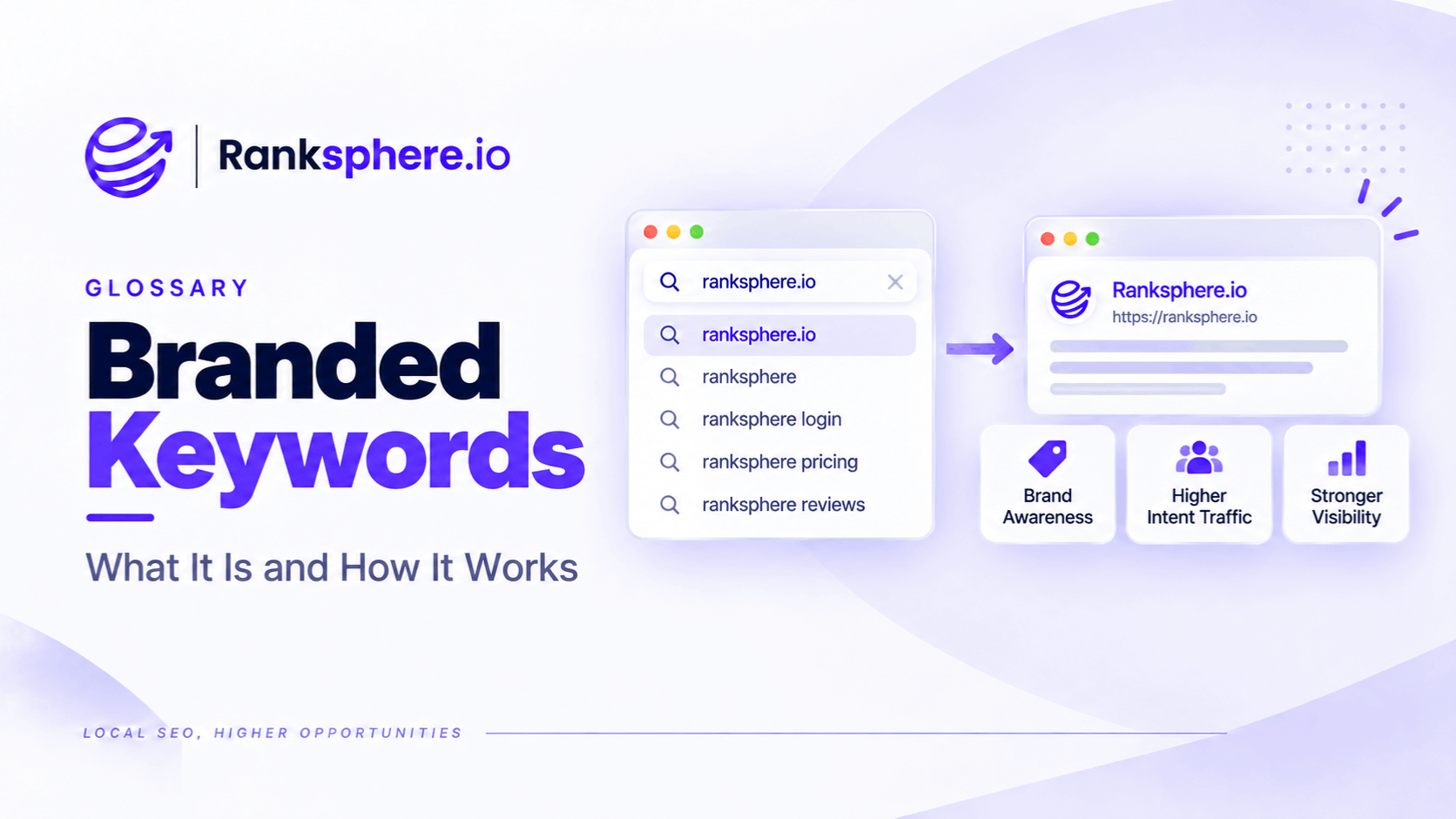
Branded keywords are search queries that contain a company's brand name, domain, product name or another term strongly associated with that business.
Non-branded keywords describe a product, service, problem or need without naming a particular brand.
For example:
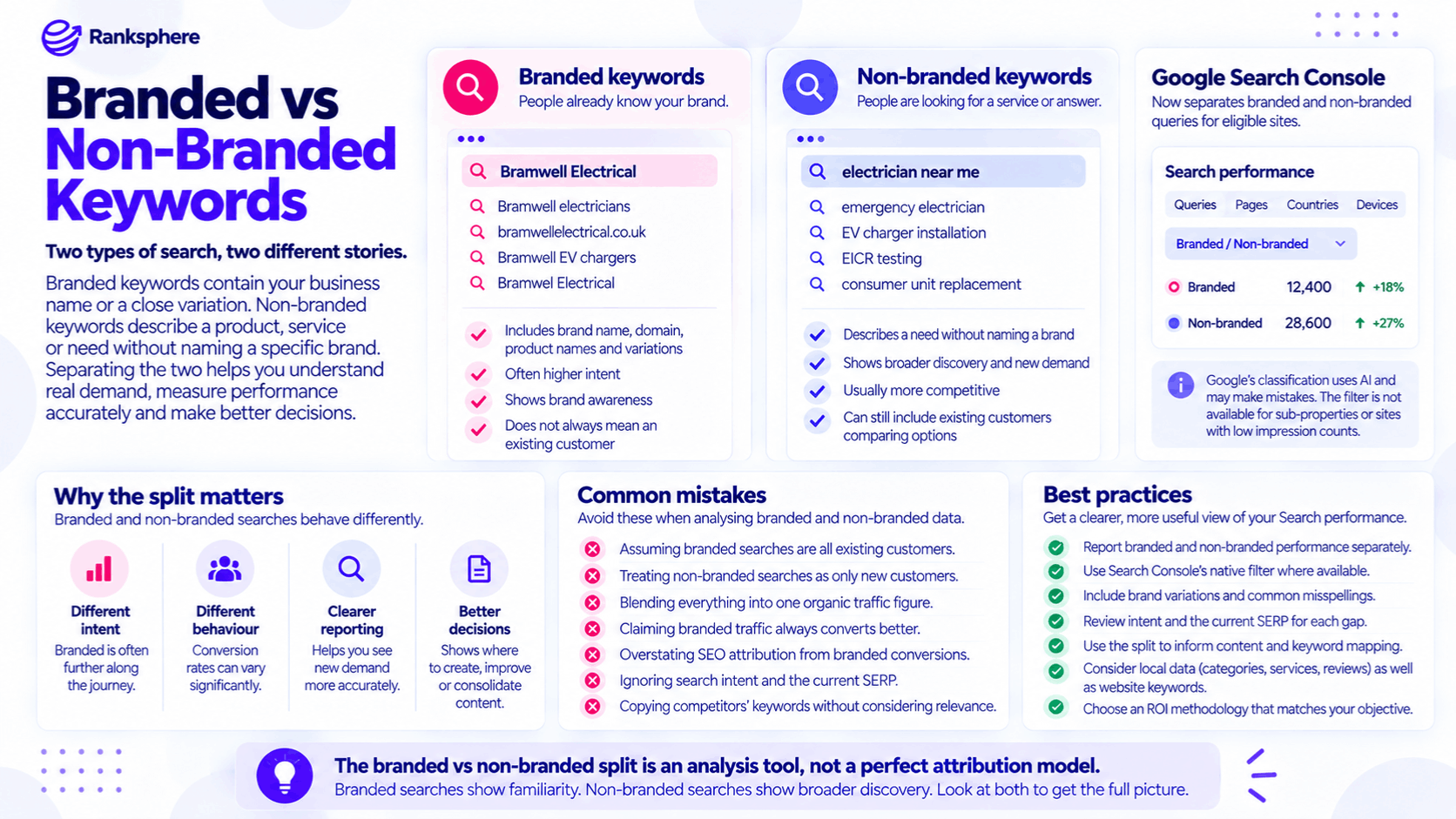
Branded
- Bramwell Electrical
- Bramwell electricians
- bramwellelectrical.co.uk
- Bramwell EV chargers
Non-branded
- electrician near me
- emergency electrician
- EV charger installation
- EICR testing
The distinction is useful because the two groups often represent different levels of brand familiarity and different types of search behaviour.
But they should not be treated as perfect attribution categories.
A branded query does not tell you how the person first discovered the business, and a non-branded query does not prove that the searcher has never heard of it before.
What is a branded keyword?
A branded keyword contains something that clearly identifies a specific business or brand.
That can include:
- Business name
- Domain
- Product name
- Service combined with the brand
- Common misspelling
- Abbreviation
- Recognisable brand variation
Google's current Search Console definition also includes brand-specific products and services, as well as common misspellings and variations.
For example, all of these could be branded:
- Bramwell Electrical
- Bramwel Electrical
- Bramwell electricians
- Bramwell emergency electrician
The exact classification depends on the brand.
What is a non-branded keyword?
A non-branded keyword does not identify a specific business.
Examples might include:
- emergency electrician Birmingham
- consumer unit replacement
- EV charger installer
- how much does an EICR cost
These searches are particularly useful when measuring how visible a business is to people searching for a service or answer rather than for the company by name.
That is why non-branded visibility is often important in SEO reporting.
Branded does not mean existing customer
This is one of the most important distinctions.
Someone searching:
Bramwell Electrical
could be:
- An existing customer
- A new customer referred by a friend
- Someone who saw the company in local press
- Someone who noticed it in Google earlier
- Someone who encountered the brand through digital PR
- Someone who saw a brand mention
- Someone responding to offline advertising
The query tells you they know the brand at the moment of that search.
It does not tell you where that awareness came from.
Non-branded does not always mean a new customer
The opposite is also true.
An existing customer may search:
dentist near me
rather than remembering the practice name.
Someone who already knows three local plumbers may still search:
emergency plumber Leeds
to compare them again.
So avoid translating:
non-branded = completely new person
too literally.
A better interpretation is:
non-branded search is less dependent on the searcher explicitly naming your brand.
Why separate branded and non-branded search?
The split helps make SEO reporting easier to interpret.
Branded and non-branded queries often behave differently in terms of:
- Search intent
- Click-through rate
- Conversion behaviour
- Ranking competition
- Customer familiarity
If all organic traffic is reported as one figure, those differences disappear.
Branded search often has stronger intent
Someone searching:
Halewood Veterinary
has already selected, remembered or encountered that business in some way.
Someone searching:
vet near me
is still choosing among options.
That can mean branded traffic often behaves differently.
But avoid saying:
“Branded always converts several times better.”
Conversion rates vary by:
- Business
- Query
- Device
- Customer journey
- Conversion definition
Measure the difference on the actual account.
Non-branded search measures broader discovery
Non-branded performance can be especially useful for understanding whether the site is becoming visible for:
- Services
- Problems
- Topics
- Commercial needs
where the user has not explicitly asked for the brand.
For example, growth for:
cat vaccination cost
may tell you more about broader search discovery than growth for:
Kelsall Veterinary vaccinations.
That makes non-branded impressions and clicks useful SEO indicators.
They are still not pure measures of SEO causation.
Search Console now separates branded and non-branded queries
Google Search Console now includes a Branded / Non-branded query filter in the Search performance report for eligible sites.
Google defines:
Branded queries as queries containing the brand name, domain, or a brand-specific product or service, including common variations and misspellings.
Non-branded queries are queries that do not contain the brand name.
Google says the feature is designed to help site owners understand brand awareness and growth opportunities.
This makes branded reporting considerably easier than it used to be.
The Search Console classification is not perfect
Google says branded-query classification is powered by AI and may misclassify queries.
That is worth remembering.
For example, a brand name may also be:
- A common word
- A place name
- Another company's product
- A person's surname
So review unusual classifications rather than assuming every automated label is correct.
The filter is not available everywhere
Google currently says the branded / non-branded filter is unavailable for:
- Sub-properties
- Sites with low numbers of impressions
The underlying data for the native filter begins from 11 March 2025.
That means older historical comparisons may still require a manual approach.
Manual branded filtering is still useful
Where the native classification is unavailable, Search Console also supports query filters and regular expressions.
You can include:
- Brand name
- Common misspellings
- Domain
- Abbreviations
in one regex.
For example:
(bramwell|bramwel|bramwell electrical)
Search Console supports RE2 regular expressions and lets you either include or exclude matching queries.
Manual filtering has limitations
Search Console omits anonymised queries from the query table.
Google also warns that applying query filters can cause filtered totals not to add cleanly back to the unfiltered total because of:
- Anonymised queries
- Data truncation
So do not present a manually calculated:
“27.84% of all organic traffic was branded”
as perfect measurement.
It is an estimate based on the query data Google exposes.
Branded search and brand awareness
Branded search can be a useful brand-awareness indicator.
Google itself describes its branded/non-branded Search Console insight as a way to better understand brand recognition and Search performance.
For example, if searches for:
Bramwell Electrical
rise steadily over a year, that may indicate that more people are aware of the business.
But it does not tell you why.
Possible contributors include:
- SEO
- Advertising
- PR
- Word of mouth
- Social media
- Offline campaigns
- Partnerships
- Customer growth
- Seasonality
Treat branded search as a signal.
Not a complete attribution model.
Do not call branded search the “closest proxy” for all awareness
That claim goes too far.
Brand awareness can also be assessed through:
- Direct research
- Surveys
- Branded impressions
- Social signals
- Direct traffic
- Referral activity
- Search demand
Each has limitations.
Branded search is useful because it represents an observable behaviour:
someone searched for the brand.
That does not mean it captures everyone who knows the brand.
Branded search and digital PR
Digital PR can create:
- Editorial coverage
- Backlinks
- Brand mentions
- Awareness
Some people exposed to that coverage may later search the brand.
If branded search rises after sustained PR work, the two may plausibly be related.
But do not write:
“Digital PR increased branded search by 20%.”
unless the measurement design genuinely supports that conclusion.
Other campaigns or market conditions may have contributed.
Branded search and zero-click visibility
Zero-click search creates a similar measurement problem.
Someone might:
- See the business in a search result
- Read enough information without clicking
- Remember the name
- Search the brand later
That journey may not appear as a straightforward referral path.
Branded search can therefore provide useful context around awareness.
But it is not proof that a particular zero-click appearance caused the later search.
Branded search and AI visibility
The same caution applies to AI-generated search experiences.
A person may encounter a brand in:
- AI Overviews
- AI Mode
- Other AI tools
and later search it directly.
That is possible.
It does not mean an increase in branded queries proves that AI exposure caused the increase.
Google currently counts AI Mode traffic in overall Search Console performance totals, and has clarified that AI Overview interactions are also logged within Search Console's Performance reporting.
So branded Search Console trends are not a clean, isolated measurement of:
AI-generated awareness.
Treat them as one piece of a wider measurement picture.
Branded search and SEO
SEO can influence branded search indirectly.
For example, someone may:
- Search a non-branded query
- Discover your guide
- Remember the company name
- Return later through a branded query
So it is too simplistic to say:
branded traffic comes from everything except SEO.
SEO can contribute to:
- Discovery
- Familiarity
- Repeat exposure
- Brand recall
At the same time, it would also be wrong to claim all later branded conversions as direct SEO acquisitions.
This is an attribution problem.
Non-branded search is not produced only by SEO
Likewise, non-branded growth does not come exclusively from SEO work.
A strong offline brand can improve behaviour on generic searches.
Advertising may cause users to recognise and choose a familiar company even when they search:
plumber near me.
Changes in:
- Demand
- Competition
- Google features
- Seasonality
can also affect non-branded impressions and clicks.
SEO reporting should distinguish contribution from proof of causation.
Branded vs non-branded conversion rates
Report the two separately where possible.
For example:
| Segment | Organic clicks | Leads | Conversion rate |
| Branded | 1,200 | 150 | 12.5% |
| Non-branded | 2,400 | 96 | 4.0% |
This hypothetical example makes the behavioural difference visible.
But do not use the numbers as a universal benchmark.
Another business may see very different rates.
Do not compare them as though they are identical audiences
A branded visitor may:
- Already trust the company
- Be returning
- Have received a recommendation
A non-branded visitor may still be:
- Comparing businesses
- Researching
- Discovering the service
So a lower non-branded conversion rate does not automatically mean the traffic is low quality.
The groups are at different stages of the decision process.
Google Business Profile search terms
Google Business Profile performance shows search terms people used when the Business Profile appeared.
Google says the search-term metric is updated monthly and reports terms associated with the profile appearing in Search or Maps.
That can provide useful local query insight.
However, the current Business Profile Performance documentation does not describe a native:
- Branded
- Non-branded
- Direct
classification.
Do not claim that this split is provided automatically by the current GBP Performance report.
Classify GBP search terms separately if needed
If you want a branded vs non-branded view of Business Profile search terms, classify the terms using:
- Brand name
- Misspellings
- Domain or recognisable brand variations
and keep the methodology consistent over time.
Ranksphere's GBP management surfaces profile search terms across locations, which can help make multi-location query analysis easier.
The classification itself should still be described accurately.
Branded and direct are not the same thing
Do not confuse:
branded search
with:
direct traffic.
Branded search means someone searched for the business on a search engine.
Direct traffic in analytics generally describes sessions for which no referring source is available or assigned.
A person can:
Google the brand → click organic result
and that is branded organic search.
It is not direct traffic.
Keep the channel concepts separate.
Branded search and SEO ROI
This is where the original draft needs the most nuance.
There is no universal rule saying:
exclude every branded conversion from SEO ROI.
Doing so may understate SEO's contribution in journeys where organic discovery later creates branded demand.
Counting every branded organic conversion as newly generated SEO revenue can overstate it in the opposite direction.
The answer depends on what the ROI calculation is intended to measure.
Option 1: Non-branded acquisition ROI
If the question is:
How much measurable acquisition did non-branded organic search produce?
then analysing non-branded conversions separately is useful.
This is deliberately conservative.
State the methodology clearly.
Option 2: Overall organic ROI
If the question is:
What value was associated with organic search overall?
then branded organic conversions may legitimately be included.
But do not describe all of that revenue as:
incremental revenue caused by SEO.
Those are different claims.
Option 3: Report both
Often the clearest presentation is:
Organic performance overall
plus:
Branded
and:
Non-branded
as separate segments.
Then explain what the business can and cannot infer from each.
That is much harder to misinterpret than forcing one number to answer every attribution question.
Existing customers complicate attribution
Suppose an existing dental patient searches:
Halewood Dental
and books a check-up.
That organic conversion is real.
But it is not necessarily a new customer acquisition generated by SEO.
If the objective is customer-acquisition ROI, existing-customer bookings may need separate treatment regardless of whether the query was branded.
The branded/non-branded split does not solve customer identity by itself.
Referrals complicate attribution too
Suppose a friend recommends:
Halewood Veterinary.
The person searches:
Halewood Veterinary
and books.
Analytics may record:
Organic Search
as the final channel.
The actual customer acquisition source was arguably:
word of mouth.
That is why channel attribution and customer acquisition are not always the same thing.
SEO can create later branded conversions
Now reverse the journey.
A user searches:
best vet for senior cats
discovers the practice organically, reads the site, leaves, then searches the brand three days later and books.
The final click is branded.
But non-branded SEO clearly played a role earlier.
If you automatically remove every branded conversion from SEO reporting, that contribution disappears.
So use segmentation rather than pretending attribution is perfectly binary.
Diagnosing branded declines
A decline in branded search deserves investigation.
Possible causes include:
- Lower brand awareness
- Reduced advertising
- Seasonality
- Lower customer demand
- Rebranding
- Search-behaviour changes
- Reporting changes
Do not automatically label it:
a reputation problem.
Check the wider evidence.
Diagnosing non-branded declines
A non-branded decline might relate to:
- Ranking losses
- Lower demand
- Competitor improvement
- Search-result changes
- Seasonality
- New SERP features
So do not immediately conclude:
SEO visibility failed.
Investigate:
- Impressions
- Positions
- CTR
- Query groups
- Search demand
separately.
SERP features can change clicks without changing demand
Suppose non-branded impressions remain stable but clicks fall.
Potential reasons include:
- AI Overviews
- Local results
- Featured results
- Other SERP changes
That is different from a visibility decline where impressions collapse.
Separate:
visibility
from:
click acquisition.
Reporting branded and non-branded search
A useful report might show:
Branded
- Impressions
- Clicks
- CTR
- Conversions
- Trend over time
Non-branded
- Impressions
- Clicks
- CTR
- Conversions
- Important query groups
Then interpret them separately.
That gives a much clearer picture than:
organic traffic increased 18%.
Lead with the metric that matches the objective
If the SEO objective is new service discovery, non-branded visibility may deserve more attention.
If the objective includes:
- Brand defence
- Reputation
- Returning customers
- Brand awareness
branded organic performance matters too.
There is no need to demote branded search to a meaningless metric.
Just avoid claiming more attribution than the data supports.
Search Console branded filtering best practice
For eligible sites, start with Google's native classification.
Google says its branded filter includes:
- Brand name
- Domain
- Brand-specific products or services
- Misspellings
- Variations
and is designed to support brand-awareness analysis.
Then review examples to make sure the classification makes sense for your business.
Use regex where the native filter is unavailable
For sites without the native filter, create a stable manual definition.
For example:
(bramwell|bramwel|bramwell electrical)
Then use the inverse to approximate non-branded query performance.
Document the expression.
Otherwise different analysts may classify the same traffic differently from month to month.
Branded filtering can undercount
Remember that Search Console hides anonymised queries from the query table.
Google says these queries are still included in chart totals but are removed from query-level reporting. Filtering by queries can therefore change the totals you can see.
Do not imply that a branded query filter captures every Google search involving the brand with perfect precision.
Brand variants matter
When manually classifying branded searches, include legitimate variants such as:
- Bramwell Electrical
- Bramwell Electric
- Bramwel Electrical
- Bramwell electricians
But do not become so broad that ordinary generic searches are accidentally classified as branded.
Review the results periodically.
Product names can also be branded
Google's native definition can include brand-specific products and services.
For some companies, users may search a proprietary product without typing the parent company name.
That can still represent brand-led demand.
This matters especially for businesses where the product brand is better known than the corporate name.
Branded impressions vs branded clicks
Do not track only branded clicks.
Branded impressions can help show how often the site appears when people search for the brand.
A change in:
impressions
and a change in:
clicks
can tell different stories.
For example:
- Impressions up, clicks flat
- Impressions flat, CTR down
- Impressions and clicks both up
Each deserves a different interpretation.
Brand search volume is not the same as Search Console impressions
Search Console impressions represent occasions when your site appeared for reported searches.
A keyword tool's:
search volume
is an estimate of total searches for a query.
They are not interchangeable.
Avoid writing:
“Search Console says our branded search volume is 3,000.”
A more accurate phrase is:
“Search Console recorded 3,000 branded impressions.”
if that is what the data shows.
Branded traffic is not automatically protected
Some companies assume they will always rank first for their own name.
That is not guaranteed.
Branded results can also include:
- Directories
- Review sites
- Social profiles
- Competitors in advertising
- News coverage
SEO still has a role in ensuring the company's own useful pages are:
- Crawlable
- Indexable
- Clearly branded
- Relevant
Branded SEO still matters.
Non-branded SEO is not the only SEO
The phrase:
“non-branded is the SEO traffic”
is too narrow.
SEO work can also improve:
- Branded result quality
- Sitelinks
- Important brand pages
- Search snippets
- Reputation visibility
The split is analytical.
It does not define what counts as SEO.
Common branded vs non-branded mistakes
- Treating every branded searcher as an existing customer.
- Treating every non-branded searcher as a completely new prospect.
- Claiming branded traffic always converts at a fixed multiple of non-branded.
- Reporting only blended organic traffic and hiding the underlying mix.
- Calling every branded conversion an SEO-generated acquisition.
- Excluding every branded conversion from SEO ROI without explaining what the calculation is intended to measure.
- Treating branded search growth as proof that SEO, PR or AI visibility caused it.
- Calling branded search a direct measure of zero-click or AI exposure.
- Claiming Google Business Profile Performance currently provides a native branded/non-branded/direct split.
- Missing common brand misspellings when classifying queries manually.
- Ignoring anonymised Search Console query data when presenting precise percentages.
- Assuming a branded decline automatically means a reputation problem.
- Assuming a non-branded decline automatically means rankings fell.
Branded vs non-branded best practices
- Report branded and non-branded Search performance separately where the data supports it.
- Use Search Console's native branded / non-branded filter on eligible properties.
- Remember that Google's automated classification can make mistakes.
- Use documented regex filters where the native classification is unavailable.
- Include genuine brand variations and misspellings.
- Treat branded search as an awareness and familiarity indicator, not a perfect attribution metric.
- Use non-branded performance to understand broader discovery without assuming every visitor is new.
- Analyse conversion rates separately rather than assuming one universal relationship.
- Do not automatically remove all branded conversions from ROI; choose a methodology that matches the question and disclose it.
- Use Google Business Profile performance search terms as local query data, but classify branded and non-branded separately if needed.
- Interpret changes alongside demand, seasonality, rankings, SERP features and other marketing activity.
- Keep branded, non-branded and overall organic performance visible rather than forcing one segment to represent the whole channel.
Example
“Consider a hypothetical veterinary practice called Halewood Veterinary.
An agency reports:
640% SEO ROI.
The practice manager asks how that figure was calculated.
The agency has counted every conversion attributed to organic search, including searches for:
Halewood Veterinary
and:
Halewood vets
as revenue generated by SEO.
That is too confident.
Some branded conversions may come from:
- Existing patients
- Friend recommendations
- Offline advertising
- Prior brand awareness
But the practice should not simply delete all branded conversions from the analysis either.
Some customers may have first discovered Halewood through non-branded organic searches before returning later through the brand name.
So the report is rebuilt.
It separates:
Searches where the brand is explicitly named.
Searches around veterinary services, needs and questions without the brand name.
The complete Search channel for context.
The agency then creates a deliberately conservative acquisition view using non-branded conversions, while reporting branded conversions separately rather than pretending they have no value.
It also tracks branded impressions as a brand-awareness indicator.
Over time, branded searches rise.
The report does not say:
“SEO caused the increase.”
Instead, it notes that several activities were happening simultaneously:
- Content
- Digital PR
- Brand mentions
- Offline referrals
The increase is therefore reported as:
a positive brand-demand trend
rather than revenue claimed exclusively by one channel.
The result is less dramatic than the original headline ROI figure.
It is also much easier to defend.
That is the value of the branded/non-branded split:
it does not tell you exactly who deserves credit for every customer. It gives you a clearer view of whether Search demand is coming from people explicitly looking for the brand, people searching more generally, or a mixture of both — so attribution and SEO performance can be discussed with far more precision.”
See also
- SEO ROI — measuring the financial return from organic search without overstating attribution
- Attribution — understanding which touchpoints contributed to a conversion
- Google Business Profile performance — local search terms and customer-interaction data
- Zero-click search — visibility that may not produce an immediate website visit
- Google Search Console — where branded and non-branded Search performance can now be analysed
- KPI — choosing metrics that match the actual business objective