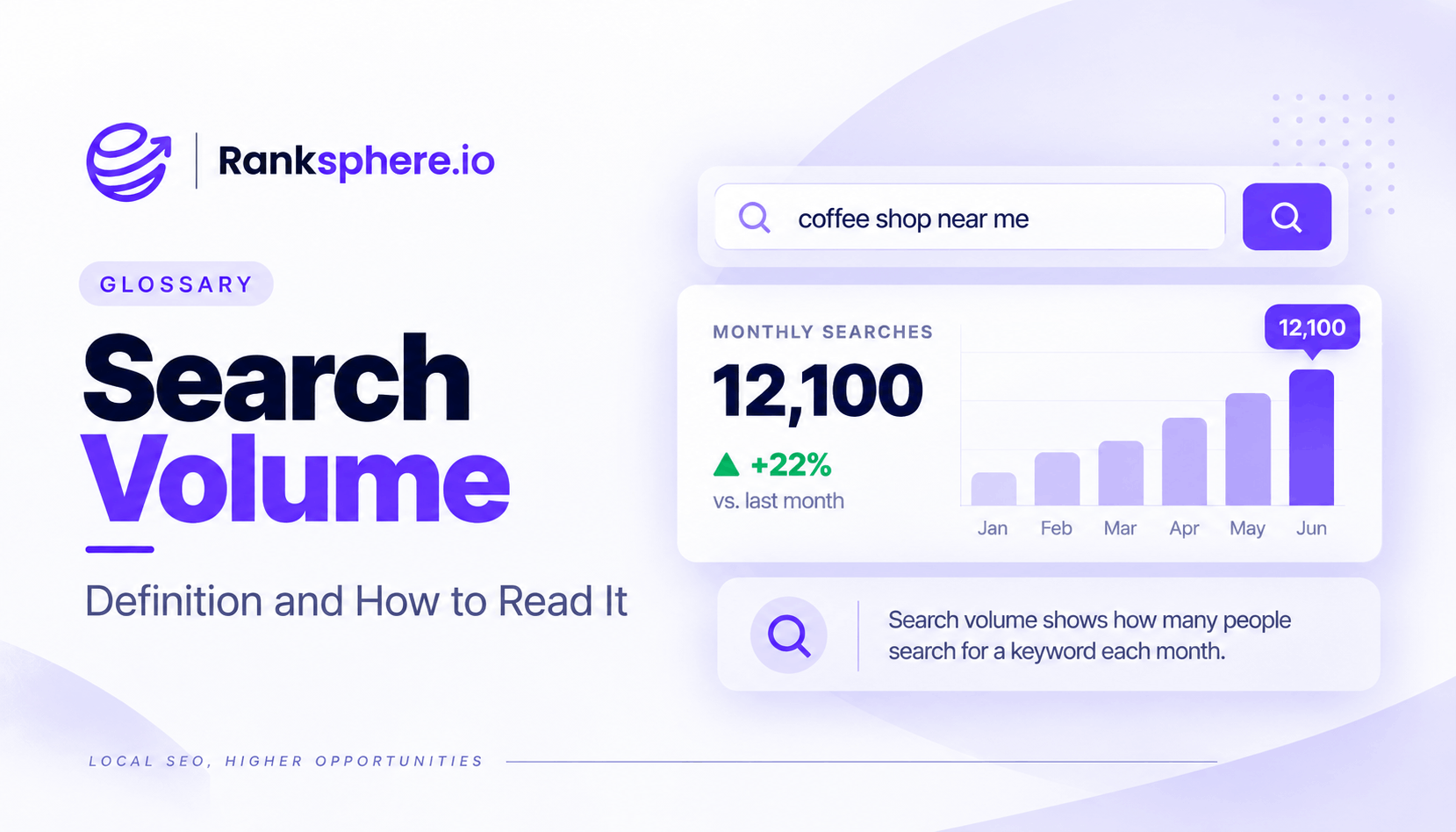
Search volume is an estimate of how often people search for a particular keyword over a given period, usually shown as an average number of searches per month.
It is one of the most commonly used metrics in keyword research, but it is also one of the easiest to misread.
Search volume is not an exact count of how many people searched a phrase. It is an estimate based on the data and methodology available to the tool you are using. The number also depends heavily on location. A keyword with thousands of searches across the UK may have relatively little demand in the town or city your business actually serves.
That makes search volume useful for comparing opportunities, but much less reliable as a prediction of how much traffic or revenue a keyword will generate.
Where search volume data comes from
Different SEO tools calculate search volume in different ways.
Google Keyword Planner is commonly used as one source of keyword demand data, while third-party SEO platforms may combine advertising data with their own modelling, historical information and other datasets.
Because the methodology differs, two tools can show noticeably different search volumes for the same keyword.
There are a few things worth keeping in mind:
- Search volume figures are estimates rather than exact query counts
- Closely related keyword variations may sometimes be grouped together
- Different SEO tools can report different numbers for the same search
- Monthly averages can hide seasonal changes
- Very specific, low-volume keywords are often harder to estimate accurately
That does not mean search volume is useless.
It simply means the metric works best as a guide. Use it to compare keywords and understand approximate demand rather than treating it as a precise traffic forecast.
How to read search volume for local SEO
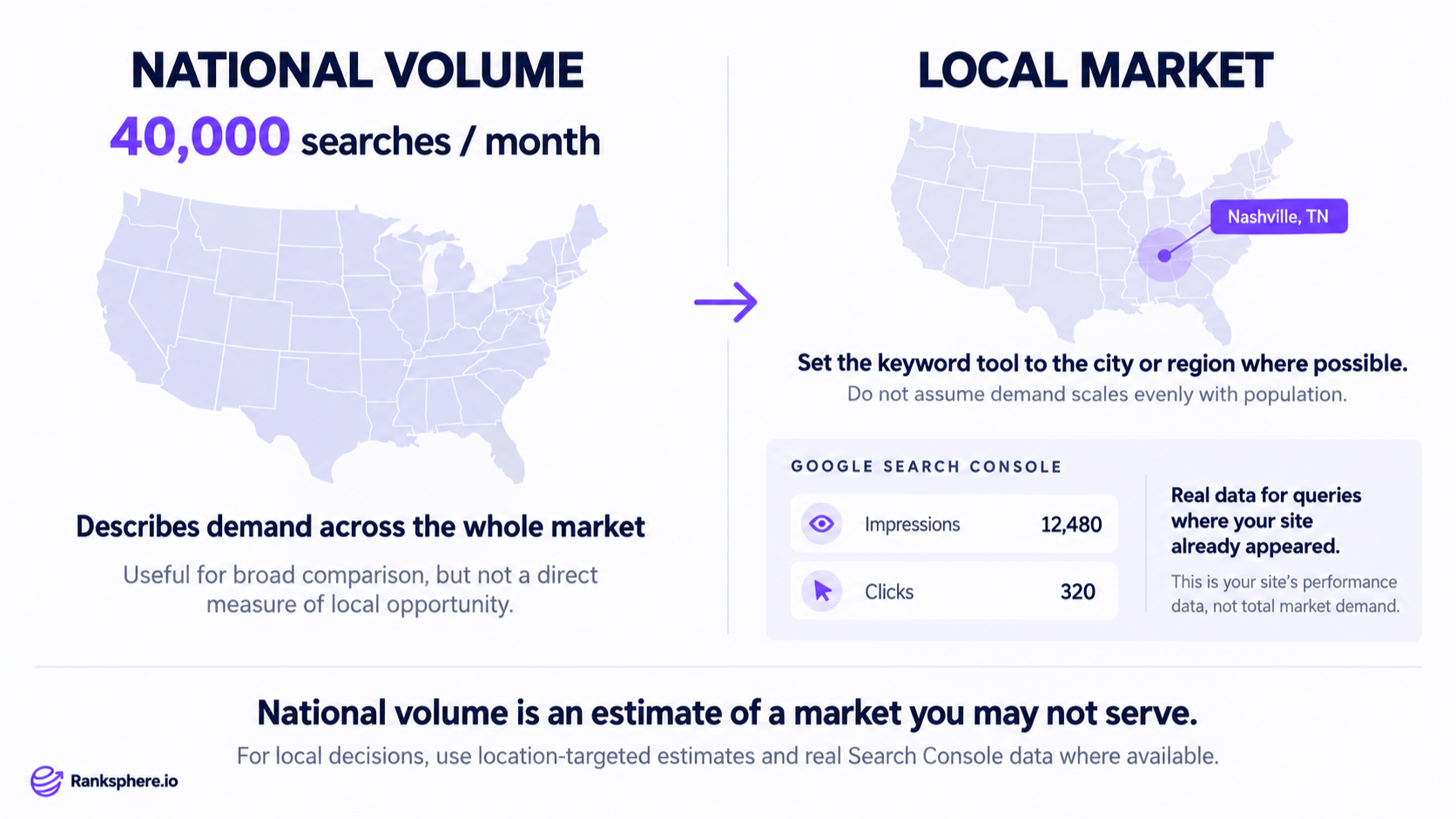
Search volume needs more context when you are doing keyword research for a local business.
A national monthly search volume tells you how much estimated demand exists across the country. It does not tell you how many potential customers are searching inside your service area.
Whenever possible, set the keyword tool to the city, region or area you actually serve.
If local targeting is not available, use the national number cautiously. Dividing it by population can provide a rough sense of scale, but search demand does not follow population evenly.
For example, demand for:
- Emergency plumbing
- Flood restoration
- Air conditioning repair
- Tourism services
- Seasonal landscaping
can vary significantly from one area to another.
For local keyword research:
- Use city or regional search volume when the tool supports it
- Treat local estimates as directional rather than exact
- Do not dismiss a keyword simply because the volume looks small
- Consider how commercially valuable each search could be
- Compare estimates with your own performance data whenever possible
For keywords where your website already appears in search, Google Search Console can provide another useful perspective.
Search Console shows the queries that generated impressions and clicks for your actual website. It will not tell you the total demand for every keyword in the market, but it can show how often your pages were seen for terms you are already appearing for.
Search volume vs search intent
A keyword with more searches is not automatically a better keyword.
Consider these two searches:
“garden ideas”
and
“garden designer near me”
The first may have much higher search volume, but the second shows much clearer commercial intent for a garden design business.
This is why search volume should always be considered alongside search intent.
Ask:
- Is the keyword relevant to the service?
- What is the person actually looking for?
- Are they likely to become a customer?
- Does the search have local intent?
- Can your website realistically satisfy the query?
A smaller keyword with strong intent can be far more valuable than a broad term that brings large amounts of irrelevant traffic.
What search volume is useful for
Search volume is useful when you want to:
- Compare several related keywords
- Estimate the relative demand for different topics
- Find broader and more specific keyword opportunities
- Identify seasonal patterns when combined with trend data
- Decide which topics may deserve more attention
- Support wider keyword research
It is especially useful when comparing keywords within the same tool, because the methodology remains more consistent.
What search volume cannot tell you
Search volume does not tell you:
- Exactly how much traffic your page will receive
- How many people will click your result
- Whether those visitors will become customers
- Whether your business can realistically rank for the term
- How valuable each enquiry will be
- What percentage of national demand exists in your local area
There are too many additional factors involved, including ranking position, click-through rate, SERP features, competition and conversion rate.
Use search volume as one input rather than the answer to the entire keyword decision.
Ranksphere's rank tracker measures position across your actual service area, helping you compare estimated keyword demand with how visible the business actually is in the locations that matter.
Search volume and seasonality
Monthly search volume is often shown as an average, which can hide large changes throughout the year.
A keyword related to Christmas services, garden maintenance, heating repairs or summer travel may have very different demand from one month to the next.
Before committing significant time to a keyword, check whether the search is seasonal.
Look at:
- Monthly search trends
- Year-on-year demand
- Seasonal peaks
- Weather-driven changes
- Industry-specific buying cycles
A keyword showing 1,000 average monthly searches may not receive anything close to 1,000 searches every month.
For businesses affected by seasonality, knowing when people search can be just as important as knowing how often.
Common search volume mistakes
- Treating search volume as an exact count. It is an estimate and should be read accordingly.
- Using national volume for a local business without context. Most of that demand may sit outside the area you can serve.
- Ignoring low-volume keywords. Specific searches can have strong commercial intent even when the numbers are small.
- Comparing numbers from different tools as if they are identical. Different platforms use different datasets and models.
- Ignoring seasonality. An average can hide large monthly swings.
- Choosing keywords based on volume alone. Relevance and intent are often more important.
- Forecasting revenue directly from search volume. Too many assumptions sit between a search and a sale.
- Rejecting a keyword because a tool reports zero volume. Very specific local searches can still occur even when tools do not have enough data to estimate them reliably.
Search volume best practices
- Use search volume as a comparison metric. It is better for judging relative demand than predicting exact results.
- Set the correct location wherever possible. Local businesses should work with local data whenever the tool provides it.
- Use one tool consistently when comparing keywords. This reduces differences caused by methodology.
- Look at intent alongside volume. A relevant commercial search is often worth more than a broad informational one.
- Check seasonal trends. Average volume alone may hide when demand actually occurs.
- Use Search Console data where available. Real impressions can add useful context to estimated demand.
- Do not ignore long-tail keywords. Lower-volume searches often reveal much clearer needs.
- Combine volume with competition and business value. A keyword should make sense commercially as well as statistically.
Example
“Fenwick Garden Design is deciding which topic to prioritise for its website.
One keyword, “garden design ideas,” has a much larger estimated search volume than “small courtyard garden design.”
At first, the higher-volume keyword looks like the obvious choice.
But the search results tell a different story.
“Garden design ideas” is broad and largely informational. Many people searching it simply want inspiration, photographs or DIY ideas.
“Small courtyard garden design” has far fewer searches, but it closely matches one of Fenwick's services and describes a specific problem the company regularly solves for customers.
The business chooses to create a detailed page around small courtyard gardens, using examples of its work, practical design considerations and a clear route to enquire.
The page does not need thousands of searches to be useful. It only needs to reach the right people.
That is the best way to use search volume: not as a target by itself, but as one piece of evidence when deciding which searches are worth pursuing.”
See also
- Keyword research, finding and evaluating the searches worth targeting
- Keyword difficulty, estimating how competitive a keyword may be
- Search intent, understanding what the searcher actually wants
- Long-tail keyword, specific searches that often have lower volume and clearer intent
- Google Search Console, query, impression and click data from your own website
- Impressions, how often your pages are shown in search results