Thin content is content that provides little useful value to the person who lands on the page.
It is not defined by word count.
A short page can be completely useful if it answers a specific question clearly. A much longer page can still be thin if it repeats obvious information, avoids answering the query or adds hundreds of words without adding substance.
That distinction matters because thin content is often confused with short content.
They are not the same thing.
A 200-word page that gives someone exactly what they need can be stronger than a 2,000-word article padded with generic explanations.
The right question is not:
“How many words does this page have?”
It is:
“Does this page give the searcher a useful reason to be here?”
What counts as thin content?
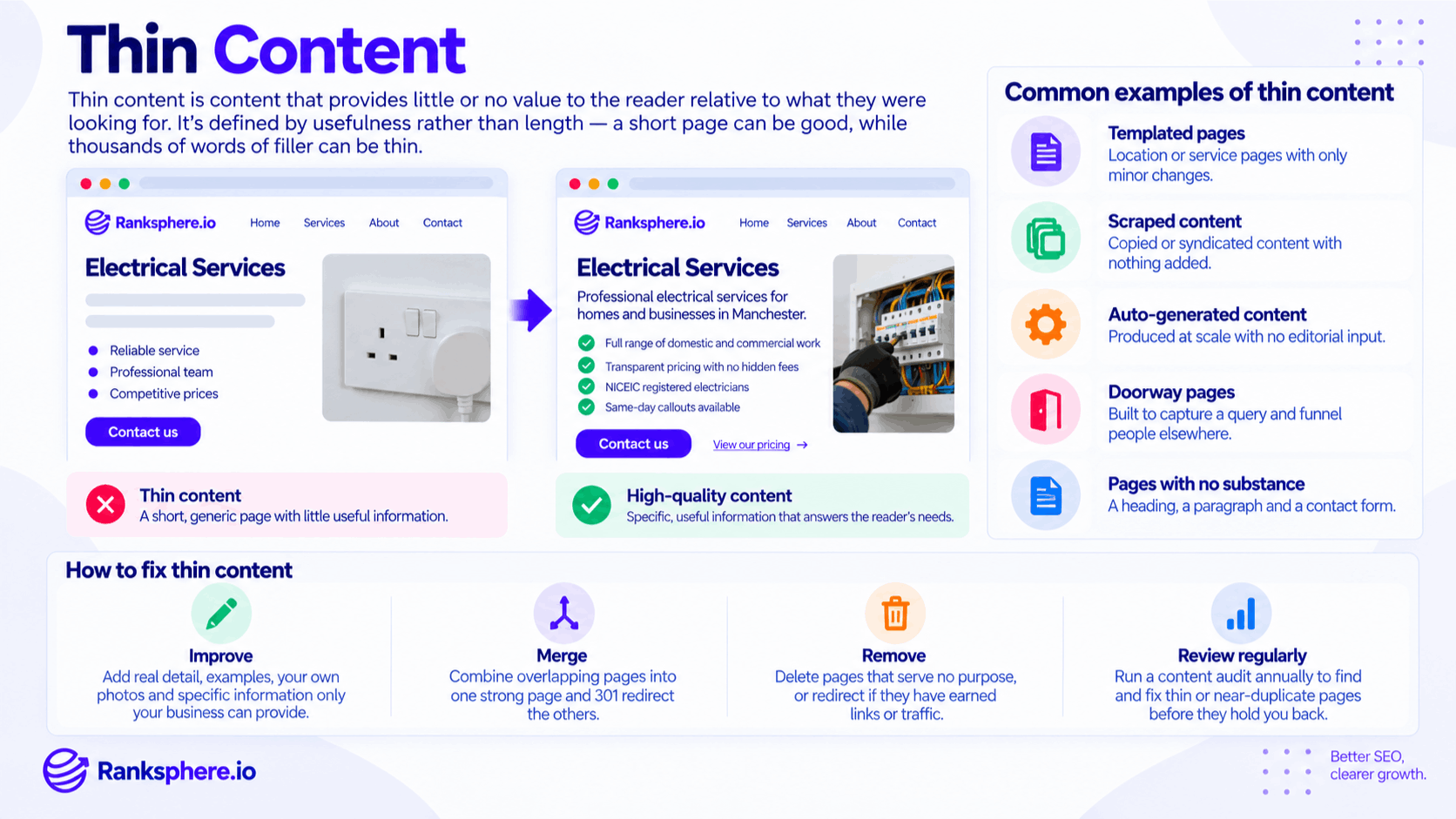
Thin content can appear in several forms.
The common thread is that the page exists without offering enough distinctive or useful information for the reader.
Pages with almost no substance
A service page might contain:
- A heading
- One short paragraph
- A generic benefits list
- A contact form
That is not automatically bad.
But if the page never explains:
- What the service involves
- Who it is for
- What problems it solves
- How the business provides it
- What someone should expect next
then it may not offer much beyond the page title.
Templated location pages
Local SEO is one of the most common places thin content appears.
For example:
Electrician in Bristol
Electrician in Bath
Electrician in Cardiff
If all three pages use exactly the same service copy with only the town name changed, the pages may technically be separate but offer little unique value.
See location pages for more on building pages with genuine local purpose.
Near-identical service pages
A company may create multiple pages for very similar services purely to target separate keywords.
For example:
- Emergency electrician
- Urgent electrician
- 24-hour electrician
- Same-day electrician
If the pages all describe essentially the same service and search intent, separate URLs may not be necessary.
Scraped or republished content
Copying information from another website without adding anything useful can create low-value pages.
The same can happen with syndicated or manufacturer content used exactly as supplied.
The issue is not simply that the text appears elsewhere.
The problem is that your page adds no meaningful reason for someone to choose it.
Automatically generated pages
Automation itself does not automatically create thin content.
The problem arises when large numbers of pages are generated without enough:
- Editorial review
- Original information
- Useful differentiation
- Human expertise
- Quality control
A page can be automatically produced and still be useful.
It can also be manually written and completely empty of value.
Judge the result, not simply the tool that created it.
Doorway-style pages
Pages created mainly to capture similar searches and funnel everyone to the same destination can become low-value.
For example, producing hundreds of nearly identical city pages when the business has no meaningful location-specific information may create more URLs without creating more usefulness.
Padded content
A page can be thin even when it is long.
If the answer requires two paragraphs and the article stretches it into 2,500 words through repetition, unnecessary definitions and vague commentary, the additional length does not make it stronger.
Useful depth is good.
Filler is not.
Affiliate and aggregation pages with little added value
A comparison page can be useful if it contains:
- Original testing
- First-hand experience
- Genuine analysis
- Useful comparisons
- Clear methodology
It becomes much weaker if it simply rewrites product descriptions or collects information available everywhere else.
Thin content is not about word count
There is no universal minimum word count for SEO.
A useful page can be:
- 150 words
- 500 words
- 2,000 words
depending on what the searcher needs.
For example:
What time does your clinic open?
may need one sentence.
What happens during dental implant treatment?
may require a much more detailed explanation.
Search intent should determine the depth.
Do not add words simply because an SEO tool says a page is too short.
Word count is an easy metric to measure.
Usefulness is harder, but usefulness is what actually matters.
Why thin content matters
Thin content can create several SEO and usability problems.
It may struggle to be indexed
Google does not automatically index every page it crawls.
A weak, repetitive or low-value page may remain unindexed, particularly when there are many similar URLs competing for the same purpose.
In Google Search Console, some thin or repetitive pages may appear as:
Crawled – currently not indexed
But that status should not automatically be interpreted as a thin-content diagnosis.
Other causes can include:
- Duplication
- Canonicalisation
- Rendering issues
- Weak internal linking
- Crawl or processing decisions
- Google simply not selecting the page for indexing yet
Treat the status as a reason to investigate rather than proof of one particular problem.
It creates weak search results
Even when a thin page is indexed, it may have little reason to perform well.
If competing pages explain the subject more clearly, provide better evidence or answer the query more completely, the thin page may struggle for visibility.
It can create duplication
Large sets of templated pages often overlap heavily.
That can lead to duplicate content, unexpected canonical selection or multiple pages competing for similar searches.
It can contribute to keyword cannibalisation
Several weak pages targeting essentially the same search intent can create keyword cannibalisation.
For example:
/emergency-electrician/
/urgent-electrician/
/24-hour-electrician/
may not need to exist separately if they all provide the same service and answer the same query.
One stronger page may be more useful than maintaining several near-identical ones.
It wastes maintenance effort
Every page creates ongoing work.
It may need:
- Updating
- Internal links
- Image maintenance
- Technical checks
- Schema
- Redirect management
Maintaining dozens of pages that provide little value can consume time that would be better spent improving the pages customers actually use.
Thin content and E-E-A-T
Thin content should not be described as simply “failing” E-E-A-T.
E-E-A-T covers broader ideas around:
- Experience
- Expertise
- Authoritativeness
- Trust
However, pages that contain very little original knowledge, evidence or useful information may struggle to demonstrate those qualities.
For example, compare:
Generic version:
Roof leaks can cause damage to your home. Our experienced team can help repair your roof quickly.
with:
Experience-led version:
On older tiled roofs in Maidstone, we often find leaks around damaged flashing rather than the tiles themselves. During an inspection, we check the flashing, underlay and surrounding fixings before recommending a repair.
The second version contains useful first-hand context.
That does not make word count the difference.
It makes specificity the difference.
Thin content and scaled content
Creating pages at scale is not automatically a problem.
The risk appears when scale is used to produce large quantities of content primarily for search visibility without providing enough value to users.
Whether pages are written manually, with automation or using AI, the important questions remain:
- Is the page useful?
- Is it accurate?
- Does it add something meaningful?
- Does it exist for a real audience?
- Has it been reviewed?
Large-scale low-value content can create serious quality and spam concerns.
For a typical local business, however, the more common problem is much simpler: too many weak service or location pages that were created because someone believed every keyword needed a separate URL.
How to find thin content
No single metric reliably identifies thin content.
You need to combine data with human review.
Review non-indexed pages
Start with Google Search Console.
Look at important URLs that remain unindexed.
Pay particular attention to groups of pages with similar templates.
But remember:
Non-indexed does not automatically mean thin.
Investigate the page before deciding.
Look for pages with almost no search visibility
Pages with no impressions over a long period may deserve review.
That does not automatically mean they are poor.
Some pages target very small audiences or serve useful non-SEO purposes.
Ask whether the page is intended to attract organic search traffic in the first place.
Crawl for low-content pages
A technical crawl can identify pages with unusually small amounts of body text.
That is useful for finding candidates.
It is not a quality verdict.
A contact page may legitimately contain very little text.
A major service page with 80 generic words may deserve much more attention.
Find near-duplicate pages
Look for groups such as:
- Location pages
- Service variations
- Product variants
- Category pages
Read several side by side.
If only the town, service name or product changes, you may have a templating problem rather than genuinely distinct pages.
Check internal linking
Pages with few or no incoming links may also be worth reviewing.
Sometimes the reason a page receives little search visibility is that the website itself barely acknowledges it.
See orphan pages and internal linking when investigating these cases.
Read the page yourself
This is still one of the most important checks.
Ask:
If I searched for this topic and landed here, would I be satisfied?
Tools can count words.
They cannot reliably decide whether those words are useful.
Ranksphere's website audit surfaces thin and near-duplicate pages, helping narrow down the URLs that deserve closer human review.
How to improve thin content
The answer is not always “write more.”
First decide what the page actually needs.
Add useful specifics
Generic copy becomes stronger when you add information the business genuinely knows.
That can include:
- Real pricing ranges
- Project examples
- Original photographs
- Timescales
- Areas covered
- Common customer questions
- Materials used
- Limitations
- What happens during the service
- Who carries out the work
The goal is not to make the page longer.
It is to make it more useful.
Add first-hand experience
For local businesses, original experience is often the easiest way to differentiate a page.
For example:
Instead of:
Blocked drains can have many causes.
you might explain:
In older terraced properties we often find recurring blockages caused by cracked clay pipes or tree roots entering the joints.
That is useful because it comes from actual work rather than generic research.
Answer the questions customers actually ask
Customer questions are often better content prompts than keyword tools.
What do people ask:
- Before booking?
- On the phone?
- During quotes?
- After the job?
- When something goes wrong?
Those questions can help turn a generic page into something genuinely useful.
Improve, merge or remove
Thin pages generally have three sensible outcomes.
Improve
Improve the page when:
- The topic has real demand
- The page serves a distinct search intent
- You have useful information to add
- The URL has a genuine role on the site
Do not improve it by adding filler.
Add substance.
Merge
Several weak pages may work better as one stronger page.
For example:
- Boiler servicing costs
- Boiler servicing prices
- Cost of annual boiler servicing
may not require three separate URLs.
If they serve the same intent, one comprehensive page may be clearer.
When consolidating permanently, use an appropriate 301 redirect from retired URLs to the relevant surviving page.
Remove
Some pages simply do not need to exist.
If a page has:
- No useful purpose
- No meaningful traffic
- No valuable links
- No unique intent
- No sensible replacement
removing it may be the cleanest option.
A proper 404 is acceptable when content is genuinely gone and no relevant replacement exists.
Do not redirect every deleted page to the homepage.
Should every thin page be improved?
No.
This is an important part of content maintenance.
If a website has 40 weak pages, turning all 40 into slightly longer weak pages is not necessarily progress.
You may get better results by:
- Improving 10 properly
- Merging 15
- Removing 15
The website becomes smaller but stronger.
That is often a better outcome than preserving every URL simply because someone created it years ago.
Thin location pages
Location pages deserve particular scrutiny.
A page should not exist simply because:
Service + Town
has search volume.
If you create separate pages for several towns, ask what makes each one genuinely different.
Useful local information could include:
- Neighbourhoods served
- Real projects
- Original photographs
- Travel or response information
- Local property types
- Location-specific services
- Customer examples
- Genuine pricing differences
If none of that exists, a broader service-area page may be more useful than dozens of nearly identical local pages.
Thin service pages
The same principle applies to services.
Suppose an electrical company has separate pages for:
- Fault finding
- Electrical diagnostics
- Electrical troubleshooting
- Electrical fault diagnosis
If all four describe the same service, separate pages may create more confusion than value.
Think in terms of customer intent rather than individual keywords.
One strong page can target several related phrases naturally.
Thin content vs duplicate content
Thin content and duplicate content often appear together, but they are different problems.
Thin content lacks useful depth or value.
Duplicate content substantially repeats content available elsewhere.
A page can be:
- Thin but unique
- Detailed but duplicated
- Both thin and duplicated
- Neither
The solution depends on which problem actually exists.
Do not automatically rewrite a duplicate page when the better answer is consolidation.
Thin content vs short content
A short page can be perfectly good.
For example, a page answering:
What documents should I bring to my dental appointment?
may need only a short list.
Adding 1,500 words about the history of dentistry would make the page worse.
Length should follow the question.
Good content stops when the reader has what they need.
Common thin content mistakes
- Using word count as the definition. Short does not mean thin.
- Padding pages to reach an arbitrary target. More words do not automatically mean more value.
- Rewriting templated pages without changing their substance.
- Creating separate pages for every keyword variation.
- Assuming every “Crawled – currently not indexed” URL has a content-quality problem.
- Keeping pages purely because they already exist.
- Deleting pages without checking links, traffic or replacements first.
- Generating more content to solve a content-quality problem.
- Adding generic FAQs purely to make the page longer.
- Assuming automation automatically creates thin content. Quality depends on the finished result.
Thin content best practices
- Judge pages by usefulness rather than length.
- Write for a clear search intent.
- Add specific information rather than generic filler.
- Use first-hand experience where relevant.
- Show original examples and photographs where possible.
- Consolidate overlapping pages.
- Remove pages that have no meaningful purpose.
- Use redirects when retired URLs have a relevant replacement.
- Review non-indexed pages individually rather than assuming one cause.
- Prioritise fewer useful pages over large numbers of repetitive ones.
- Review content regularly through a content audit.
Example
“Fenwick Electrical has built 34 separate service pages over several years.
Most contain roughly the same structure:
- A heading
- A short generic introduction
- Three benefits
- A contact form
Some cover genuinely different services.
Others differ only slightly.
Search Console shows that many of the URLs receive little visibility, and several remain unindexed.
At first, the owner assumes the site has a technical indexing problem.
A closer review finds that the bigger issue is the content structure.
Several pages target almost the same intent, while others provide little more than a service name and a sales paragraph.
Instead of adding another few hundred generic words to every page, the company restructures the section.
The 34 pages are reduced to nine core services.
Each surviving page is rebuilt using information the business can genuinely provide:
- Typical job types
- Real photographs
- Pricing guidance where appropriate
- Common customer questions
- Expected timescales
- Examples from completed work
- Clear explanations of what the service includes
Retired URLs with a relevant replacement are redirected to the appropriate surviving page.
The result is a smaller service section, but every page has a clearer purpose.
That is the right way to approach thin content: do not ask how to make every page longer. Ask whether each page deserves to exist, and if it does, give the reader something genuinely useful when they arrive.”
See also
- E-E-A-T — experience, expertise, authoritativeness and trust
- Content audit — systematically reviewing existing content
- Duplicate content — when substantially similar content exists at multiple URLs
- Indexing — whether a page becomes eligible to appear in search
- Location page — a common source of repetitive local content
- Keyword cannibalisation — when multiple pages compete for the same search intent