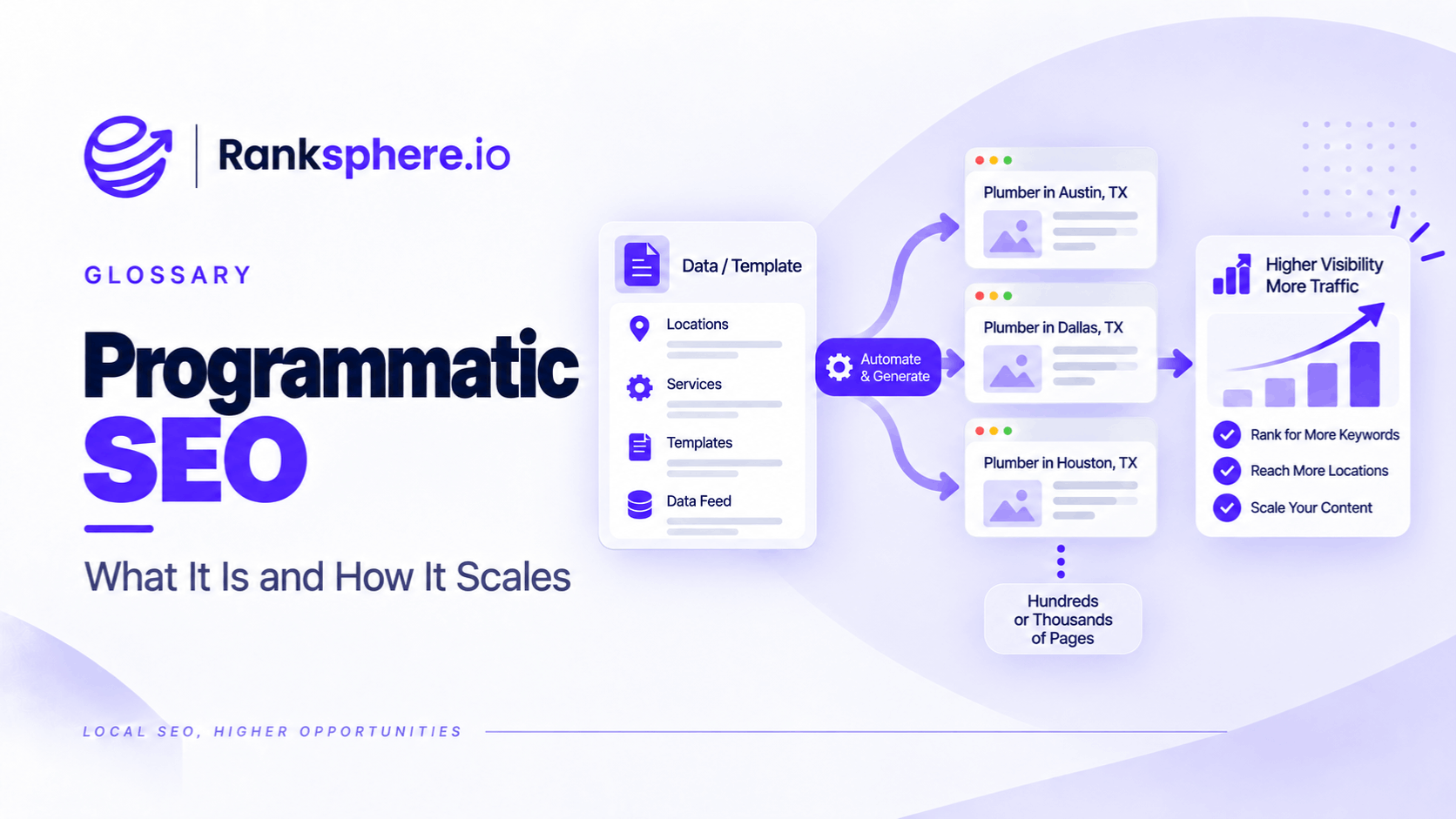
Programmatic SEO is the practice of creating pages at scale from structured data and reusable templates.
Instead of writing every page manually, a system combines:
- A repeatable page structure
- A structured data source
- Variables that genuinely differ between pages
The method can work extremely well when each URL answers a distinct need.
It can also create hundreds or thousands of nearly interchangeable pages when the only meaningful difference is a:
- City name
- Product name
- Keyword variation
The important question is not:
Was this page generated automatically?
It is:
Does this page provide enough unique value to deserve its own URL?
Automation is simply the production method.
The quality and purpose of the resulting pages are what matter.
What is programmatic SEO?
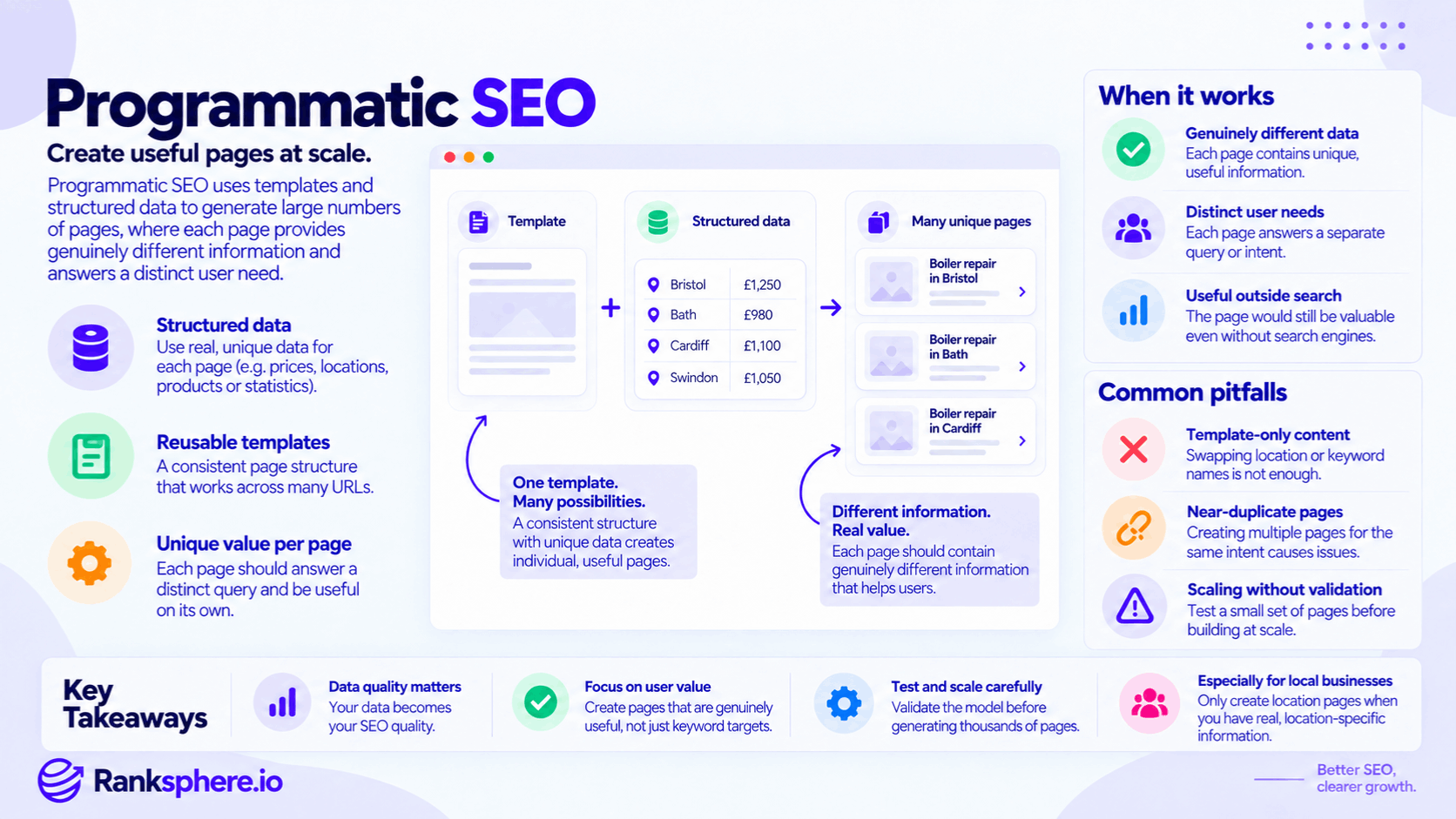
Programmatic SEO uses structured data and templates to create search-focused pages efficiently at scale.
A simple model looks like:
Template + unique data = individual page
For example, a property platform might use the same structural template for thousands of postcode pages while changing:
- Average sale price
- Number of transactions
- Property types
- Local schools
- Market trends
The page structure repeats.
The underlying information does not.
That distinction is what makes scalable publishing potentially useful rather than repetitive.
Programmatic SEO does not mean low-quality content
Programmatic SEO is sometimes treated as a synonym for:
mass-generated SEO pages
but the two are not necessarily the same.
Automation can be used to build genuinely useful resources.
For example:
- Property databases
- Travel platforms
- Ecommerce catalogues
- Software directories
- Financial comparison tools
- Statistical reference sites
Many websites naturally contain thousands or millions of pages because the underlying data genuinely differs.
Scale itself is not the problem.
The problem begins when scale creates URLs with little reason to exist independently.
When programmatic SEO works
Programmatic SEO is strongest when the underlying data is the main source of page value.
Good candidates usually have three characteristics:
- Each page answers a meaningfully different query.
- Each page contains genuinely different information.
- The page would still be useful if search engines did not exist.
That third question is particularly useful.
Ask:
Would somebody benefit from landing directly on this page?
If the answer is yes, the page may have a legitimate purpose.
Property pages
A property website could create individual pages for:
- Postcodes
- Neighbourhoods
- Property types
if each page contains genuine information such as:
- Actual sales data
- Price trends
- Transaction volumes
- Property characteristics
- Local amenities
The page is useful because the data changes.
It is not simply:
Homes in Bristol
copied into:
Homes in Bath
with the place name replaced.
Flight and travel pages
A travel platform might create pages for individual routes.
For example:
Manchester to Barcelona
could contain:
- Airlines
- Typical journey times
- Current route availability
- Schedule information
- Fare data
while:
Manchester to Rome
contains genuinely different information.
The template stays similar because the user need is similar.
The answer changes because the data changes.
Conversion and calculator pages
Programmatic publishing can work particularly well when every page produces a mathematically distinct answer.
For example:
- Measurement conversions
- Currency calculations
- Finance calculators
The layout may be almost identical across thousands of URLs.
But each page performs a different calculation.
That gives each page a distinct purpose.
Integration directories
A software company might create pages such as:
Slack + CRM integration
Xero + CRM integration
Shopify + CRM integration
if each page explains:
- Different configuration
- Different capabilities
- Different limitations
- Different workflows
Again, the value is not the swapped product name.
The integration itself is genuinely different.
When programmatic SEO fails
The weakest form of programmatic SEO uses a template as though the template itself were enough content.
For example:
We provide professional plumbing services in Bristol. Our experienced plumbers serve customers throughout Bristol and provide reliable plumbing solutions in Bristol.
Then the same page is generated for:
- Bath
- Cardiff
- Swindon
- Gloucester
- Newport
Nothing meaningful changes.
That is not useful geographic content.
It is a template with a location variable.
Service-by-location pages
This is one of the most common programmatic SEO ideas proposed to local businesses.
A company has:
12 services
and:
20 towns
so someone proposes:
12 × 20 = 240 landing pages
For example:
- Boiler repair Bristol
- Boiler repair Bath
- Boiler repair Weston-super-Mare
- Boiler installation Bristol
- Boiler installation Bath
and so on.
The mathematics looks efficient.
The content problem is much harder.
Does the business genuinely have enough distinctive information to justify 240 separate URLs?
Often, it does not.
Location swapping is not localisation
Replacing:
Bristol
with:
Bath
does not create meaningful local content.
A genuine location page might contain relevant information such as:
- Real work completed in that area
- Genuine customer examples
- Location-specific service considerations
- Branch information where there is a real branch
- Accurate coverage information
The location name should correspond with real differences.
Otherwise, the page exists primarily because the keyword exists.
Keyword-variation pages
Another common failure is creating separate pages for:
- Emergency plumber
- Emergency plumbing
- Emergency plumbing service
- Emergency plumber service
when all four searches have essentially the same intent.
Those variations may belong on one strong page.
Creating a separate URL for every phrasing can lead to:
- Repetitive content
- Unnecessary site complexity
- Keyword cannibalisation
Search intent should determine page structure.
Not the number of keyword variations in a spreadsheet.
Programmatic SEO and thin content
Poorly designed programmatic pages can result in thin content.
Thin content is not defined by:
- Low word count
- Templates
- Automation
It is content that provides insufficient value for its purpose.
A 300-word data page can be extremely useful.
A 2,000-word templated city page can still provide very little value.
Judge the usefulness of the page, not its length.
Programmatic SEO and duplicate content
Programmatic websites can also create large amounts of duplicate content.
Duplicate content is not automatically a Google penalty.
Search engines regularly encounter similar and duplicated pages across the web.
The practical issue is whether multiple URLs provide essentially the same answer.
If they do, Google may:
- Cluster them
- Choose one version
- Ignore some URLs
That can make the site unnecessarily complicated.
The solution is usually better information architecture and consolidation rather than trying to make every page artificially different.
Google's position on scaled content
Google's spam policies address scaled content abuse.
The important issue is not whether the content was created with:
- AI
- Scripts
- Freelancers
- In-house writers
The concern is creating many pages primarily to manipulate search rankings rather than help people.
That distinction matters.
Automation itself is not the violation.
Low-value scale designed mainly for search manipulation is the problem.
Human-written scaled content can still be poor
A company could hire 100 writers to manually produce 10,000 nearly identical pages.
The fact that humans wrote them does not automatically make them useful.
Likewise, software can generate pages from accurate, valuable structured data that serve users extremely well.
The production method does not determine quality by itself.
AI and programmatic SEO
AI can be used within a programmatic workflow.
For example, it might help with:
- Formatting data
- Creating initial summaries
- Organising page sections
- Editorial review
But allowing a model to generate slightly different paragraphs for thousands of otherwise identical pages does not solve the underlying problem.
If 500 pages have no distinct reason to exist, adding unique-sounding prose does not suddenly create 500 useful pages.
Use AI to improve a valid content system.
Do not use it to disguise duplication.
Programmatic SEO and indexing
Large programmatic sets often expose indexing problems.
Search Console may show URLs as:
Crawled – currently not indexed
But that status should not be interpreted as:
Google confirmed this page is thin.
Several factors can influence indexing.
A page may be:
- Low value
- Similar to other pages
- Newly discovered
- Poorly linked
- Affected by broader indexing decisions
Investigate the pattern before deciding what the status means.
See indexing for the wider process.
Crawled – currently not indexed is not a quality score
This deserves emphasis.
Search Console indexing labels are diagnostic statuses.
They are not editorial reviews from Google saying:
This content is bad.
If 900 out of 1,000 programmatic pages remain unindexed, that is certainly worth investigating.
But do not diagnose the cause from the label alone.
Look at:
- Page usefulness
- Internal linking
- Similarity
- Canonicalisation
- Search demand
- Site structure
before deciding what to change.
Should every programmatic page be indexed?
Not necessarily.
Some sites create useful URLs that do not need to appear in search.
For example:
- Filter states
- Internal tools
- User-specific combinations
The first question should be:
Should this URL be searchable?
Only then ask:
Why isn't Google indexing it?
Not every URL on a website needs to compete in search.
Why programmatic SEO is difficult for local businesses
Programmatic SEO is not inherently unsuitable for local companies.
The problem is that many local businesses do not possess enough location-specific data to support large-scale page generation.
A local plumbing company may have:
- 12 services
- 30 target towns
but that does not automatically mean it has:
360 distinct search experiences
worth publishing.
Without unique information, the resulting pages tend to become repeated sales copy.
Programmatic pages do not manufacture proximity
Creating a page titled:
Plumber in Leeds
does not move the business physically closer to someone in Leeds.
Google's local results broadly involve factors such as:
- Relevance
- Distance
- Prominence
as discussed in local ranking factors.
A location page may help with:
- Organic search
- Customer information
- Explaining genuine service coverage
but it cannot manufacture physical proximity in the local pack.
Local organic search is different from the local pack
This distinction matters.
A service-area company may struggle to appear in the local pack far from its real location.
That does not mean a useful location-specific page can never perform organically.
Local organic results and local-pack results are different search surfaces.
A good location strategy should understand both.
When local programmatic SEO can work
There are cases where a local or multi-location company genuinely has structured location data.
For example, a national healthcare organisation may have hundreds of real clinics.
Each location may have unique:
- Address
- Opening hours
- Staff
- Services
- Accessibility information
- Booking options
That can justify scalable location pages.
This is closer to multi-location SEO than generating artificial service-area pages for towns where no distinct location exists.
Genuine branches can justify scale
Imagine a retailer with:
400 stores.
Creating 400 store pages programmatically can be perfectly reasonable because each store is a distinct real-world entity.
Every page may contain:
- Address
- Phone
- Hours
- Available services
- Facilities
- Directions
The template repeats.
The entity does not.
That is exactly the kind of problem templates are good at solving.
Service-area businesses need more restraint
A plumber covering 40 towns is different from a retailer with 40 branches.
The plumber does not have:
40 physical locations.
Creating 40 near-identical location pages can therefore become much harder to justify.
Use location pages when you have enough useful information to serve someone specifically interested in that area.
For broader coverage, a service-area page may be enough.
There is no fixed number of location pages
Do not replace:
240 pages is too many
with:
five pages is correct.
There is no universal limit.
A company might legitimately justify:
- Three location pages
- Fifteen location pages
- Several hundred branch pages
The correct number is the number for which there is a genuine user need and enough distinct information to support the page.
Start with real data
The safest programmatic SEO projects begin with a dataset.
Not a keyword spreadsheet.
Ask:
What unique information do we already have?
For example:
- Property records
- Product inventory
- Branch information
- Prices
- Integrations
- Route schedules
- Statistics
Then ask what useful pages that data can support.
Starting from keywords alone often encourages page creation where no underlying value exists.
One page should answer one distinct need
Before generating a URL, ask:
What does this page answer that its sibling pages do not?
If the answer is merely:
the city name is different
that may not be enough.
If the answer is:
this page contains different availability, pricing, local data and relevant examples
the case is much stronger.
Templates are not the enemy
Templates are useful.
They provide:
- Consistency
- Scalability
- Easier maintenance
- Predictable UX
The problem is not having a repeated structure.
Most ecommerce product pages use templates.
Most hotel websites use templates.
The question is whether the template is displaying valuable unique information.
Add editorial content when it improves the page
Structured data may be enough for some page types.
Others benefit from editorial context.
For example, a property-data page may also explain:
- What changed in the local market
- Which property types dominate
- How recent trends compare
Do not add 500 words purely to satisfy an imaginary content-length requirement.
Add narrative only when it helps someone interpret the data.
Internal linking matters at scale
A programmatic site needs clear internal linking.
Thousands of pages that can only be reached through:
- XML sitemap
- Internal search
may be difficult for users and search engines to navigate.
Create logical structures such as:
Country → Region → City → Individual page
where that reflects the information hierarchy.
Pages should belong somewhere meaningful within the site.
Avoid orphan programmatic pages
If each generated page has no meaningful internal links, you may end up with a large collection of orphaned or nearly orphaned URLs.
Consider:
- Parent pages
- Related pages
- Breadcrumbs
- Relevant cross-links
Internal linking should reflect relationships in the data.
Do not connect random pages simply to increase link counts.
Control URL generation
One danger of programmatic systems is producing URLs faster than anyone can review them.
For example, combinations of:
- Location
- Service
- Filter
- Feature
can create millions of possible URLs.
Decide intentionally:
- Which combinations deserve URLs
- Which should be indexable
- Which should remain filters or application states
Do not allow every database combination to become a search landing page automatically.
Test before scaling
A pilot is one of the most useful safeguards.
Instead of immediately creating:
10,000 pages
publish:
50 or 100 representative pages
first.
Then evaluate:
- Crawlability
- Indexation
- Rankings
- User engagement
- Maintenance burden
The exact pilot size depends on the project.
The principle is:
validate the model before multiplying it.
Do not judge the pilot by indexing alone
A page being indexed does not prove the strategy is successful.
Likewise, temporary non-indexing does not necessarily prove failure.
Evaluate:
- Whether the pages answer real searches
- Whether they receive impressions
- Whether users engage
- Whether they contribute to business goals
Indexing is a prerequisite for organic visibility.
It is not the final KPI.
Scale gradually
If the pilot demonstrates that the model is useful and manageable, increase the set progressively.
This provides opportunities to catch:
- Template problems
- Data errors
- Duplicate combinations
- Internal-linking issues
before they affect thousands of URLs.
Data quality becomes SEO quality
Programmatic SEO depends heavily on the underlying data.
If the data is:
- Incomplete
- Duplicated
- Outdated
- Incorrect
the generated pages will inherit those problems.
At scale, one bad database field can create an error on thousands of pages.
Programmatic SEO therefore needs strong data governance, not only content templates.
Maintenance is part of the project
Do not build a scalable page system without asking:
How will this information stay current?
A page may contain:
- Prices
- Stock
- Location information
- Schedules
If those fields change, the programmatic system should update reliably.
The advantage of structured content is that one data update can potentially correct many pages.
That only works if the data pipeline itself is maintained.
Do not automatically prune unindexed pages
An unindexed URL is not automatically dead weight.
Before deleting it, ask:
- Should this page be indexed?
- Does it serve users?
- Is there genuine search demand?
- Is it too similar to another page?
- Is there a technical problem?
- Is the page properly linked?
Possible actions could include:
- Improve
- Consolidate
- Canonicalise
- Noindex
- Remove
The right action depends on why the page exists.
Remove pages that genuinely have no purpose
Programmatic systems do sometimes create useless URLs.
If a page:
- Serves no real user need
- Duplicates another page
- Has no meaningful data
- Should never have been generated
then removing or consolidating it can make sense.
The criterion should be usefulness and site architecture.
Not simply:
Google didn't index it.
Programmatic SEO and content pruning
At scale, periodic content review becomes important.
Look for:
- Empty data pages
- Broken combinations
- Obsolete locations
- Duplicate variants
- Pages generated from insufficient data
Good programmatic SEO systems should have rules that prevent weak URLs being generated in the first place.
Prevention is easier than deleting 100,000 pages later.
Use minimum data thresholds carefully
One way to control quality is to require certain data before creating a page.
For example:
A neighbourhood property page might only be generated when there are enough transactions to provide useful information.
This prevents pages that effectively say:
No data available.
But do not use arbitrary thresholds simply for SEO.
The threshold should correspond to whether the page can provide useful information.
Canonicalisation is not a substitute for bad architecture
If thousands of programmatic URLs represent essentially the same content, adding canonical tags afterwards is not necessarily the ideal solution.
A better question is:
Why are these URLs being created at all?
Canonicalisation can help manage legitimate duplication.
It should not be the design strategy for an uncontrolled URL explosion.
Programmatic SEO and sitemaps
Large scalable sites often benefit from well-organised XML sitemaps.
For example, separate sitemaps might cover:
- Products
- Locations
- Integrations
This can make monitoring easier.
But submitting a page in an XML sitemap does not guarantee indexing.
The page still needs to justify its existence.
Programmatic SEO metrics
Useful measurements may include:
- Valid indexable URLs
- Indexed pages
- Search impressions
- Organic clicks
- Conversions
- Revenue
Also monitor quality at the template level.
If one page type consistently:
- Receives no impressions
- Creates duplicate content
- Generates no business value
the issue may be the template strategy rather than the individual URLs.
Ranksphere and programmatic SEO audits
Ranksphere's website audit surfaces thin and near-duplicate pages across a site, helping identify patterns within large page sets that may require investigation.
That is particularly useful with programmatic content because the real problem often appears at scale.
One page may look acceptable in isolation.
Two thousand pages built from the same weak template reveal the structural issue.
Common programmatic SEO mistakes
- Starting with a keyword spreadsheet rather than a useful dataset.
- Assuming more URLs automatically create more search visibility.
- Creating service-by-location matrices with no genuine local differentiation.
- Generating separate pages for minor keyword variations with the same intent.
- Treating automation itself as the SEO problem.
- Using AI to disguise near-identical pages rather than create genuine value.
- Interpreting “Crawled – currently not indexed” as a formal thin-content verdict.
- Deleting every page Google does not index.
- Assuming duplicate content automatically causes a penalty.
- Building an entire page set before testing the concept.
- Scaling based only on indexation rather than useful search performance.
- Publishing pages that have no meaningful internal links.
- Allowing every possible filter combination to generate an indexable URL.
- Ignoring maintenance and data quality.
- Creating local pages in an attempt to manufacture physical proximity.
Programmatic SEO best practices
- Start with genuinely differentiating structured data.
- Make sure each generated page serves a distinct user need.
- Use templates as presentation systems, not as substitutes for information.
- Create separate pages according to search intent, not every keyword variation.
- Set clear rules for which data combinations deserve URLs.
- Build a small representative pilot before scaling.
- Evaluate indexation, search performance and user value together.
- Use logical internal linking and site hierarchy.
- Monitor page quality at the template level.
- Keep the underlying data accurate and maintainable.
- Investigate unindexed pages before deciding whether to improve, consolidate or remove them.
- Avoid creating local landing pages unless there is genuine location-specific value.
- Prefer a smaller useful page set over a large collection created solely for keyword coverage.
Programmatic SEO for local businesses
For most small local businesses, programmatic SEO should be approached cautiously.
Not because automation is bad.
Because the underlying business often does not have enough structured location-specific data to justify hundreds of pages.
A service company may be better served by:
- Strong service pages
- Useful location pages where genuine local differentiation exists
- One clear service-area page for broader coverage
than by automatically combining every service with every nearby town.
The right architecture depends on the business.
Programmatic SEO for multi-location businesses
Programmatic SEO becomes much more natural when there are genuine physical locations at scale.
A multi-location company may have:
- Hundreds of branches
- Distinct addresses
- Different hours
- Different services
- Location-specific facilities
In that case, templates can make it practical to create and maintain accurate branch pages.
See multi-location SEO for the wider strategy.
Example
“An agency proposes a programmatic SEO project for Halstow Plumbing.
The company provides:
12 services
across:
24 towns
The initial proposal is:
288 location-service pages.
Before building the entire set, the agency tests one small group.
Several pilot pages are created for one service across different towns.
The structure is almost identical.
The main differences are:
- Town name
- Title
- A few local phrases
Search Console later shows weak indexing and very little search activity across most of the test set.
That does not prove the indexing status itself means:
thin content.
Instead, the agency reviews the pages and reaches the more important conclusion:
there is very little reason for these URLs to exist independently.
The full 288-page build is abandoned.
The site's structure is redesigned around what the company can genuinely support.
It creates:
- Strong service pages
- A smaller number of useful location pages for areas where the company has substantial real-world experience and useful local information
- A broader service-area page explaining the remaining coverage
The location pages include genuine material such as:
- Completed jobs
- Original photographs
- Area-specific examples
rather than simply swapping place names inside the same template.
The smaller site is easier to:
- Maintain
- Navigate
- Internally link
- Keep accurate
The lesson is not:
programmatic SEO does not work for plumbers.
It is:
scale only works when the information scales with it.
If you have 288 genuinely distinct answers, automation can be an efficient way to publish them.
If you have one answer repeated 288 times, automation simply creates the same weak page faster.
That is the real test of programmatic SEO.”
See also
- Thin content — pages that provide insufficient value for their purpose
- Duplicate content — substantially similar content appearing across multiple URLs
- Location page — useful geographic content for genuine local needs
- Indexing — how search engines decide whether pages enter the searchable index
- Content marketing — creating useful content without relying primarily on automated scale
- Multi-location SEO — where scalable location publishing may be genuinely justified