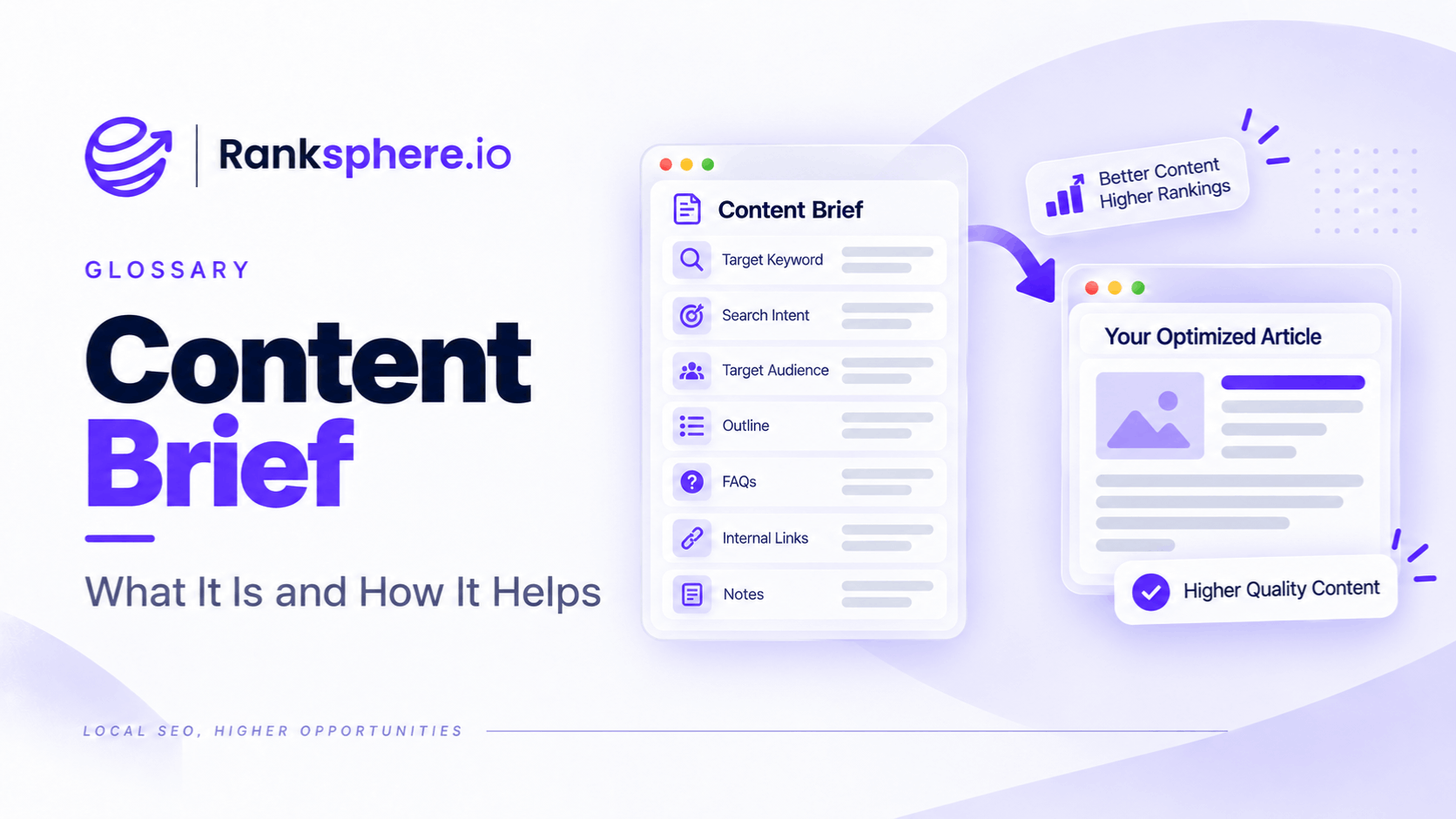
A content brief is a working document that defines what a piece of content needs to accomplish before the writing starts.
It can set out:
- The target search query
- The intended audience
- Search intent
- The questions the page should answer
- Recommended structure
- Important facts and examples
- Internal links
- The page's commercial or informational purpose
A good brief gives the writer enough direction to create the right page without trying to write the page for them.
That distinction matters.
A brief that says:
“Write 1,500 words about dental implants and use this keyword eight times”
is not much of a brief.
It defines an output.
It does not define the job the content needs to do.
What is a content brief?
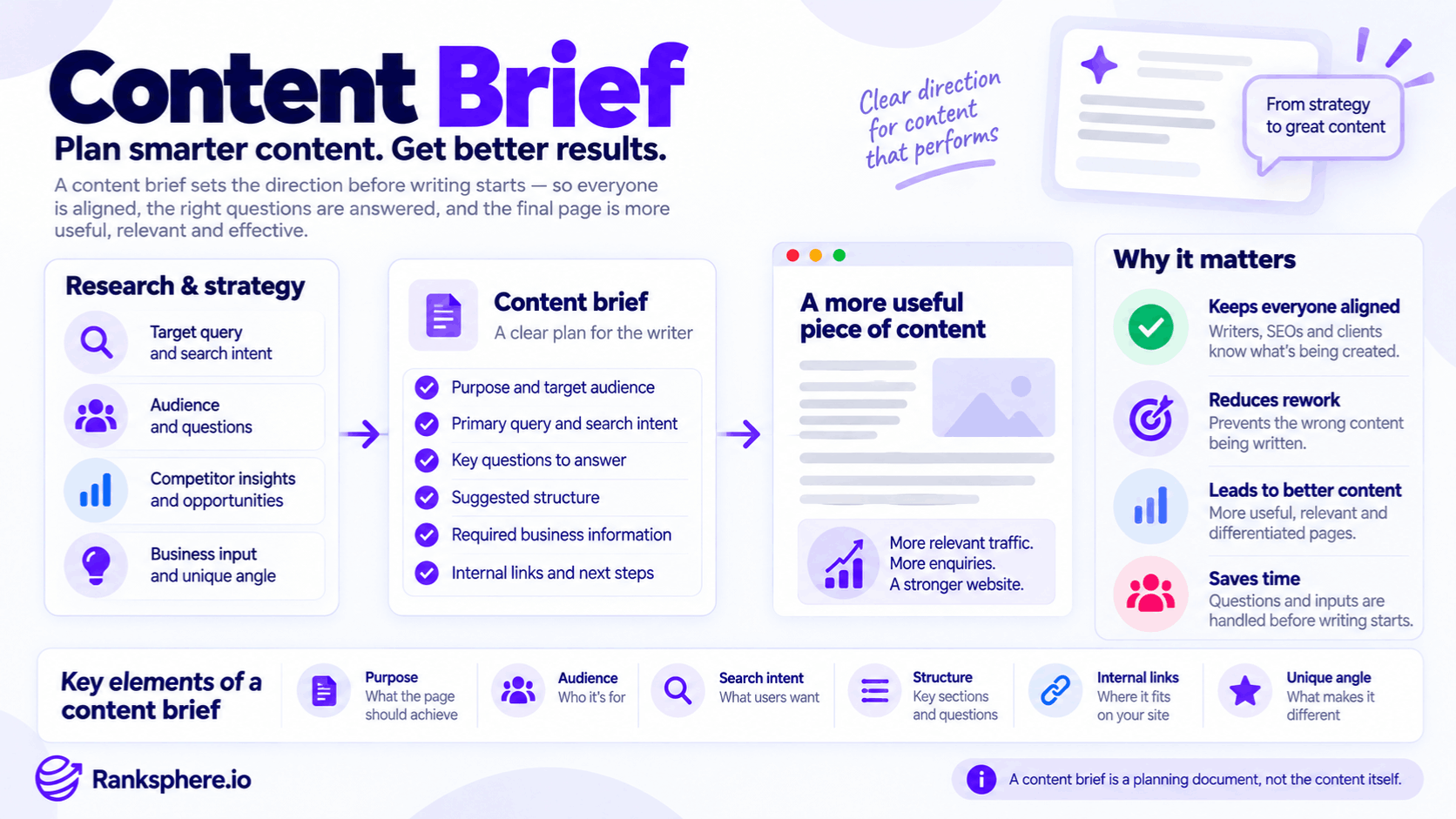
A content brief translates research and strategy into instructions a writer can actually use.
Before drafting begins, it should answer questions such as:
Who is this page for?
What are they trying to find out?
What should they understand by the end?
What should this page cover?
What information must come from the business?
Where does this page fit within the rest of the website?
The purpose is alignment.
The SEO specialist, writer, subject-matter expert and client should have broadly the same understanding of what is being created before anyone spends hours writing it.
Why content briefs matter
Content problems are much easier to prevent before writing begins than after a full draft exists.
Without a clear brief, a writer may produce a perfectly readable article that:
- Targets the wrong search intent
- Duplicates another page
- Misses important customer questions
- Uses generic examples
- Has no clear next step
- Fails to connect with commercial pages
The writing may be good.
The page can still be strategically wrong.
A strong brief reduces that risk.
A content brief is not just an SEO document
Although content briefs are often associated with SEO, they should not exist only for search engines.
They also help coordinate:
- Marketing
- Sales
- Subject-matter experts
- Designers
- Editors
For example, a brief may reveal before writing starts that the page needs:
- Original photographs
- Current pricing
- A technical explanation from an engineer
- A quote from the dentist performing the procedure
That work can then happen in parallel rather than being discovered after the first draft.
Start with the purpose of the page
Before choosing headings or keywords, define why the page needs to exist.
For example:
Purpose: Help homeowners understand whether their roof needs repairing or replacing and guide people who need professional help towards the roof-replacement service page.
That is much more useful than:
Topic: Roof replacement.
The writer now understands both:
- The information need
- The business purpose
Define the target audience
Who is the page actually for?
For example:
First-time homeowners who have noticed roof damage and are unsure whether repair is still worthwhile.
That can influence:
- Language
- Level of detail
- Examples
- Calls to action
A page written for a homeowner should not read like a technical document written for roofing contractors.
Target query
A content brief should normally identify the primary search query or topic the page is intended to address.
For example:
Primary query: How much do dental implants cost?
Related searches might include:
- Dental implant cost
- Cost of a dental implant
- How much is one dental implant?
- Dental implant prices
These are not necessarily separate keywords that need to appear repeatedly.
They help define the language and intent surrounding the subject.
Do not brief every keyword separately
Search engines can understand closely related wording.
You usually do not need separate instructions such as:
Use “dental implant cost” five times
Use “cost of dental implants” four times
Use “dental implant prices” three times
That encourages unnatural writing.
The brief should define the topic clearly enough that appropriate language appears naturally.
Keyword density is not a useful target
There is no useful Google-recommended keyword density such as:
1.5%
or:
use the keyword once every 100 words.
Content briefs should not prescribe arbitrary repetition.
Use the primary terminology where it helps clarify:
- The title
- Main heading
- Relevant subheadings
- Body copy
Then write naturally.
Search intent
Search intent should be one of the most important fields in the brief.
Ask:
What is the person searching this query actually trying to accomplish?
Depending on the query, the intent might be primarily:
- Informational
- Commercial investigation
- Transactional
- Navigational
Sometimes the intent is mixed.
The point is not to force every query into a rigid label.
It is to understand what kind of page would genuinely satisfy it.
Check the search results
Search the target query before briefing the page.
Look at what Google currently returns.
Pay attention to:
- Page types
- Search-result features
- Common questions
- Level of commercial intent
- Videos
- Local results
- Forums
- Product results
This helps you understand the current search environment.
But do not turn the first ten results into an instruction to copy them.
Competitors are evidence.
They are not the brief.
Search results can reveal the right format
Suppose you search:
how long does a roof last
and the results are dominated by detailed educational guides.
That suggests a guide may be appropriate.
Now search:
roof replacement Bristol
and the results are largely commercial service pages.
That probably needs a different page.
The keyword may determine the subject.
Intent helps determine the format.
What currently ranks
A useful brief can include notes about relevant competing pages.
For example:
| Observation | What it suggests |
| Most results explain lifespan by material | Include material differences |
| Few show real project examples | Opportunity for first-hand examples |
| Prices are rarely discussed | Consider adding useful cost context |
| Several results use comparison tables | A table may help users scan |
This is more useful than:
Competitor average length: 2,237 words. Write 2,500.
Word count is not the benchmark
A page should be long enough to answer the question properly.
No longer.
Competitor length can help reveal how complex a subject is, but it is not an SEO requirement.
If the searcher's question can be answered properly in:
900 words
do not stretch it to:
2,000
because competitors are longer.
Likewise, do not force a complex subject into 800 words because someone put that number in the brief.
Questions the page should answer
One of the most useful sections of a content brief is a clear question list.
Sources can include:
- People Also Ask
- Search Console
- Customer calls
- Sales teams
- Support teams
- Reviews
- Competitor content
For example, a dental implant brief might include:
- How much does one dental implant cost?
- What is included in the price?
- Why do prices vary?
- Are implants available on finance?
- How long do dental implants last?
- Is the procedure painful?
These questions give the writer genuine coverage requirements.
People Also Ask is a research source, not the outline
People Also Ask can reveal related questions.
But do not automatically copy every PAA question into the article.
Some may be:
- Only loosely related
- Duplicative
- Better answered elsewhere
Use judgement.
The brief should include the questions that genuinely help fulfil the page's purpose.
Customer questions can be more valuable
For local businesses especially, some of the strongest questions come from:
- Reception
- Phone calls
- Enquiry forms
- Sales conversations
If customers ask:
Can I drive after a dental implant?
every week, that may matter more than a question a keyword tool suggests.
Actual customer language can make the content far more relevant.
Suggested structure
A content brief can recommend the page structure.
For example:
Dental Implant Cost
How much do dental implants cost?
What is included in the price?
What affects the cost?
Single implant vs multiple implants
Finance options
Is a cheaper implant always better?
Getting an accurate quotation
The structure gives the writer a logical route through the topic.
It should not dictate every sentence.
Structure should follow the reader's journey
Good heading order often follows the questions someone naturally asks.
For example:
- What is it?
- How much does it cost?
- Why does the price vary?
- What is included?
- Is it right for me?
- What happens next?
That usually produces a better article than arranging headings according to keyword volume.
Define the angle
The angle explains how the page will be especially useful.
That might be:
- First-hand data
- Original pricing
- Expert commentary
- A local perspective
- Original photographs
- A clearer explanation
- Real case studies
For example:
Angle: Competitor guides talk about national averages. This page will use the practice's actual current implant pricing and explain exactly what is included.
Now the writer knows what makes the page different.
Differentiation does not need to be theatrical
Every article does not need a revolutionary new idea.
Sometimes the improvement is simply:
- Better evidence
- Clearer explanation
- More useful examples
- More current information
- Genuine first-hand experience
A page can cover an established topic and still deserve to exist.
The aim is to add value, not novelty for novelty's sake.
Required business information
For local-business content, this is often one of the most important sections.
The writer may need the business to supply:
- Current prices
- Service process
- Qualifications
- Photographs
- Real examples
- Warranty details
- Opening information
- Local experience
If those details are not supplied, the writer has only generic information to work with.
Generic inputs tend to produce generic content.
Assign responsibility
Do not write:
Add real job examples
and leave it there.
Specify:
Required from client: three recent flat-roof projects, including location, problem, repair method and photographs.
If there is a deadline, include it.
This turns:
we should probably get some examples
into an actual task.
First-hand information
A strong local content brief should deliberately look for things competitors cannot easily reproduce.
For example:
- Customer questions
- Actual jobs
- Internal data
- Real prices
- Mistakes the business regularly sees
- Original images
That makes the eventual content more useful and less interchangeable.
Local information
If the content is intended to be genuinely local, define what local information belongs in it.
For example:
Include examples of drainage problems the company frequently sees on properties built on clay soil in this area.
That is useful localisation.
This is not:
Mention Bristol seven times.
Local relevance should come from genuine local knowledge, not location-name repetition.
Internal links
Specify relevant internal links in the brief.
For example:
Link to: Dental implant service page Context: When explaining who implants are suitable for
Link to: Nervous patient page Context: When discussing anxiety around treatment
This helps the writer place links naturally.
Suggested anchor text
A brief can suggest anchor wording, but it should not make the prose rigid.
For example:
Possible anchor:
dental implant treatment
is more useful than insisting every writer use exactly:
best dental implant treatment London
Internal anchor text should describe the destination naturally.
Inbound internal links
A more complete brief can also identify pages that should link to the new content after publication.
For example:
A new guide to:
dental implant costs
might deserve links from:
- Implant service page
- Finance page
- Related implant guides
This prevents the new page from becoming isolated.
External sources
If the page requires factual evidence, the brief can specify acceptable source types.
For example:
- Government sources
- Regulators
- Professional bodies
- Primary research
- Manufacturer documentation
This is particularly useful for:
- Medical
- Financial
- Legal
- Technical content
Do not leave writers to find the first statistic that appears in Google.
Fact-checking requirements
Some pages need a formal review before publication.
A medical brief, for example, might include:
Clinical review required by: Dr Jane Smith
That can reduce factual errors.
The need for review should be decided by:
- Topic
- Risk
- Expertise required
not simply because SEO best practice supposedly requires every page to display credentials.
Author and reviewer
Where appropriate, include:
- Author
- Reviewer
- Relevant expertise
This can be particularly useful for subjects where expertise materially affects trust.
See E-E-A-T for the wider concept.
But do not invent author credentials merely to create the appearance of expertise.
Page type
Specify what is actually being built.
For example:
Page type: Informational guide
or:
Page type: Commercial service page
or:
Page type: Comparison page
This prevents situations where the strategy requires a service page and the writer produces a generic blog article.
URL recommendation
Where useful, the brief can include the proposed URL.
For example:
/dental-implants/cost/
This helps avoid:
- Unnecessarily long URLs
- Keyword-stuffed slugs
- Duplicate page creation
It also makes it easier to check whether a similar URL already exists.
Existing-page check
Before briefing a new page, ask:
Do we already have content targeting this intent?
If yes, the correct action may be:
- Refresh
- Expand
- Consolidate
rather than publish another URL.
This simple step can prevent unnecessary keyword cannibalisation.
Title and H1 guidance
The brief can include a suggested:
- SEO title
- H1
but these should remain working recommendations rather than immovable requirements.
For example:
Suggested H1: How Much Do Dental Implants Cost?
The editor can refine it after the article is written.
Meta description
A draft meta description can also be included where useful.
But it should not consume disproportionate briefing time.
Google may rewrite snippets based on the query.
The page content itself matters more.
Calls to action
Specify what the reader should be able to do next.
For example:
Primary CTA: Book an implant consultation
Secondary CTA: Read the full implant treatment guide
The CTA should match the page's intent.
A person researching:
how long does a dental implant last
may not need:
BOOK NOW
after every section.
Success criteria
A strong content brief can define what success will eventually look like.
Depending on the page, that may include:
- Relevant search visibility
- Qualified organic traffic
- Enquiries
- Internal assisted journeys
- Backlinks
This makes it easier to evaluate the content later.
Avoid defining success solely as:
Rank #1.
Rankings depend on many things outside the writer's control.
Length guidance
If you provide length guidance, treat it as a range or editorial expectation.
For example:
Likely length: 1,200–1,800 words, but cover the subject fully rather than writing to the count.
Even that may be unnecessary for experienced writers.
Length should follow the information requirement.
Not the other way around.
What should not be in a content brief?
Avoid instructions that create worse writing without providing useful strategic direction.
Keyword-density targets
Do not say:
Primary keyword density: 2%.
There is no useful Google target that makes this worthwhile.
It encourages repetitive copy.
Fixed keyword counts
Avoid:
Mention “dental implant cost” 12 times.
The writer should use the phrase where it naturally fits.
Search relevance is not built by hitting an arbitrary repetition quota.
Arbitrary word counts
Avoid:
Exactly 2,000 words.
Unless the word count exists for a genuine editorial reason, it should not be treated as an SEO objective.
Every competitor heading
Do not combine the headings from the top ten search results into one enormous outline.
That often creates bloated content.
Competitor research should help reveal important themes.
It should not produce a Frankenstein article containing everything anybody else mentioned.
Do not over-brief
A content brief should provide constraints without removing the writer's judgement.
If every paragraph has already been prescribed, you may as well write the article yourself.
The writer still needs room to:
- Explain
- Reorder
- Clarify
- Make editorial decisions
The brief defines the destination.
It does not need to dictate every step.
Content briefs for local SEO
Briefs can be especially useful for local businesses because the most valuable information often sits inside the business rather than online.
An external writer probably does not know:
- What customers ask every day
- What jobs typically cost
- What mistakes the team frequently sees
- What work was completed recently
- Which services create the best enquiries
If none of that information reaches the brief, the writer usually has to rely on generic research.
That is how genuinely experienced businesses end up publishing content that sounds like it could belong to anybody.
Brief the evidence, not just the topic
Compare these two instructions.
Weak
Write about resin driveway costs.
Better
Explain resin driveway costs for homeowners. The company must provide its current installation range, three recent projects showing area and size, and the three factors that most often cause quotations to increase.
The second instruction gives the writer something original to work with.
Content briefs and E-E-A-T
For appropriate topics, the brief should plan how genuine E-E-A-T signals will appear naturally.
That might include:
- First-hand experience
- Qualified expert review
- Original photography
- Reliable sources
Do not treat E-E-A-T as a checklist or direct score.
The goal is credible content.
Content briefs and topic clusters
If the page belongs within a topic cluster, note that in the brief.
For example:
Pillar topic
Dental implants
Current brief
Dental implant cost
Related pages
- Implant recovery
- Who can have implants?
- Implant maintenance
This helps prevent overlap and improves internal linking.
Content briefs and keyword research
Keyword research can help identify:
- Query language
- Related topics
- Search demand
- Questions
But the brief should translate that research into a page strategy.
Dumping a spreadsheet of 200 keywords into the writer's brief is not strategy.
The writer needs to know:
which search need this particular page is supposed to solve.
Content briefs and content marketing
Briefs sit between strategy and production.
Content marketing might identify:
pricing transparency
as an important subject.
The content brief turns that into:
Create a practical guide explaining what a flat roof replacement costs, why quotes vary, what is included and when repair may be more economical.
The strategy identifies the opportunity.
The brief defines the deliverable.
Ranksphere and content prioritisation
Ranksphere's smart tasks turn audit findings into a prioritised queue, helping teams decide which content problems deserve attention before briefs are created.
That can prevent a common content-marketing problem:
producing pages simply because they appeared on an old editorial calendar while more important site issues remain unresolved.
A practical content brief structure
A usable brief might contain:
Page purpose
What should this page accomplish?
Audience
Who is it for?
Primary query
What search need does it target?
Search intent
What does the user appear to want?
Page type
Guide, service page, comparison, category page or another format.
SERP observations
What does the current result page tell us?
Questions to answer
What does the reader need to know?
Suggested structure
What is the logical order?
Angle
What will make this especially useful?
Required business input
What facts, examples or assets must be supplied?
Sources
Which references should be used?
Internal links
Where should the page connect within the site?
Author or reviewer
Where subject expertise genuinely matters.
CTA
What should the reader do next?
Length guidance
Only where useful, and never as a rigid SEO target.
Common content brief mistakes
- Briefing a broad topic instead of defining the actual page purpose.
- Ignoring search intent.
- Creating the outline without checking the current search results.
- Copying competitor structures instead of learning from them.
- Using competitor word count as an SEO target.
- Providing a keyword spreadsheet instead of a clear primary search need.
- Setting keyword-density targets.
- Prescribing exact keyword repetitions.
- Leaving out genuine business-specific information.
- Failing to assign who supplies examples, prices and photographs.
- Creating a new page without checking whether an existing page already serves the intent.
- Forgetting internal links.
- Using an outline so rigid that the writer has no room to improve it.
- Assuming every article needs a named expert purely for SEO.
- Failing to define what the page should help the reader do next.
Content brief best practices
- Define the purpose before choosing headings.
- Identify the target audience.
- Check search intent before writing.
- Review the live SERP instead of relying only on keyword tools.
- Use competing pages as research, not templates.
- List the questions the page genuinely needs to answer.
- Provide a logical suggested structure without prescribing the finished prose.
- Identify useful differentiation where possible.
- Specify original information the business needs to provide.
- Assign responsibility and deadlines for those inputs.
- Include appropriate internal links.
- Check for existing content targeting the same intent.
- Include trustworthy sources and review requirements where the subject demands them.
- Use word counts as loose editorial guidance, not ranking targets.
- Define a sensible next step for the reader.
Example
“An agency sends a writer this brief:
“1,500 words on dental implants for Wexham Dental. Use ‘dental implants’ eight times.”
The writer produces a competent article.
It explains:
- What implants are
- How they work
- Their advantages
Nothing is technically terrible.
The problem is that it could belong to almost any dental practice.
It contains:
- No current practice pricing
- No original examples
- No named practitioner
- No patient-specific insight
Worse, the team never established what search intent the page was supposed to target.
The page ends up somewhere between:
service page
and:
general educational article
without doing either job particularly well.
The brief is rebuilt.
This time it specifies:
How much do dental implants cost?
Primarily informational with strong commercial investigation.
Help prospective patients understand implant pricing before deciding whether to book a consultation.
- How much does one implant cost?
- What is included?
- Why does pricing vary?
- Are finance options available?
- What can increase the final price?
- Current price range
- What the quoted price includes
- Three real case examples
- Original photographs where consent allows
- Name and qualifications of the implant clinician
- Implant treatment page
- Finance information
- Nervous patient page
Competitor pages discuss pricing vaguely. Wexham can explain its real pricing structure and what patients receive for that price.
The writer is not told:
how many times to repeat a keyword.
They are given better information.
The resulting page is more specific, more useful and much harder for another practice to reproduce.
That is what a content brief should do.
It should remove strategic ambiguity before writing starts, while leaving enough room for the writer to produce something clear, useful and genuinely worth publishing.”
See also
- Search intent — understanding what the target audience actually wants from the query
- Content marketing — the wider strategy content briefs help execute
- People Also Ask — one source of related customer questions
- Topic cluster — how individual briefs can fit into a wider content structure
- E-E-A-T — why genuine experience and relevant expertise may need to be planned into the content
- Keyword research — identifying the search language and opportunities a brief turns into a page