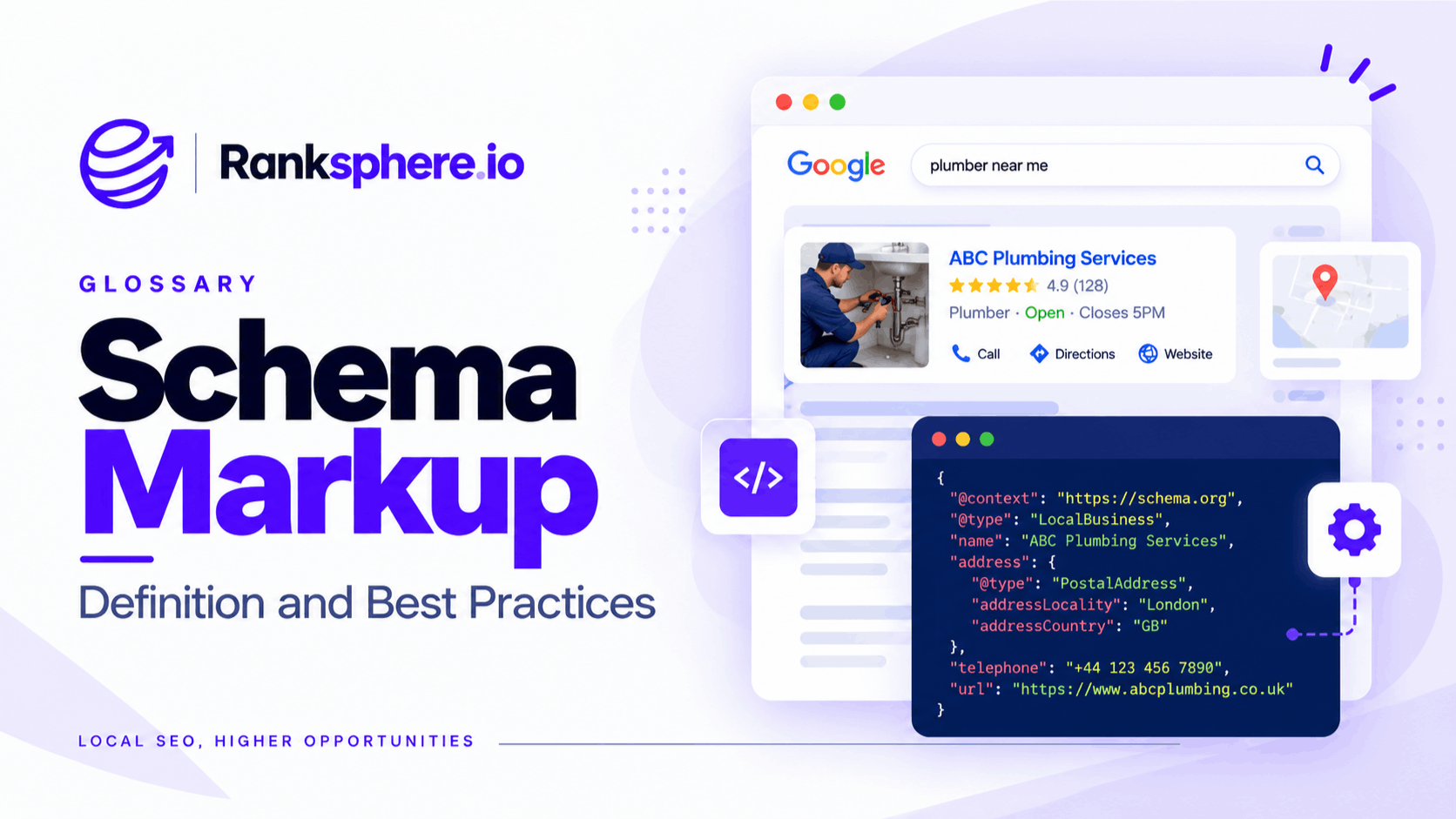
Schema markup is structured data added to a webpage to describe its content in a format search engines can understand more easily.
It does not normally change what visitors see on the page. Instead, it provides additional information about things such as a business, product, article, event or location.
Most schema markup uses the vocabulary defined by Schema.org, while Google provides its own documentation explaining which structured data types it supports for specific search features.
When implemented correctly, structured data can help Google understand a page more clearly and may make the page eligible for enhanced search appearances known as rich results. It does not guarantee that those features will appear.
Why schema markup matters
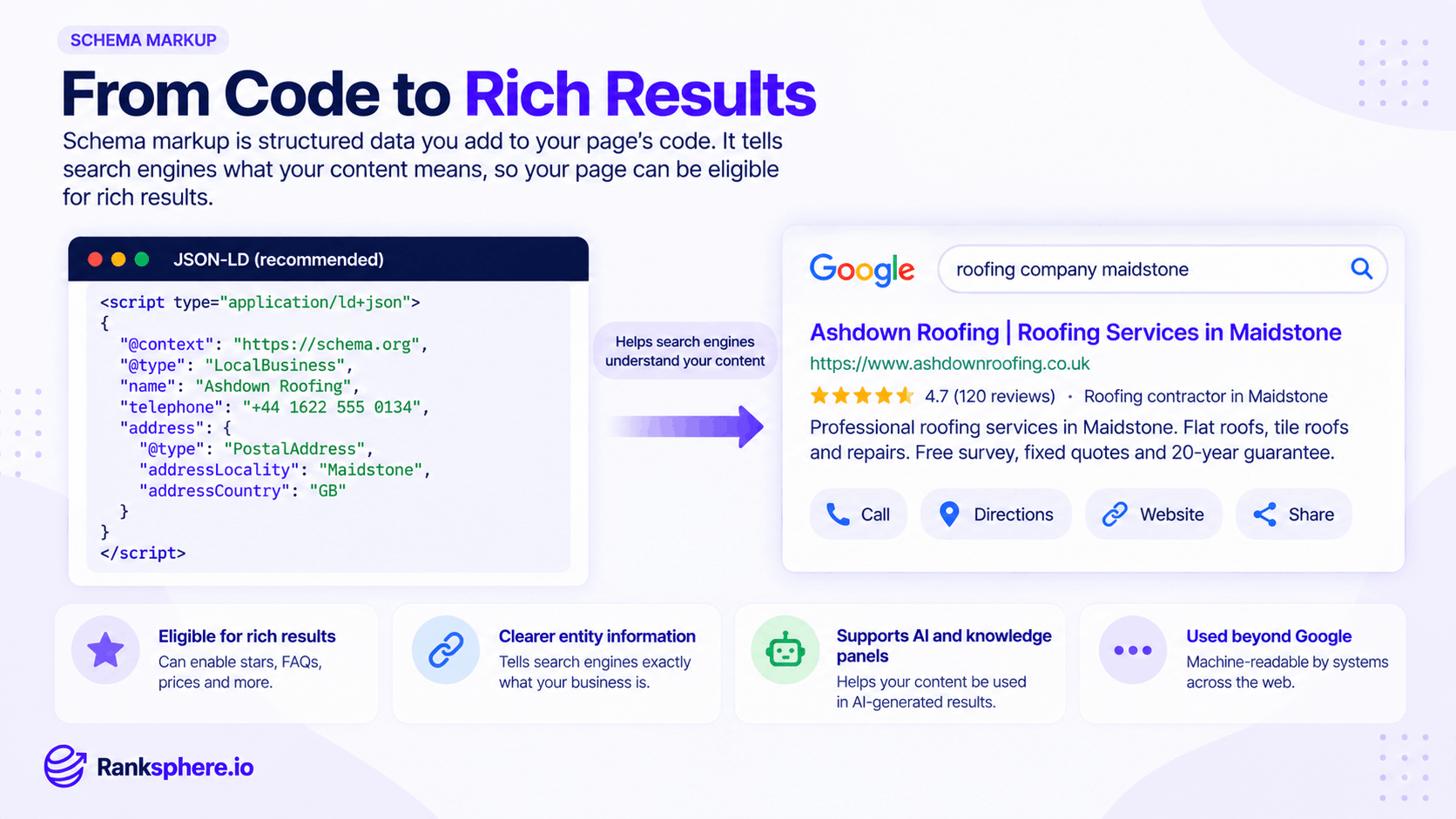
Schema markup has two main uses in SEO.
The first is helping search engines interpret information on a page more explicitly.
Instead of relying entirely on the surrounding text to work out that a number represents a price, an address belongs to a business or a date belongs to an event, structured data can label those details directly.
The second is eligibility for certain enhanced search results.
Depending on the content type, structured data can support search features involving information such as:
- Prices
- Availability
- Ratings
- Event details
- Breadcrumbs
- Business information
- Article details
Not every schema type creates a rich result, and valid markup does not guarantee that Google will display one. Google's documentation makes that distinction clear.
Schema markup and rich results
A rich result is an enhanced search result that may show more information than a standard organic listing.
For example, supported structured data can help make some pages eligible for search features involving:
- Products
- Events
- Recipes
- Articles
- Breadcrumbs
- Local businesses
- Review snippets where permitted
Eligibility is the important word.
Passing a structured data test does not mean Google will display the enhanced result every time.
Google can decide whether a rich result is appropriate based on the page, query, feature requirements and other factors.
Does schema markup improve rankings?
Schema markup should not be treated as a direct ranking shortcut.
Its main SEO value is helping search engines interpret information and making qualifying pages eligible for supported search features.
Adding schema to a weak page does not suddenly make the content more useful or relevant.
If the page does not satisfy search intent, structured data will not fix that problem.
Think of schema as a way of describing good content more clearly rather than a substitute for creating it.
Schema markup and AI search
Structured data can still be part of a good technical SEO setup, but it should not be presented as a special way to rank in AI-generated search experiences.
Google states that there is no additional schema markup required to appear in AI Overviews or AI Mode. The usual SEO fundamentals still apply, including ensuring that structured data accurately reflects the visible page content.
So the sensible approach is:
Use schema because it accurately describes the page and supports relevant Search features — not because you expect a particular AI system to quote the markup.
Schema markup formats
Google supports three common structured data formats:
- JSON-LD
- Microdata
- RDFa
All three can work when implemented correctly.
For most new websites, JSON-LD is usually the easiest option to manage because the structured data can be kept separate from the visible HTML.
Google also recommends JSON-LD in most cases because it is generally easier to implement and maintain at scale.
JSON-LD
JSON-LD is added inside a script block.
For example:
<script type="application/ld+json">
{
"@context": "https://schema.org",
"@type": "LocalBusiness",
"name": "Ashdown Roofing",
"telephone": "+44 1622 555 0134"
}
</script>
The markup describes the business without adding visible text to the page.
Microdata
Microdata places structured data attributes directly inside the page's HTML.
It can work perfectly well but is often more difficult to maintain because the markup becomes mixed into the visible content.
RDFa
RDFa also adds structured information through HTML attributes.
It is supported, but it is less commonly used for typical local-business SEO implementations.
Schema types worth knowing
Schema.org contains a large number of types, but most businesses only need a small selection.
LocalBusiness
LocalBusiness schema is one of the most relevant types for businesses with a physical presence or local customer base.
Where possible, use the most specific subtype that accurately represents the business.
For example, a restaurant, dentist or other specific business type may have a more precise subtype than the general LocalBusiness type.
Google recommends using the most specific appropriate business type where available.
Organization
Organization markup can describe the company or organisation behind a website.
It can include information such as:
- Name
- Logo
- Contact details
- Website
- Other identifying information
For a local business, a suitable LocalBusiness subtype may be more specific than using only Organization.
BreadcrumbList
BreadcrumbList describes the navigation hierarchy of a page.
For example:
Home → Services → Roof Repair
Breadcrumb structured data is supported by Google and can help it understand where a page sits within the wider website structure.
Article
Article structured data can be used on suitable editorial or blog content.
It can identify information such as the article's headline, author and publication details.
Product
Product structured data is relevant when the page genuinely describes a product.
Depending on the implementation and page type, it can support information such as:
- Price
- Availability
- Ratings
- Shipping
- Returns
Google has specific requirements for product rich results, so follow the relevant documentation rather than relying only on the Schema.org definition.
Event
Event markup can describe genuine public events and may make qualifying pages eligible for event-related search features.
Service
Schema.org also provides a Service type for describing services.
It can be useful for explaining what a business offers, but it should not be confused with a standalone Google rich-result type.
Not every Schema.org type corresponds to a visible Google Search enhancement.
What about FAQ schema?
FAQPage structured data used to be a common SEO recommendation because FAQ rich results appeared for a much wider range of websites.
That is no longer a good general recommendation.
Google changed FAQ rich results so that they are now shown mainly for well-known, authoritative government and health websites.
For most ordinary local-business websites, adding FAQ schema should not be expected to produce an FAQ rich result in Google Search.
You can still write useful FAQ content for visitors.
The content itself may be valuable even when the markup does not create a special search appearance.
Review schema and local businesses
Review markup needs particular care.
Google stopped displaying self-serving review rich results for LocalBusiness and Organization pages when the business being reviewed controls the page containing the reviews.
That applies even when the reviews are displayed through a third-party widget.
See review schema for the distinction in more detail.
This does not mean local businesses must remove legitimate reviews from their websites.
It means you should not assume that adding review or aggregate-rating markup to your own business pages will produce review stars in organic search.
Schema markup for local SEO
For a local business, schema should accurately reinforce information that already exists on the website.
Relevant details may include:
- Business name
- Address
- Telephone number
- Website
- Opening hours
- Business type
- Location
- Logo
- Relevant social or identity profiles
This information should remain consistent with your Google Business Profile and other important business listings.
The goal is consistency, not forcing every source into character-for-character identical formatting.
For example, minor differences such as Street and St are less important than having conflicting telephone numbers or different business addresses.
See NAP for more on business information consistency.
Ranksphere's schema generator produces valid Local Business markup, helping businesses create structured data without manually writing every JSON-LD property.
What schema markup cannot do
Schema is useful, but it is frequently oversold.
It cannot:
- Guarantee a rich result. Correct markup only makes qualifying content eligible.
- Fix weak content. Structured data describes the page; it does not improve the information itself.
- Guarantee higher rankings. Do not treat schema as a direct ranking shortcut.
- Create legitimate information that does not exist. Prices, ratings, addresses and other values must be accurate.
- Guarantee review stars. Self-serving LocalBusiness and Organization reviews are not eligible for those review snippets.
- Guarantee inclusion in AI Overviews or AI Mode. Google does not require special schema markup for those features.
Structured data must match the page
Structured data should accurately represent the content and entity described on the page.
Do not use schema to tell search engines something substantially different from what users are being shown.
For example, do not:
- Add ratings that do not exist
- Mark up fake reviews
- Add a price that is not actually offered
- Describe a different business location
- Mark up misleading content solely to qualify for a search feature
Google's structured data guidelines require markup to accurately represent the page, and violations can result in a structured-data manual action that removes eligibility for rich results.
How to validate schema markup
Do not assume structured data is correct simply because the page loads normally.
Use testing tools.
Google's Rich Results Test can show whether the page contains markup that is eligible for Google-supported rich-result features.
For broader Schema.org validation, use the Schema Markup Validator.
These tools answer slightly different questions.
The Rich Results Test is focused on Google's supported Search features.
The Schema Markup Validator checks Schema.org markup more generally.
Also remember:
Valid does not mean Google will display a rich result.
It only means the markup passes the relevant technical checks.
Common schema markup mistakes
- Using schema that does not match the visible page. Structured data needs to represent the actual content accurately.
- Adding fake ratings, reviews or prices. Never invent properties for the sake of a richer search result.
- Assuming every Schema.org type creates a Google rich result. Google supports a specific subset of structured-data features.
- Using FAQ schema as a general rich-result tactic. FAQ rich results are now heavily restricted.
- Adding review schema to your own business and expecting stars. Self-serving local-business reviews are not eligible for review snippets.
- Using conflicting business information. Your schema, website and Business Profile should agree on important details.
- Treating a successful validation as guaranteed visibility. Validation checks implementation, not whether Google will show the feature.
- Adding schema before fixing the page. Content and search intent come first.
- Ignoring markup after a redesign. Templates can leave old structured data behind after visible content changes.
Schema markup best practices
- Use JSON-LD where practical.
- Choose the most specific accurate schema type.
- Follow Google's documentation as well as Schema.org.
- Mark up real information only.
- Keep important business details accurate and consistent.
- Use LocalBusiness markup where it genuinely applies.
- Add BreadcrumbList where appropriate.
- Use Product, Article, Event and other types only when the page genuinely matches them.
- Do not expect FAQ markup to produce rich results for a normal local business.
- Validate with the Rich Results Test and Schema Markup Validator.
- Recheck structured data after website redesigns or template changes.
Example
“Merrow Dental has several service pages containing useful questions and answers.
Years ago, the site added FAQPage structured data because FAQ rich results were widely available.
The markup was valid, and at the time it occasionally produced enhanced search listings.
But Google's treatment of FAQ structured data later changed.
The practice still keeps the questions because they help patients understand the services, but it no longer treats FAQ schema as an important source of search visibility.
During a later website redesign, the team also checks its LocalBusiness and Organization markup.
They discover that an old telephone number remains in one JSON-LD template even though the visible website and Google Business Profile use the new number.
The markup is updated, validated and brought back into line with the actual business information.
Nothing magical happens to the rankings.
What improves is the quality of the underlying data: search engines receive accurate, structured information that matches what customers see.
That is the right way to think about schema markup: use it to describe real content clearly, support eligible search features and reduce ambiguity — not as a shortcut around good SEO.”
See also
- LocalBusiness schema — structured data for local business information
- Review schema — when ratings and reviews may be eligible for rich results
- Rich result — enhanced search appearances supported by structured data
- On-page SEO — the wider optimisation of content and page elements
- Technical SEO — implementation, crawling and validation
- Google Business Profile — business information that should remain consistent with your website