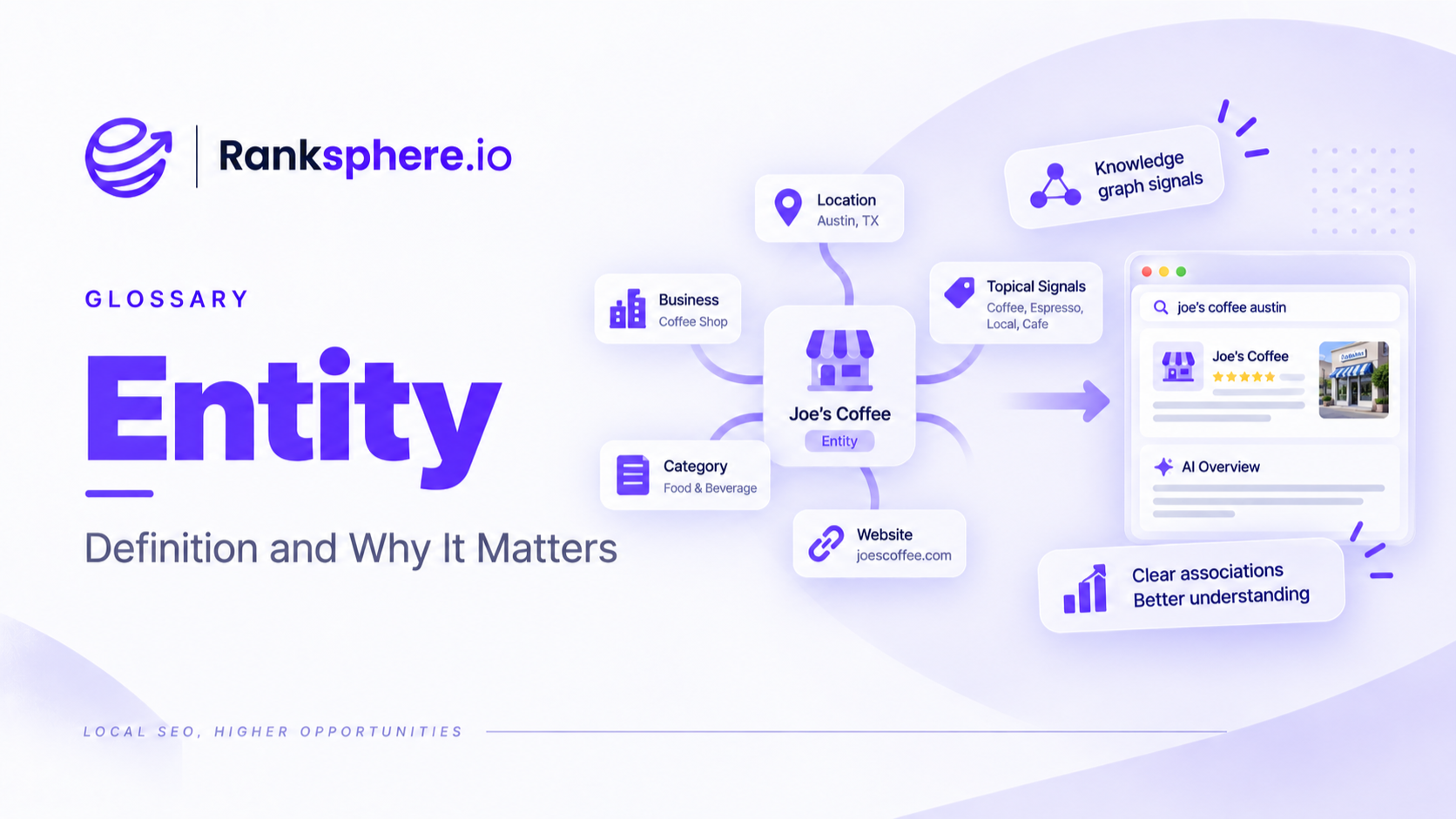
An entity is a distinct thing that a search engine can identify and distinguish from other things.
An entity might be:
- A person
- A business
- A place
- A product
- An organisation
- A concept
The useful shorthand is:
Things, not just strings.
Take the word:
Apple
As a string, it is simply five letters.
As an entity, it could refer to:
- Apple Inc., the technology company
- An apple, the fruit
A modern search engine tries to understand which one the user means by looking at the query, context and relationships between concepts.
That ability to distinguish one thing from another is an important part of modern search.
What is an entity in SEO?
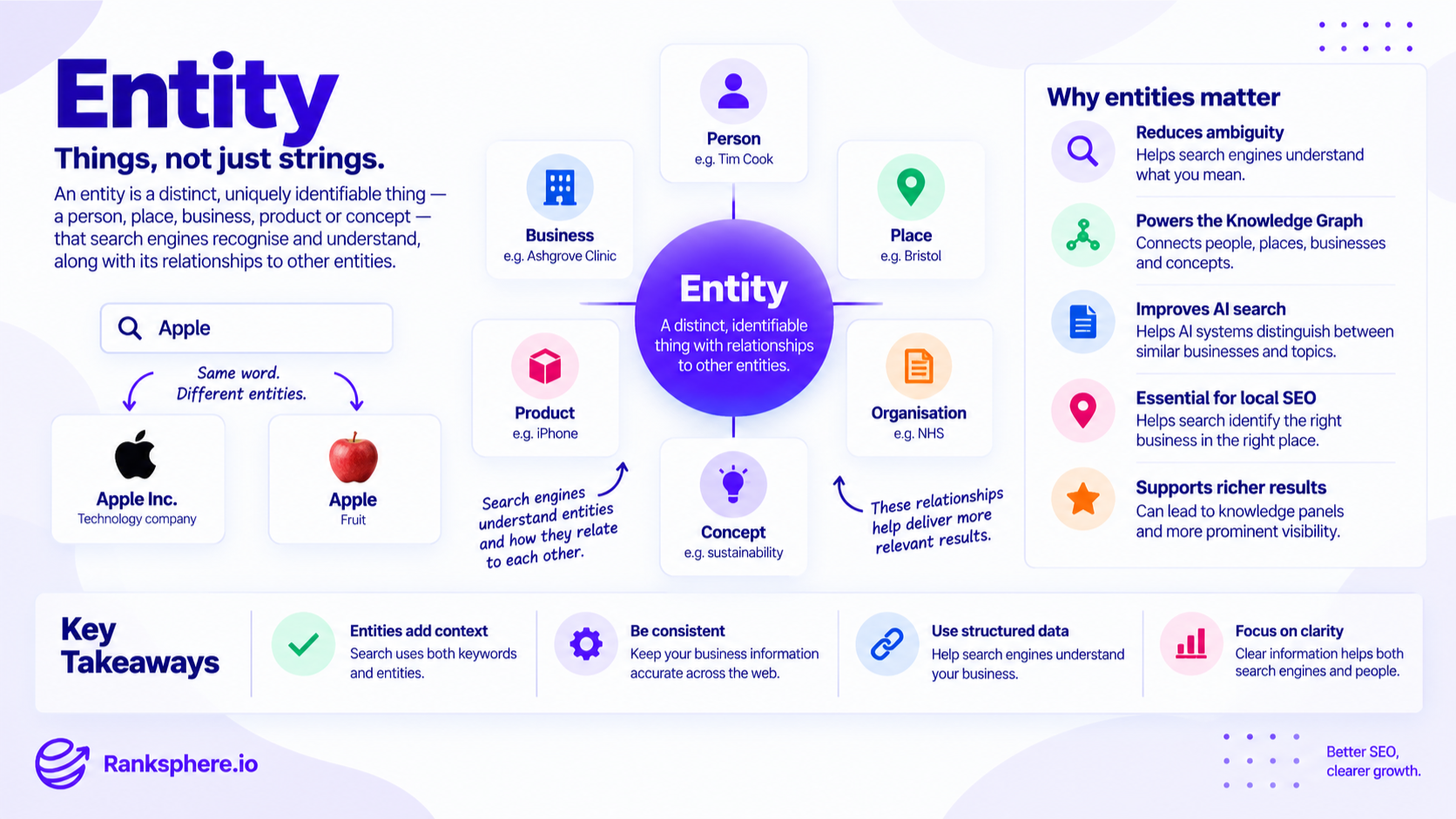
In SEO, an entity is something that search engines can recognise as a distinct subject.
For example:
Manchester
can be understood as a place.
Apple Inc.
can be understood as a company.
Tim Cook
can be understood as a person associated with Apple Inc.
Once those things are distinguished, a search engine can begin understanding relationships between them.
That is different from treating every query as a simple collection of matching words.
But entities have not replaced keywords.
Modern search uses both lexical information and broader semantic understanding.
The words on the page still matter.
Entity understanding adds context around what those words refer to.
Why entities matter for SEO
Entity understanding helps search engines interpret meaning.
This is particularly useful when:
- Words are ambiguous
- Several people share a name
- Businesses have similar names
- A search refers to a person indirectly
- A query depends on relationships between people, places or organisations
For businesses, this can help search systems distinguish:
which company is being discussed
from:
other companies with similar names.
Entities and semantic search
Semantic search is about understanding the meaning and intent behind a search rather than relying entirely on exact keyword matches.
Entities can contribute to that understanding.
For example, consider:
who founded Apple?
A search engine needs to understand that:
- Apple refers to the company
- “founded” describes a relationship
- The user is asking about people associated with the company's creation
That requires more than simply finding pages containing the individual words.
Entity recognition is one part of how modern search can handle those relationships.
Entities and the Knowledge Graph
Search engines can organise known information about entities and the relationships between them.
Google refers to its system as the Knowledge Graph.
Conceptually, it might contain relationships such as:
Company → founded by → Person
Business → located in → City
Person → works for → Organisation
This allows Search to answer questions involving relationships rather than only matching phrases.
The Knowledge Graph should not be thought of as one public database containing a fixed profile for every business.
It is better understood as part of Google's broader systems for organising and understanding information about real-world things.
Entities and knowledge panels
Knowledge panels are one visible example of entity understanding.
Google may display information about a recognised:
- Person
- Company
- Organisation
- Place
- Product
directly within the search results.
A knowledge panel does not mean the entity has a particular SEO score.
It means Google has enough information to present structured information about that subject in that context.
Not every recognised entity receives a knowledge panel.
Entities and AI search
Entity clarity can also matter in generative search.
An AI system answering:
Which dental practices in Bristol offer implants?
needs to distinguish one practice from another.
That can involve understanding:
- Business names
- Locations
- Services
- People
- Relationships between those pieces of information
Clear, accurate public information can reduce ambiguity.
But avoid framing this as:
“AI answers are built entirely around entities.”
Generative systems use many forms of retrieved information and language understanding.
Entity recognition is one useful part of that process.
Entities and local SEO
Entity understanding is particularly relevant to local businesses because local search needs to distinguish individual businesses operating in real places.
For example:
Ashgrove Dental
may need to be distinguished from:
- Another business with a similar name
- Another branch
- A business in another city
- An unrelated organisation
Search systems can use different sources of information to understand which business is which.
That makes accurate business information important.
But local SEO should not be reduced to entity resolution alone.
Local visibility also depends on factors such as:
- Relevance
- Distance
- Prominence
- Website quality
- Google Business Profile information
- Reviews
Entity clarity supports that wider system.
How search engines understand entities
Search engines can gather information from many sources.
For a local business, useful sources can include:
Your website
Your own site should state clearly:
- Business name
- What the business does
- Where it operates
- How customers can contact it
Avoid making visitors or search engines work out basic identity information from vague marketing copy.
Google Business Profile
A Google Business Profile provides Google with important information about a local business.
That can include:
- Name
- Address or service area
- Phone number
- Categories
- Opening hours
- Services
- Photos
Keep this information accurate.
Do not treat the profile as the single authoritative source for every search system, but within Google's local ecosystem it is particularly important.
Citations
Local citations can provide further references to the business across directories and other platforms.
These often contain:
- Business name
- Address
- Phone number
- Website
The underlying information should agree with reality.
Minor formatting differences are normally harmless.
The problem is conflicting information.
Structured data
Schema markup gives search engines machine-readable information about a page and the entities represented on it.
For a local business, that might include:
- LocalBusiness
- A more specific business subtype
- Address
- Telephone
- Opening hours
- URL
Schema helps describe information already represented by the site.
It does not create an entity automatically or guarantee a knowledge panel.
Third-party references
Search engines can also encounter a business through:
- News coverage
- Professional directories
- Associations
- Reviews
- Social profiles
- Backlinks
- Other websites
Independent references can provide additional context about who the business is and what it does.
But there is no public formula stating exactly how many mentions are needed for a search engine to “trust” an entity.
Entity corroboration
You will often hear entity SEO described as corroboration.
The idea is useful.
If several reliable sources independently describe the same business using compatible information, there is less ambiguity about what that business is.
For example:
Website
Ashgrove Clinic, Bristol
Business Profile
Ashgrove Clinic, Bristol
Professional register
Ashgrove Clinic, Bristol
Those sources broadly agree.
Compare that with:
Website
Ashgrove Clinic
Business Profile
Ashgrove Health Centre
Directory
Ashgrove Medical Ltd
Old listing
Ashgrove Clinic, Bath
Now it becomes less clear whether every source refers to the same business.
The goal is not perfect textual duplication.
It is consistent underlying identity.
Entity SEO for local businesses
“Entity SEO” is often presented as a separate branch of optimisation.
For most local businesses, the practical work is much simpler.
It largely comes down to making information about the business:
- Accurate
- Clear
- Consistent
- Easy to verify
That is good SEO whether or not you call it entity optimisation.
Use the real business name
Use the genuine real-world business name consistently.
Do not add keywords merely to make it look more optimised.
For example, if the actual business is:
Carrick Plumbing Ltd
do not change the Google Business Profile name to:
Carrick Plumbing Ltd – Best Emergency Plumber Manchester
unless that wording genuinely forms part of the business's real-world name.
Keyword stuffing in a Google Business Profile name can also create compliance problems and potentially contribute to suspension.
Keep NAP accurate
NAP means:
Name
Address
Phone number
The underlying information should be accurate across important sources.
It does not need to be character-for-character identical.
These can represent the same address:
12 King Street
and:
12 King St
Likewise, punctuation or company suffixes may vary harmlessly.
The problem is meaningful conflict.
For example:
12 King Street
versus:
42 Queen Street
is not a formatting difference.
That needs correcting.
Use LocalBusiness schema accurately
LocalBusiness schema can help describe a local business on its website.
Use the most specific accurate subtype where appropriate.
For example:
Dentist
may be more useful than a generic:
LocalBusiness
for a dental practice.
The markup should reflect information that is genuinely true about the business.
Do not use schema to:
- Invent locations
- Add fake reviews
- Claim services the company does not provide
- Manufacture entity relationships
Structured data clarifies information.
It does not manufacture reality.
Where should LocalBusiness schema go?
Schema belongs on relevant pages of your own website.
For a single-location business, that may include the homepage or a dedicated location/contact page.
For a multi-location business, individual location pages may describe each genuine branch separately.
You do not add schema “to every external profile you own”.
Those platforms manage their own structured data.
Your job is to describe your own website accurately.
What does sameAs mean?
The sameAs property can be used in structured data to reference other URLs that identify or provide information about the same entity.
Examples might include appropriate:
- Social profiles
- Authoritative organisation profiles
- Professional profiles
- Other identity pages
For example:
"sameAs": [
"https://www.linkedin.com/company/example/",
"https://www.facebook.com/example/"
]
The purpose is to help clarify that those URLs refer to the same organisation.
But sameAs should not be treated as:
“This guarantees Google will merge all of these into one entity.”
It is structured information.
Search engines still make their own interpretation.
Do you need sameAs for every profile?
No.
Use it for useful, authoritative profiles that genuinely identify the same entity.
There is little value in listing every obscure directory page simply because one exists.
Quality and clarity are more important than quantity.
Consistent business descriptions
Your description does not need to be identical everywhere.
In fact, forcing exactly the same paragraph onto every website can make the content unnatural.
What should remain consistent are the underlying facts.
For example, if one profile describes the company as:
a family-run roofing contractor serving Kent
and another says:
a roofing company working across Maidstone and the wider Kent area
those descriptions can both be perfectly accurate.
Problems arise when one source says the business is a roofing company and another incorrectly describes it as a building surveyor.
Consistency means agreement on reality, not identical wording.
About pages and entity clarity
A useful About page can make the organisation easier for people to understand.
It may include:
- Business name
- Location
- History
- Services
- Founders
- Staff
- Qualifications
- Professional memberships
Do not create an About page just for “entity SEO”.
Create one because visitors genuinely want to know who they are dealing with.
Clear information has SEO benefits because it reduces ambiguity.
People are entities too
Staff, founders and authors can also be recognised as distinct entities.
That can be particularly useful where professional expertise matters.
For example, a private medical practice might clearly identify:
Dr Jane Smith
Consultant Dermatologist
with appropriate credentials and professional information.
That helps readers understand who created or reviewed specialist information.
But avoid saying that adding staff names automatically “strengthens the business entity” or improves rankings.
The value comes from transparency, expertise and clearer relationships.
Businesses with ambiguous names
Some companies face genuine disambiguation problems.
For example, there might be:
Oakfield Dental
in Bristol
and another:
Oakfield Dental
in Birmingham.
Search engines need enough context to distinguish them.
Useful signals include:
- Location
- Contact information
- Website
- Staff
- Business category
- Local citations
- Professional memberships
- Structured data
The more clearly each business is described, the easier it is to distinguish one from the other.
Generic business names
A generic name can make disambiguation harder.
Imagine a company called:
The Roofing Company
That phrase could refer to:
- The actual business
- Roofing companies generally
- Another company using similar branding
A distinctive business identity can be easier to distinguish.
That does not mean businesses with generic names cannot rank.
It simply means identity clarity may require more context.
Entity disambiguation
Entity disambiguation is the process of determining which specific entity a name or reference refers to.
For example:
Jordan
could refer to:
- A country
- A person's surname
- A person's first name
- A brand
Context resolves the meaning.
For local businesses, the same process applies when several organisations share similar names.
Clear information about:
- Place
- Category
- Website
- People
- Services
can reduce ambiguity.
Entities and brand mentions
Mentions of a business across the web can provide additional context.
These might appear in:
- News articles
- Association pages
- Industry websites
- Local publications
- Reviews
That can support the broader public information available about a business.
But avoid turning this into:
“Every brand mention increases entity authority.”
There is no public entity-authority score.
Mentions are useful because they provide information and recognition, not because you can count them like points.
Entities and backlinks
Backlinks can also help connect information across the web.
For example:
A trade association may link from a member profile to the business's official website.
That relationship is easy for both users and search systems to understand.
But backlinks and entity understanding are not the same thing.
A business can be recognised as an entity without having a huge backlink profile.
Entities and reviews
Reviews can provide information about:
- The business
- Services
- Customer experience
- Location
- Reputation
They can therefore contribute to the wider public picture of a local business.
But do not ask customers to insert specific entity keywords or repeat the business name artificially.
Reviews should reflect genuine customer experiences.
Entity SEO and AI visibility
Entity clarity is frequently discussed in generative engine optimisation.
The logic is reasonable.
If an AI assistant is asked:
Which physiotherapy clinics in Bristol specialise in sports injuries?
it needs to distinguish:
- Individual clinics
- Their locations
- Their services
Clear information makes that easier.
But avoid claiming:
“Entity optimisation guarantees AI citations.”
It does not.
Generative systems use different retrieval methods, search providers and sources.
Entity clarity is useful because it reduces ambiguity.
It is not a citation switch.
How to audit entity clarity
For a local business, start with basic questions.
Search for:
Business name
Business name + city
Business name + phone number
Business name + address
Then review the major sources that appear.
Check whether they agree on:
- Name
- Location
- Phone
- Website
- Services
Also review:
- Google Business Profile
- Website contact information
- Important citations
- Professional profiles
- Structured data
Fix major contradictions before creating more listings.
Common entity SEO mistakes
- Treating search as though keywords no longer matter. Modern search uses both lexical and semantic understanding.
- Using different business identities across important platforms. Meaningful conflicts create unnecessary ambiguity.
- Demanding character-for-character NAP matching. Formatting differences are usually harmless.
- Adding keywords to a Google Business Profile name.
- Treating Google Business Profile as the universal authoritative database for every search or AI system.
- Assuming schema automatically creates or verifies an entity.
- Using sameAs as though it guarantees entity reconciliation.
- Adding every directory URL to sameAs.
- Forcing identical business descriptions everywhere.
- Inventing staff biographies or credentials for SEO.
- Treating entity SEO as a standalone ranking product.
- Expecting entity clean-up to produce an immediate ranking increase.
Entity SEO best practices
- Use the genuine business name consistently.
- Keep underlying NAP information accurate across important sources.
- Maintain a complete and accurate Google Business Profile.
- Use LocalBusiness schema where it accurately describes the business.
- Use sameAs selectively for useful identity profiles.
- Create a clear About or business-information page.
- Identify real staff and authors where that helps users understand expertise.
- Keep services and locations consistent across your main properties.
- Earn genuine third-party references over time.
- Fix conflicting information before creating additional citations.
- Think about clarity rather than trying to manufacture an entity score.
Example
“Ashgrove Clinic discovers that its business information has become inconsistent over several years.
Its website uses:
Ashgrove Clinic
Its Google Business Profile uses:
Ashgrove Health Clinic
Several directories list:
Ashgrove Clinic Ltd
An old listing still shows a previous address.
To make matters more confusing, an unrelated clinic with a similar name operates in another county.
The solution is not to buy an “entity optimisation package”.
The clinic reviews the facts.
It chooses the correct real-world business name and updates important profiles where the naming was inaccurate.
The old address is corrected.
Its website clearly states:
- Business name
- Town
- Services
- Contact details
Relevant LocalBusiness structured data is updated to match the real business information.
The About page is improved so visitors can clearly see who operates the clinic and which professionals work there.
Useful authoritative profiles are referenced appropriately in the site's structured data.
Over time, the public information surrounding the clinic becomes much less ambiguous.
That does not guarantee a particular ranking or AI citation.
What it does achieve is more fundamental:
people and search systems have a clearer, more consistent picture of which business Ashgrove Clinic is, where it operates and what it actually does.
That is the practical value of entity SEO.”
See also
- Knowledge graph — how search systems organise information about entities and their relationships
- Semantic search — understanding meaning and context beyond exact keywords
- NAP — core local business information
- LocalBusiness schema — structured data used to describe a local business
- Knowledge panel — one visible presentation of entity information in search
- Generative engine optimisation — improving visibility within generative search systems